Anthropic’s AI-Native SDLC playbook, published by Louis Claxton on Friday, August 21, 2026, starts with a blunt diagnosis: code generation is no longer the slowest part of software development. Product decisions, architecture, review, security approval, deployment, and maintenance now determine how quickly AI-generated work reaches production. citeturn0view0
The argument goes beyond using Claude Code as a faster pair programmer. Anthropic wants organizations to redesign the software development lifecycle (SDLC) around agents that can move between stages, consume structured artifacts, and continue working without repeatedly reconstructing context.
That approach becomes more consequential alongside the security team’s companion account. Anthropic says AI currently authors roughly 80% of its merged code, with the proportion ranging from 70% to 90% across teams. Securing that volume requires controls designed for machine-speed development rather than larger queues of manual reviews. citeturn0view1
The Bottleneck Has Moved Outside the Editor
The traditional SDLC assumed implementation was expensive. Requirements documents, estimates, architecture reviews, security assessments, and release approvals surrounded a build stage that could take weeks or months. Once AI agents compress implementation into hours, the surrounding stages retain their human-speed cadence.
That mismatch creates two bad outcomes. Organizations can let review queues grow until AI’s speed advantage disappears, or they can loosen controls and ship more code with less scrutiny. Anthropic’s playbook proposes a third option: automate and connect the entire lifecycle while reserving human attention for intent, risk, exceptions, and consequential decisions. citeturn0view0
This distinction separates AI-assisted development from an AI-native SDLC. An AI-assisted team adds code generation to its existing process. An AI-native team changes how work is specified, divided, reviewed, deployed, and learned from because producing another implementation is now comparatively cheap.
Committed Artifacts Turn the SDLC Into a Loop
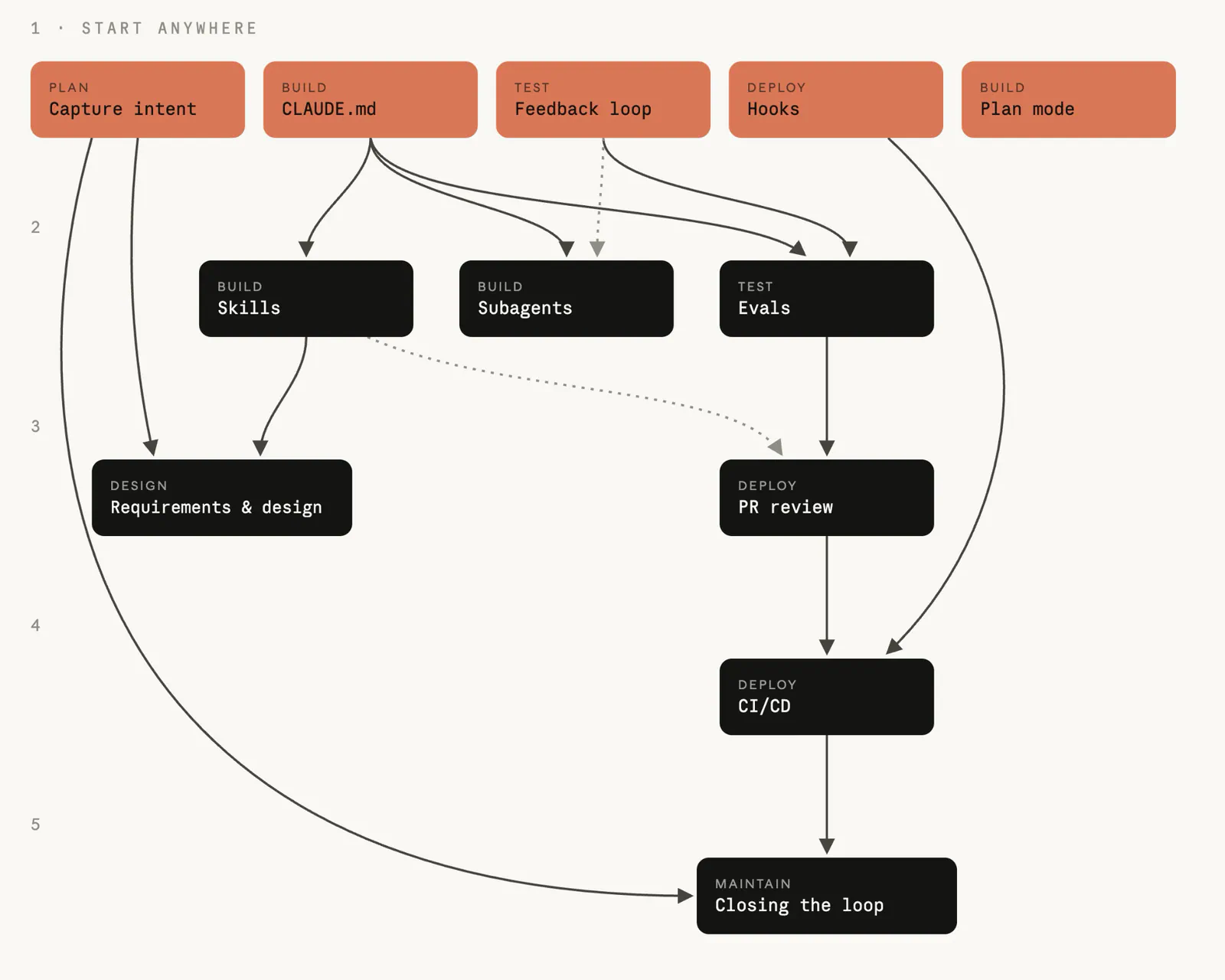
Image: The AI-Native SDLC playbook | Claude by Anthropic.
The playbook’s most useful design choice is its artifact-based handoff system. Each agent commits a version-controlled result that the next agent can consume:
- Planning produces an
intent.mdfile defining the problem, expected outcome, constraints, and supporting evidence. - Design turns that intent into a
spec.mdand an implementation plan such asplan.md. - Build produces the code diff, tests, and documentation.
- Test records review findings, risks, and required fixes.
- Deploy and Maintain add operational evidence, incident records, and updated guidance.
An agent can detect the newly committed artifact and begin the next stage. In effect, the repository becomes an orchestration layer as well as a code store. Intent, specifications, plans, diffs, and review findings form both the agent’s working memory and the project’s audit trail. citeturn0view0
These files are more than documentation. They constrain later passes. A clear intent prevents an agent from solving the wrong problem, while an explicit specification reduces the number of design assumptions it must make. Humans can review these high-leverage decisions before spending time on thousands of generated lines.
The model still inherits a familiar documentation risk: stale or ambiguous artifacts can propagate errors faster. Version control records what changed, but it cannot determine whether an assumption was correct.
Plan, Design, and Build Become Agent Pipelines
In Anthropic’s planning model, ideas enter an intent inbox rather than waiting for a single product manager to develop each proposal. Parallel Claude sessions can group related requests, investigate the codebase, gather evidence, and build lightweight prototypes. Humans then decide which opportunities deserve further investment, and approved ideas become committed intent files. citeturn0view0
Design focuses on contracts rather than prose-heavy requirements. The playbook recommends explicit decision hierarchies that tell an agent which source wins when instructions conflict. Existing standards and versioned interfaces take precedence over local patterns, followed by the current brief and model defaults. That hierarchy limits silent improvisation and makes disagreements easier to diagnose.
Build work then runs through isolated worktrees, narrow tasks, and test-driven loops. An agent reads the intent, specification, implementation plan, and repository instructions before modifying code. Smaller changes can run with a human monitoring the loop, while high-risk systems keep human approval inside it.
For large changes, Anthropic recommends dividing work by subsystem and assigning an integration agent to reconcile the results. The engineering challenge shifts from typing code to supervising dependencies, interfaces, and a collection of simultaneous agent passes.
Test, Deploy, and Maintain Become Active Loops
Testing begins during implementation rather than after it. A universal AI reviewer can inspect every pull request, while higher-risk changes receive additional security, performance, and architecture passes. Multiple agents can review the same change independently, with disagreements escalated to a person instead of averaged away. citeturn0view0
Deployment follows the same pattern. Agents verify environments, check migration requirements, apply feature flags, deploy to a small canary group, inspect telemetry, and roll back failed releases. Promotion expands only after the system produces evidence that the change is healthy.
Maintenance closes the loop. Deterministic monitoring first detects a threshold breach, after which an agent investigates logs, traces, dependencies, and recent changes. Incident findings can update runbooks, repository instructions, tests, and planning artifacts so the same failure becomes less likely in future work.
None of this works well without reliable tests, observable production systems, scoped permissions, and automated rollback. AI can accelerate a mature engineering system, but it will also expose weak foundations quickly.
Security Moves From Reviewing Lines to Governing Loops
Image: How Anthropic secures its AI-native software development lifecycle | Claude by Anthropic.
Anthropic’s security post adds a firm boundary: AI-generated code does not merge without human review. That is stricter than the general playbook’s risk-based option for humans to remain “on the loop” during low-risk work. A practical way to reconcile the two is to give agents autonomy inside development stages while protecting merge, permission, and deployment boundaries with explicit approval policies. citeturn1view0
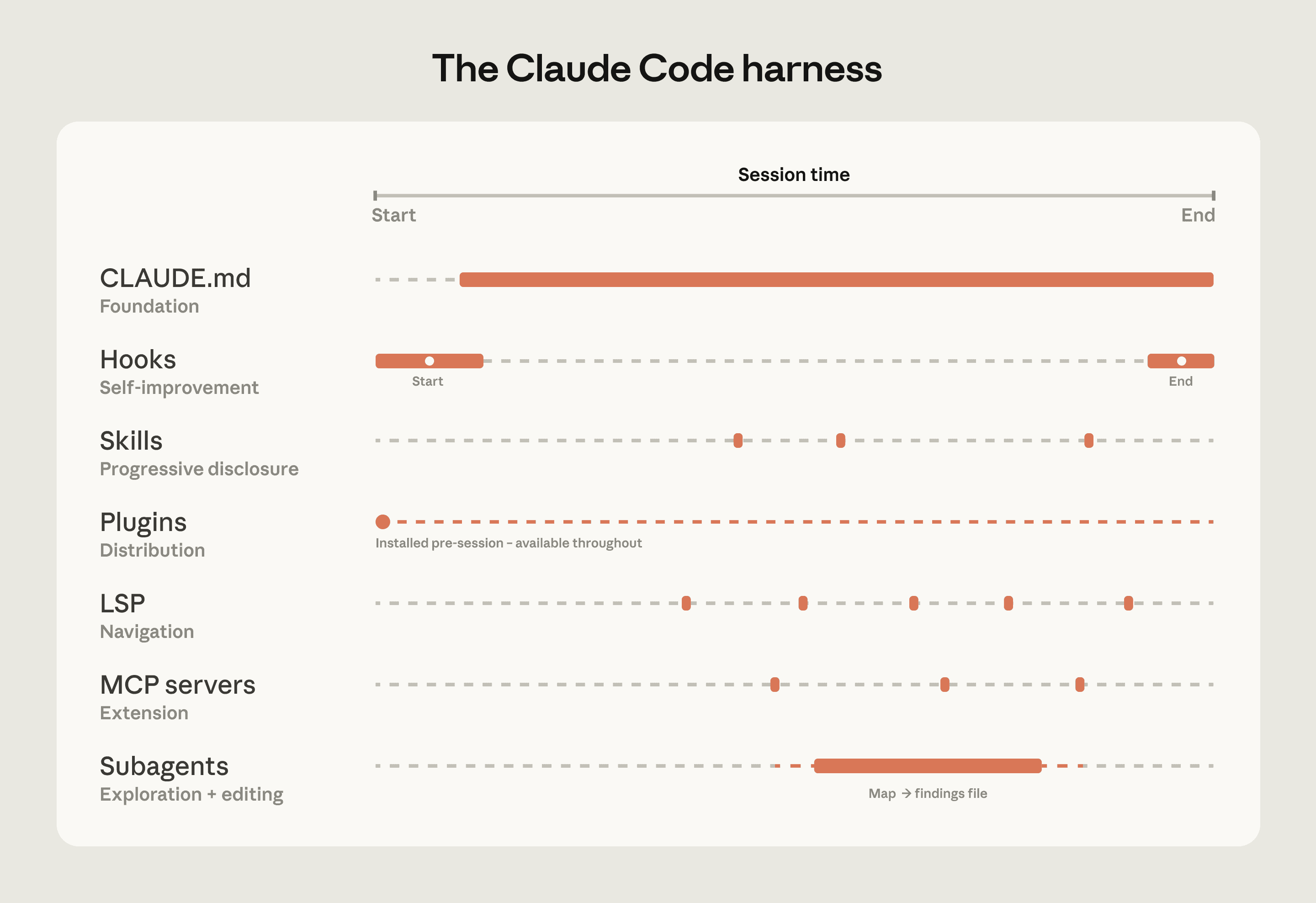
Security starts in the specification. Threat models and abuse cases become part of the design artifact, allowing later coding and review agents to see them. Secure development practices are encoded in CLAUDE.md files and reusable organizational skills rather than left in guidelines that engineers must remember manually.
When Anthropic discovers a recurring vulnerability class, it can update those instructions so future agent passes avoid generating the same pattern. This turns a security finding into a change to the code-generation environment, not just a one-time patch. citeturn1view0
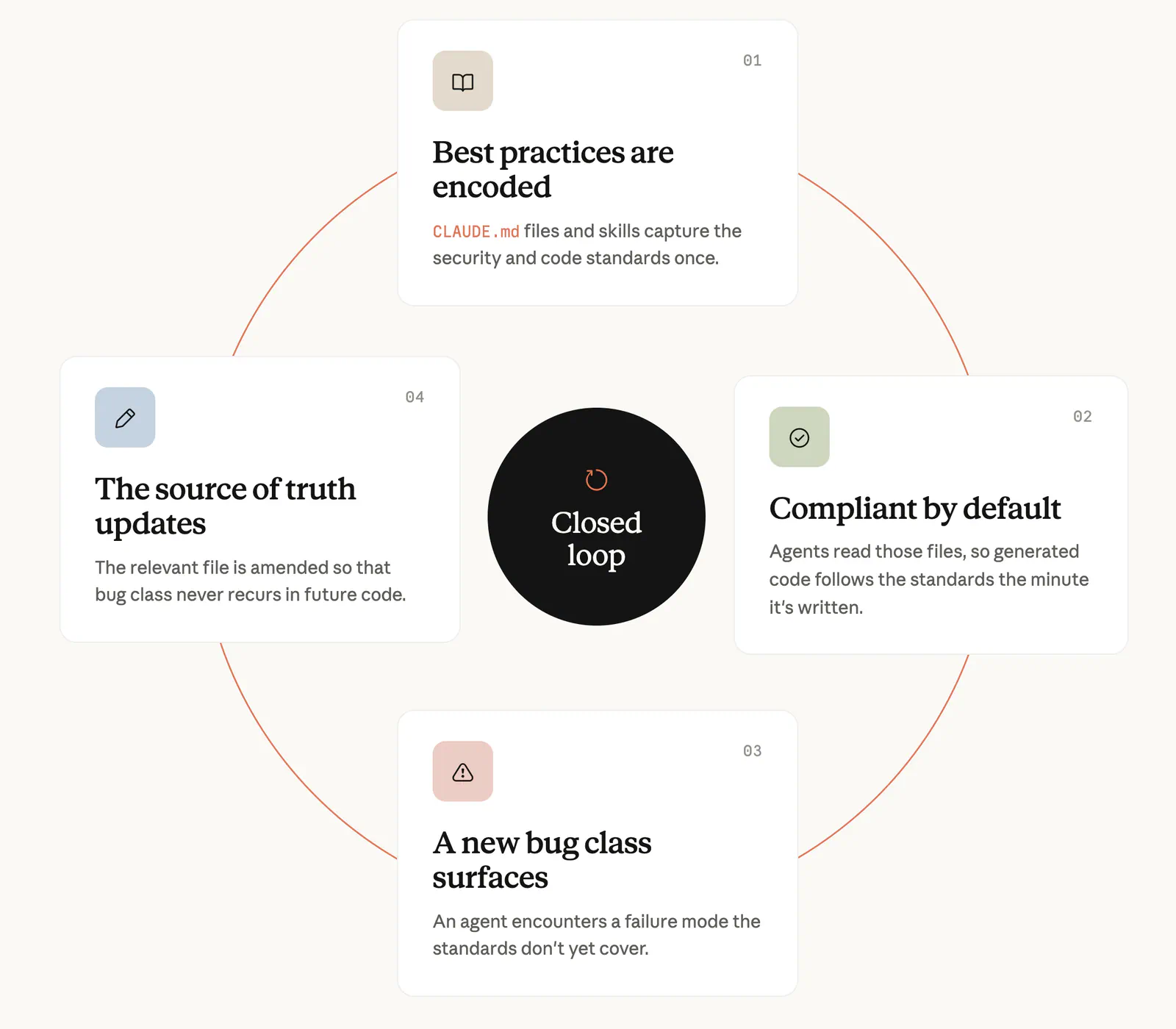
Image: How Anthropic secures its AI-native software development lifecycle | Claude by Anthropic.
During implementation, agents work in isolated branches with scoped credentials and restricted tool access. Anthropic says it uses allow-listed Model Context Protocol integrations and narrowly issued tokens rather than inheriting a developer’s full permissions. Continuous integration remains the final authority, running static analysis, dependency and secret scanning, policy checks, fuzzing, and dynamic tests before promotion. citeturn1view0
The reviewer should not simply reproduce the authoring model’s assumptions. Anthropic recommends heterogeneous review models where possible because one model family may share blind spots across generation and evaluation. At runtime, deterministic systems continue to detect anomalies, while Claude helps triage alerts, investigate likely causes, and prepare remediation.
Anthropic reports that security output is growing about five times faster than security headcount, but that is an internal operational claim rather than an independent benchmark. More AI-authored code does not reduce organizational responsibility for the resulting software.
The Playbook Depends on Decision Quality
Anthropic’s playbook is strongest as a systems design document, not a checklist that can be copied into any repository. It assumes teams can define clear interfaces, maintain trustworthy tests, observe production behavior, control agent identities, and keep artifacts current.
The central risk is optimizing throughput before improving decision quality. A weak intent.md can scale the wrong priority. A stale spec.md can turn an outdated assumption into dozens of coordinated changes. An incomplete test suite can give agents repeatable evidence that broken behavior is correct.
Teams adopting this model should measure more than generated code or commit volume. Lead time, human review load, escaped defects, rollback frequency, security findings, artifact freshness, and incident recovery provide a more credible picture of whether AI is improving the lifecycle or merely increasing its output.
Final Thoughts
The durable idea in Anthropic’s AI-native SDLC playbook is not that Claude should replace every developer task. It is that code has become abundant enough that the control system around code must change.
Teams that add AI generation without redesigning approval will accelerate directly into a review wall. Teams that connect intent, specifications, tests, deployment evidence, and operational learning can move faster without treating human accountability as an obsolete step. Anthropic’s playbook is most convincing when read as a model for governing machine-speed engineering, not as permission to remove governance.
Frequently Asked Questions
4 questions
1What is Anthropic’s AI-native SDLC playbook?
Anthropic’s AI-native SDLC playbook is a framework for applying AI agents across planning, design, building, testing, deployment, and maintenance. It treats code generation as one part of a connected lifecycle and uses committed artifacts to pass structured context between agents while preserving an auditable record for human reviewers.