Google’s latest spam update began on August 18, 2026, and finished three days later. Publishers hit by the rollout may see groups of related pages lose conventional search visibility and their AI Overview citations at roughly the same time.
That does not prove Google introduced a separate AI penalty. Pages generally need to be indexed and eligible for a normal search snippet before they can appear as supporting links in Google’s generative AI features. When spam systems remove that eligibility, search rankings and AI citation visibility can fall together. citeturn6view0turn17view0
Google has not said that the update targets AI-written content, programmatic SEO as a category, or a particular affiliate format. It is applying its existing spam policies, with mass-produced pages carrying the clearest risk when they were created primarily to capture search traffic rather than help readers. citeturn4view2turn21view1
The August 2026 Spam Update Moved Fast
The Google Search Status Dashboard records the release at 8:00 a.m. Pacific on August 18 and its completion at 8:48 a.m. Pacific on August 21. Google said it affected all regions and languages, but it did not announce a new spam policy or identify one specific SEO tactic as the target. citeturn6view0
One source mix-up is worth correcting. Google’s linked August 26, 2025 X post announced the previous year’s spam update, not the August 2026 release. The two rollouts are separate events. citeturn22search0
As of August 25, only four days have passed since the current rollout finished. That is enough to identify a sharp decline, but not enough to make confident claims about every affected site or declare a recovery strategy successful.
A Search Drop Can Remove AI Overview Citations Too
Google’s documentation for AI features says the same fundamental SEO requirements apply to AI Overviews and AI Mode. A page must be indexed and eligible to appear with a snippet in Search. Google also clarified in May 2026 that its spam policies apply to content displayed in generative AI responses. citeturn17view0turn4view2
That creates a straightforward explanation for same-day losses. If a spam system reclassifies hundreds of URLs and removes their search eligibility, those pages can also disappear as AI Overview sources. It is one underlying eligibility change affecting two surfaces, not necessarily two independent penalties.
There is an important reporting caveat. Google documented a Generative AI report logging error from August 13 through August 17, with reporting fully recovered on August 18. That incident ended before the spam rollout began, so it does not explain a clean decline starting after August 18. It can, however, distort the baseline if those five days are included in the comparison. citeturn18view1
The Search Console AI report also measures source-link impressions and clicks, not every mention of a brand or page inside an AI response. A decline there should be treated as a loss of measurable citation visibility, not proof that Google’s models have stopped using or recognizing the site entirely. citeturn17view1
Mass Production Is the Risk, Not AI Authorship
Google defines scaled content abuse as generating many pages primarily to manipulate rankings rather than help users. The policy applies whether pages are produced by AI, human writers, automated feeds, or a mixture of all three. citeturn4view2
Google’s separate guidance on AI-generated content makes the same distinction. Using generative AI is not automatically against its guidelines. Producing content at scale for the main purpose of gaining rankings is. citeturn21view1
Potentially vulnerable page families include:
- “Best X for Y” pages that reuse the same recommendations and reasoning.
- Competitor comparisons assembled from public specifications without testing or original analysis.
- Location pages where only the city, state, or service name changes.
- Integration, industry, glossary, and use-case pages built from one template.
- Affiliate pages that summarize other websites without adding measurements, evidence, or a defensible selection method.
None of these formats is inherently spam. The deciding question is whether each URL solves a distinct problem with information that could not be produced by swapping a few nouns in a template.
Page Families Can Fall While the Rest Survives
A site does not have to disappear completely. Google’s own traffic-drop guidance recommends determining whether a decline affects the entire domain, one important page, or a specific group of URLs.
If every competitor review falls while tutorials and product documentation remain stable, investigate the shared review template, evidence standard, intent, and publishing process. The surviving sections do not prove the site is healthy. They show that the problem may be concentrated in one content system. citeturn4view1
A cohort-shaped decline is still evidence, not confirmation of a special “batch penalty.” Similar pages can also fall together because they share technical errors, internal links, canonical tags, demand patterns, or the same competitive search results.
Confirm the Drop Before Rewriting the Site
Start with Google’s traffic-drop debugging process, then isolate the affected page family before editing anything.
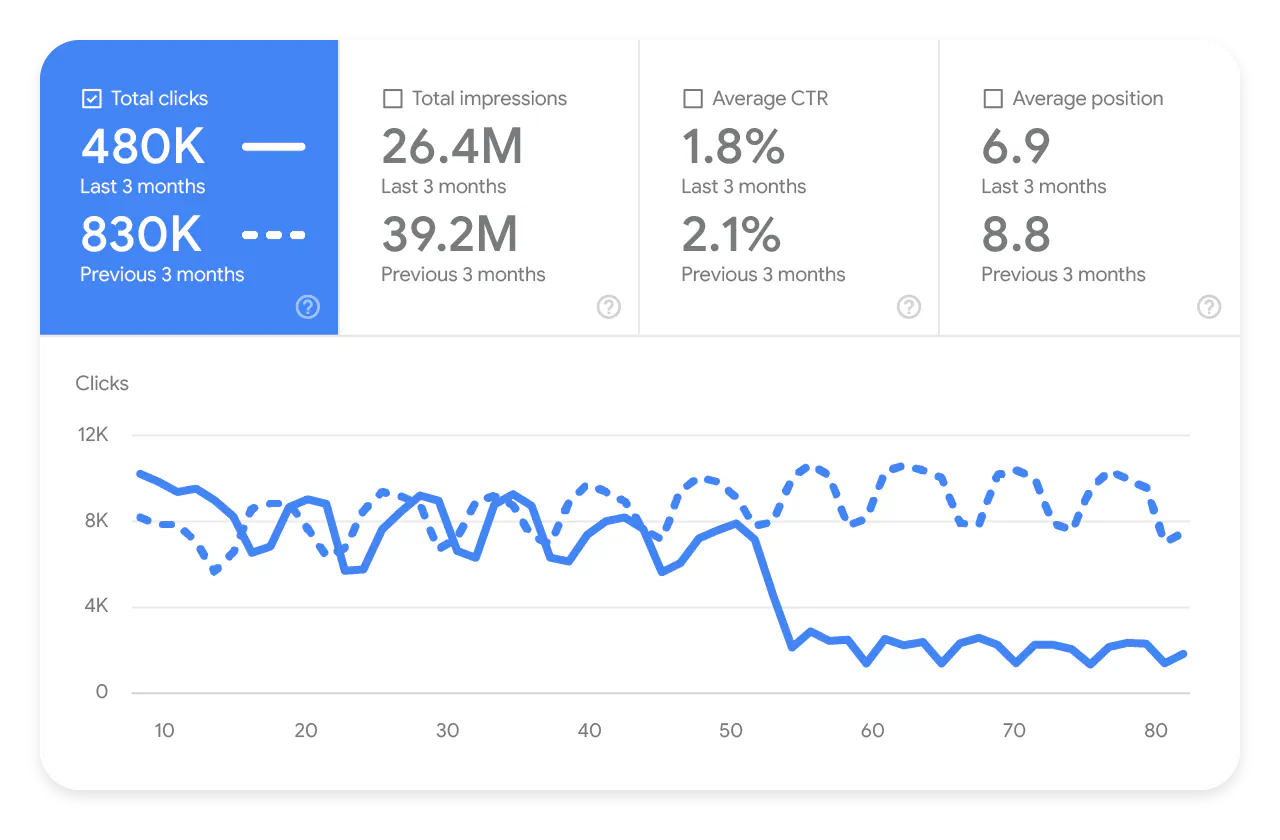
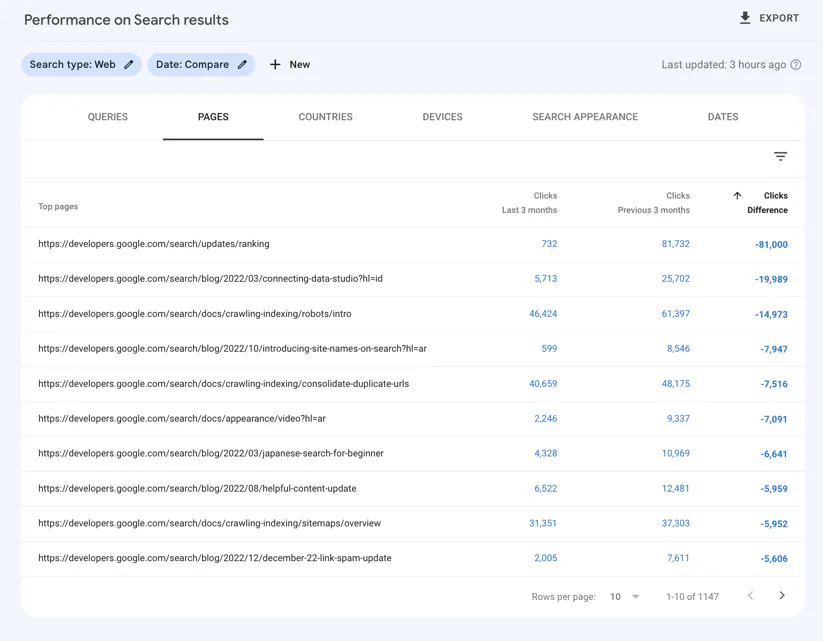
- Annotate August 18 and August 21 in your analytics.
- Compare affected directories, templates, authors, and query types with stable sections.
- Review impressions, clicks, and average position separately. Stable impressions with fewer clicks suggests a different problem from disappearing impressions and collapsing positions.
- Exclude August 13 through August 17 when assessing the Generative AI report.
- Check indexing, canonicalization,
noindextags, server errors, security issues, and Search Console’s Manual Actions report.
An absent manual action does not rule out an algorithmic spam classification. Spam updates are automated, so affected sites often receive no individualized warning.
Replace Template Scale With Real Editorial Decisions
“Humanizing” the text is not a meaningful recovery plan if it means changing sentence rhythm, adding casual phrases, or running AI output through another rewriting tool. Google evaluates the purpose and usefulness of the resulting pages, not whether software can make them sound less automated.
Frequently Asked Questions
5 questions
1Did AI-generated content trigger Google’s August 2026 spam update?
AI-generated content is not automatically a spam violation. Google’s policy focuses on content produced at scale primarily to manipulate rankings, regardless of whether it was written by people, AI, or both. AI-assisted pages can remain eligible when they provide original evidence, accurate information, clear editorial oversight, and a distinct purpose beyond capturing keyword variations.
2
Sources
- Google Search Status Dashboardstatus.search.google.com
- August 26, 2025 X postx.com
- documentation for AI featuresdevelopers.google.com
- Generative AI report logging errordevelopers.google.com
- scaled content abusedevelopers.google.com
- guidance on AI-generated contentdevelopers.google.com
- traffic-drop debugging process