OpenAI just launched Dots, its autonomous personal agent competing with Meta’s Muse and Grok Bot. I did not watch the live event, but I was surprised to see how viral it was this morning. Not because it was a great product, but because the demo was a disaster.
The comments were brutal. I will share some of them below. OpenAI seems to have rushed a product launch, and the failed demos made that impression worse.
Here is one of the viral posts on X:
What happened here?
During a live on-stage demo, product lead Holly Li asked her agent (“Dottie”) to handle launch prep for a fictional music app using Codex. The agent stalled with an error (it reported an iOS build failure and delayed responses), creating an awkward pause.
She joked that Dottie was having “a slow morning.”
With regard to the cut audio from the livestream, I have not confirmed it.
And you know what’s even funnier? SpaceX bought dot.com, which redirects users to Grok Bot (https://x.ai/bot). Don’t believe me? Go check it yourself lol.
What Is “Dots”?
OpenAI introduced Dots during DevDay 2026.
They are personal AI agents inside ChatGPT. Each has its own cloud computer and browser, runs on GPT-6 Astra, and can connect to more than 4,000 apps through OpenAI’s plugin ecosystem.
You can talk to your dot through ChatGPT, Slack, or Microsoft Teams.
Here’s a list of the key features:
- Always-On Automation: Runs 24/7 on its own cloud computer to handle tasks independently.
- Extensive Integrations: Connects to 4,000+ apps and operates directly in ChatGPT, Slack, and Microsoft Teams.
- Contextual Adaptation: Learns your specific work style and standards to execute complex, multi-step projects.
- Proactive Background Work: Uses read-only access to research and prepare tasks while you are away.
- Granular Control: Lets you set strict boundaries and require manual approvals for sensitive actions.
- Enterprise Specialists: Provides dedicated, IT-managed dots to handle structured organizational workflows securely.
It’s important to note that these Dots agents require a Business Premium seat. I know it’s a bummer coz it doesn’t count toward your current subscription. You’d have to pay for the seat separately.

Dots require Business Premium seat. Image by Jim Clyde Monge
You give it a goal, connect the apps it needs, and let it work. OpenAI says it can keep working between conversations and learn your preferences over time.
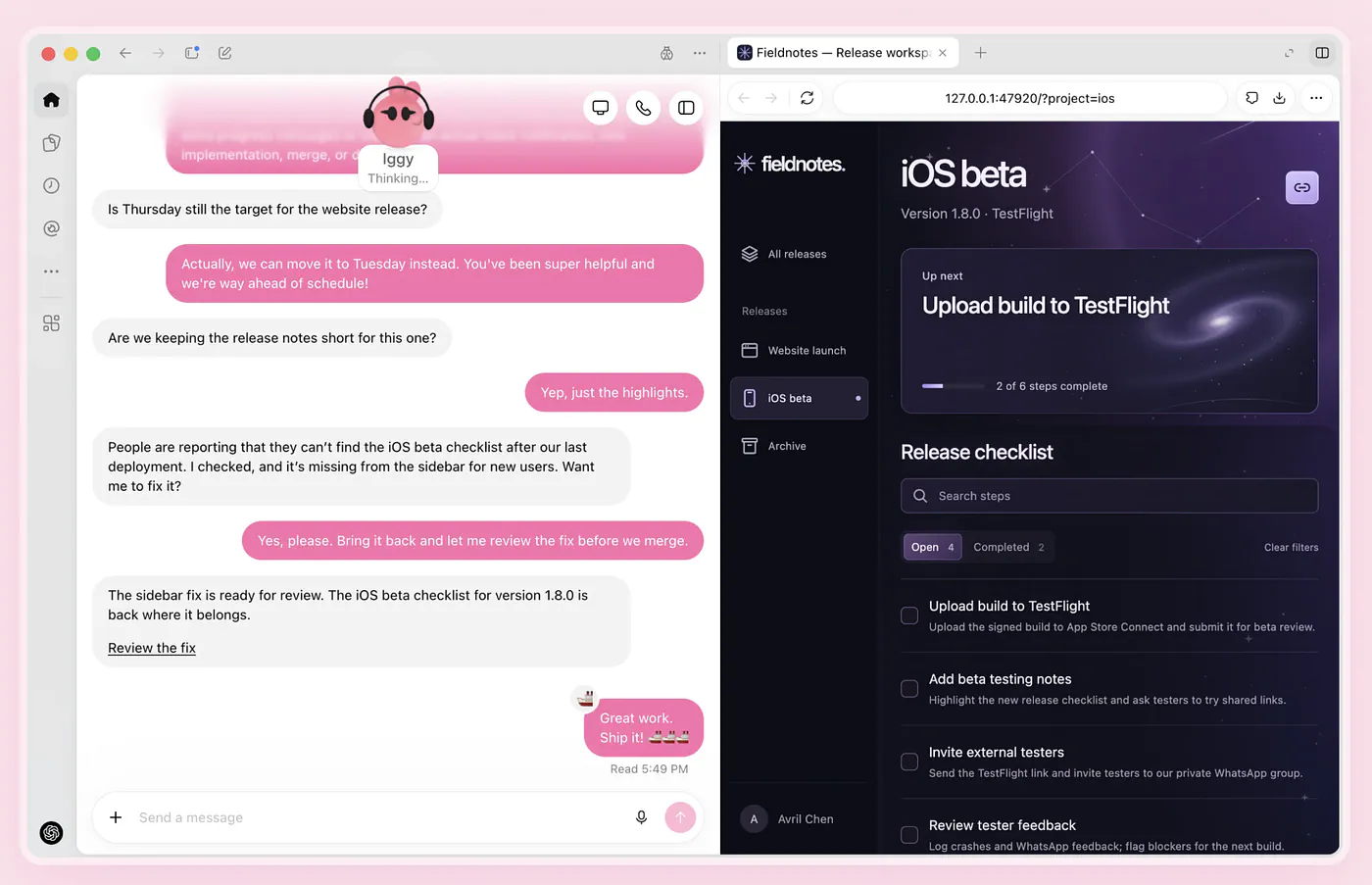
Dots sample usage screenshot. Image by OpenAI
The examples include monitoring customer feedback, fixing bugs, preparing pull requests, and turning interview transcripts into content drafts.
As a technical writer, I would use an assistant that helps me monitor AI news, gather sources, and prepare research. But I already use AI tools for those tasks. I have not tried it yet because I am not totally convinced of its benefits. Dots needs to show me why I should switch.
Was it a Rushed Product?
OpenAI seems to have rushed this launch. A lot can go wrong with live demos, so they should’ve rehearsed it many times before going live.
The company earned goodwill with its generous Codex access and capable models. Big props to Tibo for all the weekly resets on Codex! But for users who switched from Claude because of that value, lower usage allowances are a good reason to be pissed off.
Tibo confirmed in an X post that the new $200 Pro subscriptions that do not qualify for grandfathering come with a lower usage allowance. So the complaints about changing limits are not coming out of nowhere.
Tomorrow we are re-opening the Pro $200 subscriptions to new subscribers, but together with it we are also changing how we calculate the usage for it. In effect, if you do the math, it will net out at half the dollar in API spend compared to the old Pro $200 plan.
To me, OpenAI risks wasting that goodwill by pushing more products while making the tools people already use less generous. I would rather have better models and reasonable limits than another assistant I need to upgrade to try.
I am also disappointed that users on plans without Dots access need a higher-tier subscription. Eligible Pro and Business Premium users get their first dot at no extra cost, but that does nothing for someone whose current plan does not include it.
But to be fair, always-on agents consume substantial tokens. That's why Anthropic has the same pricing model with its Claude Tag.
People on the internet weren’t kind. Some are having trouble navigating the UI despite OpenAI’s effort to make it as cute and easy to use as possible.
I’ve also read people who questioned whether they needed Dots at all. Others hated how OpenAI and Meta were presenting these assistants.
One Reddit commenter called the characters “off-canny childlike toys” and said they made the tools look unsuitable for serious work.
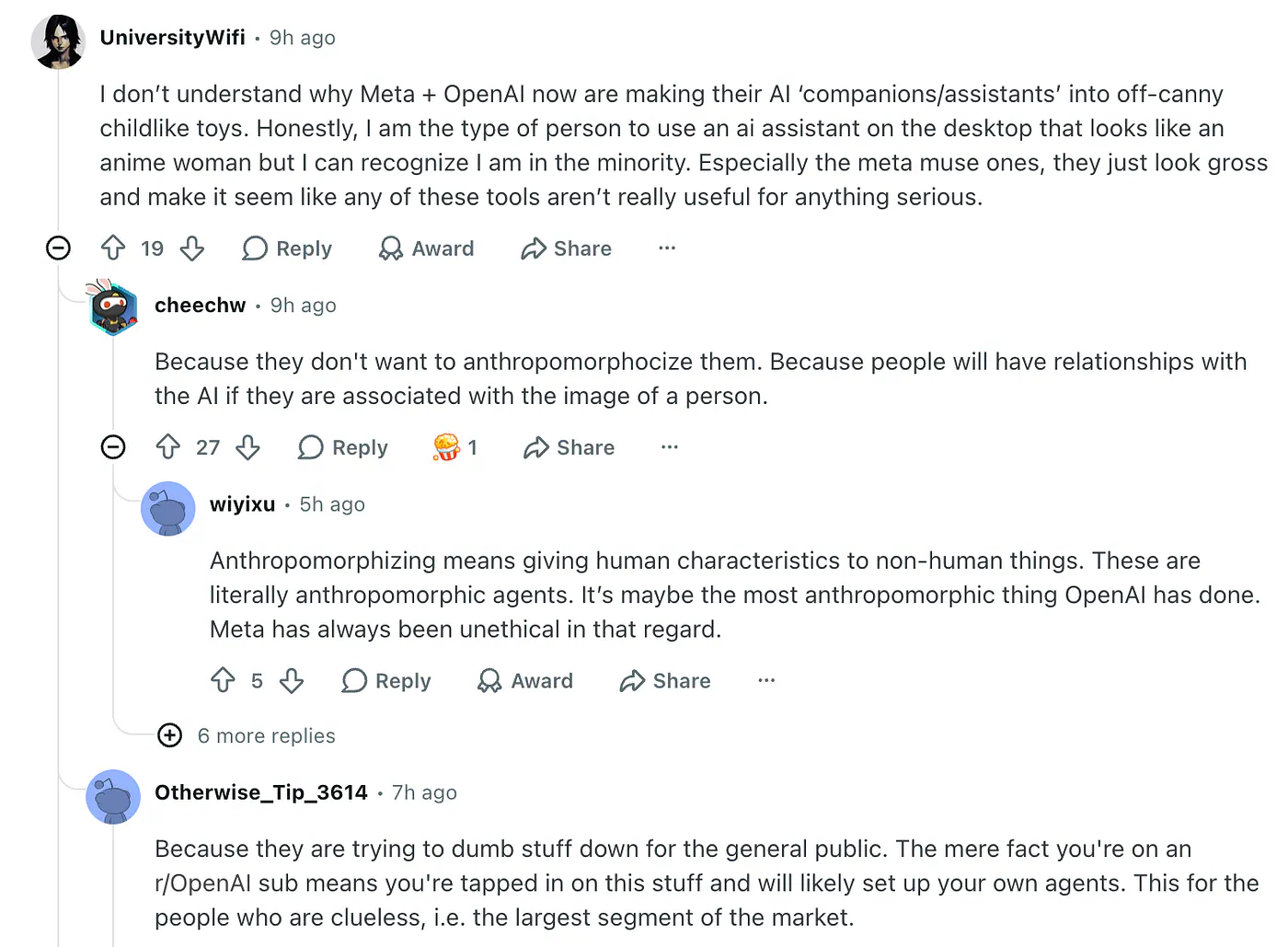
Dots reaction on Reddit. Image by Jim Clyde Monge
I don’t mind cute characters. I understand OpenAI wants to make it look appealing to mass users. But if you want people to trust an assistant with their work, show it doing that work properly. The character is not what I am paying for.
There are also practical questions raised on Hacker News: what does Dots do that existing tools cannot?
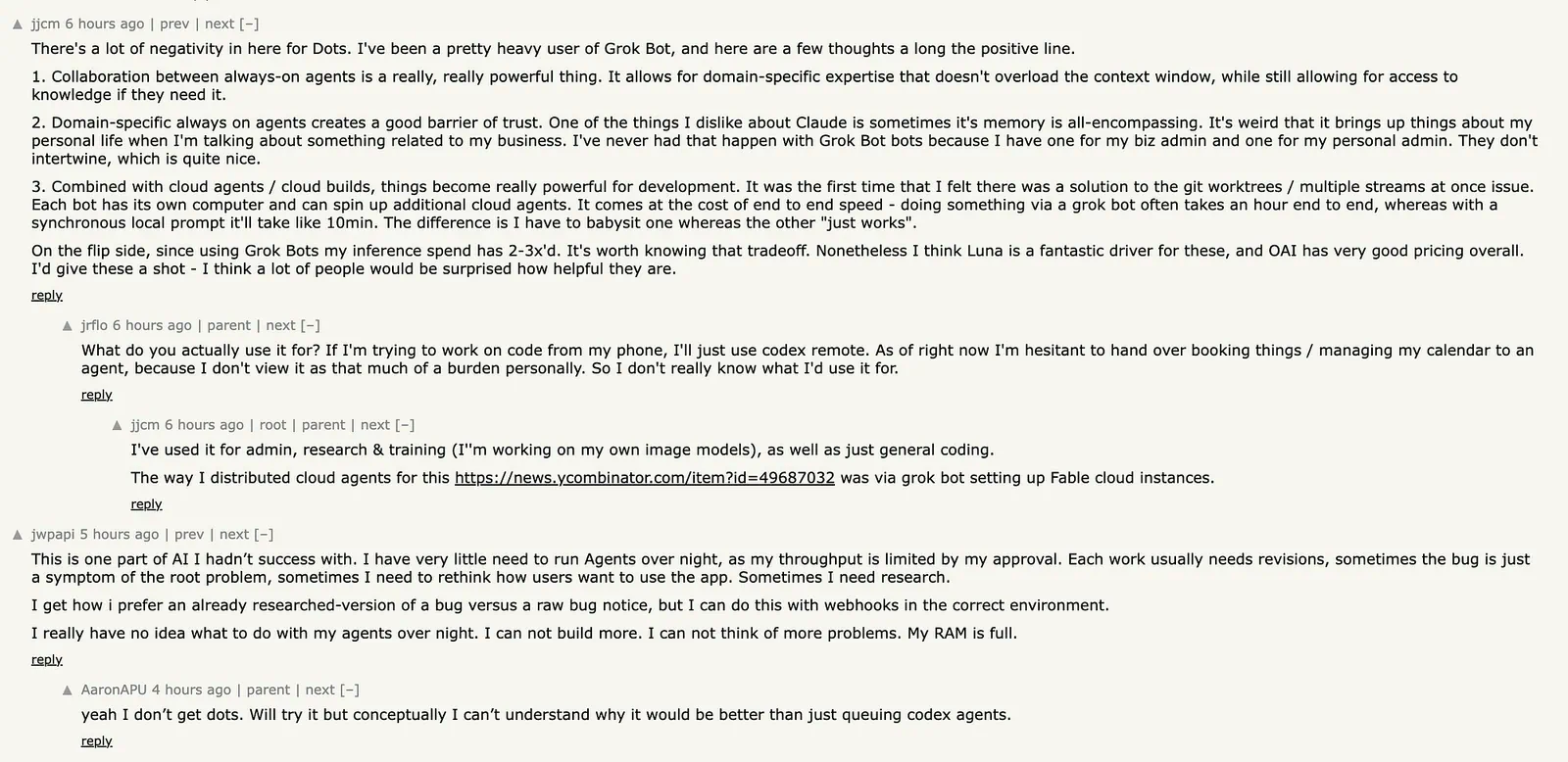
Dots reaction on Hacker News. Image by Jim Clyde Monge
I already have agents that can research and write code. Why do I need another product to manage them?
The Rise of AI Assistants
Following OpenClaw’s popularity, Grok Bot became one of the assistants I kept seeing on my social media feed. I have personally tried it but didn’t appeal to me that much to upgrade my Grok subscription.
As a technical writer, its integration with X is useful when monitoring AI news. Grok Bot can search posts, read timelines, check mentions, and gather updates from the platform.
Meta also released Muse on September 8. Its promotion focuses on practical benefits like lowering bills, negotiating, booking travel, and handling tasks after you close the app.
I haven’t tried it yet because its initial rollout was in the US. But I understand why the promise of saving or making money gets people’s attention.
Just a few days ago, Manus released Cue, its own personal agent app. Each agent gets an email address, phone number, wallet, and computer. You can also put multiple agents in a group chat to work together.
I have been using Cue since yesterday. So far, I haven’t seen anything special in the tasks I have tried. Much of what I have done with it was already possible with Codex.
Now OpenAI has Dots. To me, the company seems to have felt the pressure to release its own personal agent so it would not look like it was lagging behind.
Business Insider made a similar observation. It described Dots as OpenAI’s answer to competing personal agents and said the company initially appeared to be slipping behind after those launches.
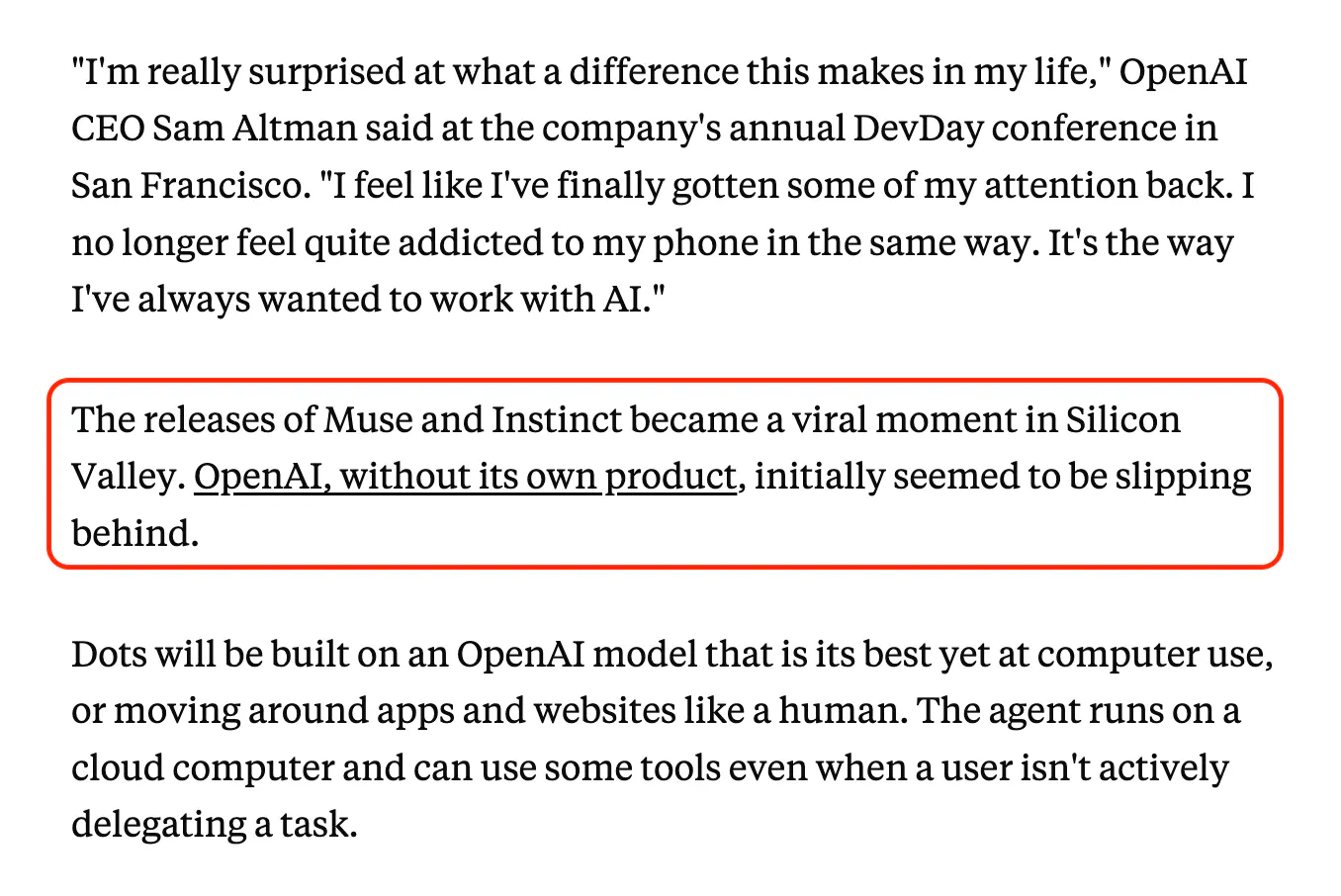
Business Insider news on Dots. Image by Jim Clyde Monge
The competition is real. Whether OpenAI rushed development is something I cannot establish, but the launch certainly looked rushed.
What Does Dots Actually Add?
OpenAI’s documentation says dots can create tasks in Codex and ChatGPT Work. So part of what Dots does is coordinate tools OpenAI already offers.
That could make those tools easier to use. But I want to see whether it actually reduces the amount of work I have to do.
- Can it follow my instructions without making me repeat them?
- Can it finish a task and check the result?
- When something fails, can it explain the problem and recover?
There is also a limit to the “always-on” promise. OpenAI says proactive background research uses read-only tools. Those research tasks cannot directly send messages, change connected app content, or control a browser or desktop. Follow-up actions must go through the usual checks.
I will judge Dots by the work it completes. If I have to keep checking its progress and fixing its mistakes, it is not saving me much time.
Final Thoughts
I think the recent releases of Grok Bot, Meta’s Muse, and Manus’ Cue put pressure on OpenAI to launch its own personal agent.
The live demo looked half-cooked, but OpenAI presented it anyway. It backfired.
And by the way, let’s not forget the call for an AI slowdown made by Dario, Sam, and the rest of the biggest tech bros in the field. Where is the slowdown in product releases?
OpenAI announced more than 20 major updates at DevDay alone. I can barely keep up with everything being released, and following AI is part of my job. These companies are still competing aggressively to get more products into people’s hands.
To be clear, I have not tried Dots yet. I will review it in the coming days with coding, research, automation, and writing tasks, then compare it with the other assistants I use. I want to see if it really gives me something useful that I am not already getting from existing tools.
What do you think about Dots? Let me know your thoughts in the comments.
Sources
- Dotsopenai.com
- https://x.com/ns123abc/status/2104997638462652838x.com
- finance.sina.cn
- dot.comdot.com
- https://x.ai/botx.ai
- Jim Clyde Mongemedium.com
- Tibox.com
- https://x.com/thsottiaux/status/2104823812042940713x.com
- https://x.com/rednech_ai/status/2105113028114952488x.com
- Reddit commenterreddit.com
- Hacker Newsreddit.com
- released Muse on September 8about.fb.com
- released Cuemanus.im
- Business Insiderbusinessinsider.com