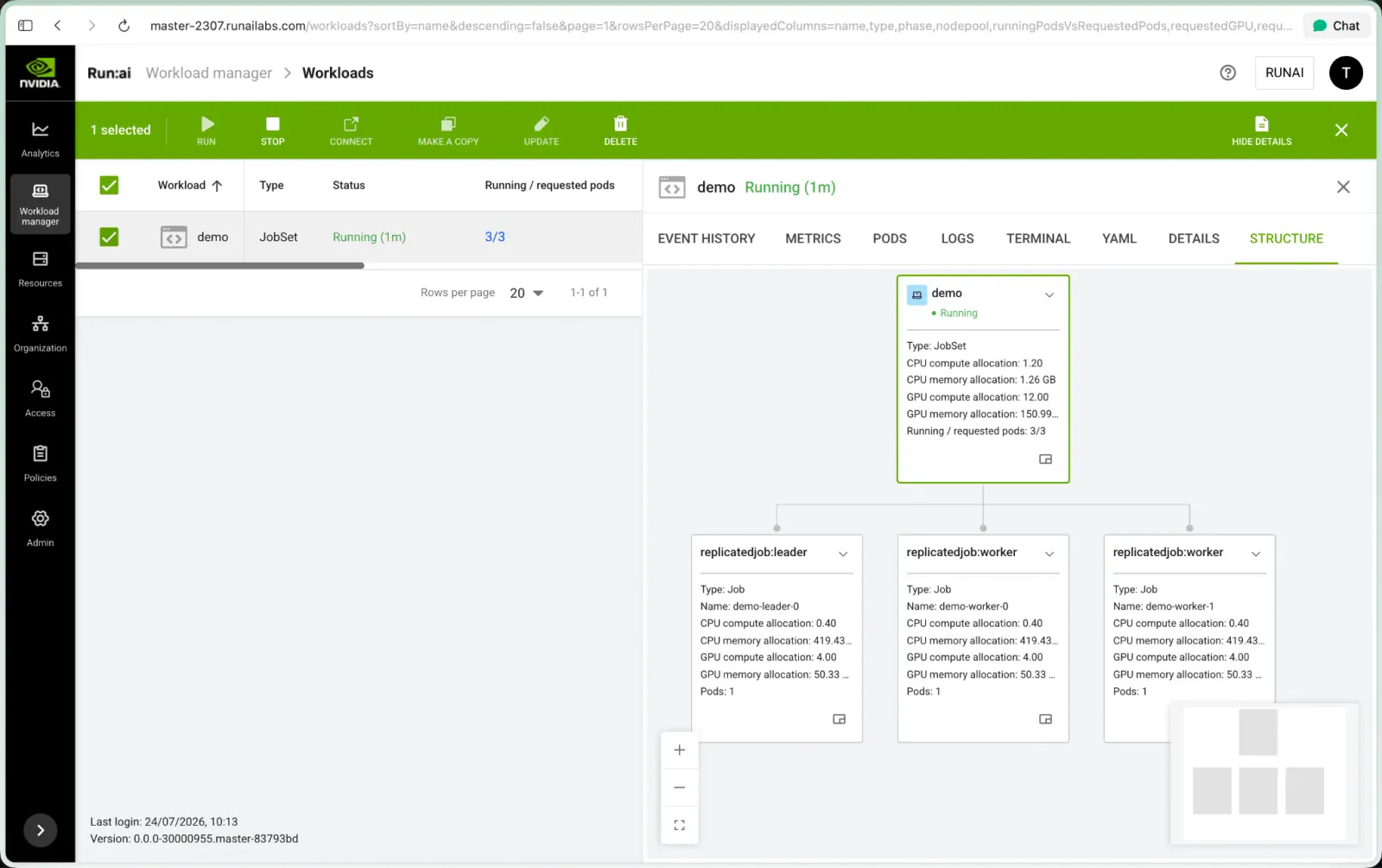
NVIDIA detailed Workload Map in a November 2, 2026 technical post, describing a common way for Kubernetes tools to understand distributed AI workloads. The project combines declarative workload definitions with a Go library, allowing integrated schedulers, controllers, and platforms to find components, pod templates, replica counts, and status through a shared interface.
Workload Map belongs to the NVIDIA DSX AI Factory Platform. It is open-source infrastructure tooling, not a new AI model. Its purpose is to reduce a recurring integration problem: every AI framework organizes its Kubernetes resources differently, even when the underlying questions are similar. NVIDIA’s announcement demonstrates how one JobSet definition can support workload inspection, scheduling, and platform visibility.
The useful change is where framework-specific knowledge lives. Teams still need to describe each workload type, but multiple tools can reuse that description.
Why Kubernetes Tools Need More Than a Pod List
A distributed training job can contain a leader, several workers, and intermediate Kubernetes resources connecting them. A multi-node inference service can have another hierarchy entirely. A tool needs to understand those relationships before it can report the workload’s total resource requirements or manage its components coherently.
NVIDIA’s JobSet example uses API version jobset.x-k8s.io/v1alpha2 and defines:
- One leader Job, with one pod requesting four GPUs.
- Two worker Jobs, each with one pod requesting four GPUs.
- A combined requirement of 12 GPUs across three pods.
A resource listing exposes the JobSet, its Jobs, and their pods as separate entries. Owner references connect the objects, but a platform still needs JobSet-specific knowledge to identify roles and aggregate their requirements. NVIDIA illustrates this with a Run:ai view that initially presents the three component Jobs separately. These figures describe the example’s configured GPU requirements, not measured utilization. Source: NVIDIA technical blog
The same problem repeats when a platform adds PyTorchJob, RayCluster, or another custom resource. Developers must locate pod templates, interpret scaling fields, and translate framework-specific status conditions.
My view is that this structural work is the strongest reason to consider Workload Map. A dashboard and a scheduler need different behavior, but both first need an accurate account of what belongs to the workload.