
NVIDIA published preview Kubernetes recipes for Vera Rubin NVL72 on November 2, 2026, giving platform teams a concrete starting point for evaluating the hardware with RKE2 and Ubuntu 26.04. The release includes training, inference and NVIDIA Dynamo inference variants, plus validation results from early Rubin systems.
The important word is Preview. These recipes do not carry the production support and lifecycle qualification of a Supported recipe. NVIDIA reports successful deployment and conformance checks, alongside a training-oriented communication benchmark, but explicitly leaves inference-serving performance unresolved. NVIDIA’s announcement describes an early migration path, not a completed production certification.
For platform teams, the useful contribution is the configuration itself: which driver runs on the host, which components Kubernetes manages, how multi-node NVLink resources are exposed, and where validation stops. Those details make this more actionable than a general promise of Rubin support.
What the AICR Preview Actually Packages
NVIDIA AI Cluster Runtime, or AICR, captures platform settings in versioned recipes, generates deployment bundles for existing tools, and validates the resulting cluster. It is part of NVIDIA’s DSX AI Factory Platform.
A recipe connects choices that otherwise need to be reconciled separately: operating system, kernel, GPU driver, container runtime, operators and hardware-specific settings. A working driver alone cannot establish that Kubernetes workloads can access the GPU or communicate correctly across nodes.
The Vera Rubin recipe family uses RKE2, the vr200 accelerator identifier and Ubuntu. The published configuration includes these coordinates and management choices, as detailed in the recipe coverage from BPDATA:
| Component | Published Rubin configuration | Operational significance |
|---|---|---|
| Operating system | Ubuntu 26.04, arm64, Vera-optimized 64k-page kernel | The kernel and architecture belong to the tested combination |
| Kubernetes | 1.34.1 or later; RKE2 containerd integration needs 1.34.1+rke2r1 | Captures the DRA API and runtime-integration floor |
| GPU driver | Host-installed R615.23 open-kernel-module driver | GPU Operator does not install the driver |
| GPU Operator | v26.7.0 | Manages other GPU-stack components, including the container toolkit |
| DRA driver | v0.5.0 with IMEX-backed ComputeDomains | Supports the validated multi-node NVLink arrangement |
| GPU allocation | Whole GPUs through the device plugin | MIG partitioning is outside this validation |
The host-managed driver choice matters. The system image already includes the arm64 driver, so the recipe sets driver.enabled: false for GPU Operator while leaving the container toolkit operator-managed. That setting means “do not install another driver,” not “run without a GPU driver.”
The recipe also raises the Node Feature Discovery topology updater’s default 60Mi memory limit to avoid out-of-memory kills on multi-terabyte NVL72 workers. This is a useful example of what a reusable recipe preserves: a small control-plane setting that can still prevent a large machine from operating cleanly.
I’d treat the recipe as a versioned integration baseline. Its value comes from preserving a working combination, including less obvious settings, so another team can evaluate the same configuration without rediscovering every dependency.
What Changes From the GB200 Baseline
Vera Rubin NVL72 continues the MGX rack-scale architecture used by GB200 NVL72, but several software and topology assumptions change. NVIDIA’s migration notes distinguish tested versions from future support targets.
| Area | GB200 baseline described by NVIDIA | Vera Rubin preview |
|---|---|---|
| GPU driver | AICR baseline R580.173.02 | Tested with R615.23; early support targeted for R610, official platform support for R620 |
| Network hardware | ConnectX-7 NICs and BlueField-3 DPUs | ConnectX-9 SuperNICs and BlueField-4 DPUs |
| Compute-tray layout | Two CPUs and four GPUs | Two CPUs and four GPUs |
| Network PCI exposure | Four ConnectX-7 adapters on the DGX GB200 reference tray | Eight ConnectX-9 PCI device groups exposing 32 functions |
| GPU NUMA affinity | GPUs 0–1 on NUMA 0; GPUs 2–3 on NUMA 1 | Same mapping |
| Multi-node NVLink | Uses IMEX | Still uses IMEX |
R615.23 is the tested driver, not a confirmed minimum for official Rubin support. Similarly, the validated system image ships with DOCA-OFED 3.3.0, and NVIDIA identifies DOCA 3.3.0 as the first generally available release supporting ConnectX-9. It explicitly avoids turning that testbed version into a requirement or recommendation.
Network Operator compatibility also remains a separate qualification step. This preview uses host-installed NIC drivers and DRANET for pod allocation.
The topology comparison exposes a practical migration trap: unchanged CPU and GPU counts do not mean unchanged I/O placement. NVIDIA says GPU-to-NIC connectivity is NODE within a socket and SYS across sockets. Teams running RDMA networking or GPUDirect Storage need to check affinity against the Rubin layout. The 32 PCI functions should not be interpreted as 32 physical network ports.
IMEX ownership needs attention too. With DRA-managed IMEX, NVIDIA instructs operators to stop, disable and mask the host’s static nvidia-imex service to prevent competing ownership. The validated cluster uses driverManaged mode. DRA v0.5.0 also introduces an alpha host-managed option, but that option provides domain isolation only.
My read is that this migration preserves some placement concepts while changing enough surrounding machinery to make a copied GB200 configuration risky. Keeping the same NUMA mapping does not remove the need to review networking, drivers and service ownership.
What NVIDIA Validated on Early Hardware
NVIDIA reports end-to-end validation using GPU Operator v26.7.0, DRA driver v0.5.0 and a host-installed R615 driver. Its training and inference variants passed deployment and conformance checks.
The training recipe also passed a cross-node NCCL all-reduce performance gate over the NVLink fabric through an IMEX ComputeDomain. NVIDIA reported 744.71 GB/s of bus bandwidth at a 16 GiB message size. These are vendor results from early hardware, not independently verified measurements. The validation coverage separates that communication result from the unfinished inference benchmark.
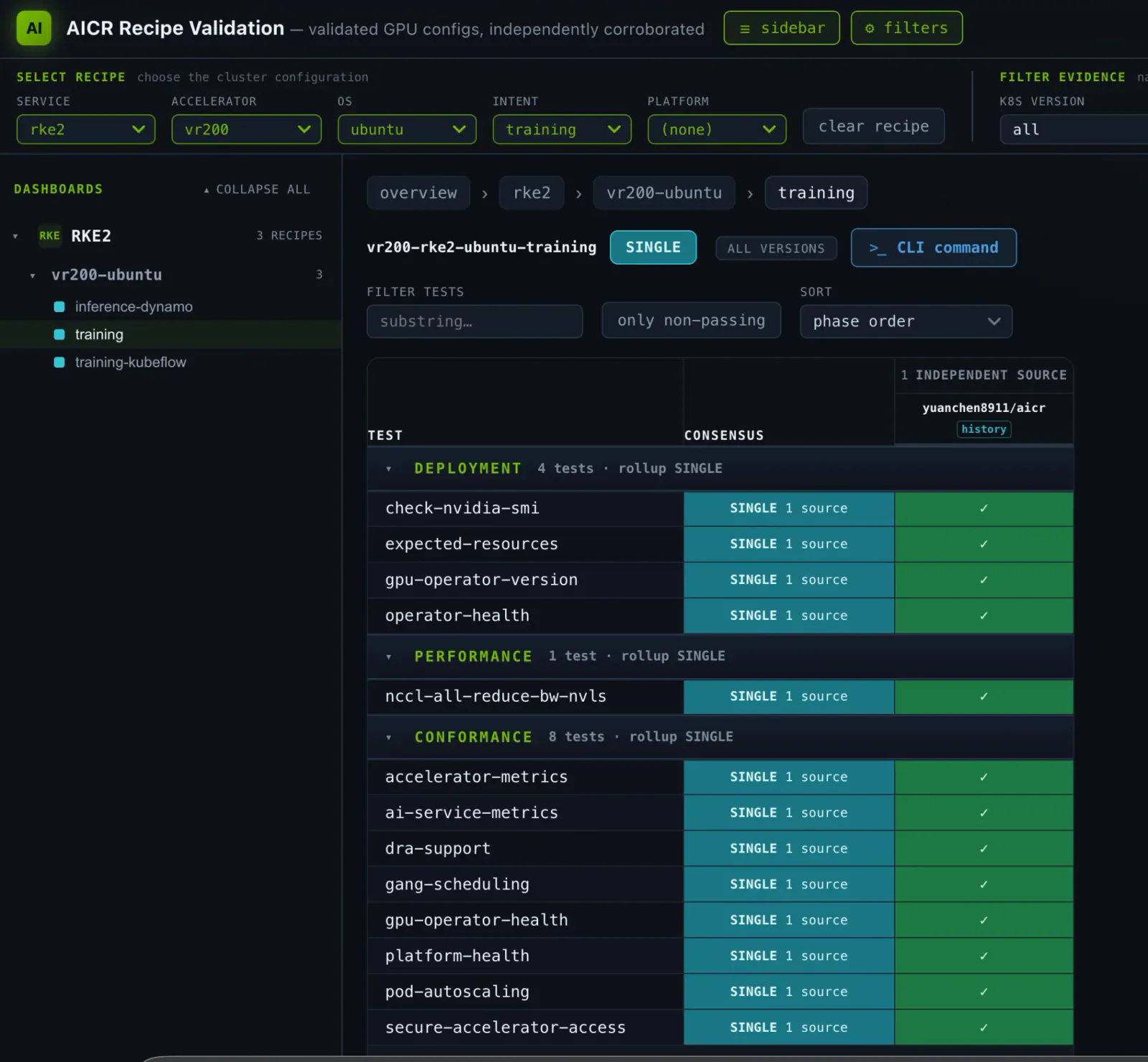
| Validation area | Reported result | Scope |
|---|---|---|
| Deployment | Passed for training and inference variants | The selected runtime components deployed successfully |
| Conformance | Passed for both variants | The published conformance checks succeeded |
| Cross-node NCCL all-reduce | Training recipe passed; 744.71 GB/s at 16 GiB | Collective communication over the tested NVLink arrangement |
| Inference-serving performance | Deferred | No published Rubin serving-performance floor |
All-reduce combines data across participating GPUs, making it relevant to distributed training communication. Bus bandwidth is a communication benchmark metric. It is not model throughput, tokens per second or end-to-end training speed.
The 16 GiB test size matters because it defines the reported measurement point. A single result cannot describe every message size or application workload. NVIDIA also provides no like-for-like GB200 result here, so the figure cannot support a Rubin-versus-GB200 speedup claim.
The useful conclusion is narrower: NVIDIA demonstrated that the selected stack could run its cross-node collective test and meet its performance gate on the tested system.
The DRA Crash Loop Shows Why Versions Matter
Early validation exposed an unmapped Rubin architecture value in go-nvlib. That missing mapping caused the DRA driver’s kubelet plugin to crash-loop. NVIDIA says the fix propagated through the stack and shipped in the official DRA driver v0.5.0 release. identifies this as a concrete outcome of testing on early silicon.
Frequently Asked Questions
3 questions
1Does AICR Replace Existing Deployment Tools?
No. NVIDIA describes AICR as generating bundles for existing deployment tools and validating the running cluster.