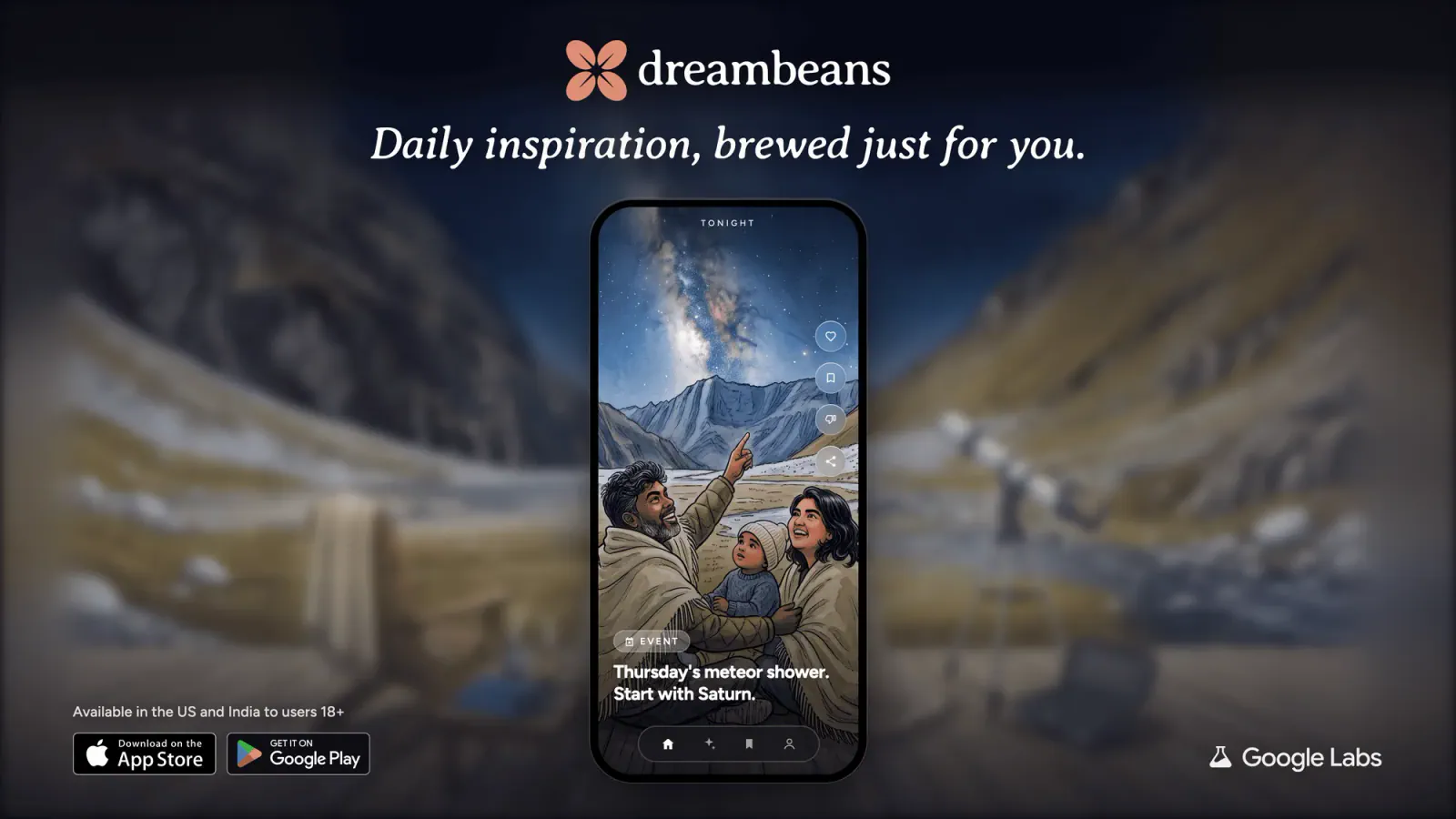
Google has launched its experimental AI story-generating app, Dreambeans, in India for Android and iOS users over 18. Supporting 14 languages, including English and 13 local dialects, the app creates personalized narratives by pulling data from connected services like Gmail, Photos, and Calendar. While it can ingest multilingual source data, the output is restricted to a single language, limiting its utility for users who communicate in mixed-language formats. Users must carefully manage service connections, as linking accounts like Google Photos may surface sensitive personal memories or unwanted content despite existing privacy controls.
Google launched Dreambeans in India on November 3, 2026, bringing its experimental, personalized story app to Android and iOS users aged 18 and older. The rollout supports 13 local languages plus English and makes India the app’s first market outside the United States, according to Google’s announcement and TechCrunch’s reporting.
Dreambeans generates illustrated stories from information in Google services that a user chooses to connect. It can suggest places to explore, surface interests or offer reminders about upcoming events without waiting for a typed prompt.
The expansion brings that format to a much larger multilingual audience. It also exposes an important distinction: Dreambeans can draw on information in multiple languages, but each generated story currently uses one selected language. Its access to personal information creates another practical choice, because a more personalized story may require connecting services containing material a user would prefer to keep out of the app.
What Changed for Indian Users
Google’s India announcement lists Hindi, Bengali, Telugu, Marathi, Tamil, Urdu, Gujarati, Kannada, Malayalam, Odia, Punjabi, Assamese and Nepali. English brings the total to 14 supported languages.
The launch expands access to an existing Google Labs experiment. Google introduced Dreambeans in June and opened it broadly to eligible U.S. users on September 10, 2026. That earlier announcement already described daily stories built from Calendar, Gmail, Photos, Search, YouTube and Gemini.
Comparing the two official announcements shows that India’s main changes are availability and language support, not a newly introduced set of connected services.
The app’s purpose also remains narrow. Users receive personalized story collections, then can explore a story further, bookmark it or share it. Dreambeans is not presented as a general-purpose assistant for answering arbitrary questions, writing documents or completing a broad range of tasks.
Google’s India post confirms the age threshold and mobile platforms. TechCrunch adds that Dreambeans is available to personal Gmail account holders, not enterprise users. The India announcement does not provide a price or paid-plan breakdown, so it should not be read as a detailed pricing guide.
How Connected Google Services Shape the Stories
Dreambeans uses what Google calls Personal Intelligence to draw on selected services:
The published material explains the mechanism at a product level: selected account information supplies context, and Dreambeans turns that context into personalized stories. It does not explain exactly how individual messages, searches or other records are ranked and combined.
Google Photos can contribute more than subject matter. In its September U.S. announcement, Google said a connected Photos account can let Dreambeans incorporate visuals of users and their loved ones into stories. That makes the output more personal, while increasing the chance that a story includes someone or something the user did not want surfaced.
My view is that the connection list is the most consequential part of setup. Choosing a story language affects presentation; choosing connected services affects what the app can draw from. I’d begin with the fewest connections needed to make the experiment useful, then expand only if the resulting stories justify sharing more context.
Fourteen Languages Still Means One at a Time
TechCrunch reports that users can select only one language at a time for generated stories. Google product manager Gozde Oznur told reporters that Dreambeans can use source information across languages, but cannot currently generate stories that mix them.
That separates three capabilities which can otherwise sound interchangeable:
Capability
What the reporting supports
Language availability
Thirteen local languages plus English
Multilingual source information
Connected information can span multiple languages
Mixed-language generated stories
Not currently supported
For someone whose Google account contains Hindi and English material, the source information need not all be in the same language. The output still has to follow a single selected language.
That is a meaningful constraint in India, where multilingual use can include switching languages within a conversation or sentence. TechCrunch specifically highlights Hinglish as a potential mismatch with the app’s current output format.
The practical implication is narrower than saying Dreambeans lacks multilingual support. It supports multiple language choices and multilingual inputs, but not mixed-language storytelling. I would treat the 14-language figure as a measure of available output choices, not proof that the app can reproduce a user’s everyday language habits.
This restriction comes from launch reporting, not independent testing, and may change as the experiment develops.
Privacy Controls Address Different Problems
Google says users choose which services to connect, can disconnect them and can delete their Dreambeans data. Those controls operate at different stages: selecting inputs, managing stored personalization and influencing future stories.
Lets users withdraw a source without abandoning every connection
Delete Dreambeans data
Deletion is available through the app’s profile area
Provides a separate way to remove Dreambeans data
Delete underlying information
Google says deleted source information is also removed from its personalization system
Links personalization to changes in the source services
Request topic avoidance
Users can ask the app to avoid subjects
Gives users a way to influence what future stories surface
Separate consent choices
Dreambeans opt-ins do not change choices in Gemini or AI Mode
Keeps these permissions specific to Dreambeans
The distinction between disconnecting a service and deleting Dreambeans data is worth noticing. The reporting describes both options; users should not assume they are interchangeable. Someone who wants to stop a connection and remove the app’s accumulated personalization should review both controls.
These are company descriptions and assurances, not an independent assessment of how completely or quickly deletion propagates through the system.
The personal-account restriction also has a practical limit. A personal Gmail account can still contain business-related material. Oznur specifically mentioned that users can ask Dreambeans to avoid business subjects, which underlines why account eligibility alone is not a reliable separation between personal and work information.
The Hindu reports that Dreambeans permissions are separate from Gemini and AI Mode choices. Users should therefore review Dreambeans’ own connections instead of assuming that settings made elsewhere in Google automatically carry over.
Private Stories Can Still Surface Unwanted Memories
Google says generated stories are visible only to the account holder, according to TechCrunch. Users can deliberately share stories, but Dreambeans is not currently described as a social feed that automatically distributes them to other people.
Private visibility does not remove the risk of an upsetting recommendation. Oznur acknowledged that Dreambeans could generate stories involving people who have died. Users can ask the app to stop showing certain subjects, with Google comparing that approach to memory controls in Google Photos.
That is an important consequence of proactive generation. A conventional prompt gives the system a topic the user has chosen at that moment. Dreambeans chooses what to surface from connected information, so the user may encounter a memory before deciding whether they want to revisit it.
I’d distinguish a topic-avoidance request from a strict exclusion guarantee. TechCrunch reports that the app will try to adjust its stories after feedback; it does not describe a measured guarantee that a sensitive subject can never reappear. Anyone considering connecting a photo library with difficult personal memories should weigh that limitation before enabling it.
Generated Stories Still Need Checking
Google acknowledges that Dreambeans can hallucinate and produce incorrect stories, The Hindu reports. The company recommends giving a thumbs-down response to problematic output.
Access to real account information does not make every generated statement reliable. A story can be personalized yet still contain an incorrect detail or interpretation. For anything consequential, such as an event mentioned in a story, checking the underlying calendar entry or message is the safer choice.
Google is also exploring ways to make Dreambeans more actionable, Oznur told TechCrunch. That is a direction under consideration, not evidence that the current app can carry out a broad range of tasks.
For now, Dreambeans offers Indian users a specific exchange: selected Google-account context becomes proactive, illustrated stories. Its usefulness will depend on whether those stories are worth the connections required to produce them, and whether a single-language format fits the way the user wants to read.
Frequently Asked Questions
4 questions
1
Who Can Use Dreambeans in India?
Google says the Android and iOS app is available to users aged 18 and older. TechCrunch reports that access is limited to personal Gmail accounts, excluding enterprise users.
2
Can Dreambeans Generate Stories in Hinglish?
Not currently, according to TechCrunch’s launch reporting. It can draw on information in multiple languages, but generated stories use one selected language at a time.
3
Can Users Disconnect Google Services?
Yes. Google says users can choose and disconnect services, and can separately delete their Dreambeans data within the app.
4
Is Dreambeans a General-Purpose AI Assistant?
No. Its current focus is generating personalized story collections from connected Google services. Google is exploring more actionable features, but those should not be treated as existing capabilities.