
The UK House of Commons Business, Innovation, Science and Trade Committee has asked Anthropic to provide an unredacted independent assessment of AI research acceleration, or the material removed from it, and explain the redactions. Committee chair Liam Byrne requested a response by Friday, December 4, 2026.
The committee published its letter on November 27 at 12:15, three weeks after Model Evaluation & Threat Research, known as METR, released its assessment. METR said Anthropic allowed it to publish its highest-level risk conclusions but removed a majority of the evidence it considered most informative.
The public can read METR’s conclusions about accelerating AI development, but cannot inspect much of the evidence behind them. The parliamentary request seeks that missing material. It is correspondence, not a court order or a finding of wrongdoing, and Anthropic’s response was not available in the reviewed sources.
What Parliament Asked Anthropic to Provide
Anthropic has been asked to supply the full, unredacted METR assessment or the omitted material, alongside an explanation of why information was removed. The request comes from the Commons committee responsible for the published correspondence, chaired by Liam Byrne.
The committee’s publication record places the letter within its work on AI adoption, safety and governance. The December 4 response date gives Anthropic one week from publication to answer.
Two separate questions sit behind the request:
- What evidence was withheld? The unredacted assessment or omitted material would let the committee examine information unavailable to public readers.
- Why was it withheld? An explanation would allow scrutiny of Anthropic’s confidentiality rationale and how it was applied.
Providing evidence to a parliamentary committee would not, by itself, mean publishing that evidence for everyone. The request concerns access to the material; the available sources do not establish how any confidential response would subsequently be handled.
That distinction keeps the immediate stakes precise. December 4 is a deadline for Anthropic’s response, not an announced public-release date for the full report.
What METR Says Anthropic Redacted
METR’s November 5, 2026 assessment says Anthropic held contractual rights to redact non-public information before publication. METR retained the right to disclose that those rights had been exercised and whether its findings depended significantly on removed information.
According to METR’s redaction summary, Anthropic removed a majority of the evidence the evaluator found most informative for its conclusions. METR could still freely share its highest-level conclusions about risk.
METR attributed the following explanation to Anthropic: the redactions were “aimed at removing confidential information that could accelerate other AI developers.”
That is Anthropic’s stated rationale as reported by METR. It is not an independent determination that every redaction was necessary.
The evaluator also described an important separation between control over conclusions and control over disclosure:
| Part of the assessment | METR’s account |
|---|---|
| Final conclusions | Anthropic did not control METR’s conclusions. |
| Non-public supporting evidence | Anthropic could control which information appeared publicly through its redaction rights. |
| Disclosure of redactions | METR could say redactions occurred and explain whether important findings depended on them. |
| Public transparency | METR said the report did not achieve transparency about evidence. |
Some removed material was difficult even to describe without revealing information covered by the redactions. METR said its report identified the important omissions through a process table and descriptions elsewhere in the document.
The result is a specific transparency gap, not evidence that Anthropic dictated the assessment’s verdict. Independence in reaching a conclusion and freedom to publish its supporting material are different safeguards. METR’s disclosure shows why both matter.
The issue also connects with Zeniteq’s prior coverage of reported efforts by Anthropic and OpenAI to control safety reports. The present case adds a concrete parliamentary request for the underlying material.
What METR Found About AI Research Acceleration
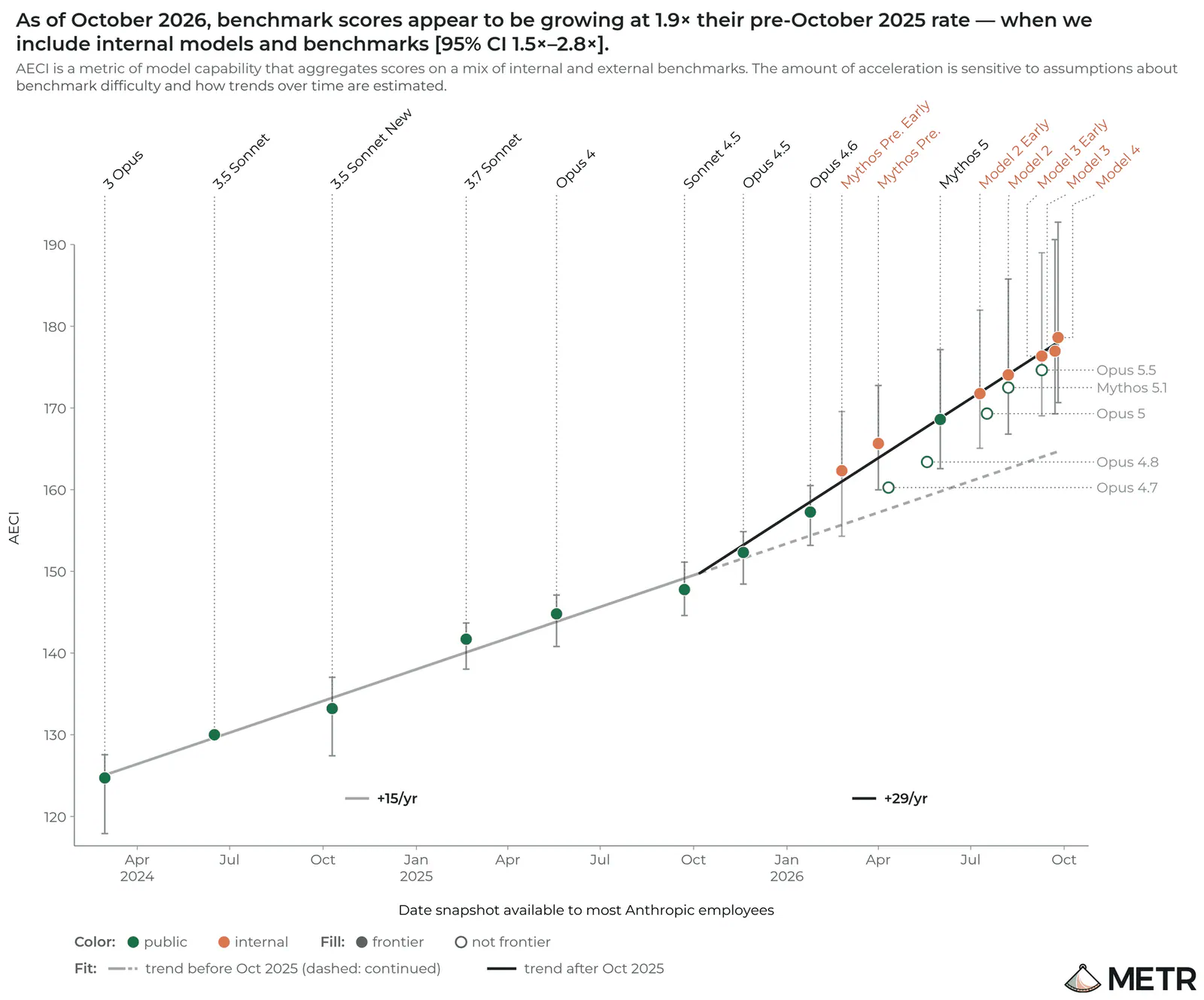
METR’s October 2026 assessment concluded that Anthropic was likely improving model capabilities on well-specified tasks at roughly twice its earlier rate, with substantial uncertainty. METR staff conducted the high-access evaluation from August 12 through October 29, 2026.
Anthropic provided access to internal information covering pretraining, reinforcement learning, training compute, internal model benchmark scores, AI speedup analyses, forecasts and staff interviews. Those inputs gave METR a broader view than an outside benchmark comparison alone.
The published assessment distinguishes a measured benchmark trend from a wider judgment about its causes:
| Measure or judgment | METR’s published finding | Conditions and limits |
|---|---|---|
| Overall pace of capability improvement | Around 2× the rate between March 2024 and October 2025 | A subjective synthesis with high uncertainty; METR said roughly 1.3× or 3× would not surprise it. |
| Growth in model benchmark scores since October 2025 | An estimated 1.9× the earlier growth rate | Measured using AECI, Anthropic’s version of the Epoch Capabilities Index; reported 95% confidence interval of 1.5–2.8×. |
| Contribution from AI-assisted R&D | A majority of current acceleration was likely attributable to AI use | METR identified significant uncertainty and said other causes likely contributed substantially in late 2025. |
| Further progress over the next 12 months | No significant bottlenecks observed in the areas assessed | METR’s understanding changed as it received information, leaving it uncertain about this judgment. |
These are findings from METR’s assessment using Anthropic’s internal evidence, not independently reproduced measurements by Zeniteq.
The 1.9× figure describes the rate at which benchmark scores were improving. It does not mean that a particular Anthropic Claude model was 1.9 times faster, that every researcher doubled productivity, or that training required half as much compute.
METR said it was confident the observed acceleration did not result from faster scaling of training compute. That narrows one possible explanation, but identifying the contribution of AI assistance still requires interpreting several kinds of evidence together.
Staff interviews and surveys were consistent with AI use doubling the pace of capability progress, according to METR, though the evaluator warned that self-reported productivity gains were difficult to interpret. METR was told the acceleration came primarily from AI assistance, with signs that fully autonomous contributions could become more important.
Why the Missing Evidence Matters for Acceleration Risk
METR’s assessment concerns a feedback loop: AI systems help researchers develop better AI systems, which may then provide more capable research assistance. Faster progress could shorten the time available to evaluate and respond to newly emerging capabilities.
An acceleration claim has several layers. A benchmark trend can show that measured capabilities improved faster. Explaining why the trend changed requires additional evidence. Predicting whether the acceleration will continue requires judgments about constraints, future automation and diminishing returns.
Those layers should not be treated as interchangeable.
For example, METR’s reported 95% confidence interval applies to its estimate of benchmark-score growth. It does not capture every uncertainty in the broader conclusion that AI caused most of the acceleration or that further acceleration poses a significant risk. METR separately expressed uncertainty about those judgments.
METR also said much of the redacted evidence had multiple plausible interpretations, and that both its researchers and Anthropic researchers were uncertain about how to combine it into an overall picture. That makes access consequential even when readers accept the evaluator’s competence and good faith.
An outside analyst might give different weight to staff reports, internal benchmark trajectories or evidence of emerging bottlenecks. Without the material, readers cannot fully compare those interpretations, reconcile them with other research or assess how strongly each conclusion follows.
METR explicitly acknowledged that the public consequently had to rely on its judgment more than was ideal.
The analytical consequence is limited public checkability, not a demonstrated false conclusion. Confidentiality prevents outsiders from assessing both the substance of the withheld evidence and whether the scope of the redactions was proportionate. The published record supports scrutiny of that gap; it does not show that the redactions concealed proven misconduct.
What the December 4 Deadline Can Clarify
Anthropic’s December 4 response could clarify what it is prepared to share with Parliament and how it justifies the boundaries placed on public disclosure. The reviewed sources do not contain its answer, so they provide no basis to say the company has refused the request.
The confidentiality rationale also creates a genuine tension within this particular assessment. Anthropic’s stated concern was that releasing internal information could help competing AI developers. METR’s task was to assess whether AI development itself was accelerating in ways that could increase risk.
Information useful for evaluating that acceleration may therefore overlap with information a developer considers competitively sensitive. The parliamentary letter seeks the material and an explanation, giving the committee a way to examine that tension without assuming the answer in advance.
For readers following Anthropic’s wider AI development and safety work, the next useful distinction is between three outcomes: whether the committee receives the evidence, whether Anthropic explains its redaction decisions, and whether more information becomes public. Those are separate developments. A response could advance parliamentary scrutiny without resolving the public transparency gap METR identified.
Frequently Asked Questions
3 questions
1What Did Parliament Ask Anthropic to Provide?
The Commons Business, Innovation, Science and Trade Committee asked Anthropic for METR’s full unredacted assessment or the material omitted from it, plus an explanation of the redactions. Chair Liam Byrne requested a response by Friday, December 4, 2026. The committee published the correspondence on November 27.
2Why Did Anthropic Redact the METR Assessment?
Anthropic said the redactions were intended to remove confidential information that could accelerate other AI developers, according to METR’s account. METR said Anthropic had rights to redact non-public information and exercised them over a majority of the evidence most informative to its conclusions. Outside readers cannot assess that material’s sensitivity from the public report.
3Do the Redactions Make METR’s Conclusions Unreliable?
The redactions alone do not show that METR’s conclusions are wrong. METR said it could publish its highest-level conclusions, but acknowledged that withheld evidence limited public scrutiny. Its assessment explains that some evidence had multiple plausible interpretations, leaving readers more dependent on the evaluator’s judgment than METR considered ideal.


