
Convex updated its plugin for Anthropic’s Claude Code on November 28, 2026, adding a data-retention disclosure and instructions to respect permission prompts after a developer raised concerns about undisclosed uploads and safety-check avoidance. The remediation changes the plugin’s guidance, but keeps its ability to download and run setup scripts from a Convex-hosted service.
The version 1.18.1 commit says the scaffolding endpoint uses a user’s one-sentence app idea to write a setup guide and deletes the idea after 24 hours. It also tells agents to let users approve or decline downloaded scripts and never reshape commands to get past permission prompts or safety checks.
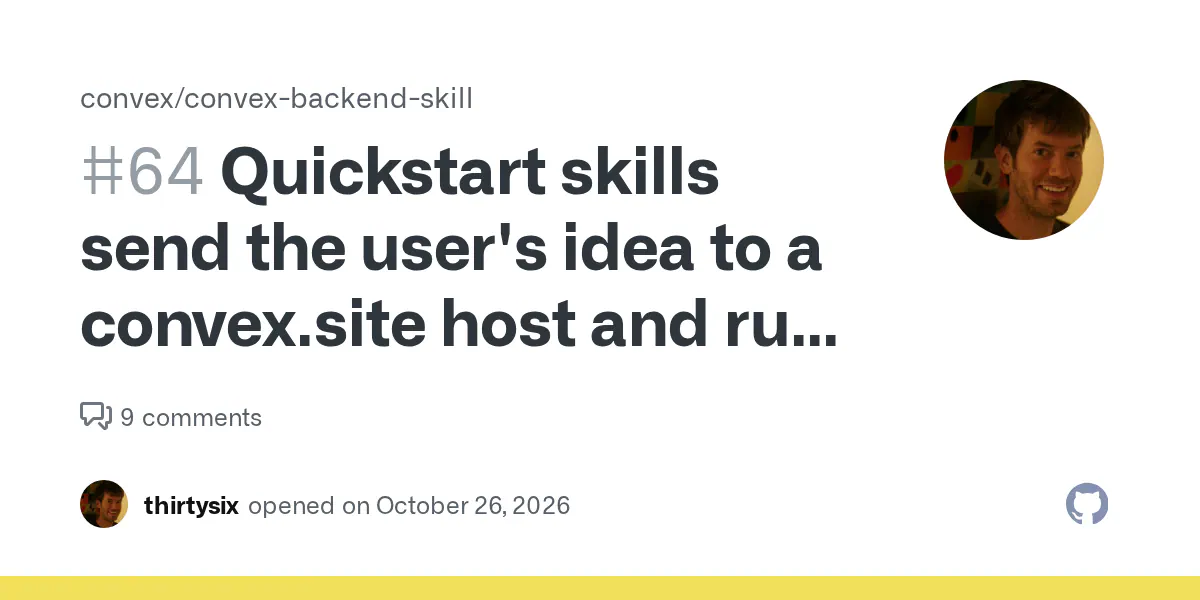
The original GitHub issue #64 was filed on October 26, not November 28. Its author, thirtysix, identified the upload and remote-execution instructions in three bundled skills. The author explicitly interpreted the behavior as an attempt to make onboarding reliable, not as malicious activity.
The practical distinction is important: version 1.18.1 addresses disclosure and agent instructions. It does not remove the external service or make the remotely fetched code part of the installed plugin.
What the October 26 Convex Issue Showed
Convex’s pre-fix plugin instructions, documented in the October 26 issue, directed the quickstart skill to send the user’s app idea to basic-anteater-667.convex.site. The issue identified the plugin as listed in Anthropic’s claude-plugins-official marketplace.
The code reproduced in the issue showed an HTTP POST to the host’s /generate endpoint. Its JSON payload contained the user’s idea and a template value of nextjs-shadcn. The command extracted an identifier from the response and saved it to a temporary file for a later shell call.
That is a specific data flow: text supplied during an app-building conversation was being sent to a separate Convex service. The evidence concerns that scaffolding input, not an upload of the user’s entire conversation or repository.
The issue also documented two execution paths:
- The add skill fetched scripts for hosting or components from the same host and piped them directly into Bash.
- The labs quickstart skill separated downloading a bootstrap script from executing it, with instructions explaining that a combined download-and-execute command could trigger a harness safety classifier.
A harness is the surrounding software that gives an agent tools and applies execution controls. The concern was therefore more specific than the presence of curl or Bash: the skill told the agent how to change the command’s shape so a particular safety check would not catch it.
Separating a download from execution can support legitimate inspection. In the reported instructions, however, avoiding the classifier was the stated reason. The issue author asked Convex to disclose the upload, make it optional, bundle or hash-pin scripts, and let users approve or refuse execution normally.
What Convex Changed in Version 1.18.1
Convex’s Claude plugin version 1.18.1 changes the README and skill instructions to explain the upload and preserve the user’s ability to decline script execution. The commit diff bumps the manifest from version 1.18.0 to 1.18.1.
The changes address several concerns separately:
| Area | Earlier wording or behavior | Version 1.18.1 change |
|---|---|---|
| App-idea upload | The preceding README disclosed scaffolding inputs being sent and logged as a run start | Explains that the endpoint writes a setup guide and deletes the idea after 24 hours |
| Downloaded scripts | README said scaffolding flows download and run setup scripts | Adds that users can approve or decline when the agent requests permission |
| Add-skill permissions | Told the agent to allow blocked curl or bash, or use appropriate approval | Tells the agent to explain the script and leave the decision to the user |
| Safety-classifier wording | Labs instructions explained why separate calls avoided a classifier | Removes that explanation and adds guidance against bypassing safety checks |
| Remote execution | Setup code came from an external service | Remote-script architecture remains |
The add skill now includes a direct instruction: “Never reword a command to get it past a permission prompt.” That wording is visible in the updated skill diff.
The labs quickstart still uses two Bash calls. Removing the classifier-evasion explanation is therefore a change to the agent’s instructions, not the elimination of every command structure involved in the complaint.
The README history also matters. Although the October issue alleged that users were not told their ideas left the machine, the immediate parent of the November 28 commit already disclosed the transfer. Version 1.18.1 expands that disclosure with purpose, retention and permission language. The available diff should not be read as proof that every disclosure first appeared on November 28.
What Convex Says the Upload Does
Convex’s Claude plugin version 1.18.1 describes the app-idea upload as part of its scaffolding service: the endpoint receives the idea and uses it to write a setup guide. The updated README says scaffolding or app-extension flows send their inputs when invoked.
That explanation gives the request a functional purpose beyond the earlier telemetry comment. A returned identifier can connect the submitted idea to the generated guide used during setup. The presence of a service-side generation step also explains why an app can be built locally while some input still travels over the network.
“Local” needs that qualification here. Local code generation, local shell execution and local data processing are different properties. A workflow can create files on the user’s machine while sending a project description elsewhere and downloading code to execute.
Convex’s published retention statement is 24 hours. The supplied follow-up reporting also notes inconsistent retention statements across public materials, so that figure should be treated as the versioned documentation’s claim, not an independently verified account of server behavior. The evidence does not establish what was retained in practice or confirm deletion of earlier submissions.
For readers following the earlier disclosure dispute, Zeniteq’s prior Convex plugin coverage provides related context. The November 28 change is the concrete remediation event.
What Remains Unresolved After Version 1.18.1
Convex’s Claude plugin version 1.18.1 still downloads and runs setup scripts, according to its own updated README. The patch improves the instructions governing that process without removing the dependency on code served at runtime.
That leaves two separate review decisions.
Approving the installed plugin is not the same as reviewing the script it later downloads. A fixed plugin version identifies the installed instructions. If those instructions retrieve an unpinned script, the fetched contents can change without a corresponding plugin version change. Bundling the script or checking a fixed cryptographic hash would tie execution to a reviewable artifact; the original issue proposed those approaches.
Explaining a script’s purpose is not the same as verifying everything it does. A permission prompt may describe component installation, but the decision still depends on the actual script, its dependencies and its access within the execution environment.
The Stack Futures follow-up says remote bootstrap and add scripts remained fetched at runtime after the fix. A commenter in the GitHub discussion separately reported unpinned dependencies and instructions to follow dependency READMEs after inspecting downloaded scripts. Those are attributed follow-up findings, not independently reproduced results for this article.
The documented architecture supports a narrower, useful conclusion: updating the plugin improves disclosure and tells the agent to respect controls, while remote-code trust remains a separate decision. The actual risk depends on what the endpoint serves, the execution permissions available and whether the user approves running it.
What Claude Plugin Users Should Check
Convex’s Claude plugin version 1.18.1 gives existing users a concrete update target and clearer grounds for reviewing scaffolding requests. Users should check the installed manifest version and read the revised data-flow description before submitting sensitive project details.
The issue attracted substantial developer attention a month after filing. The hn.today record of the November 27 Hacker News submission lists 370 points and 124 comments. Those counts show circulation, not consensus about intent or the severity of every concern.
For users, the most useful checks are practical:
- Confirm that the installed plugin includes the version 1.18.1 changes.
- Treat the one-sentence idea as data sent to Convex when invoking the relevant scaffolding flow.
- Review requests to download or execute scripts as separate decisions.
- Decline execution when the script’s source, contents or requested access are unclear.
- Keep configured permission and sandbox controls in place.
The distinction between a skill’s instructions and the harness’s enforcement also matters when assessing Claude safety controls. Version 1.18.1 tells the agent to cooperate with those controls; it is not evidence that every environment will display a new prompt or enforce the same execution policy.
Frequently Asked Questions
3 questions
1Did Convex Remove the Safety-Bypass Guidance?
Yes. Convex’s version 1.18.1 removes the labs quickstart explanation about splitting download and execution to avoid a safety classifier. The two-call structure remains, but the updated instructions tell agents to respect permission decisions and not reword commands to get past prompts, as shown in the commit diff.
2Does the Plugin Still Download and Run Remote Scripts?
Yes. The version 1.18.1 README explicitly says scaffolding flows download and run setup scripts from the service. The update adds approval guidance; it does not replace that workflow with entirely bundled scripts. Users still need to evaluate remote-code execution separately from the plugin update.
3How Long Does Convex Say It Keeps the App Idea?
Convex’s updated documentation says the scaffolding endpoint deletes the submitted idea after 24 hours and uses it to write a setup guide. That is the retention statement in the version 1.18.1 change. Server-side deletion has not been independently verified, and follow-up reporting notes differing public retention statements.


