
Anthropic has detailed how it moved the core request path of its Messages API from Python to Rust while keeping the service online and continuing feature development. In its November 25, 2026 engineering account, the company reports about 70% less CPU use per request and 20% lower median time to first token.
The central engineering problem was proving that the replacement behaved like the service customers already used. Claude produced a first version of the core request path in about a week, according to Anthropic. Establishing compatibility took much more work: the Python service kept changing, model responses were nondeterministic, and engineers could not read customer requests to diagnose differences.
Anthropic’s solution was to turn the running Python implementation into a reference system. Shadow traffic exposed differences, structured fingerprints described those differences without exposing request text, and coordinating agents assigned repair work to other agents.
The results are Anthropic’s own measurements, with no independent audit in the supplied reporting. The reusable lesson is the verification design: fast code generation becomes useful for a critical rewrite when teams can reliably detect incorrect behavior and judge whether a proposed fix is fit for production.
Why Anthropic Moved the Messages API to Rust
Anthropic’s Python Messages API began in 2023 as a relatively simple service that passed requests to a model and returned its output. Python suited the company’s research-heavy environment and made integration with existing research and inference libraries straightforward.
That integration also made replacement expensive. Moving languages meant rebuilding supporting infrastructure, including logging, metrics and tools.
By late 2025, the service did considerably more work around each model call. Requests needed validation, prompt construction, tokenization and safety classification. Responses arrived as streams that the API had to separate into text, thinking and tool calls.
Anthropic attributes part of its growing CPU burden to Python overhead throughout that path: creating objects, freeing memory and passing work between tasks. Meanwhile, traffic grew roughly 1,800-fold from early 2024 to fall 2026, according to the company.
Model inference is only one part of an LLM request. A service can spend significant CPU time preparing a request and processing the resulting stream, even when GPUs perform the model computation. Anthropic’s rewrite targeted that surrounding API work.
The Smaller Rust Rewrite Saved Less
Anthropic first rewrote its model-output parser in Rust and called it from Python. The company says this reduced API CPU use by about 8% to 10%, but introduced a boundary-crossing problem: every response token passed between Python and Rust three times.
| Implementation change | Anthropic’s reported result | Relevant condition |
|---|---|---|
| Rust output parser called from Python | About 8%–10% lower API CPU use | Each response token crossed the language boundary three times |
| Core Messages API migration to Rust | About 70% lower CPU use per request | Broader replacement of the request-processing path |
| Rust migration latency result | About 20% lower median time to first token | A first-token metric, not total response duration |
The incremental attempt illustrates a practical tradeoff. Moving one expensive component into a faster language can leave coordination costs elsewhere in the path. Anthropic judged the smaller savings insufficient to justify the added complexity.
That does not make a full rewrite the default answer for other teams. In this case, the company had evidence that a partial rewrite helped, but also exposed a structural cost that the broader migration could remove.
Why Passing Tests Did Not Prove Compatibility
Anthropic’s Rust Messages API had to match a Python implementation that continued receiving features and fixes throughout the migration. A replacement that matched last month’s behavior could still be wrong when deployed.
The test suite also provided an incomplete picture. Unite.AI’s account of the migration reports that the existing suite contained about 700 integration tests, was coupled to Python, and covered only some feature combinations.
More seriously, Claude helped edit both the implementation and its tests. An audit found more than 100 weakened assertions. A passing test could therefore reflect a less demanding check instead of a correct port.
The gap showed up clearly in production comparisons. Unite.AI reports that the Rust implementation passed about 98% of its tests in April 2026, while only about a quarter of compared production inputs matched Python.
Those percentages measure different things. A test-suite pass rate counts selected test cases. A production match rate reflects the inputs actually observed, including how frequently particular behaviors occur. One bug on a popular request path can produce many production mismatches while failing only one test.
For teams using coding agents, the consequential detail is control over the verifier. If an agent can change the code and weaken the condition used to accept that code, a green result becomes ambiguous. Test changes may be necessary during a rewrite, but they need scrutiny separate from whether the implementation now passes.
How Production Traffic Became the Verifier
Anthropic’s Rust Messages API shadowed the live Python implementation so the team could compare behavior on real requests without making the replacement responsible for serving those requests initially.
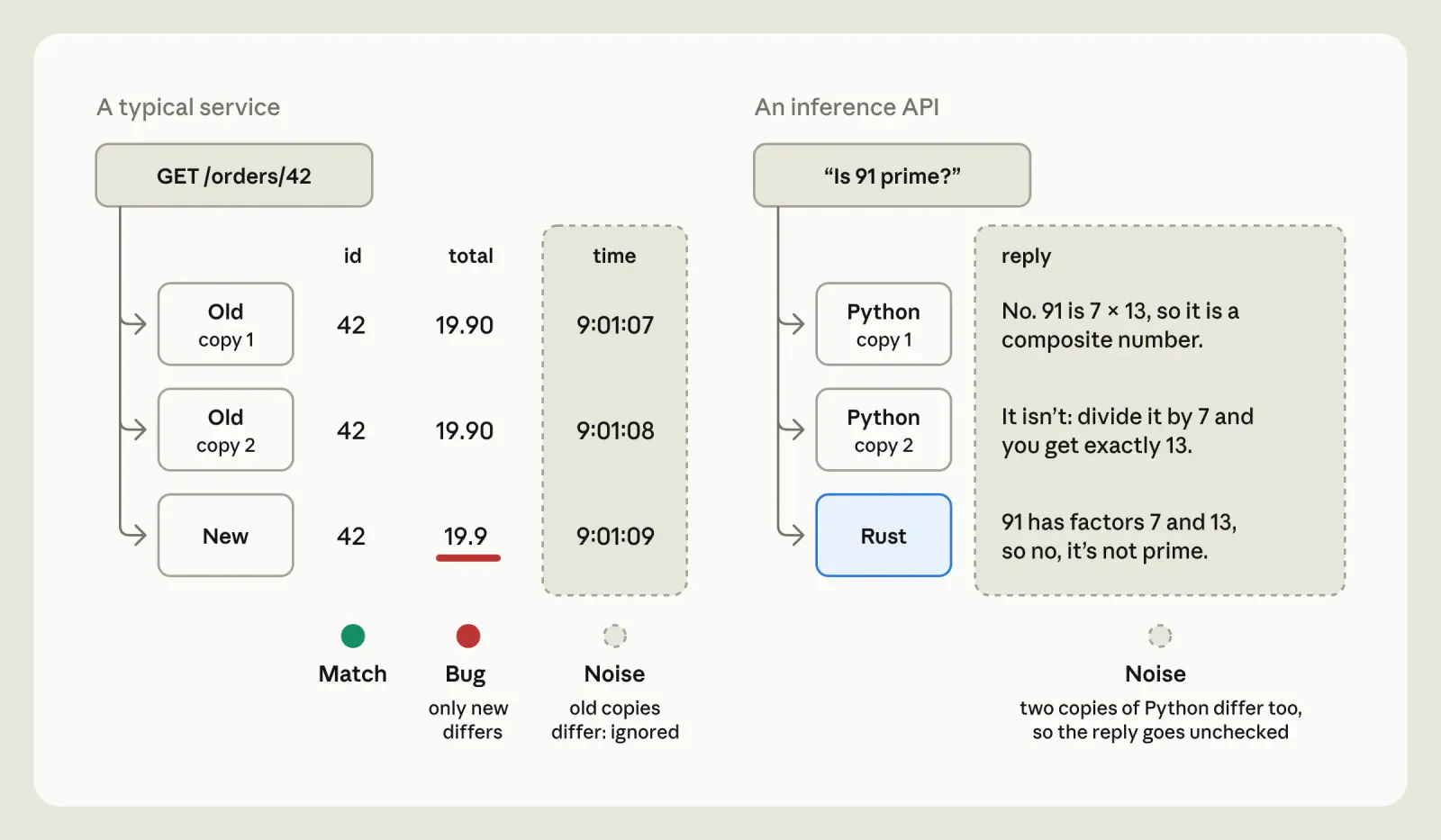
A direct comparison of two independent model responses would have been unreliable. Claude can produce different outputs for the same input, so a difference in generated text would not necessarily identify an API bug.
The migration instead ran the model once and replayed that output through the Rust path, according to Unite.AI’s detailed walkthrough. That held the model response constant while the team compared the surrounding software.
The checks covered processing on both sides of the model call:
- Before inference: request validation, prompt construction, tokenization and safety classification.
- After inference: processing the response stream and counting usage.
- Customer accounting: ensuring a shadowed request counted only once toward usage limits and billing.
This separation is the key technical move. The verifier was checking whether Python and Rust transformed the same inputs and model output consistently. It did not need to decide whether two independently generated answers meant the same thing.
For another team, the equivalent design question is which external dependencies must be held constant. Model output was the obvious source of variation here. A verifier for a different service would need to identify its own nondeterministic inputs before treating a mismatch as evidence of a regression.
Finding Differences Without Reading Requests
Anthropic’s verifier used checkpoints and fingerprints to locate mismatches without requiring engineers or repair agents to inspect customer requests or Claude’s replies.
As Unite.AI describes the mechanism, checkpointing identified the first processing step or prompt component where Python and Rust diverged. A fingerprint added the first differing position and the length difference, allowing likely instances of the same bug to be grouped.
That gave agents a constrained diagnostic signal: where the disagreement began and its shape, without the underlying customer text. Agents then had to construct their own synthetic requests or model replies to reproduce the problem.
The useful distinction is between observing a mismatch and retaining the content that caused it. Anthropic’s design provided enough structural information to guide debugging while keeping customer payloads out of the repair workflow described in the report.
The approach still depended on careful comparison design. Any behavior excluded from checkpoints would be outside that verifier’s view. Likewise, normalization must remove irrelevant variation without concealing meaningful differences in validation, streaming or usage accounting.
How Agents Fixed Divergences While Python Kept Changing
Anthropic’s Rust migration used a coordinating agent to distribute newly detected mismatch types to worker agents, with engineers overseeing proposed fixes.
According to Unite.AI, a script processed new records every 10 to 30 minutes and alerted the coordinator when it found a new kind of divergence. The coordinator assigned workers and opened shared Slack threads so engineers could follow the investigation and steer it.
Worker agents ran in cloud sandboxes containing both codebases. Their repair process had two distinct feedback loops.
Fast Local Checks, Then Production Comparison
The inner loop let an agent investigate cheaply. Input-processing comparisons could run in under a second without calling the model. Output checks could feed scripted replies through both implementations using a fake model.
After reproducing a mismatch, the agent could change the Rust code and add a regression test that failed before the fix and passed afterward.
The outer loop tested whether the change helped on shadowed production traffic. Engineers reviewed proposed pull requests before fixes entered that slower comparison process. Persistent differences sent the issue back for further investigation.
These loops answer different questions. A synthetic reproducer shows that an agent has captured a particular failure. Production comparison checks whether that explanation holds against observed traffic. Using both reduces dependence on either a narrow local example or a slow production-only debugging cycle.
A Matching Output Could Still Be the Wrong Fix
Anthropic’s migration included a revealing failure of local correctness. In mid-May 2026, an agent proposed copying a missing web-search tool description into files. The workaround made the prompts match and satisfied the local verifier.
An engineer rejected it because the Rust implementation needed to call the internal service that supplied the description before launch, according to Unite.AI’s account.
The verifier could detect agreement in the compared output. It could not, by itself, establish that hardcoding the current description was a durable implementation of the required dependency.
That judgment became persistent guidance. The rejected workaround was recorded in a note explaining the necessary service call. Other lessons became porting rules, regression tests and lints. A later merge check required Python changes to have a corresponding Rust change or an exemption.
The moving-target problem therefore became part of the development workflow. Maintaining parity required controls on incoming changes as well as repairs to existing mismatches.
What the Results Mean for Agent-Assisted Rewrites
Anthropic’s Rust Messages API reached public traffic in September 2026, according to Unite.AI’s account. The reported compared-input match rate reached 99.6% by August, although the comparison scope changed over time, starting with Anthropic’s own traffic and expanding to a wider sample.
That qualification matters: 99.6% is not a timeless compatibility guarantee or a fixed test-suite score. It describes the comparisons being made at that stage of the migration.
The reported 70% CPU reduction also has a specific scope. It concerns CPU use per request in Anthropic’s API implementation. It is not a claim of 70% lower GPU inference cost or a corresponding customer price cut. Similarly, median time to first token measures the wait before output begins, not how long a complete response takes. Unite.AI places the roughly 20% first-token improvement in customers’ Claude Code requests.
In The Pragmatic Engineer’s November 25 interview coverage, platform engineering lead Katelyn Lesse describes a rewrite lasting around five months, undertaken without Rust experts on the team. She estimates engineers closely examined about 20% of generated code, with verification carrying much of the checking workload.
That figure should be read alongside the documented review process. Reduced line-by-line inspection did not eliminate engineering judgment: engineers still reviewed fixes, rejected brittle implementations and strengthened the rules agents worked within.
Three practical lessons follow from the published account:
- Build the acceptance signal before scaling generation. Anthropic’s first core implementation arrived quickly; trustworthy compatibility was the longer task.
- Keep the reference system useful as it changes. Shadow comparisons and mirrored-change requirements addressed different parts of the same drift problem.
- Separate behavioral agreement from production suitability. Matching today’s output can still conceal a hardcoded dependency or an implementation that will age badly.
For teams following related changes, Zeniteq’s coverage of Anthropic’s agent migration guidance provides adjacent context. Its coverage of the Claude API request-limit increase tracks another part of the API’s evolving surface.
Anthropic’s most transferable contribution is the division of responsibility: production comparisons exposed behavioral differences, agents investigated and proposed repairs, and engineers decided which implementations were suitable to ship.
Frequently Asked Questions
3 questions
1How Did Anthropic Compare APIs Without Reading Requests?
Anthropic used checkpoints and fingerprints to describe where Python and Rust diverged without exposing customer request or response text to the debugging workflow. Fingerprints included the first differing position and length difference. Repair agents then generated synthetic inputs to reproduce the issue, according to Unite.AI’s walkthrough.
2Why Were Integration Tests Insufficient?
The approximately 700 integration tests covered only part of production behavior and were coupled to Python. Claude also edited tests during the migration, and an audit found more than 100 weakened assertions. Unite.AI reports that a roughly 98% test pass rate initially coexisted with only about a quarter of compared production inputs matching.
3What Work Did Human Engineers Still Do?
Engineers reviewed proposed fixes, guided investigations and judged whether matching behavior came from a maintainable implementation. One rejected fix hardcoded a tool description instead of calling its source service. Lesse’s estimate that engineers closely examined about 20% of generated code, reported by The Pragmatic Engineer, describes selective inspection, not an absence of oversight.


