
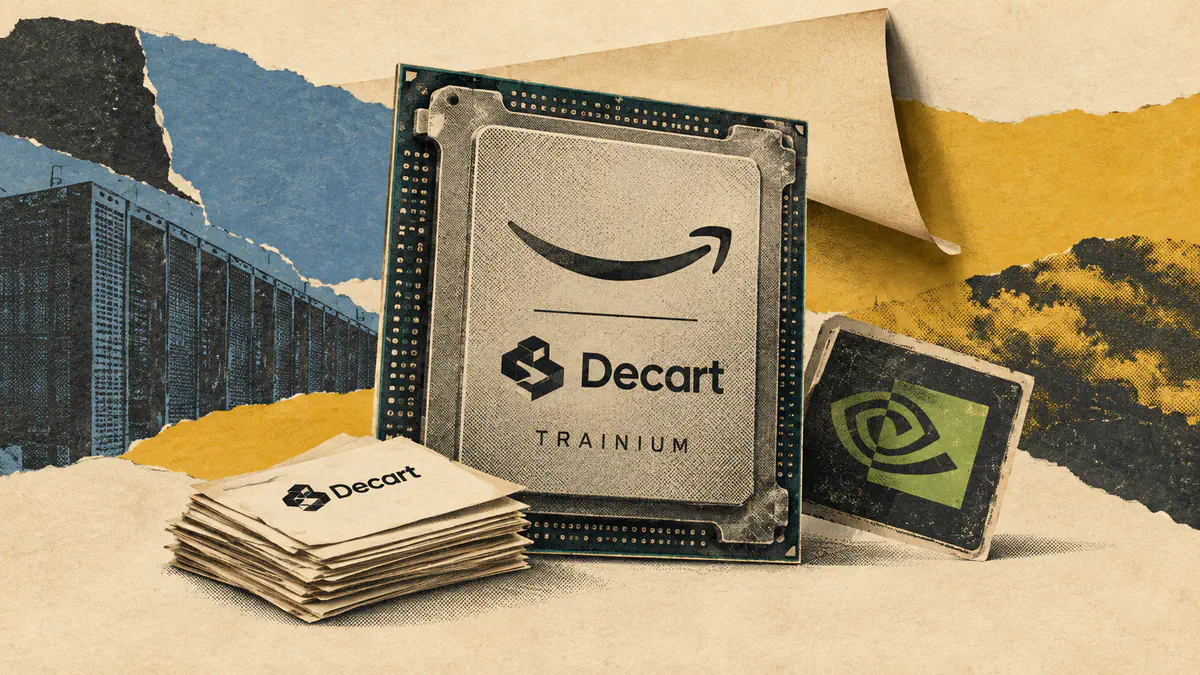
Amazon announced on November 23, 2026, that it had signed an agreement to purchase the technology behind Decart’s Optimization Stack, known as DOS, and hire the startup’s three co-founders and its AI research and engineering team.
The reported price is $7.5 billion, according to Bloomberg reporting cited by TechCrunch. Amazon did not disclose financial terms.
The scope matters as much as the price. Amazon’s announcement describes a technology-and-team purchase, not a takeover of every Decart product. The target is software expertise that could help Amazon’s Trainium chips run AI workloads more efficiently, strengthening an alternative to Nvidia hardware.
The agreement also builds on an existing relationship. Amazon says the two companies have worked together since 2025 on Trainium optimization. Bringing that technology and engineering team inside Amazon could make the work more closely connected to its chip and model development.
What Amazon Is Buying From Decart
Amazon’s Decart agreement covers the proprietary technology behind DOS and the planned hiring of co-founders Dean Leitersdorf, Moshe Shalev and Orian Leitersdorf, alongside Decart’s AI researchers and engineers.
Amazon’s announcement identifies those assets and personnel specifically. It does not describe a purchase of all Decart products or disclose a comprehensive inventory of other assets.
| Deal component | What the published sources establish |
|---|---|
| DOS technology | Amazon has agreed to purchase the proprietary technology behind the Decart Optimization Stack. |
| Founders and technical team | Decart’s three co-founders and its AI research and engineering team are set to join Amazon. |
| World models and other products | Amazon does not name them as purchased assets. TechCrunch reports that world models are not the target. |
| Financial terms | Undisclosed by Amazon; Bloomberg reported $7.5 billion, according to TechCrunch. |
| Completion | Subject to customary closing conditions, including regulatory clearance. |
Decart is also known for interactive world models and AI video-generation tools. Those are distinct from the optimization technology at the center of this agreement. In its follow-up analysis, TechCrunch reported that Amazon was not interested in Decart’s world models.
That distinction changes how the transaction should be understood. Amazon is pursuing a way to improve the computing foundation beneath AI models. The announcement does not support describing the deal as Amazon buying Decart’s entire collection of AI applications.
The signed agreement follows the proposed transaction covered in Zeniteq’s earlier report on the Decart deal. A signed agreement is a concrete step forward, but the purchase has not yet closed.
How DOS Could Improve Trainium Performance
Decart’s DOS is software for helping AI models run efficiently across different chip platforms. TechCrunch describes support for hardware from Nvidia, Amazon and Google, while Amazon emphasizes Decart’s full-stack work spanning software and hardware.
Amazon says the technology will help improve AI inference and the performance and cost efficiency of its custom silicon, including Trainium. Inference is the stage when a trained model processes new inputs and generates outputs, such as answering a prompt or producing video.
Amazon executive Peter DeSantis summarized the company’s rationale in the announcement:
“Every leap forward in AI starts with getting more out of every chip,”
The practical idea is straightforward: a chip’s theoretical computing capacity is useful only to the extent that software can turn it into completed work. Model execution has to fit the hardware’s capabilities and constraints.
In general, optimization can involve how calculations are organized, how data moves through memory and how work is distributed across processors. Those are explanations of the engineering problem, not disclosed details of DOS’s implementation. The opened sources do not provide a technical breakdown of which techniques DOS uses.
Faster Inference and Cheaper Inference Are Different Goals
Trainium optimization could benefit customers in several ways, but the measurements need to be separated:
- Latency: How long a model takes to respond to an individual request.
- Throughput: How much work a system completes over a given period.
- Compute efficiency: How much useful work the system produces for the resources consumed.
A service handling interactive requests may value a quicker response most. A large batch-processing job may care more about total work completed per hour. Better hardware utilization could lower the compute needed for either workload, but the size of the benefit depends on the model and operating conditions.
Amazon has not published DOS-specific benchmark results in its announcement. There are no disclosed speedup percentages, cost reductions or controlled comparisons against Nvidia systems. Its reference to strong results from the partnership remains a vendor claim without the accompanying measurements needed to assess it independently.
The supported conclusion is that Amazon has identified optimization as a useful way to improve Trainium. The evidence does not yet quantify how much customers will gain.
Why Software Matters in the Nvidia Competition
Amazon’s Decart purchase targets a software challenge in the AI chip race: making models run well enough on Trainium that customers have a practical reason to choose it.
TechCrunch frames the agreement as a bet on using software to narrow the gap with Nvidia. Its reporting describes DOS as working across multiple vendors’ hardware and suggests the technology could make it easier for customers to run workloads on Amazon chips.
That cross-platform background is consequential. An optimization team familiar with multiple architectures can bring knowledge of where model execution meets hardware constraints. Amazon is buying both the technology and the people who developed it, potentially preserving the expertise needed to adapt the stack as models and chips change.
The strategic analysis follows from three documented facts:
- Amazon already develops Trainium.
- Decart has worked with Amazon on Trainium optimization since 2025.
- Amazon is now purchasing DOS technology and bringing its technical team in-house.
Together, those facts suggest an effort to tighten the feedback loop between chip development and the software that uses the chips. Engineers working on model execution can identify bottlenecks; closer collaboration with hardware teams may help address them through software changes or inform future chip decisions. Amazon has not detailed how that internal process will be organized.
The deal therefore addresses a broader competitive question than whether one chip has better specifications. Customers need useful performance on their actual workloads. A hardware alternative becomes more compelling when its software can consistently translate available compute into faster or less expensive model execution.
For readers following that wider contest, Zeniteq’s Nvidia coverage tracks the company and its competitors. In this transaction, the important competitive asset is the optimization layer around the hardware.
What Customers Should Watch for Next
Amazon’s planned DOS purchase does not yet give customers a new product, a published price cut or a documented migration path. The announcement sets a direction for future improvements to Amazon’s chips and AI workloads.
TechCrunch also reports that Amazon is preparing to sell Trainium chips to customers, extending the competitive significance beyond their use in Amazon’s own data centers. The Decart agreement itself, however, provides no external chip-sales timetable or commercial terms.
For an organization evaluating Trainium, the useful evidence will be workload-specific results. A broad claim that inference is faster cannot answer every deployment question.
Frequently Asked Questions
3 questions
1How Much Is Amazon Paying for Decart’s Technology?
The reported price is $7.5 billion, according to Bloomberg reporting cited by TechCrunch. Amazon has not disclosed financial terms, so that figure is not company-confirmed. Amazon’s announcement confirms a signed agreement covering DOS technology and planned team hires, with completion still subject to closing conditions and regulatory clearance.


