MiniMax’s M3.1 Flash launch announcement puts API pricing at $0.15 per million input tokens and $0.60 per million output tokens. Developers can evaluate its cost claims now through the MiniMax API, M Plan and MiniMax Code.
Released on October 19, 2026, M3.1 Flash targets coding, tool-driven workflows, computer use and cybersecurity. MiniMax says it exceeds 200 output tokens per second and reduces agent-task usage costs by 70% compared with its predecessor. Its documentation also lists a 1 million-token context window and adjustable thinking depth.
The published prices provide a concrete starting point for budgeting. Documented capabilities, vendor-reported speed and benchmark scores require different checks, and developers will need to validate the claimed task-level savings against their own workloads.
Existing M2.5 and M2.7 users also face a migration decision. The cited materials do not establish a legacy-model retirement schedule or guarantee that switching requires only a model-name change.
API Access Is Live, but Model Weights Are Deferred
M3.1 Flash is available through three MiniMax products:
- MiniMax API, for developers integrating the model into applications and agent systems.
- M Plan, MiniMax’s subscription offering.
- MiniMax Code, the company’s coding product.
A downloadable model release is still pending. MiniMax says model weights will be released later, without providing a release date or license in the announcement.
Teams that need self-hosting, a particular redistribution license or control over inference infrastructure can evaluate the hosted release now, but cannot plan a self-hosted deployment around weights that have only been promised.
The three products may also have different billing arrangements. Published per-token prices describe API usage; they do not give a complete account of subscription allowances or product-specific limits.
The Exact API Prices and the 70% Savings Claim
MiniMax publishes the following flat rates for M3.1 Flash:
| Token category | Price per 1 million tokens |
|---|---|
| Input | $0.15 |
| Output | $0.60 |
| Cached input | $0.015 |
Cached input is priced 90% below ordinary input, a potentially useful difference for agents that repeatedly send shared instructions, repository material or other reusable context. Actual savings depend on which tokens qualify for caching. Developers should check the applicable behavior before budgeting every repeated prompt at the cached rate.
At the published rates, 1 million uncached input tokens plus 100,000 output tokens would cost $0.21: $0.15 for input and $0.06 for output. This illustrative model-token bill excludes any separate tools, execution infrastructure or other services, so it is not an estimate for a complete agent task.
The company’s claim of 70% lower agent-task usage costs measures the cost of running tasks, beyond individual token prices. Task costs also depend on the amount of reasoning and output, the number of tool calls and the frequency of failed attempts. A cheaper model that repeatedly retries a task may save less than its rate card suggests. Completing the same work with fewer attempts may save more.
MiniMax’s announcement does not provide enough workload and billing detail to reproduce that 70% figure from the text alone. Nor does it establish that every M2.5 or M2.7 deployment will receive the same reduction. Developers should treat the percentage as a vendor-reported result, then calculate cost per successfully completed task on their own evaluation set.
A 1M-Token Window Does Not Establish Long-Context Reliability
The MiniMax model documentation identifies MiniMax-M3.1-Flash as a multimodal coding model with a 1 million-token context window and tunable thinking depth.
That capacity makes the model worth evaluating for workflows involving substantial repository material, long documents or accumulated tool results. Reliability needs separate testing: can it find a particular dependency, follow an instruction buried deep in the context and maintain consistency across a long session? A useful long-context test should check whether supplying more material improves task completion, beyond confirming that the request is accepted.
Adjustable thinking depth adds another variable. Teams should test the setting alongside cost, correctness and completion time, without assuming the deepest setting is always preferable. The model overview establishes that thinking depth is tunable; developers need to check the relevant API documentation for the actual controls and billing behavior before implementation.
The overview’s “multimodal” label does not promise support for every possible input type or workflow. Developers integrating non-text inputs need to verify the supported request formats and combinations.
The 200+ TPS Claim Measures Generation, Not Task Completion
MiniMax says M3.1 Flash can reach more than 200 output tokens per second, with median, or P50, speeds consistently above 170 TPS. It attributes improved inference efficiency to more aggressive sparsity and says online inference is nearly three times faster.
These remain MiniMax’s measurements. The cited materials do not provide an independent serving benchmark establishing the same performance across regions, request sizes, concurrency levels and thinking settings.
An agent may spend substantial time waiting for its first response, running tests, querying external services or recovering from an unsuccessful action. Faster text generation shortens only part of that sequence.
For an interactive coding assistant, developers should measure time to first token alongside sustained generation speed. An autonomous coding or operations agent calls for a broader measure: total time to an accepted result, including tool execution and retries.
MiniMax has not disclosed an architecture breakdown or active-parameter count in the launch announcement. Its reference to sparsity therefore does not support precise conclusions about model size or self-hosting hardware requirements.
The Benchmark Scores Are Vendor-Reported
MiniMax reports improvements across software engineering, computer use and security evaluations:
| Benchmark | MiniMax-reported score | Area evaluated |
|---|---|---|
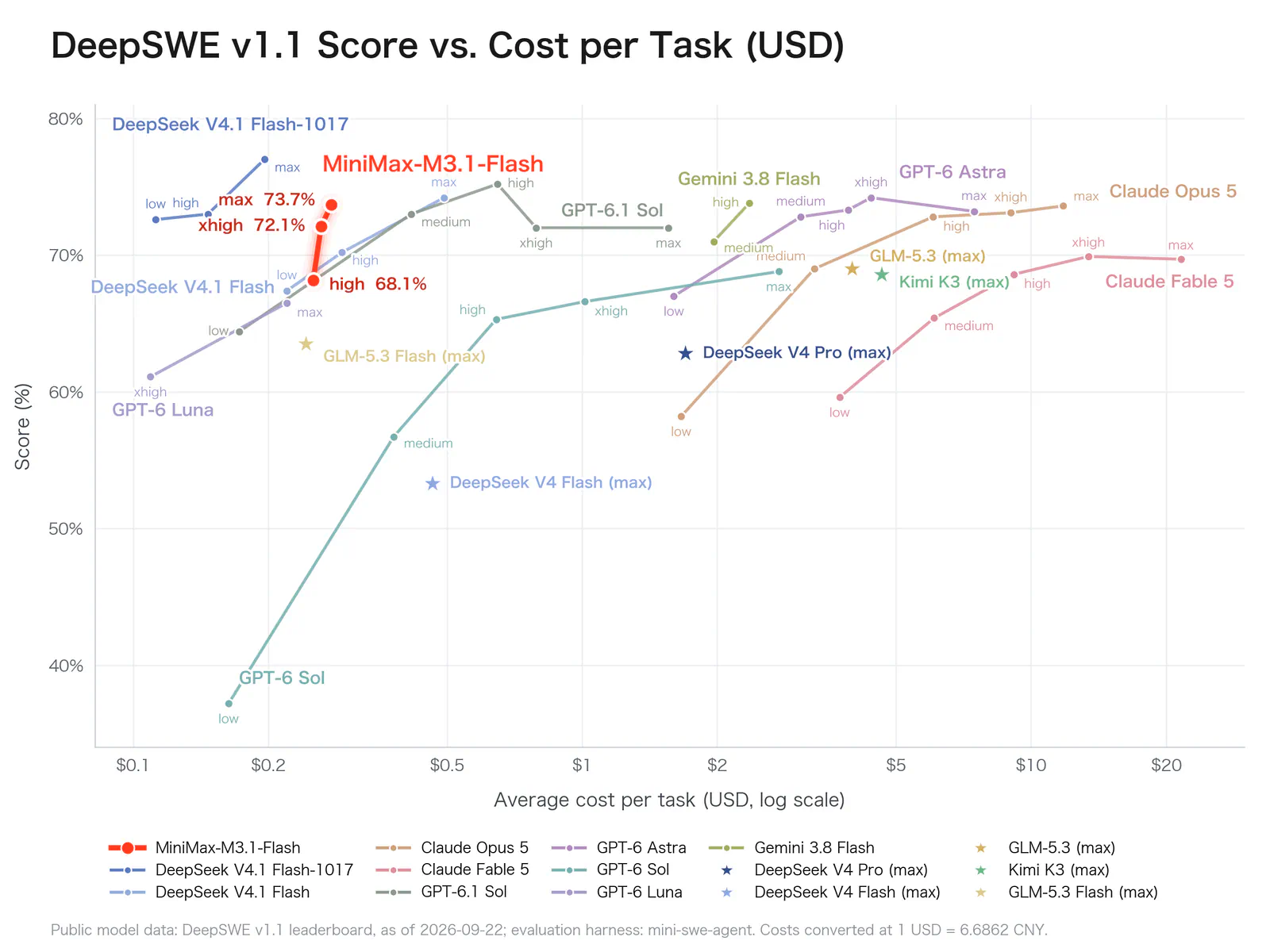
| DeepSWE v1.1 | 73.7% | Software engineering tasks |
| OSWorld V2 | 61.7 | Computer operation and cross-application tasks |
| Agents’ Last Exam | 29.6 | Complex professional tasks |
| CyberGym | 82% | Vulnerability discovery and validation |
These results appear in MiniMax’s benchmark discussion. The supplied reporting does not establish independently reproduced scores.
Sources
- M3.1 Flash launch announcementminimax.io
- MiniMax model documentationplatform.minimax.io
- Reuters’ launch reportwtaq.com