The story of enterprise AI in 2026 is no longer about which model is smartest. It's about who can afford to keep the lights on.
The industry's shift from flat-rate fees to token-based billing that charges for every line of code generated has become so expensive it is blowing up annual budgets in a matter of months. Uber has already warned employees that it burned through its entire 2026 AI budget in just four months. And now, Microsoft, which has effectively infinite cloud-computing assets, has cancelled a program providing internal staff access to Anthropic's Claude because of the unexpectedly exorbitant cost.
These aren't isolated incidents. They're a pattern, and they're happening fast.
Microsoft Cancels Its Claude Code Pilot
Microsoft began canceling internal licenses for Claude Code, abruptly ending a pilot program that gave its developers and non-technical staff access to the AI-powered programming tool. The initiative originally kicked off in December 2025, when thousands of Microsoft employees were invited to experiment with the AI assistant to speed up their workflows.
It was part of an effort to get project managers, designers, and other employees to experiment with coding for the first time, and sources indicate that Claude Code proved very popular inside Microsoft over the past six months. Popular enough, in fact, to become a problem.
Microsoft is reportedly canceling most internal Claude Code licenses in its Experiences and Devices division by June 30, 2026, and directing thousands of employees working on products such as Windows, Microsoft 365, Teams, Outlook, and Surface toward GitHub Copilot CLI instead.
Rajesh Jha, Executive Vice President of E+D, cited toolchain unification as the rationale in an internal memo, stating that Copilot CLI's value lies in Microsoft's ability to directly shape the product alongside GitHub. That's a reasonable governance argument. But the timing is hard to ignore. June 30 also marks the end of Microsoft's current fiscal year, making license cancellation a convenient means of reducing operational costs for the new fiscal year. Importantly, the discontinuation of Claude Code does not affect Microsoft's other collaborations with Anthropic; Claude models will still be accessible via Copilot CLI and continue to serve within Microsoft 365 and Copilot.
Standardizing on a single agent can reduce cost and risk, but it can also create resentment if the mandated tool lags behind developer-preferred alternatives. That tension is real here. Over the past six months, engineers have increasingly preferred Claude Code in their daily work, while the newly launched Copilot CLI has been largely neglected.
Uber Burned Its Entire 2026 AI Budget in Four Months
Microsoft isn't the only tech giant feeling this. Uber CTO Praveen Neppalli Naga confirmed the company burned through its entire 2026 AI budget in four months, driven by Claude Code adoption that jumped from 32% to 84% of its 5,000-engineer organization.
With individual engineer costs running $500 to $2,000 per month and no FinOps playbook for token-based billing, the story signals a new class of enterprise cost that finance teams across the industry are unprepared for.
Engineers are extensively using tools like Claude Code, with about 11% of Uber's live backend code updates being completely written by AI agents. Engineers were even encouraged to adopt tools such as Claude Code and Cursor, ranking staff on internal leaderboards based on usage. That kind of top-down enthusiasm accelerates adoption faster than any budget model can track. Uber's CTO said the company is "back to the drawing board" on AI budgeting.
AI Software Prices Are Climbing Fast
This isn't just an adoption problem. The underlying cost of AI software is rising sharply. US AI software prices have jumped between 20% and 37%. That increase is compounding the token-billing problem: companies are paying more per token, on top of consuming more tokens than they budgeted for.
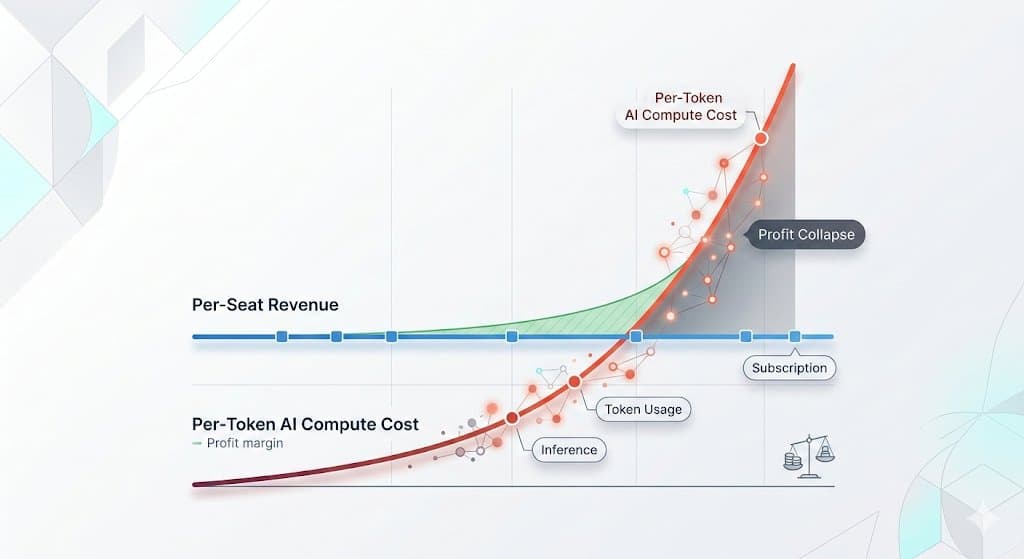
The shift reflects a brutal economic reality that has been rippling across the AI industry. The cost of inference for increasingly sophisticated agentic models has skyrocketed, turning flat-rate subscription plans into money-losing propositions for providers.
The math is straightforward. Agentic workflows, where a model autonomously inspects a codebase, writes tests, diagnoses failures, and iterates across sessions, consume orders of magnitude more compute than a simple chat prompt. GitHub's own blog post on changes to individual plans noted: "It's now common for a handful of requests to incur costs that exceed the plan price."
GitHub Drops Flat-Rate Plans for Token-Based Billing
The clearest structural signal of this shift comes from GitHub itself. Microsoft-owned GitHub announced on April 27 that its flagship AI coding assistant, GitHub Copilot, will abandon its current request-based subscription model and fully transition to a usage-based billing system effective June 1, 2026.
The move, which GitHub Chief Product Officer Mario Rodriguez described as essential for a "sustainable business model," introduces a new virtual currency called "GitHub AI Credits." While the base monthly subscription fees will remain unchanged — $10 for Pro, $39 for Pro+, $19 per user for Business, and $39 per user for Enterprise — the way those subscriptions work is being radically overhauled.
Subscribers will now receive a monthly allotment of AI Credits equal to the dollar value of their plan. Once those credits are exhausted by token consumption across input, output, and cached operations, users must either purchase additional credits or lose access to premium AI features.
The multiplier changes for premium models are significant. Claude Opus 4.7 moves from a 7.5x multiplier to 27x for annual-plan users. GPT-5.4 moves from 1x to 6x. Heavy users of top-tier models will feel this immediately.
User reaction has been sharply critical, with many warning of dramatically higher bills for heavy users. A "Pro at ~$20 / power tier at ~$200" structure has emerged across multiple tools including Cursor, Windsurf, and Claude Code. Even with different metering systems, the market is landing in the same place: a $20/month seat can't fund unlimited agentic compute anymore.
What This Means for Enterprise AI Budgets
The pattern here is consistent. Companies are realizing that giving thousands of employees unlimited access to advanced AI models is blowing through yearly budgets in a matter of months. Providers are moving away from predictable flat-rate fees, shifting to expensive token-based usage models that charge for every prompt and line of code generated.
Token-based billing has created a class of enterprise cost that finance teams haven't modeled. The result, at least for now, isn't AI replacing humans — it's AI making humans more expensive to keep, more strategically valuable to govern, and more central to the actual delivery of work than the replacement narrative would suggest.
For engineering leaders, the practical implication is clear. Under flat pricing, efficiency habits didn't have financial consequences. Under usage-based billing, every prompting decision, model choice, and context size has a measurable cost signal attached to it.
Final Thoughts
What makes Microsoft's move genuinely interesting isn't the cancellation itself. It's the fact that Claude Code became so good, so fast, that Microsoft's own developers preferred it over the company's flagship product. That's a significant internal signal about where Anthropic's tooling actually stands in the developer market, regardless of how the procurement story ends.
The token-billing reckoning was predictable, but the speed at which it arrived wasn't. When Uber's engineers go from 32% to 84% Claude Code adoption in a few months, and individual costs hit $2,000 per engineer per month, no annual budget survives that curve. Finance teams weren't modeling agentic compute consumption because nobody had a baseline for it. Now they do, and it's expensive.
The next few months will tell us whether companies pull back on AI tooling access or accept higher costs as the price of the productivity gains. My bet is most will find a middle path: tighter governance, model tiering, and budget caps at the team level. The tools are too valuable to abandon. The billing is just forcing a discipline that should have existed from the start. What do you think? Are token-based billing models the right approach, or will they slow enterprise AI adoption? Drop your thoughts in the comments.
Frequently Asked Questions
5 questions
1Why did Microsoft cancel its Claude Code licenses?
Microsoft is reportedly canceling most internal Claude Code licenses in its Experiences and Devices division by June 30, 2026, directing employees toward GitHub Copilot CLI instead. The decision is tied to both token-based cost overruns and a push to consolidate on Microsoft's own toolchain.