
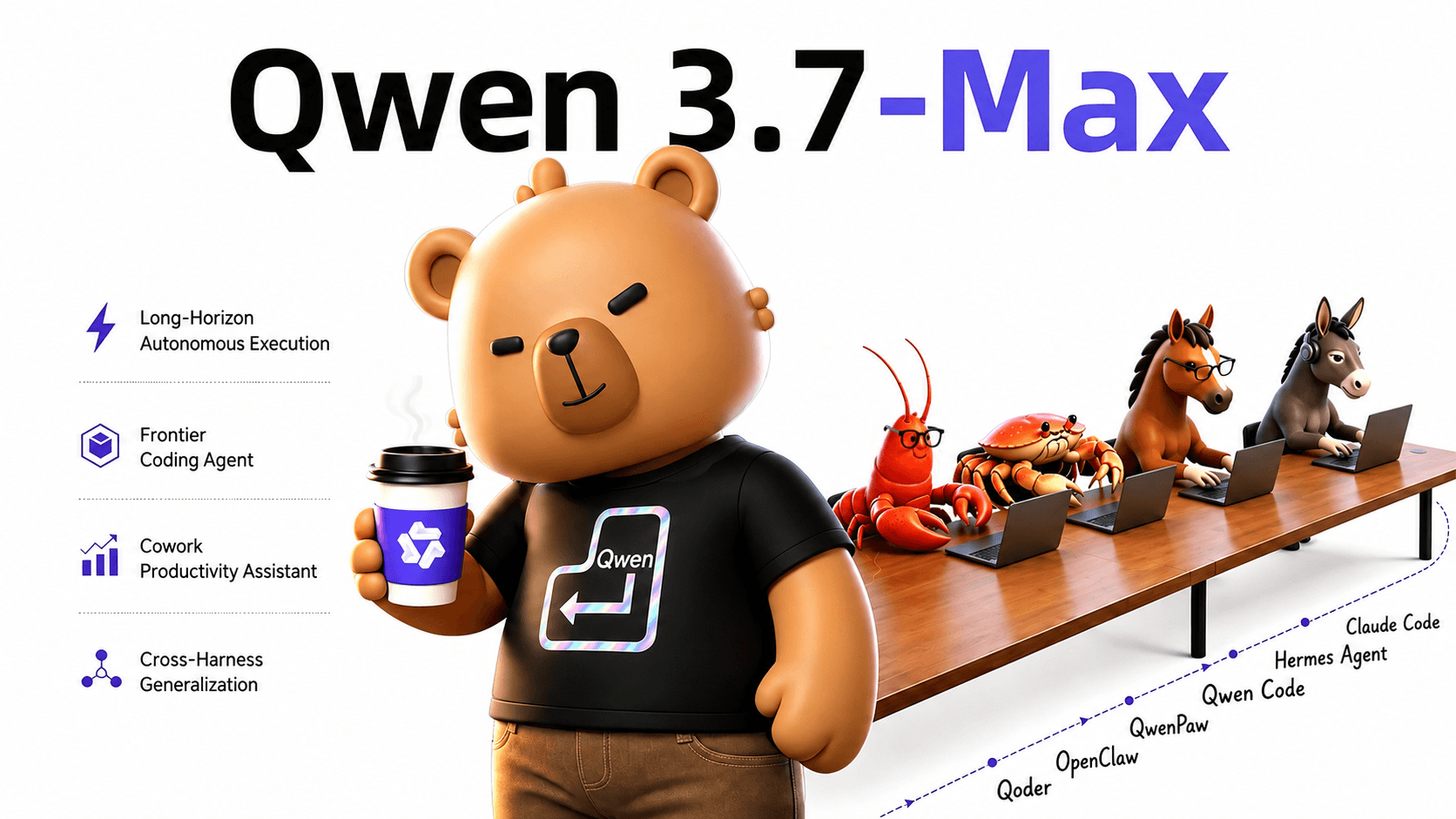
Alibaba's Qwen team formally announced Qwen3.7-Max at the 2026 Alibaba Cloud Summit on May 20. It's a reasoning model built for the agent era: long-horizon task execution, a million-token context window, and a top spot on at least one major intelligence ranking.
The company says Qwen3.7-Max is its most advanced and comprehensive agent model to date, capable of handling coding and debugging, office workflow automation, and long-horizon tasks spanning hundreds or even thousands of steps. The headline claim is hard to ignore: in an internal test on a new chip platform, the model autonomously performed more than 1,000 tool calls and iterative code modifications to optimize a key kernel, with the process running for up to 35 hours of continuous autonomous execution.
Alibaba used the Alibaba Cloud Summit in Hangzhou to launch not one product but three that together form what the company calls a complete "AI factory" stack: Qwen3.7-Max, its new flagship LLM; the Zhenwu M890, a purpose-built AI accelerator developed by its semiconductor subsidiary T-Head; and the Panjiu AL128, a rack-scale server that links 128 M890 accelerators into a single deployable unit.
What Is Qwen3.7-Max?
Qwen3.7-Max is a reasoning model, meaning it works through a problem step by step before answering, rather than producing a response in a single pass. That extended-thinking approach trades a little speed and token cost for stronger results on hard math, coding, and multi-step logic.
The framing throughout Alibaba's messaging is agentic. Qwen3.7-Max is pitched less as a chatbot and more as an engine for autonomous work: writing and debugging code, automating office workflows, and running long task chains with minimal supervision.
Qwen is billing the release as a "proprietary model." It is strictly API-only. Historically, Alibaba's Qwen has been a hero to the open-source and local LLM communities. Previous iterations, like Qwen 2.5 and Qwen 3.6, released their weights publicly. That shift will sting for some developers, but it mirrors the strategy OpenAI and Anthropic have used with their own frontier tiers.
Key Technical Highlights
- The model features a 1M token context window, up from 256K on Qwen3.6 Max Preview.
- Qwen3.7-Max is a text-only reasoning flagship. For multimodal work, the Qwen3.7-Plus-Preview handles vision inputs.
- Qwen3.7-Max was trained across a vast, scaled array of dynamic agentic environments, which Alibaba calls "environment scaling."
- The model has built-in reward-hacking self-monitoring, autonomously detecting when it attempts to cheat a training environment and adding heuristic rules to correct its own behavior.
- It uses explicit chain-of-thought reasoning, which typically improves performance on math and complex reasoning tasks at the cost of higher latency and token usage.
Performance and Benchmarks
Alibaba's latest proprietary flagship scored 56.6 on the Artificial Analysis Intelligence Index, placing it fifth overall and making it the highest-ranked Chinese model on the leaderboard. The score represents a 4.8-point gain over its predecessor, Qwen3.6 Max Preview (51.8), and puts it ahead of Google's Gemini 3.5 Flash (55.3). GPT-5.5 (60.2), Claude Opus 4.7 (57.3), and Gemini 3.1 Pro Preview (57.2) still lead the pack.
Most of the Index gains are concentrated in scientific reasoning, agentic capability, and coding. CritPt rose 9.7 percentage points (3.7% to 13.4%), Humanity's Last Exam jumped 9.2 points (28.9% to 38.1%), and Terminal-Bench Hard climbed 6.9 points (43.9% to 50.8%).
On coding specifically, Qwen3.7-Max ranks #4 out of 117 models in coding and programming benchmarks with an average score of 92.2 on BenchLM's provisional leaderboard.
On the Apex Math Reasoning benchmark, Qwen3.7-Max scored 44.5, eclipsing Claude Opus-4.6 Max's score of 34.5 and DeepSeek V4-Pro Max's 38.3. It also posted dominant scores on Humanity's Last Exam (41.4) and the realistic coding agent benchmark MCP-Atlas (76.4).
One caveat worth flagging: the 35-hour and 1,000+ tool call figures come from Alibaba's internal testing only. No independent verification exists for these specific claims. Treat them as directional signals until third-party replication exists.
Scaffold-Agnostic by Design
One of the more practically useful aspects of this release is how the model handles deployment. One of its most compelling features is "cross-harness generalization." Rather than being hardcoded to work best within a specific proprietary interface, Qwen3.7-Max is built to act as a drop-in intelligence layer for diverse agent frameworks. It supports the Anthropic API protocol natively, allowing developers to plug it directly into existing tools like Claude Code or OpenClaw.
Alibaba confirmed that Qwen3.7-Max is natively optimized for the major CLI agent frameworks developers currently use: OpenClaw, Hermes Agent, Claude Code, Qwen Paw, and Qoder. The design intent is to let a developer run the same model across rapid front-end prototyping, complex multi-file refactoring, and production debugging without switching scaffolding.
Long-Horizon Autonomy in Practice
The model is capable of simulating a one-year lifecycle of a startup in the "YC-Bench" evaluation, navigating hundreds of decision-making rounds encompassing personnel management and contract screening. In this simulation, the model managed to generate $2.08 million in virtual revenue, nearly doubling the performance of the prior generation, Qwen3.6-Plus.
A million-token context window can hold a full mid-sized code repository or a large stack of documents in a single request. Models often reason less reliably as the context window fills. Independent long-context testing hasn't been published yet, so real-world retrieval quality at extreme lengths is still an open question.
One nuance to watch: Qwen3.7-Max currently holds the lowest hallucination rate among frontier models, but partly because it's answering fewer questions. For enterprise buyers, the hallucination improvements are practically meaningful. A model that admits uncertainty is often more useful in production than one that confabulates confidently.
Pricing and Access
As of publication, Alibaba had announced API access for Qwen3.7-Max through its Model Studio platform with availability "coming soon" for developers and enterprises worldwide. You can also try it directly on Qwen Studio.
Pricing for the 3.7-Max API had not been announced at time of publication; Qwen3.6-Max-Preview was priced at $1.30 per million input tokens and $7.80 per million output tokens on Alibaba Cloud. That's a reasonable baseline to plan around until official pricing drops.
Open weights for the 3.7 generation have not been released; QwenLM's GitHub organization and Hugging Face host 3.5 and 3.6 variants but not 3.7.
Final Thoughts
What stands out to me technically isn't the 35-hour run time as a headline number. It's the reward-hacking self-monitoring: a model that detects when it's gaming its own training signal and corrects course autonomously is a meaningful architectural choice, not just a marketing claim. That kind of self-correction under long-horizon pressure is exactly what separates a capable agent from a brittle one.
The closed-weight decision is the real tradeoff here. Training AI models, especially ones as powerful as Qwen3.7-Max, is expensive, and giving them away essentially for free does not immediately help recoup any costs. That logic is sound, but it does mean the developer community that built momentum around Qwen's open releases will need to decide whether API access is enough. For most production use cases, it probably is. For researchers and fine-tuners, it's a real loss.
The cross-harness compatibility is a smart call regardless. Developers aren't going to rip out their Claude Code or OpenClaw setups for a new model. Meeting them where they already work is the right move. Whether the benchmark gains hold up under independent agentic evaluation is what I'll be watching next. Drop your thoughts in the comments below.
Frequently Asked Questions
5 questions
1What is Qwen3.7-Max?
Qwen3.7-Max is Alibaba's new flagship AI model designed for the agent era. It is capable of handling coding and debugging, office workflow automation, and long-horizon tasks spanning hundreds or even thousands of steps.
2Is Qwen3.7-Max open source?
Sources
- Qwen3.7-Maxqwen.ai
- Artificial Analysis Intelligence Indexartificialanalysis.ai
- Model Studioalibabacloud.com
- Qwen Studiochat.qwen.ai


