
Google introduced Gemini 3.5 Transcribe on August 25, 2026, positioning it as a specialized AI model for accurate, low-latency speech recognition. It is available in public preview through the Gemini API and Google AI Studio, with separate options for live audio and prerecorded files.
The headline performance claim is substantial. Google says the model delivers up to 79% lower word error rates for streaming transcription and up to 48% lower rates for non-streaming audio than leading specialized and general-purpose models.
Accuracy is only part of the release, however. Gemini 3.5 Transcribe can also interpret instructions about how a transcript should be produced, allowing an application to clean up disfluencies, organize speech, identify speakers, or adapt its output to a particular workflow.
Live and Recorded Audio Use Different Endpoints
Gemini 3.5 Transcribe is based on Gemini 3.5 Flash, but it is not a single API endpoint serving every transcription scenario. Google provides one model for continuous audio through the Live API and another for recorded audio through the standard generateContent API.
The Gemini 3.5 Transcribe model documentation describes both versions as audio-input, text-output models with support for 91 languages. Their formats, limits, and feature sets differ.
| Mode | Intended Use | Main Limit | Notable Capabilities |
|---|---|---|---|
| Live API | Calls, captions, assistants, meetings | 15-minute sessions | Streaming output, language switching, prompting, tool calls |
| Recorded audio | Interviews, podcasts, media archives | 120 minutes per request | Speaker diarization, word-level timestamps, smart formatting |
The live model accepts raw 16-bit PCM audio at 16 kHz in mono. Applications using browser, mobile, or telephony audio may therefore need to resample or convert incoming streams before sending them to the API.
The recorded-audio version supports WAV, MP3, AIFF, AAC, OGG, and FLAC files. Its two-hour limit is sufficient for many interviews, lectures, and podcast episodes, although longer recordings will still require segmentation. Live sessions present a stricter engineering constraint because they currently end after 15 minutes and do not support session resumption.
Smart Transcription Produces Usable Text
Google’s more distinctive addition is a feature it calls Smart transcription. Instead of always returning a literal stream of recognized words, developers can use natural-language prompts to control how the model handles the audio.
The official audio transcription guide shows that prompts can ask the model to remove filler words, correct obvious false starts, improve punctuation, and organize the result into readable paragraphs. Developers can also supply contextual information, such as expected names or specialized vocabulary, through the prompt.
That could reduce the amount of post-processing required in meeting assistants, customer-support systems, media workflows, and clinical or legal note-taking tools. A recording can move directly from raw audio to a structured document rather than passing through a separate cleanup model.
It also creates an important distinction between verbatim transcription and edited transcription. If the model is instructed to rewrite fragmented speech into polished prose, the result may be easier to read but less suitable as an exact record. Applications in regulated or high-stakes environments should preserve the original audio and clearly label any AI-cleaned version.
For prerecorded files, Gemini 3.5 Transcribe can add word-level timestamps and speaker diarization, which separates dialogue by participant. The live model focuses instead on continuous streaming and can detect when a speaker changes languages during a session. Google says this includes code-switching within a conversation, not merely selecting one language at the beginning.
The Accuracy Gains Need Benchmark Context
Google says Gemini 3.5 Transcribe reduces streaming word error rate by as much as 79% and non-streaming word error rate by up to 48%. Those figures are based on testing reported through Artificial Analysis and cover English, multilingual, short-form, long-form, and noisy audio.
Word error rate, or WER, measures substitutions, deletions, and insertions relative to a human reference transcript. Lower scores are better, but a single average cannot capture every deployment condition.
As of August 27, 2026, the Artificial Analysis non-streaming leaderboard ranks Gemini 3.5 Transcribe first with an AA-WER of 4.3%. Its listed English score is 5.1%, while its multilingual score is 3.8%. The results place it ahead of models including OpenAI’s GPT-4o Transcribe, ElevenLabs Scribe v2, and Speechmatics Ursa 2 on that particular evaluation.
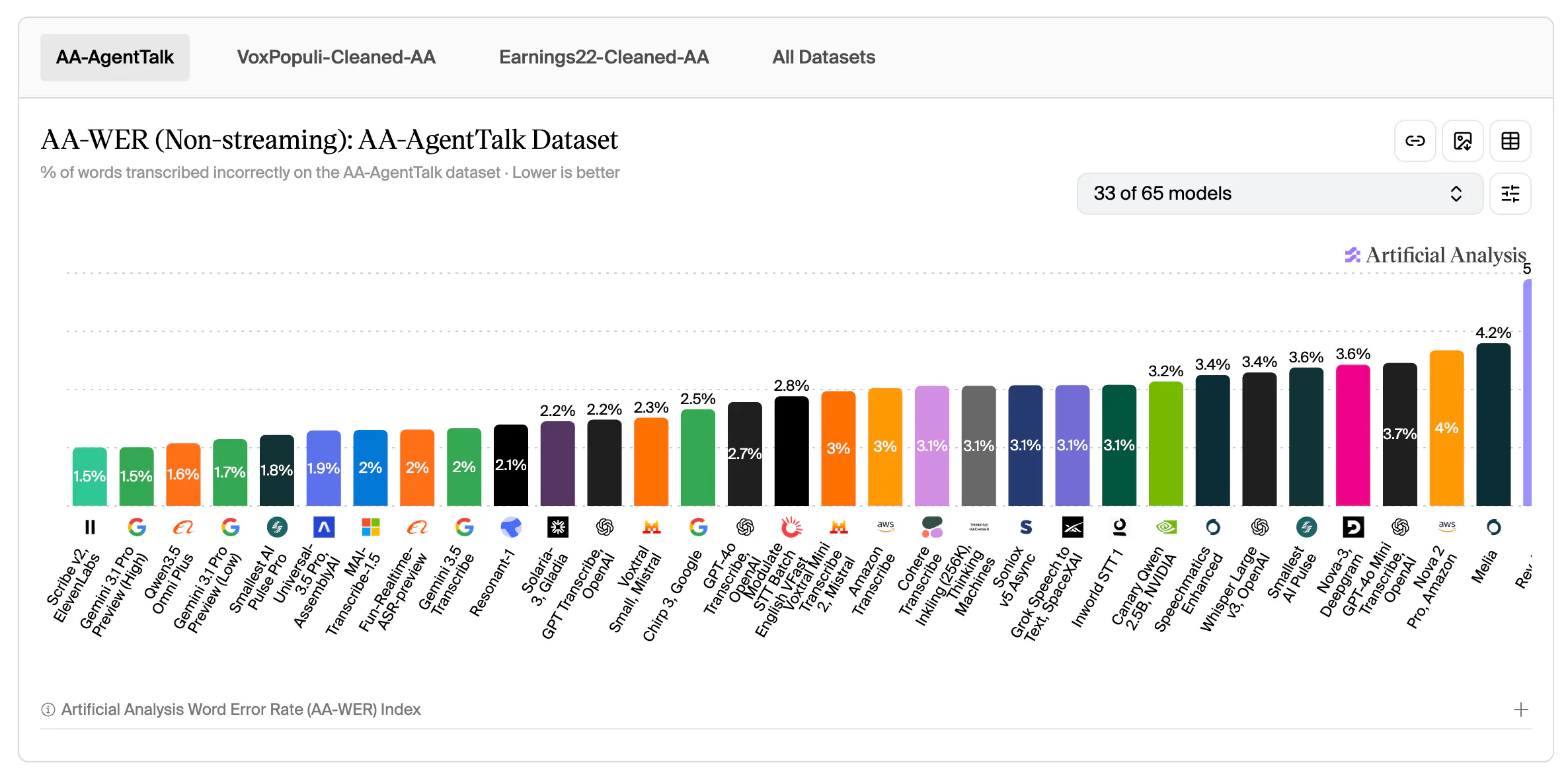
Artificial Analysis calculates AA-WER across five public speech datasets that include conversational recordings, earnings calls, audiobooks, and multilingual speech. Its speech-to-text benchmark methodology is broader than testing on one clean English dataset, but it still cannot reproduce every production environment.
The phrase “up to” also matters. Google is reporting the largest relative improvement found across the tested conditions, not a guaranteed 79% reduction for every recording. Performance can change with background noise, overlapping speakers, accents, uncommon names, compressed audio, and domain-specific terminology.
Streaming systems introduce another tradeoff: a transcript can be accurate after a sentence is complete while still delivering unstable partial results. Developers building subtitles or conversational agents should measure time to the first partial transcript, time to finalization, and how often previously displayed words are revised.
Pricing Makes Large Transcription Jobs Practical
Google’s Gemini API pricing lists Gemini 3.5 Transcribe audio input at $3 per million tokens, which it estimates at approximately $0.006 per minute. Text input and output cost $0.30 per million tokens. There is currently no free tier for either transcription model.
At the published audio rate, transcribing one hour costs about $0.36 before text tokens, storage, networking, and application infrastructure. Processing 1,000 hours would cost roughly $360 in audio-input charges.
That pricing makes the model plausible for large media libraries, voicemail archives, contact centers, and meeting platforms. The final cost will still depend on how much text context an application sends, whether recordings need preprocessing, and how often a live connection must be restarted.
The preview limits deserve attention. A production live-transcription service must account for 15-minute session boundaries, while prerecorded files longer than two hours need to be divided without losing speaker or timestamp continuity. These are manageable constraints, but they prevent the preview from functioning as a completely drop-in replacement for every existing speech API.
Google Is Taking Transcribe Beyond the API
Gemini 3.5 Transcribe is already tied to Google’s own products. The company says the model powers transcription in the Gemini app’s Live and Expressive experiences, while Google Voice is using it to improve voicemail transcription for Workspace users.
Google also named Agora, Fishjam, IntelliTek, Lingopal, Stream, and Vivo among the organizations that tested the model before launch. Their reported applications include real-time communication, meeting intelligence, customer-support transcription, multilingual dubbing, and automated captions.
Those testimonials come through Google’s announcement rather than independent reviews, so they should not be treated as neutral comparisons. They do show the range of workloads Google is targeting: Gemini 3.5 Transcribe is meant to support interactive AI products as well as traditional audio-to-text processing.
What Developers Should Test Before Switching
Leaderboard placement offers a reason to evaluate Gemini 3.5 Transcribe, but migration decisions should be based on audio that resembles the intended workload.
A useful evaluation should include:
- Entity accuracy: Test names, addresses, product terms, numbers, dates, and abbreviations separately from overall WER.
- Speaker separation: Measure diarization on interruptions, overlapping speech, and participants using similar voices.
- Streaming behavior: Record partial-result latency, finalization time, revisions, and connection reliability across session boundaries.
- Language switching: Use genuine multilingual conversations rather than isolated clips in different languages.
- Smart transcription fidelity: Compare cleaned output with a verbatim reference to identify omitted details or unintended changes.
- Operational cost: Include audio conversion, storage, retries, monitoring, and transcript post-processing rather than comparing API prices alone.
Teams should also decide whether they need a readable transcript or an exact record. Smart transcription can be valuable when producing notes, articles, and summaries, but evidentiary archives should retain a literal version alongside any rewritten output.
Final Thoughts
Gemini 3.5 Transcribe is more than a routine speech-recognition update. Its strongest feature may be the combination of competitive accuracy and prompt-controlled output, which brings transcription and document preparation into the same model call.
The public-preview status still matters. Fifteen-minute live sessions, the absence of session resumption, and the need to validate edited transcripts limit how quickly some organizations can adopt it. Google’s benchmark results are impressive, but production audio will determine whether those gains survive outside standardized datasets.
If Gemini 3.5 Transcribe maintains its accuracy across difficult accents, noisy calls, specialist terminology, and long-running live applications, Google will have a compelling foundation for AI systems that need to listen before they can act.
Frequently Asked Questions
4 questions
1What Is Gemini 3.5 Transcribe?
Gemini 3.5 Transcribe is Google’s specialized AI speech-to-text model based on Gemini 3.5 Flash. It supports live audio streams and prerecorded files, recognizes 91 languages, and can follow prompts that control formatting and cleanup. Google released it in public preview through the Gemini API and Google AI Studio on August 25, 2026.


