
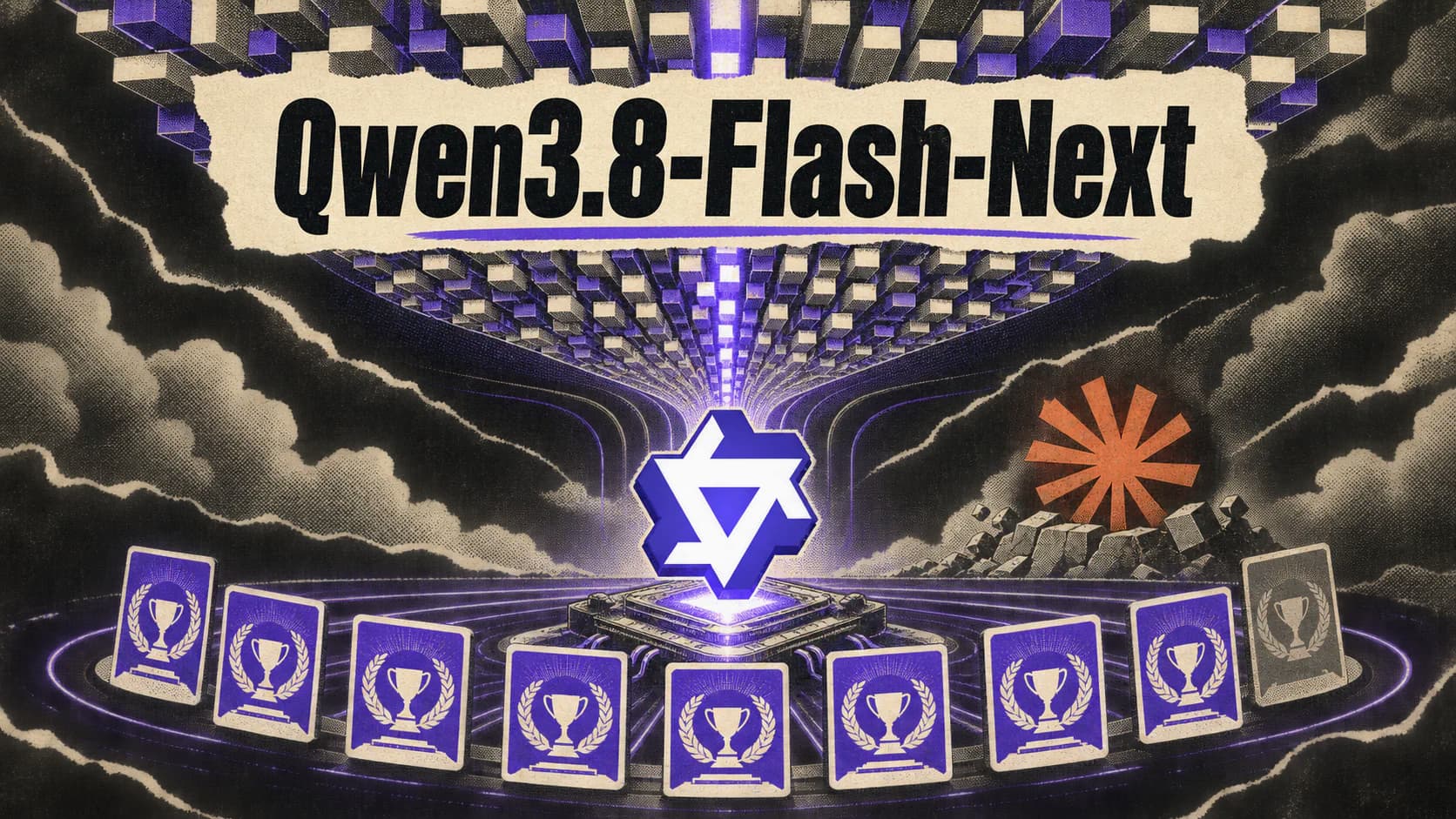
August 26, 2026, delivered two of the year’s most consequential open-weight AI releases. Alibaba’s Qwen3.8-Flash-Next activates only 6 billion parameters per token, while Z.ai’s GLM-5.3-Flash activates 18 billion. Both post benchmark results comparable to proprietary Claude Opus models that recently defined the frontier.
That comparison needs context. Anthropic released Claude Opus 4.8 on May 28, 2026, and replaced it at the top of the Opus line with Claude Opus 5 on July 24. Qwen and GLM have not made closed frontier models obsolete, but they show how quickly frontier-level capabilities are reaching downloadable weights.
Qwen3.8-Flash-Next Trades Storage for Sparse Compute
Screenshot: Qwen.
Qwen3.8-Flash-Next is an experimental preview of the architecture Alibaba plans to use for Qwen4. Its language model contains 125 billion parameters, supplemented by 51 billion n-gram embedding parameters and a 4-billion-parameter multi-token prediction module. The complete Hugging Face model therefore contains roughly 180 billion parameters, even though only 6 billion participate in the main computation for each token.
The architecture combines Gated DeltaNet layers, which compress historical information into a fixed-size state, with Qwen Sparse Attention for retrieving relevant blocks from long sequences. Its n-gram embeddings act as a large lookup memory for common local patterns. Qwen says that table can sit in system memory and be prefetched while the accelerator handles the model’s computational layers.
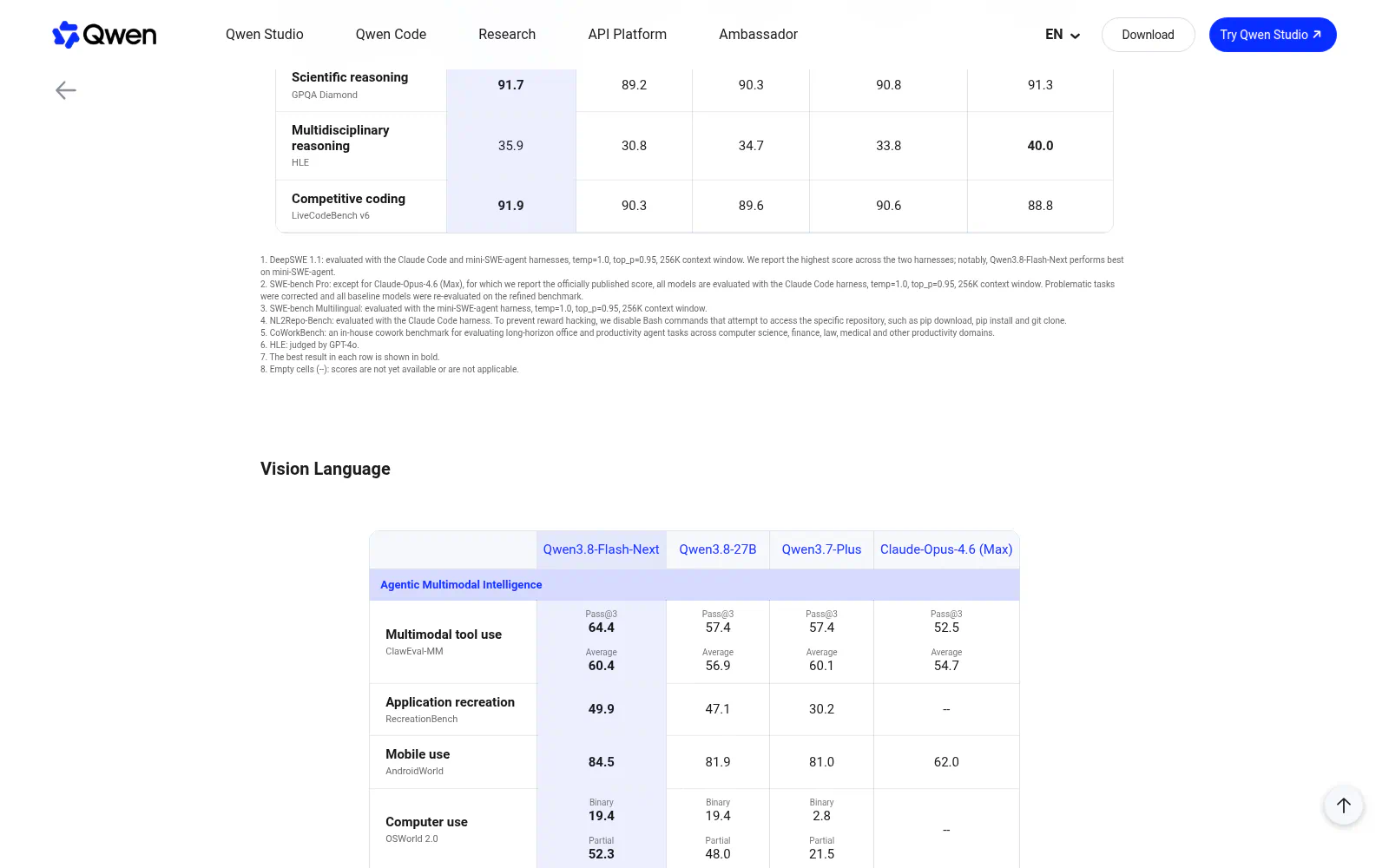
According to Qwen’s evaluation table, the model beats Claude Opus 4.6 Max on eight of the nine language benchmarks where both have scores. Those wins include:
- SWE-bench Pro: 62.5 versus 53.4
- CoWorkBench: 73.9 versus 68.2
- GPQA Diamond: 91.7 versus 91.3
- LiveCodeBench v6: 91.9 versus 88.8
It also leads on SWE-bench Multilingual, NL2Repo-Bench, JobBench, and IFBench. Opus 4.6 retains a clear advantage on Humanity’s Last Exam, scoring 40.0 against Qwen’s 35.9.
Qwen3.8-Flash-Next is multimodal, with text, image, and video input support. One specification requires clarification: the open-weight model is native to 262,144 tokens, not one million. It can be extended to one million with YaRN scaling, while the managed Qwen3.8-Flash service enables that larger window by default.
GLM-5.3-Flash Pushes Open Weights Closer to Opus 4.8
Screenshot: GLM-5.3-Flash: Frontier Intelligence, Flash Cost.
GLM-5.3-Flash scales the same sparse-compute idea further. It contains 320 billion total parameters but activates 18 billion per token. Z.ai reduced the architecture to 45 layers and combined linear attention with sparse global retrieval, lowering attention costs without abandoning access to distant context.
The model is natively multimodal, and its configuration specifies a maximum context length of 1,048,576 tokens. Z.ai says it trained the model on a 30-trillion-token multimodal corpus and added Manifold-Constrained Hyper-Connections to improve information flow during scaling. The GLM-5.3-Flash weights support vLLM, SGLang, TokenSpeed, and KTransformers.
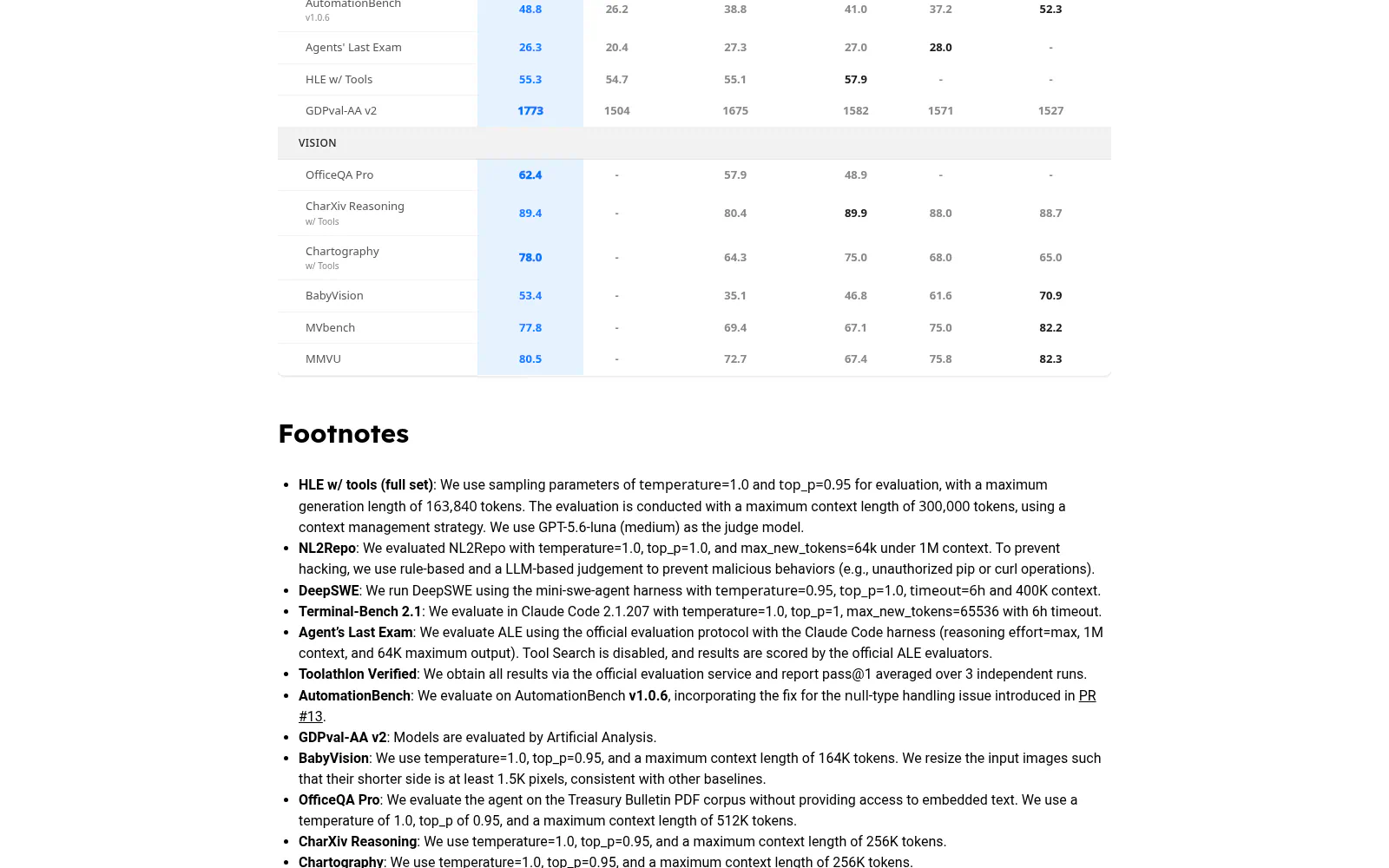
Z.ai’s launch results place it remarkably close to Claude Opus 4.8 on terminal work while ahead on several agentic evaluations:
- Terminal-Bench 2.1: 84.3 versus 85.0
- DeepSWE v1.1: 63.4 versus 58.0
- AutomationBench: 48.8 versus 41.0
- GDPval-AA v2: 1,773 versus 1,582
- Toolathlon Verified: 78.4 versus 76.2
Independent results add weight to the broad comparison. Artificial Analysis currently gives both GLM-5.3-Flash and Claude Opus 4.8 a score of 57 on its Intelligence Index. Its live GDPval-AA v2 leaderboard places GLM-5.3-Flash at 1,769 and Opus 4.8 at 1,578, slightly different from the launch figures but consistent with the same conclusion.
The Benchmark Wins Still Need Independent Scrutiny
Neither release proves that an open-weight model is categorically better than Claude. Agentic evaluations test a complete system that includes the model, reasoning budget, context limit, tools, prompts, and agent harness. Changing any of those components can materially change the result.
Qwen’s table also mixes evaluation sources. Its Opus SWE-bench Pro figure is Anthropic’s published result, while Qwen and most other models were tested by Alibaba using a refined task set and the Claude Code harness. CoWorkBench is an internal Qwen benchmark, and several evaluations rely on model judges. Z.ai likewise used specific harness versions, six-hour timeouts, and context budgets reaching 400,000 tokens for some coding tests.
The defensible reading is that these models have entered the same general performance tier as recent Opus generations on coding, tool use, and professional work. Reproducible third-party testing will determine how broadly that holds.
Six Billion Active Parameters Is Not a Six-Billion-Parameter Download
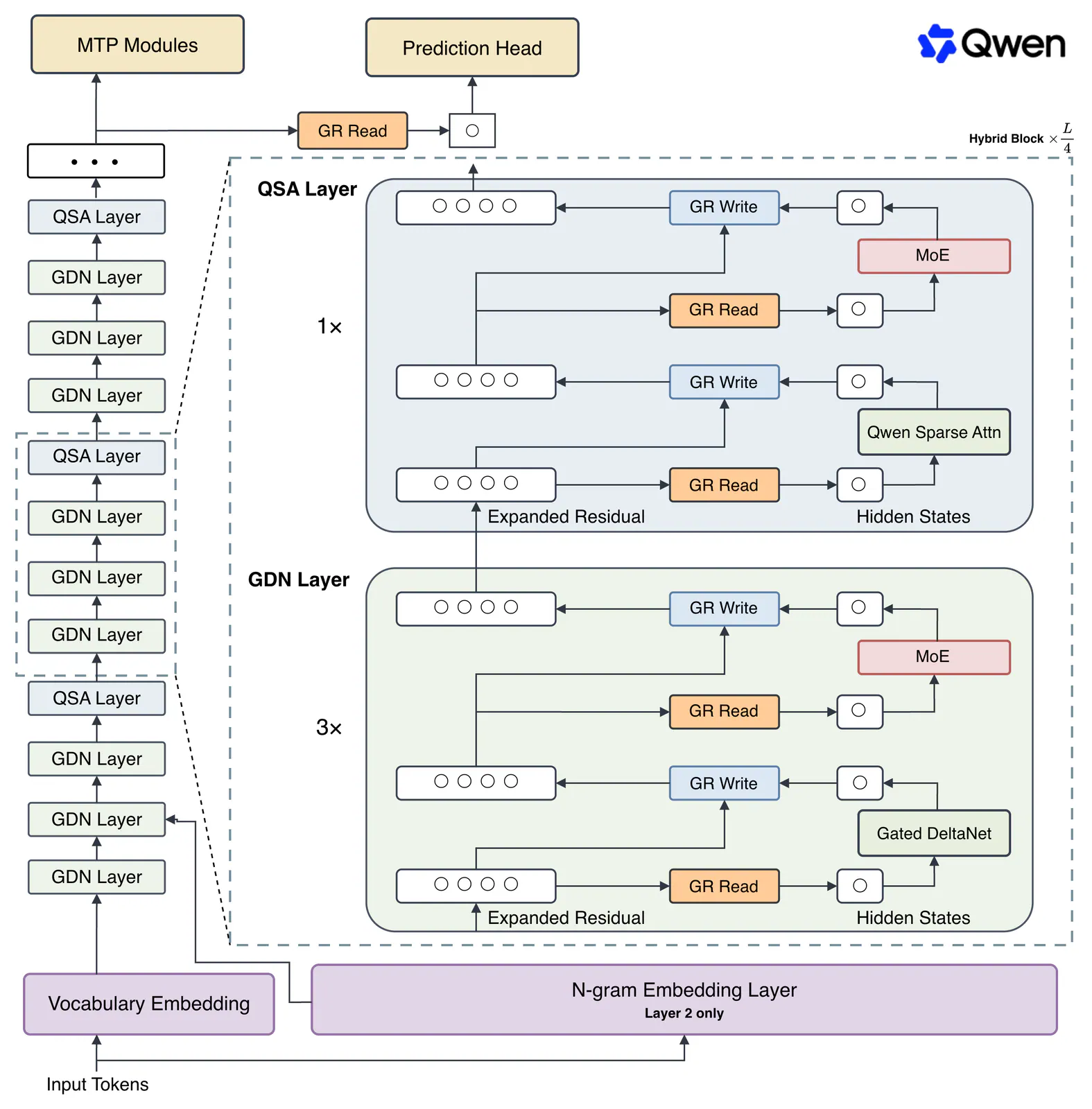
Image: Qwen/Qwen3.8-Flash-Next · Hugging Face.
Active parameters describe per-token computation, not storage. A mixture-of-experts router selects a small subset of the model for each token, reducing matrix multiplication and potentially improving generation speed. The unselected experts do not disappear. Their weights must remain stored somewhere the inference system can access.
The unquantized Qwen repository occupies approximately 360 GB, matching the rough cost of storing 180 billion parameters in 16-bit precision. GLM’s 320-billion-parameter model would require around 640 GB at pure BF16, while its official mixed FP8 release still spans hundreds of gigabytes.
Four-bit quantization produces theoretical weight-only lower bounds of roughly 90 GB for Qwen and 160 GB for GLM. Real deployments need additional capacity for quantization metadata, activations, the vision encoder, runtime overhead, and the KV cache. Trying to use hundreds of thousands of context tokens raises memory requirements further, even with the models’ more efficient attention designs.
“Local AI” therefore means a high-memory workstation, a multi-GPU machine, or a server with substantial system RAM and accelerator memory. A heavily quantized Qwen build may become practical on certain 128 GB or 256 GB unified-memory systems, although speed and quality will depend on the runtime. GLM-5.3-Flash belongs more naturally on a local server or distributed inference cluster. Neither is an ordinary laptop LLM.
Only GLM-5.3-Flash Uses the MIT License
The licensing distinction is important. GLM-5.3-Flash is released under the permissive MIT License, allowing commercial use, modification, redistribution, and hosted deployment subject to the standard notice requirement.
Qwen3.8-Flash-Next is open weight, but it is not MIT licensed. Its Qwen Community License 1.0 broadly permits use and modification, while adding conditions for very large commercial products. It also requires a separate license for certain commercial Model-as-a-Service and AI work-assistant businesses. Developers planning hosted coding or productivity products should review those terms carefully.
The Frontier’s Shelf Life Is Getting Shorter
Claude Opus 4.6 arrived on February 5, Opus 4.8 followed on May 28, and Opus 5 launched on July 24. By August 26, downloadable models were matching or exceeding the first two on selected agentic benchmarks. That does not erase Anthropic’s current lead, but it shows that a closed model’s performance advantage may now diffuse into open weights within months.
Demand is visible too. Z.ai tested GLM-5.3-Flash anonymously as ox-alpha before launch, and the model became one of OpenRouter’s most heavily used coding models. Free, near-unlimited access clearly helped drive that volume, so it should not be mistaken for paid demand or a quality ranking. It still shows how quickly developers will adopt a capable model when it offers long context, tool support, and standard API compatibility.
For U.S. frontier labs, the warning is less about losing one benchmark and more about losing control of the ecosystem. Open weights let organizations keep sensitive data on their own infrastructure, modify the model, build specialized versions, and avoid dependence on a single API provider. Closed labs can still compete through better models, easier deployment, safety work, and lower total operating costs. They can no longer assume that recent-frontier intelligence will remain scarce.
Final Thoughts
The achievement here is not that everyone can run Claude-class AI on a MacBook. They cannot. It is that organizations with serious but attainable infrastructure can now download models operating near the level of proprietary systems that led major evaluations only months ago.
GLM-5.3-Flash offers the cleaner licensing story, while Qwen3.8-Flash-Next presents the more unusual architectural experiment through its 51-billion-parameter n-gram memory. If independent testing confirms the launch results, August 26, 2026, will mark the point when recent-frontier AI became something companies could realistically own, inspect, and operate for themselves.
Frequently Asked Questions
4 questions
1Can Qwen3.8-Flash-Next run on a normal laptop?
No, Qwen3.8-Flash-Next is not designed for a normal laptop. Its BF16 weights occupy about 360 GB, and even a four-bit quantization has a theoretical weight-only size near 90 GB. Runtime overhead and context memory add more, making a high-memory workstation or local server the realistic target.


