

TypeSafe introduced Jev on September 15, 2026 as the first example of what it calls a System One Model. Jev doesn’t write articles, hold conversations, or generate code. It receives context, answers predefined questions, and attaches probabilities to those answers.
That restricted job is central to TypeSafe’s claim that Jev can run 40 to 200 times faster than frontier large language models on comparable decision workloads. A DataCamp analysis of Jev gives the slightly broader range of roughly 20 to 200 times, depending on the model and test being compared.
These figures do not show that Jev is a universally faster replacement for GPT, Claude, Gemini, or other general-purpose models. They show that a specialized decision model can avoid much of the computational work involved in generating language. Jev’s real proposition is not “a faster chatbot.” It is an AI component for software that needs rapid, structured decisions rather than sentences.
Jev Is an AI Decision Engine, Not a Chatbot
Most commercial LLMs expose a text interface. Even when an application needs a simple classification such as approve or reject, the model still processes the request as a language-generation task. Developers then constrain, parse, validate, and sometimes retry its response.
Jev changes that contract. Its API revolves around two inputs:
- State: The shared information Jev should consider, such as a customer record, transaction history, support ticket, or operational report.
- Questions: One or more typed decisions to make from that state.
A question can ask for a Boolean answer, a choice from an allowed set, or an estimate within a defined numeric or temporal range. Jev returns the selected value with a probability distribution rather than an open-ended explanation.
For example, a support system could provide one ticket as state and ask Jev to determine its department, urgency, escalation requirement, churn risk, and expected resolution time. All five results would arrive in machine-readable forms that application code already knows how to handle.
This makes Jev closer to an inference or decision layer than a conversational assistant.
| Capability | Frontier LLM | Jev |
|---|---|---|
| Primary output | Generated tokens | Typed decisions |
| Output length | Variable | Bounded by the question type |
| Uncertainty | Often expressed in text | Returned as probabilities |
| Open-ended writing | Yes | No |
| Multiple decisions | Usually prompted as one generated response | Designed for parallel questions |
| Best fit | General reasoning and content generation | Repeated decisions inside software |
The tradeoff is deliberate. Jev gives up the flexibility that makes LLMs useful across thousands of unrelated tasks. In return, it offers an interface better aligned with automation.
Typed Decisions Replace Generated Text
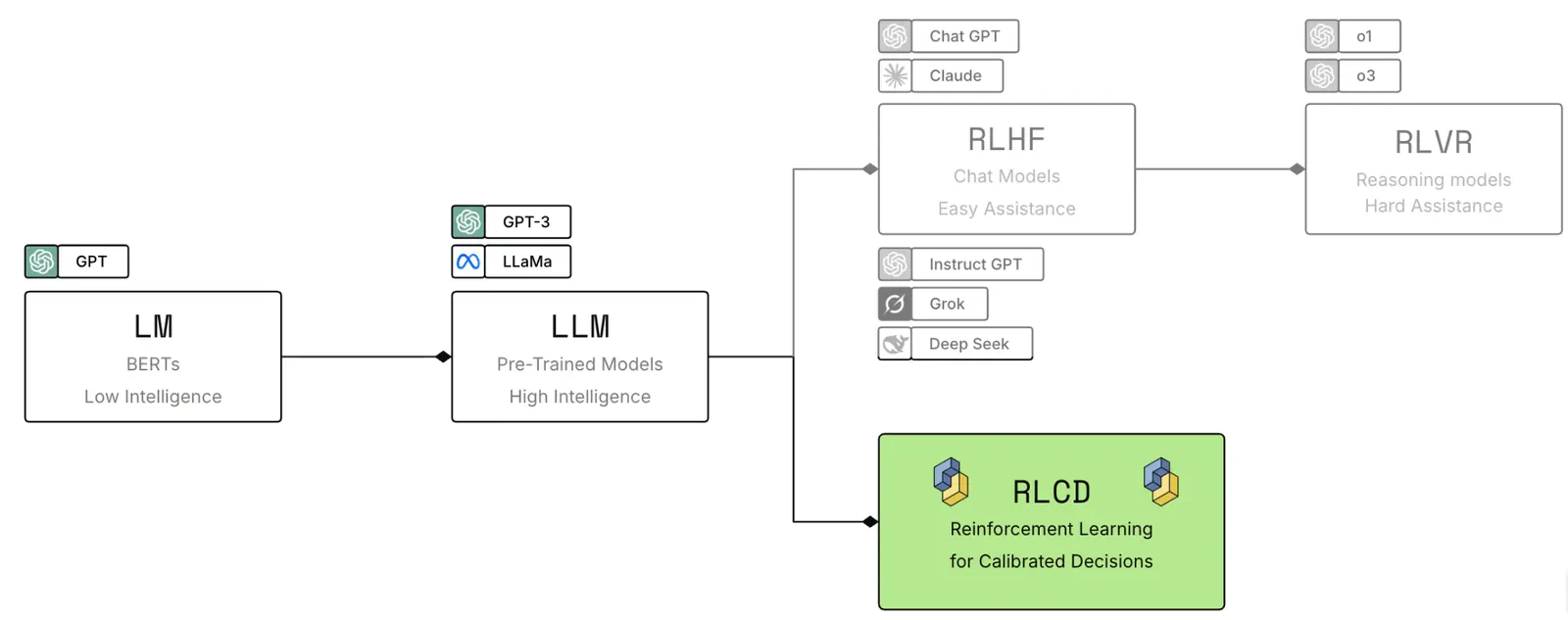
TypeSafe calls its training approach reinforcement learning for calibrated decisions, or RLCD. Its technical primer on decision-model training contrasts that objective with reinforcement learning from human feedback, which typically optimizes an LLM’s generated responses for human preferences.
Jev is instead trained to return decisions and probabilities. A well-calibrated model assigning 70% confidence to a group of predictions should be correct on approximately 70% of them under comparable conditions.
That property is valuable in software because the probability can drive subsequent logic. An application might automatically execute decisions above 95%, send uncertain cases to a human, and route difficult requests to a larger LLM.
The typed interface provides another practical benefit: the possible output space is known before inference begins. If a question allows only billing, technical, and sales, Jev cannot create an unexpected fourth department or surround the answer with several paragraphs of commentary.
According to TypeSafe’s Jev API documentation, a request can contain as many as 128 questions. That allows several decisions to reuse the same state instead of repeatedly sending the same background information in separate prompts.
The 40-200x Speed Claim Comes From a Narrower Job
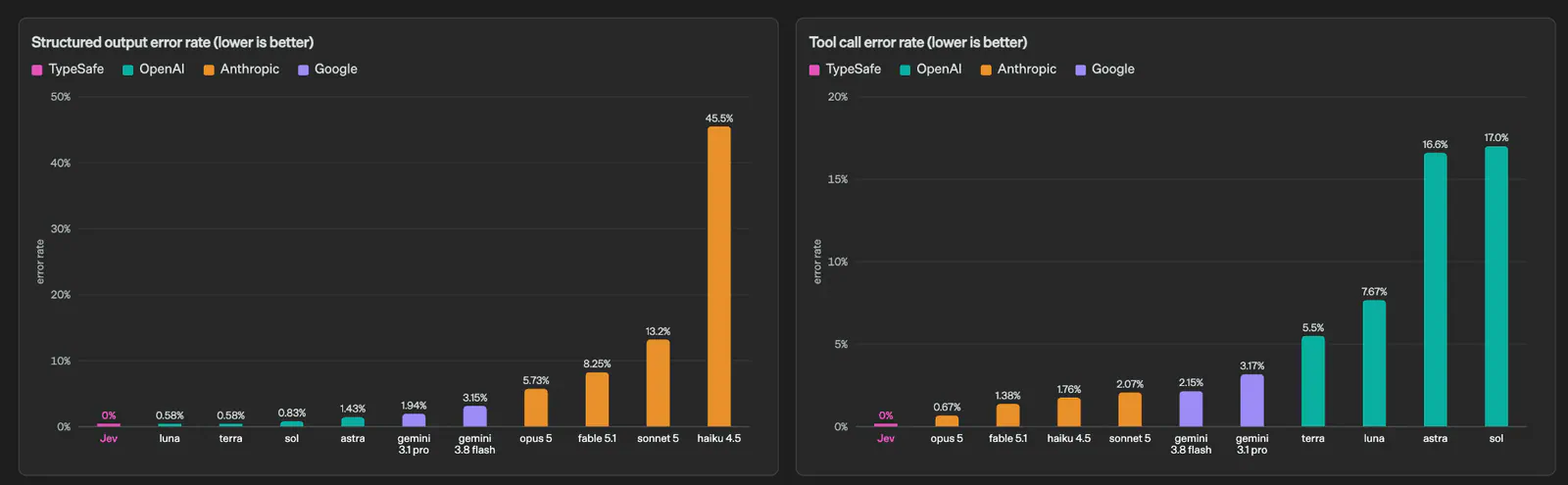
Jev gains speed by removing work that general-purpose language models normally perform.
It avoids variable-length text generation
A conventional LLM produces output sequentially. Each generated token becomes part of the context used to predict the next one. Longer answers therefore require more decoding steps, even if an application only needs a small structured result.
Jev’s output is bounded by the declared type. It doesn’t need to generate an explanation, serialize a large JSON object token by token, or continue until it predicts an end-of-response marker.
TypeSafe has not published enough low-level architecture detail to establish exactly how every internal operation differs from a transformer LLM. Its public explanation focuses on the interface, parallel sampler, and training objective rather than parameter count or implementation internals. The defensible conclusion is that Jev eliminates the variable-length generation loop from the application’s requested output.
It evaluates multiple questions in parallel
TypeSafe says Jev uses a custom parallel sampler that can evaluate questions simultaneously. A general LLM asked for ten decisions will commonly generate those answers as one sequence. Jev is designed to treat them as separate typed outputs derived from shared state.
This distinction becomes more important as the number of decisions increases. One customer record might trigger dozens of predictions, classifications, and estimates. Processing them together reduces duplicated context and avoids repeated API round trips.
It searches a constrained answer space
An LLM can theoretically produce almost any sequence in its vocabulary. Jev knows the permitted output shape in advance. Choosing among four labels is a much smaller inference problem than composing an unrestricted response explaining which label it prefers and why.
The acceleration is therefore partly architectural and partly the result of doing less. That is not a flaw, but it is why the benchmark should not be interpreted as a like-for-like comparison across every AI task.
What TypeSafe’s Benchmarks Actually Show
TypeSafe reports that Jev occupies a better speed-and-cost position than frontier LLMs on its System One workflow evaluations. The company traces its highest published result, about 193.6 times faster and 444.6 times cheaper, to these tests, while acknowledging that those numbers likely represent the upper end of real-world gains.
This explains the two performance ranges associated with Jev. TypeSafe generally describes it as 40 to 200 times faster on comparable System One queries, while DataCamp summarizes the published workflow comparisons as roughly 20 to 200 times lower latency across different baselines.
The evaluations are more sophisticated than asking models isolated multiple-choice questions. TypeSafe represents each automation process as a workflow containing state, dependencies, and several decision nodes. Jev and competing LLMs receive the same workflow, with the LLMs running through a wrapper that forces their responses into compatible structured outputs.
Several caveats matter:
- The reference is not always objective ground truth. TypeSafe measures how closely models match reference probabilities derived from powerful frontier models.
- The workflows were created internally. TypeSafe says they were outside Jev’s training distribution, but also acknowledges that its model-capabilities team produced them and could have introduced bias.
- The LLMs are performing a specialized task through a wrapper. That is a reasonable way to compare structured decisions, but it does not measure their broader capabilities.
- The results are vendor-led. DataCamp analyzes TypeSafe’s published methodology and results; it does not independently reproduce the benchmark.
- Latency depends on the workload. Input length, the number of questions, answer complexity, provider load, and the chosen frontier model can all change the ratio.
The speed claim is consequently plausible within the tested workload, especially when many bounded decisions share one state. It is not evidence that Jev can perform arbitrary language or reasoning tasks 200 times faster.
“No Hallucinations” Is Too Broad a Promise
TypeSafe says Jev “can’t hallucinate” because it returns typed outputs. That statement is accurate only under a narrow definition of hallucination.
Jev should not produce malformed prose, invent a label outside an allowed set, or return an answer with the wrong data type. If an application requests a Boolean, it receives a Boolean decision and probabilities associated with the possible outcomes.
It can still make a bad decision.
A ticket-routing model restricted to billing, sales, and technical cannot invent a nonexistent department, but it can send a billing issue to sales. A numeric prediction can remain within its allowed range and still be inaccurate. Probabilities can also become poorly calibrated when production data differs from the model’s evaluation data.
Typed outputs prevent a major class of integration failures. They do not guarantee truth.
TypeSafe itself treats model capability as uneven. Its documentation on Jev’s performance “jaggedness” recommends identifying difficult questions and routing them to a frontier LLM when they exceed Jev’s preferred complexity range. That hybrid design is more credible than assuming one model should handle every decision.
Where Jev Fits in a Production AI Stack
Jev is most relevant when an application already knows what decisions it needs. Likely workloads include routing, prioritization, risk scoring, eligibility checks, operational forecasts, anomaly assessment, and repeated classifications over shared records.
A practical system could follow this pattern:
- Collect and normalize the relevant state.
- Send several typed questions to Jev.
- Apply deterministic rules to high-confidence results.
- Route uncertain or complex cases to a larger LLM or human reviewer.
- Record outcomes to monitor accuracy and calibration.
Jev is a poor fit when the output itself must be language. It cannot replace an LLM that needs to draft a report, explain a technical issue, write code, summarize documents, conduct open-ended research, or converse with a user.
The more useful comparison is therefore not Jev versus an LLM. It is Jev plus an LLM versus an architecture that sends every task, including simple classifications, to the largest available model.
Jev’s Price and Current Limits
As of September 19, 2026, TypeSafe’s model documentation lists Jev 1.13 at $0.042 per million tokens. The model accepts text and has a documented 64,000-token total context limit, with limits also applying to the state and individual questions.
Jev supports as many as 128 questions in one request and up to 128 choices for a multiple-choice question. The launch remains positioned as early access, so pricing, rate limits, model versions, and access conditions could change quickly.
These specifications reinforce Jev’s intended role. It is designed to process substantial shared context and return many small decisions, not to produce long outputs.
Final Thoughts
Jev’s most important idea is not that a small decision model has defeated frontier LLMs. It is that many AI-powered software features never needed a general-purpose language generator in the first place.
TypeSafe still has work to do before its strongest claims can be treated as established. The public benchmarks are vendor-run, the reference answers are not always objective ground truth, and the company has disclosed relatively little about Jev’s internal architecture. Independent tests of accuracy, calibration, latency, and performance under distribution shift will be more informative than another peak speed ratio.
Even with those caveats, the separation between language generation and machine decisions is useful. If Jev can maintain reliable probabilities in real deployments, its value will come from handling the fast, repetitive layer of automation while frontier LLMs remain available for the difficult cases that genuinely require their flexibility.
Frequently Asked Questions
5 questions
1What is Jev AI?
Jev is TypeSafe’s first System One Model, an AI model designed to return typed decisions with probabilities rather than generated text. Applications provide shared state and predefined questions, and Jev returns Boolean values, classifications, choices, or bounded estimates. It is intended for software automation rather than chatting, writing, coding, or other open-ended generation.
2How does Jev run 40-200x faster than frontier LLMs?
Jev avoids generating variable-length text one token at a time. It works within constrained answer types, evaluates multiple questions in parallel, and reuses shared state across those questions. The 40-200x figure comes from TypeSafe’s decision-workflow evaluations, so it applies to comparable System One tasks rather than every capability of a frontier LLM.
3Is Jev a replacement for large language models?
No, Jev is better understood as a complement to large language models. It can handle frequent, well-defined decisions that do not require generated language, while an LLM handles open-ended reasoning, writing, explanations, and unusually complex cases. TypeSafe’s own guidance supports routing difficult questions to a frontier model instead of forcing Jev to answer them.
4Can Jev hallucinate?
Jev can avoid malformed or out-of-schema outputs, but it can still make incorrect decisions. A typed question prevents the model from inventing an unsupported answer format or label. It does not guarantee that the selected label is correct, that a numeric estimate is accurate, or that the returned probability remains calibrated on unfamiliar production data.
5How much does Jev cost?
TypeSafe’s documentation listed Jev 1.13 at $0.042 per million tokens as of September 19, 2026. The model supports up to 128 questions per request and a 64,000-token total context. Jev is still positioned as an early-access product, so its price, limits, availability, and current model version may change.
Sources
- TypeSafe introduced Jevtypesafe.ai
- DataCamp analysis of Jevdatacamp.com
- AI primer - TypeSafe AIdocs.typesafe.ai
- Jev API documentationdocs.typesafe.ai
- Jev’s performance “jaggedness”docs.typesafe.ai
- model documentationdocs.typesafe.ai


