Meta’s unified image model searches, plans, edits, and composes within one API, with production pricing set at one cent per image.
Last updated on
AI Summary
Meta has launched Muse Image through the Meta Model API, giving developers agentic image generation, editing, and composition for $0.01 per image.
The production model, muse-image-1.0, can research requests with browser and image search, execute code, plan layouts, inspect intermediate results, and revise outputs. One API supports text-to-image generation, single- and multi-image editing, multi-reference composition, and anchored generation. OpenAI-compatible /v1/images and /v1/responses interfaces let teams use the OpenAI Python client, while previous_response_id enables stateful refinements without re-uploading prior images. Meta announced the release on August 26, 2026.
The unified model could replace pipelines spanning segmentation, inpainting, compositing, and consistency tools, but production applications still need validation, safety checks, storage, retries, and review. Developers should test latency, provenance, privacy implications of server-side conversation state, and accuracy for text, charts, QR codes, labels, and prices; Meta acknowledges text rendering can vary between runs.
Meta has made Muse Image available through the Meta Model API at an announced price of $0.01 per image. The release moves the model beyond a research demonstration and gives developers production access to its generation, editing, and composition capabilities.
The unusual part is not another low-cost text-to-image endpoint. Meta describes Muse Image as an agentic model that can research a request, plan its layout, inspect intermediate work, and revise the image before returning the result.
It also consolidates tasks that developers commonly implement as separate pipelines. Text-to-image generation, targeted edits, multi-image editing, and reference-based composition all run through the same muse-image-1.0 model.
Muse Image Brings Agentic Generation to the API
Meta first presented Muse Image earlier in 2026 alongside Muse Video and its Meta Superintelligence Labs research models. The original release focused on the model’s reasoning, tool use, visual quality, and ability to refine its own generations. The new announcement is about availability: developers can now build applications around those capabilities through a hosted API.
Meta announced the production release on August 26, 2026:
The company’s production launch guide identifies muse-image-1.0 as the model developers should call. Meta provides OpenAI-compatible image and Responses API interfaces, allowing teams already using the OpenAI Python client to redirect it to Meta’s endpoint rather than adopt a completely different SDK.
That compatibility does not make Muse Image interchangeable with a conventional image generator. Its internal workflow is closer to an image-focused agent that can decide how to solve a request than a fixed diffusion model that immediately converts one prompt into one render.
Meta says Muse Image plans the visual structure before drawing. For a complicated request, that can include identifying subjects, assigning their positions, working out relationships between objects, and deciding where text or other precision-sensitive elements should appear.
The model can also use tools during generation. In Meta’s original Muse Image announcement, the company described access to browser search, image search, and code execution. These tools are intended to help with requests that depend on factual information or visual references rather than relying entirely on knowledge stored during training.
Muse Image then evaluates its work through iterative passes. According to Meta’s developer guide, the model can make a local correction when one detail is wrong, regenerate more of the scene when the composition fails, or turn to a tool when it needs better factual grounding. Meta says this self-refinement emerged during training because revised images received higher rewards.
There is a useful distinction in Meta’s descriptions. The launch material presents web search as part of the generation process, while the longer technical explanation describes tool use as adaptive, particularly when accuracy is at stake. Developers should therefore treat Muse Image as search-capable and agentic, not assume that every prompt follows an identical, externally visible sequence.
One API Covers Generation, Editing, and Composition
Muse Image exposes several image workflows through one model:
Text-to-image generation creates a new image from a natural-language prompt.
Single-image editing accepts an existing image and an instruction describing the requested change.
Multi-image editing applies one coordinated instruction across several inputs.
Multi-reference composition combines subjects, objects, styles, or environments from multiple reference images.
Anchored generation repeatedly supplies character or location references to reduce drift across an image series.
The editing interface is especially simple. Developers pass an image and state what should change. Meta’s examples include adding an item to a scene, removing a sold product from a listing, changing a displayed price, and retaining everything that was not mentioned in the instruction.
Composition uses the same editing primitive with more than one input. A developer can provide separate images of a subject, an object, and a location, then ask Muse Image to arrange them into a coherent scene. There is no need to route the request through separate segmentation, inpainting, compositing, and consistency models.
That reduces application-side orchestration, but it does not eliminate the need for an application pipeline. Production systems will still require input validation, safety checks, output review, storage, retries, and monitoring. The key change is that the difficult visual reasoning moves into one model call instead of being manually coordinated across several AI services.
The API Is Conversational Rather Than Pipeline-Based
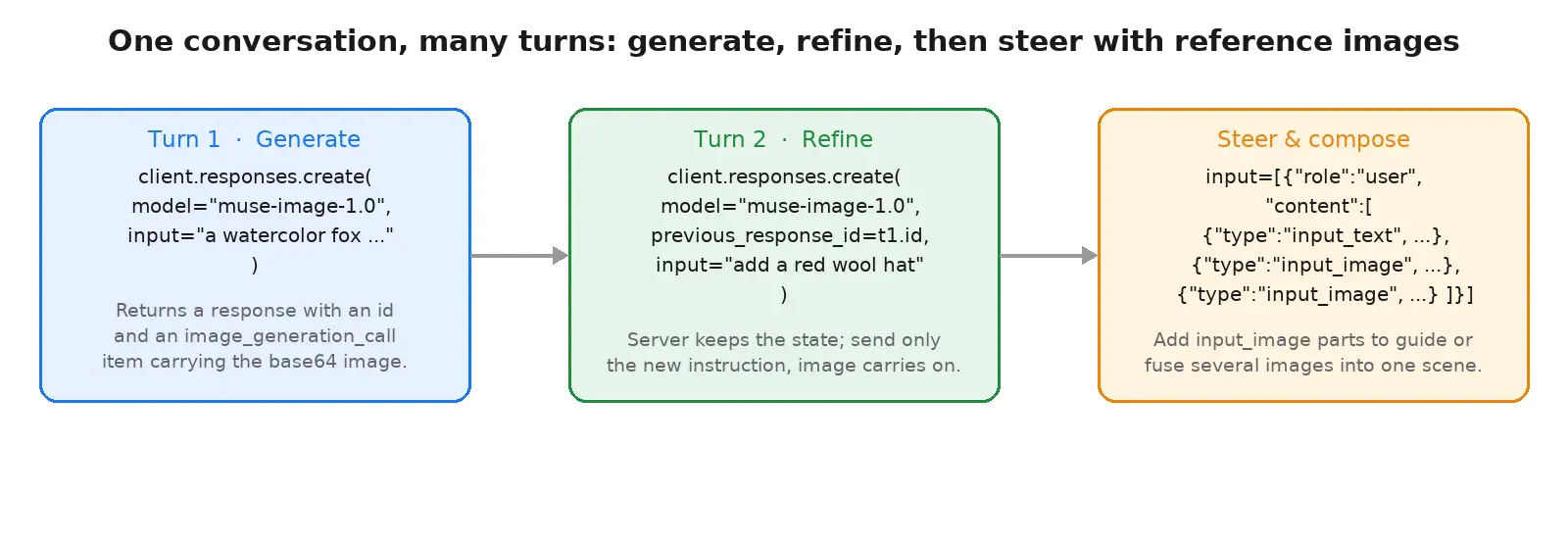
Meta supports both the familiar /v1/images interface and a more stateful /v1/responses workflow. The latter lets an application continue an image conversation by passing a previous_response_id, along with a short instruction describing the next change.
In the official Muse Image API cookbook, one request generates a watercolor fox. A second request adds a hat while retaining the fox and background. A later turn attaches new reference images and composes the existing fox with a mug and flowers. The server carries the earlier result forward, so the application does not need to upload it again.
Responses contain an image-generation result alongside usage information and response identifiers. Reference images can be supplied as public image URLs or base64 data URLs, while images already present in the conversation remain available through the chained response state.
This design should simplify iterative editors, creative assistants, product-listing tools, and storyboarding applications. Teams handling sensitive images should still examine how server-side conversation state fits their retention, privacy, deletion, and observability requirements before adopting the stateful workflow.
Agentic search is most valuable when a prompt needs more than visual plausibility. A generic image of a city can look convincing while depicting the wrong landmark. A polished infographic can still contain incorrect numbers. A QR code can appear valid to a person but fail when scanned.
Meta says Muse Image evaluates prompts for structured elements such as charts and QR codes, then uses reasoning and tools to produce a more precise result. The same approach can help with product labels, signs, diagrams, price tags, maps, or scenes based on real-world references.
Search does not make those outputs automatically reliable. Applications creating charts should verify the underlying data, labels, axes, and proportions. QR codes should be passed through a real decoder before publication. Search may retrieve the correct information while the rendering process still distorts a character, number, or encoded pattern.
Meta’s own development guide acknowledges that text rendering can vary between runs and recommends rerunning unclear labels. That is an important limitation for commerce, advertising, instructional graphics, and any workflow where a small textual error changes the meaning of the asset.
The agentic loop also raises operational questions. Tool-heavy requests and repeated internal revisions could have different latency characteristics from simple image generation. Meta’s launch material establishes the price per image, but developers will need practical testing to understand response-time variance, source provenance, and how often the model’s first output passes production review.
One-Cent Pricing Changes the Production Math
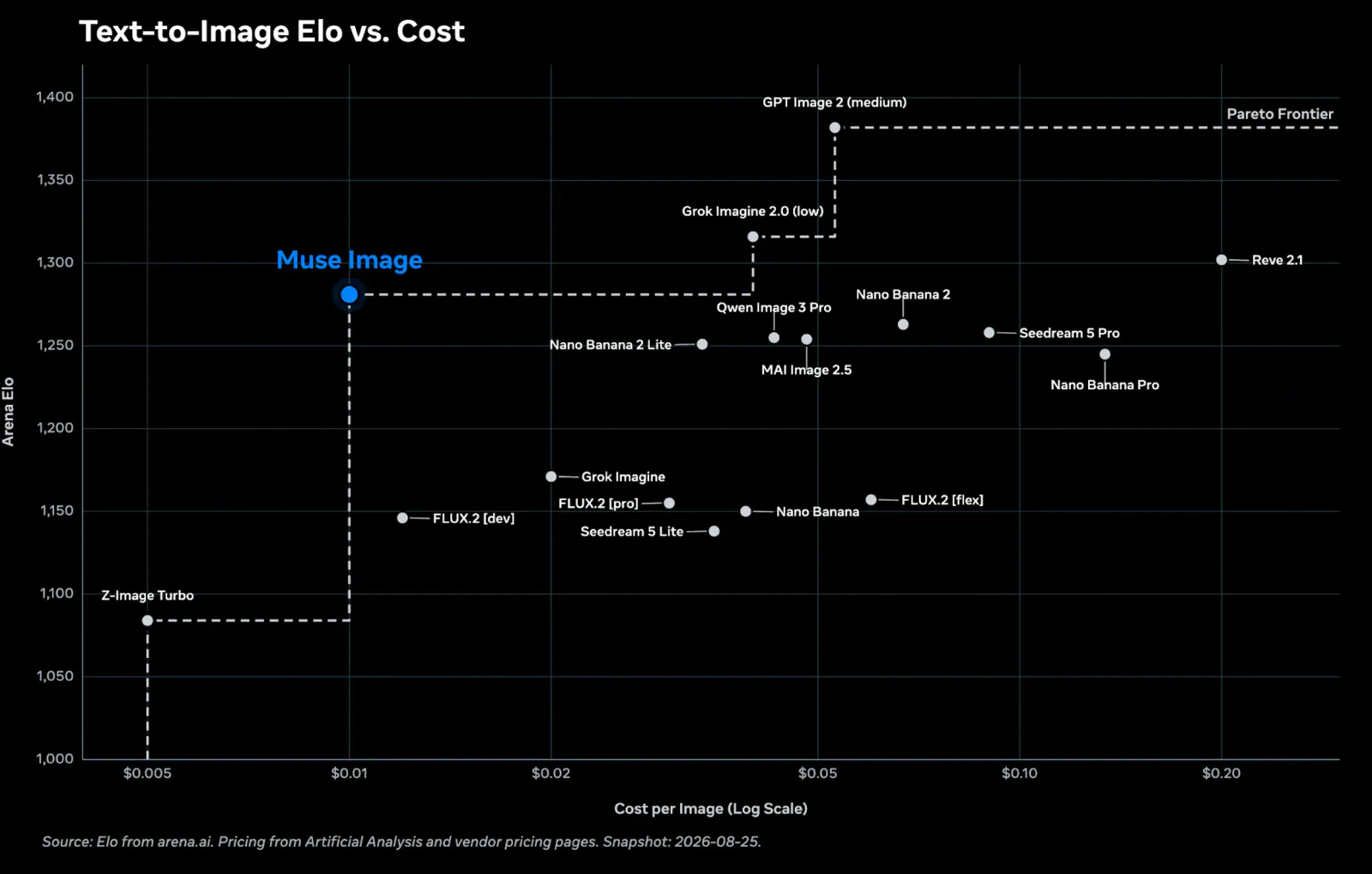
At Meta’s announced price of $0.01 per image, the direct model cost scales predictably:
Generated images
Listed model cost
100
$1
1,000
$10
10,000
$100
100,000
$1,000
1,000,000
$10,000
These figures represent the quoted Muse Image generation price. They do not include an application’s storage, network delivery, moderation, engineering, monitoring, or human-review expenses.
The more useful metric is cost per approved asset, not cost per raw output. If an application generates three alternatives for every accepted image, its effective model cost is three cents. Repeated attempts to fix text, character consistency, or precise layouts can increase that further.
Even so, one-cent generation makes high-volume applications economically plausible. Marketplaces could assemble product listings from seller photos. Creative tools could generate several variations without making every click expensive. Games and educational apps could produce contextual assets on demand.
At this price, model spend may become less important than latency and first-pass acceptance rate. A one-cent image that requires manual correction can cost more operationally than a more expensive image that is immediately usable.
What Developers Should Measure Before Shipping
Meta’s examples demonstrate a broad capability range, but they remain company-selected examples rather than an independent production evaluation. Developers should test Muse Image against the prompts and source images their applications will actually receive.
The most informative measurements include:
First-pass acceptance rate for each major prompt category
Median and tail latency for simple and tool-intensive requests
Preservation of unedited regions during targeted edits
Character and background consistency across a series
Accuracy of text, charts, labels, prices, and QR codes
Retry-adjusted cost per accepted output
Performance with low-quality or inconsistent reference images
A unified model reduces integration complexity, but it does not guarantee deterministic results. Muse Image may decide to edit locally on one run and regenerate more extensively on another. That flexibility is part of its agentic design, although applications that require pixel-level predictability may still prefer explicit masks, locked templates, or conventional graphics code for some tasks.
Final Thoughts
The most consequential part of Muse Image is the combination of agentic behavior and a unified production interface. Web search attracts attention, but the larger engineering benefit is that generation, editing, composition, and iterative refinement no longer need separate model integrations.
The one-cent price will matter only if Muse Image keeps retries and manual cleanup low. If its reasoning produces correct layouts, stable references, and usable edits on the first attempt, Meta has made sophisticated image workflows substantially easier to ship. If structured text and factual graphics still need frequent repair, the inexpensive render will be the smallest part of the production cost.
Frequently Asked Questions
5 questions
1
How much does Meta Muse Image cost?
Meta Muse Image is priced at $0.01 per generated image through the Meta Model API. At that rate, 1,000 outputs cost $10, 100,000 cost $1,000, and one million cost $10,000. Actual cost per approved asset may be higher when an application generates alternatives or reruns images that contain errors.
2
What can Muse Image do in one model?
Muse Image supports text-to-image generation, single-image editing, multi-image editing, and multi-reference composition through the same muse-image-1.0 model. It can also use recurring character and location references to improve consistency across an image series, reducing the need to connect several specialized image models.
3
Does Muse Image always search the web?
Meta’s launch announcement describes Muse Image as beginning with web search, while its longer developer guide presents tool use as an adaptive behavior that can occur when factual accuracy is important. The model is designed to search and use tools during generation, but developers should test whether every prompt triggers the same search process.
4
How can developers access Muse Image?
Developers can access Muse Image through the Meta Model API using the muse-image-1.0 identifier. Meta provides an OpenAI-compatible image endpoint for generation and editing, plus a Responses API for conversational workflows that preserve previous images and allow later instructions to build on earlier turns.
5
Is Muse Image reliable for charts and QR codes?
Muse Image is designed to reason about structured elements such as charts and QR codes, but developers should still validate every precision-sensitive output. Charts need data and label checks, while QR codes should be tested with a real decoder. Meta also warns that text rendering can vary between generations and may require another attempt.