Sponsored content. Zeniteq received compensation for this placement.
The cheapest per-token price is rarely the cheapest project. Teams pick a gateway on the advertised rate, then the invoice arrives with credit-purchase fees, markups on model rates, engineering hours spent operating a proxy, and the cost of one more service sitting in the request path.
The spread is real. An independent comparison of inference providers puts the same model at $0.10 input and $0.50 output per million tokens on one host and $0.35/$0.75 on another, with Together, Fireworks and Groq clustered near $0.15/$0.60 (AI inference platform comparison). Same weights, different bill.
So the useful question isn't which gateway lists the most models. It's who operates the thing after you sign up. That splits the market three ways: a managed router someone else runs and bills, a self-hosted control layer your team deploys and owns, and a single inference host that serves specific models. The options below are sorted on that basis, judged on pricing mechanics, API compatibility for migration, and the operational burden the pricing page leaves out.
1. UberLLM
UberLLM is a managed router with a prepaid balance, not a proxy you run. One API key sits in front of an inference marketplace: third-party model providers and sellers with unused capacity compete to fill each request, and you get one bill.
The catalog spans Claude, GPT, Gemini, DeepSeek, FLUX, Kling and Veo. Text and coding, image generation and editing, text-to-video, image-to-video, speech synthesis, music and sound effects all use the same interface. You pick the model by identifier. Text streams. Media jobs run asynchronously and come back through polling or webhooks, so a video client cannot reuse a chat streaming loop.
Routing, compatibility and the migration test
Routing selects the cheapest healthy seller for the model you named, then shifts the request if that seller slows or drops. That is the failover a hosted router is supposed to give you. Confirm it on the models you call before you treat it as reliable.
Migration rule: if your client already speaks OpenAI or Anthropic, change the base URL and the credentials. The interface patterns stay. Swapping models afterward is a different identifier.
Run that test before anything else. A gateway that forces a client rewrite is a new integration. UberLLM also scopes and revokes keys, encrypts requests in transit, and states that customer traffic serves requests rather than training models. None of that tells you which physical host handled a given prompt.
7. Eden AI
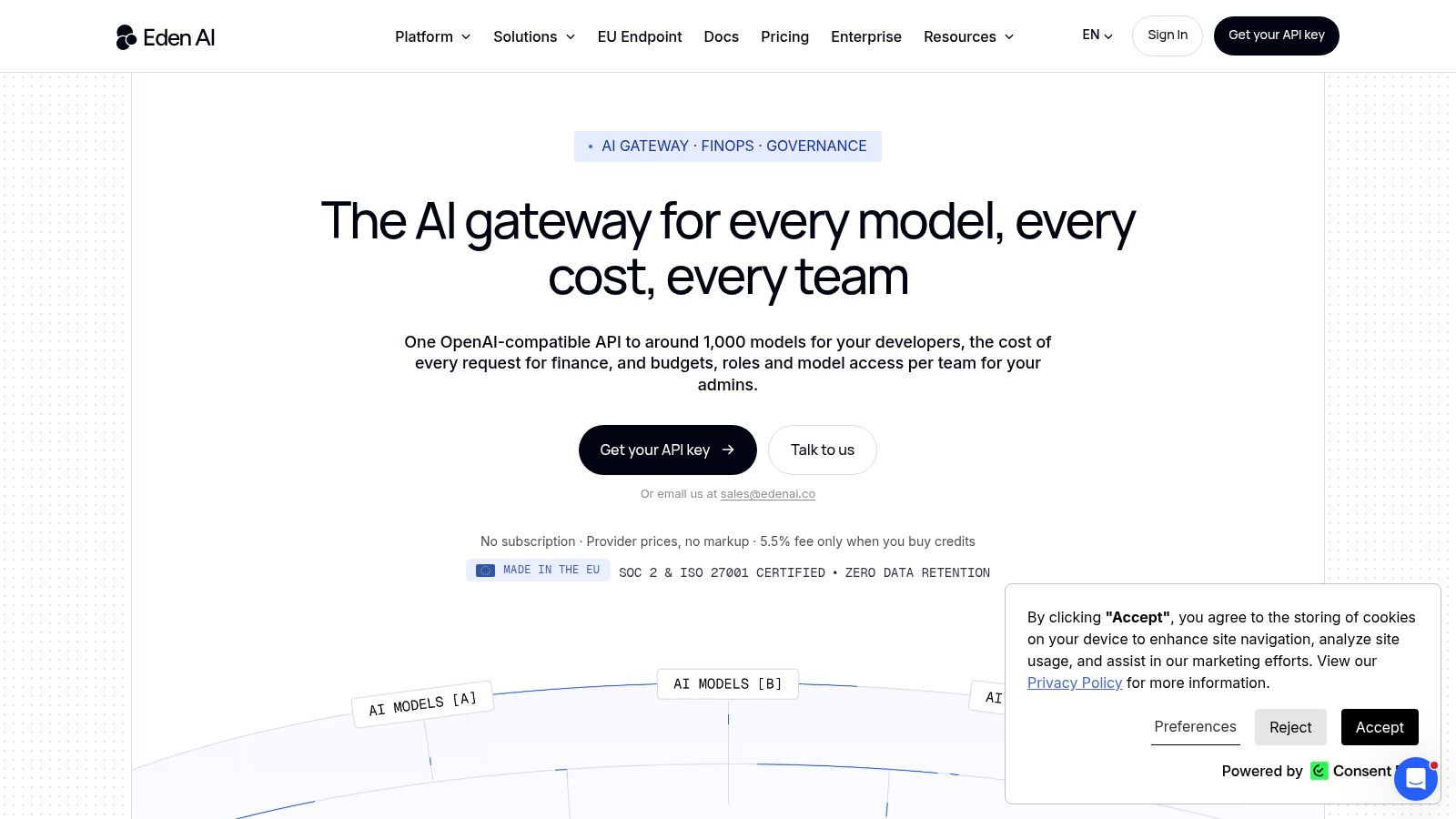
Eden AI is wider than a language-model router. One API covers LLMs plus document parsing, speech, vision, translation and web-related services, which matters the moment a product grows a feature that isn't chat.
For LLM requests it routes among providers by cost or region and applies fallbacks. The catalog lets you compare provider endpoints and prices before committing, and multiple API keys plus cost or performance monitoring sit on top.
The pricing shape is 5.5% platform fee on purchased credits, with provider model rates listed separately. No monthly subscription is shown for the self-service gateway, and an advanced plan is quoted at custom pricing.
That structure suits a team buying a mixed set of AI capabilities in modest volume. It's weaker if you're pushing heavy token spend through LLM routing alone, since a percentage of a large number stays large.
Check before you commit: specialist services and LLM routing don't always share provider constraints or regional coverage. Verify the exact endpoint you'll call, not the category it belongs to.
Pick Eden AI when OCR, translation and speech are on the roadmap next to chat. Pick a focused router if text is all you'll ever send. Eden AI
8. Helicone AI Gateway
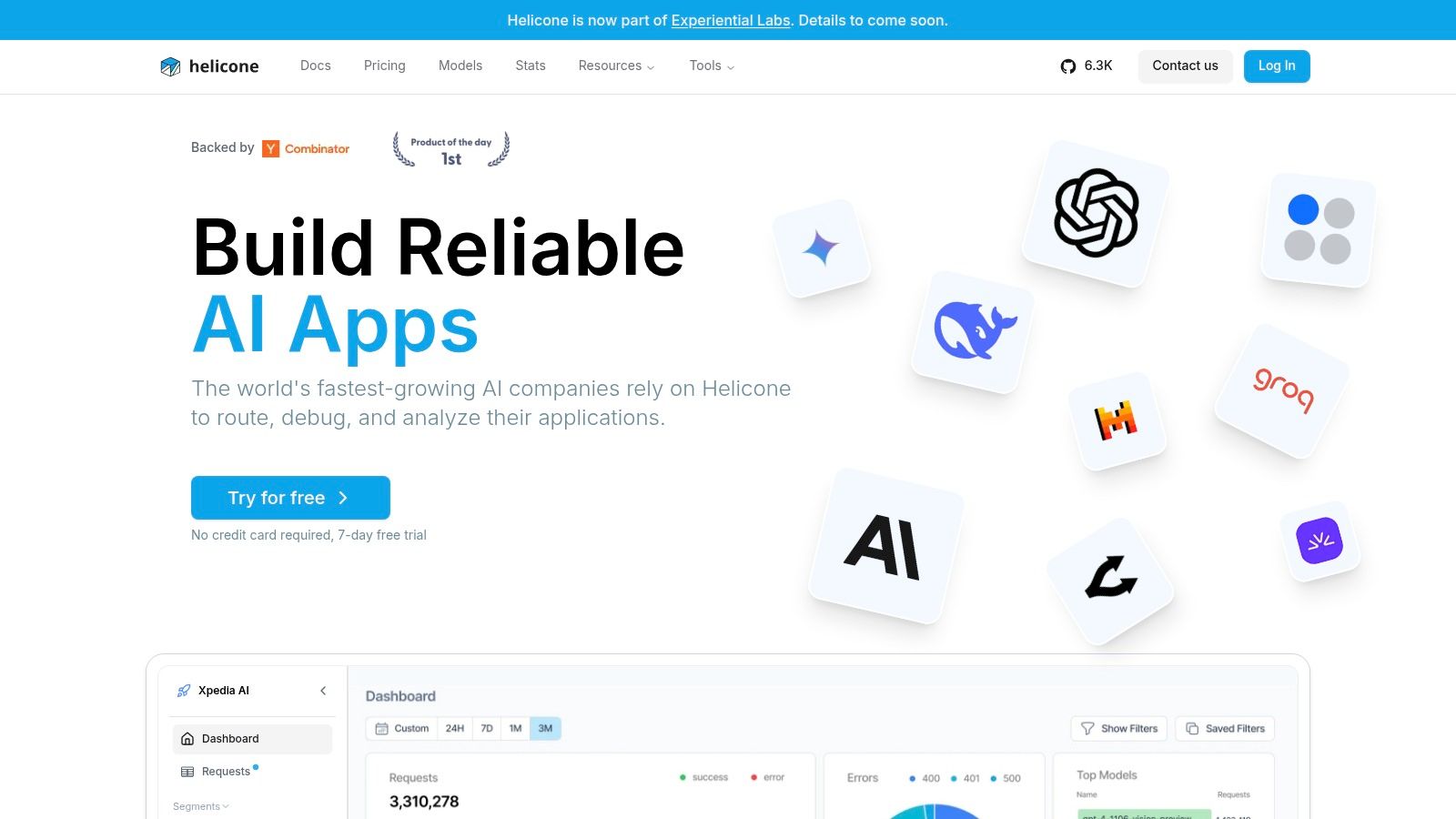
Ranking this one by model count misses the decision. Helicone is a managed gateway whose product is observability: one interface in front of multiple providers, with logging, analytics, caching, rate limits and fallbacks on the path.
Read the plan numbers before the feature list
You are buying a subscription for visibility, not tokens. Published pricing on Helicone lists a free Hobby tier with 10,000 requests, Pro at $79 per month, Team at $799 per month, Enterprise custom, with usage-based charges potentially on top.
That split is the trade-off. Migration is mostly an API swap onto a common interface. The burden the plan page does not price is what the logs hold. Hosted routes and bring-your-own-key routes can store different slices of prompts, response bodies, IP addresses, billing records and abuse-monitoring data, for different periods. Ask the vendor for retention terms, deletion evidence and the subprocessor list before production traffic. A one-line privacy label is not that map.
There is no monthly fee and no minimum. Provider charges pass through without a separate per-request fee. Failed requests and failed generations are not charged, which matters on video, where retries are normal.
The fee hides in the top-up. Card credit additions carry a percentage-plus-flat-fee charge, so buy credits in larger blocks. Several small additions cost more than one larger purchase of the same total, because the flat portion hits every time.
When it's the right pick
Choose it when one key and one prepaid balance across text and media beats four vendor accounts, and when you want hosted routing without operating the router. Sellers listing spare capacity is the piece a conventional gateway does not offer: idle GPUs can be listed and earn when demand lands on them, which is where prices under a single host's list rate come from. The trade-off is opacity. You do not get an SLA that names every upstream provider, and you cannot pin a prompt to a known machine. If the marketplace model is unfamiliar, read the OpenRouter alternatives comparison before you commit a production key. Skip it if either of those constraints is a hard requirement.
2. Vercel AI Gateway
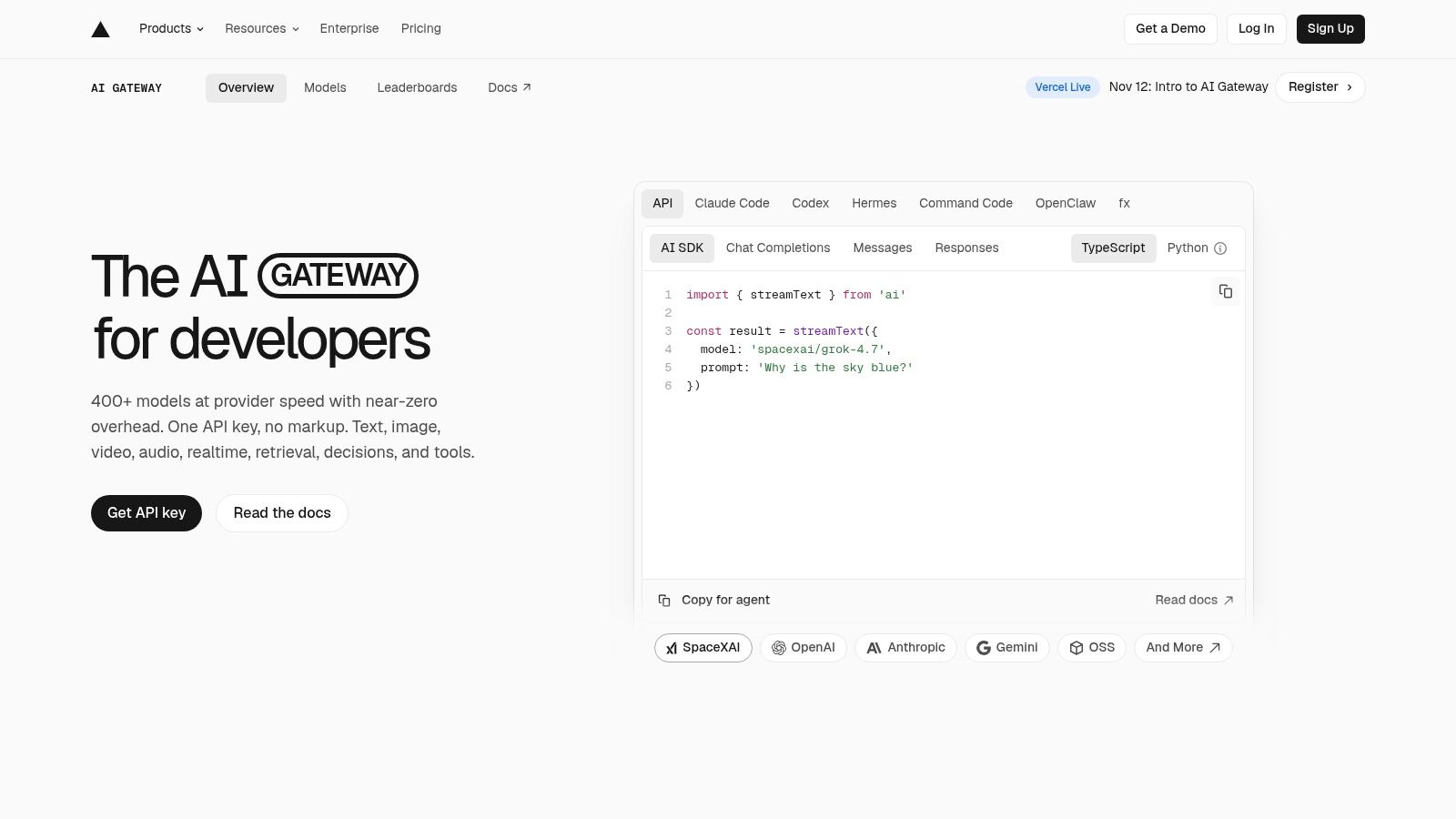
A managed gateway that doesn't mark up tokens is worth a look, and Vercel's pricing documentation says it charges provider list prices with no token markup. The free tier includes $5 in monthly credit, then usage is pay-as-you-go.
It's a router: one API and one bill across providers, failover between providers serving the same model, support for text, image, audio and video, and bring-your-own-provider-keys if you'd rather hold the accounts yourself. It works for applications that aren't hosted on Vercel.
Where it fits:
Next.js and AI SDK teams get the shortest path, since the SDK and the gateway share conventions.
Existing OpenAI or Anthropic clients keep their shape. Base URL and key change; the rest doesn't.
Prototypes can run inside the free credit and produce a real invoice early, which is useful information.
Where it doesn't: the monthly credit is small and everything past it is metered, so cost still scales with tokens. Model availability and routing behavior need verifying on the specific models you depend on, not the headline catalog. And teams outside the Vercel ecosystem, or planning to self-host later, may prefer a hosting-neutral or self-hosted gateway. Details at Vercel AI Gateway.
3. LiteLLM
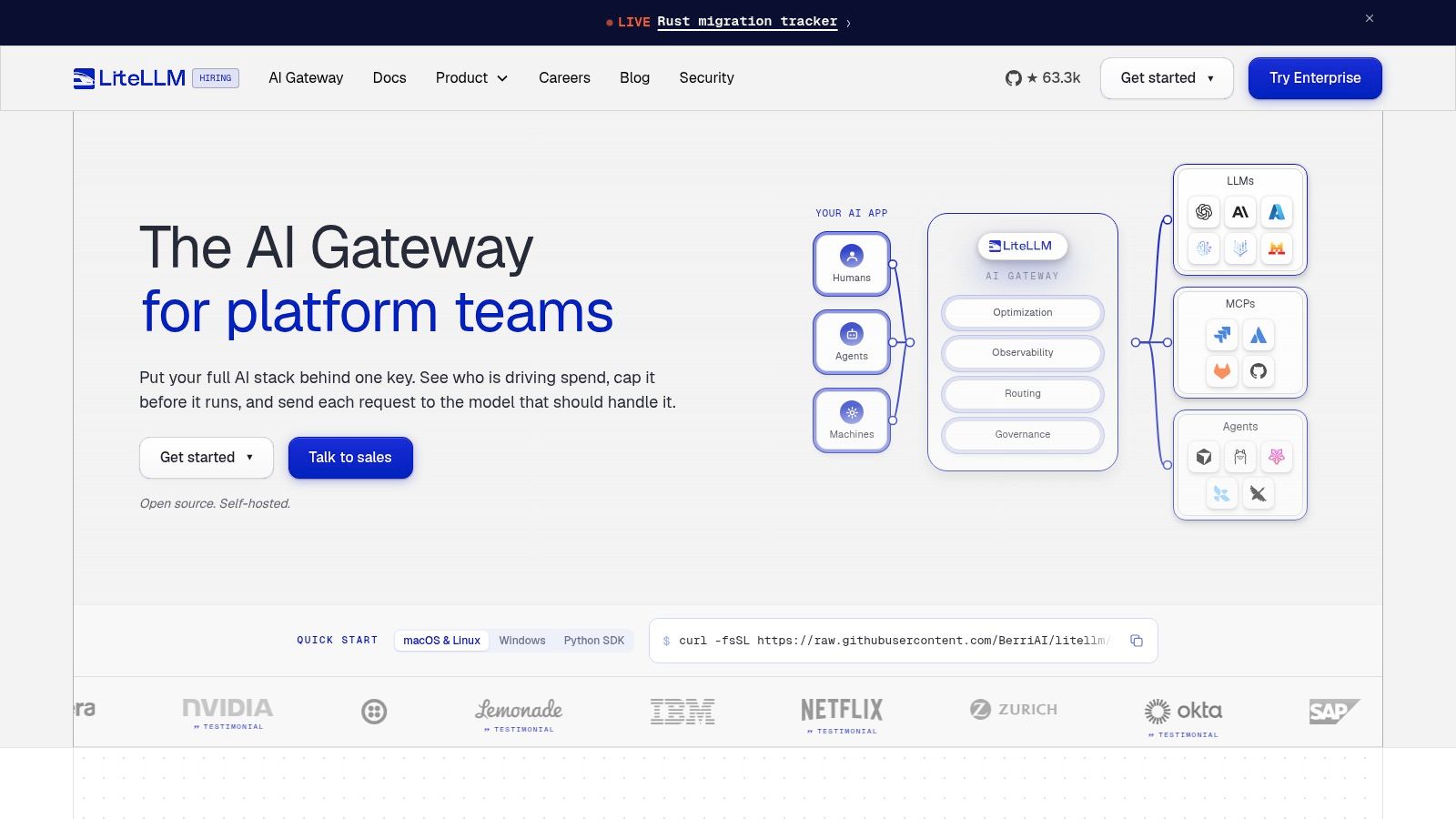
LiteLLM is what you pick when the gateway should belong to you. It's an open-source SDK plus a proxy that puts more than 100 providers behind an OpenAI-compatible interface, deployed on Docker or Kubernetes and wired to your own provider accounts.
Virtual keys, budgets, spend tracking, retries and fallbacks are in the proxy. Adding a provider or changing routing is a config edit, not an application release.
The part the pricing page hides: free software is not a free gateway. You own uptime, upgrades, credential custody and the on-call rotation for a service that now sits in front of every request.
That labor bill is why self-hosting always looks cheaper on paper. A 2026 academic preprint estimates electricity-only self-hosted inference at roughly $0.001 to $0.04 per million tokens, some 40 to 200 times below budget-tier cloud APIs, then says outright that the figure excludes hardware, operations, depreciation, networking and engineering labor (self-hosted inference cost analysis). Apply the same honesty to your gateway math.
Choose LiteLLM when no third party can sit in the request path and someone on the team will own it. Skip it if the team has no appetite for pager duty. Install notes at LiteLLM.
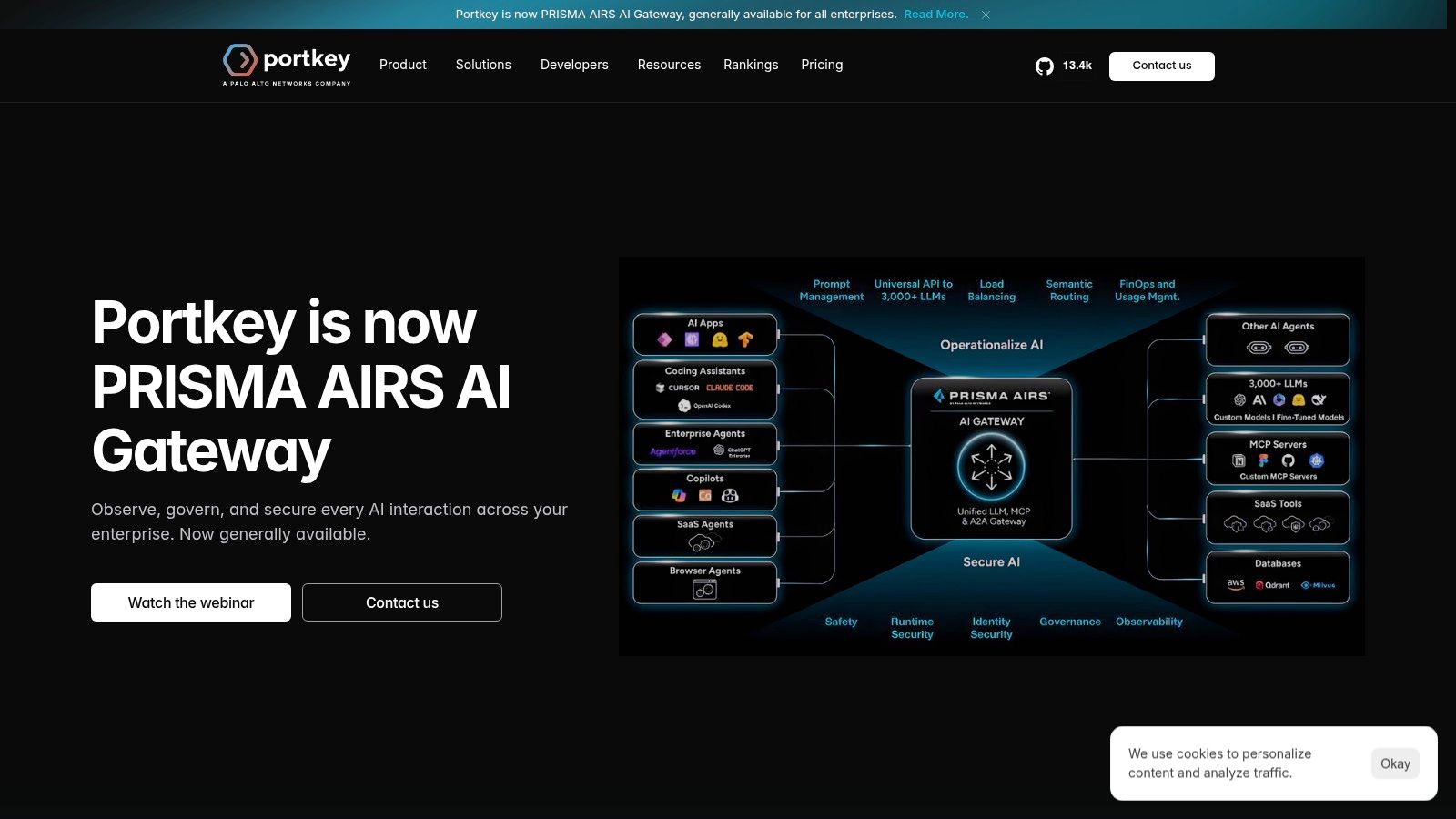
4. Portkey
Portkey sells the control plane rather than the tokens. A common interface to a large model catalog, plus the operational furniture: retries, fallbacks, load balancing, request logging, usage and cost tracking, and governance features including access control and audit-oriented workflows. There's a free tier for evaluation and an open-source gateway.
Reliability is where this category earns its keep. Independent availability tracking recorded 1,454 isolated single-region AI API failures in October 2026, alongside 141 provider-attributed outages and 122 incidents that couldn't be attributed to a provider (LLM latency tracking). Multi-model access doesn't buy resilience by itself. A gateway can be perfectly healthy while the model you selected is degraded or rate-limited.
Test these before you buy:
Fallback quality. Does the backup model produce usable answers for your prompts, or just an HTTP 200?
Retry budgets. Retries multiply latency. Cap them per request and log the ones you burned.
Feature parity. Confirm which capabilities exist in the hosted plan versus the self-hosted gateway.
The extra hop is real, so put it in the latency budget and the outage drill. Portkey suits teams that need governance artifacts and routing policy more than a wide model list. A small project will find it heavier than the problem it solves. Portkey
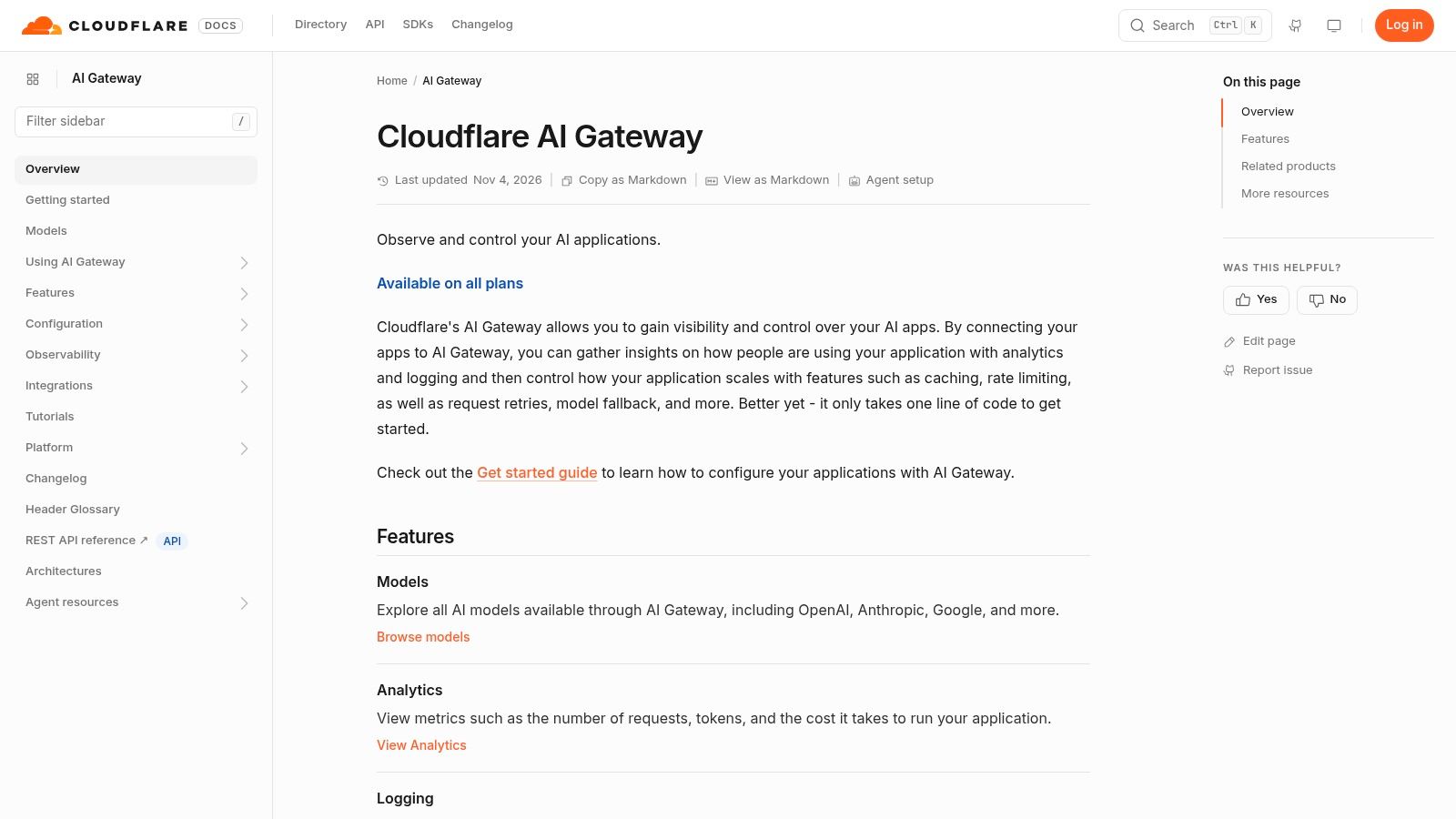
5. Cloudflare AI Gateway
Sorting gateways by model count misses the decision Cloudflare forces. This is a managed hop on an account you already operate, not a proxy you host and not a single inference vendor.
It sits between the app and the providers. Analytics, logging, caching, rate limiting, retries, and model fallbacks come with it, and the same gateway reaches Workers AI and supported third-party providers. You do not run the control layer. You do put Cloudflare account configuration, access control, and billing on the request path. That is little new infrastructure if the account is already there. It is setup cost if it is not.
Two billing routes, two economics
Bring your own provider keys and the core gateway features are free. Unified billing passes through provider inference rates and charges a 5% fee when credits are purchased (Cloudflare AI Gateway). Same product, two cost models. Choose the route before you ship. The fee is a markup on credit purchases, so it scales with spend rather than with seats.
The cache matches requests, not meanings. Two prompts that ask the same thing in different words both reach the provider, and both get billed. Semantic caching belongs in application logic in front of the gateway.
Practical rule: count identical repeated calls first. If retries and fixed system prompts are not a real share of traffic, the cache saves you very little.
Check API compatibility before you rewrite clients around the gateway URL. Confirm the providers you already call are in the supported set. A small app that is not on Cloudflare will spend more time on the account than on routing policy.
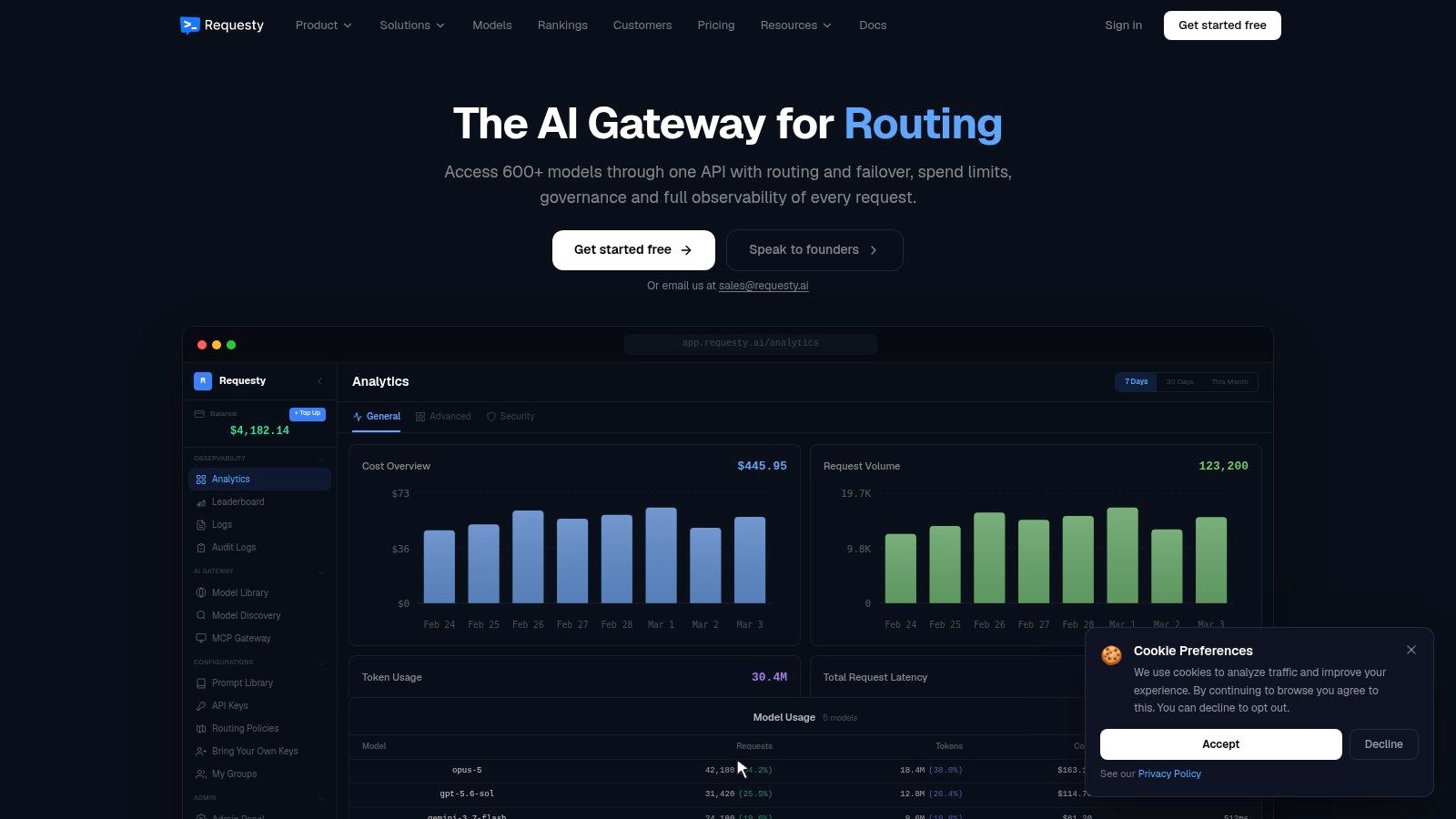
6. Requesty
Requesty publishes its markup, which is rarer in this market than it should be. Pay-as-you-go adds 5% on model costs. The bring-your-own-key option carries no model-cost markup. There's a free tier with access to free models, no per-seat fee and no minimum spend.
The product is a managed gateway: a single API across hundreds of models, configurable routing policies, load balancing, fallbacks, caching, and analytics broken down by key, model or project. Enterprise controls include SSO and role-based access.
What's useful: routing policy lives in configuration, so changing which model serves a request doesn't require an application deploy. That's the line between a gateway and a wrapper.
What to check: 5% is invisible at $200 a month and obvious at $20,000. Run the arithmetic against your own spend before comparing it to a flat control-plane fee or a self-hosted proxy. Confirm model coverage, retention terms and regional processing before customer prompts go through it, because every gateway is one more dependency between your code and the answer. Requesty
Teams actively debugging prompt quality and cost per feature get something they will read. A project that only needs a model endpoint pays to store requests nobody opens. I would take Helicone for the first case and a thinner router, or a single inference host, for the second.
9. Together AI
Together AI isn't a router and doesn't pretend to be. It hosts open-weight models itself, serving them through an OpenAI-compatible API with dedicated endpoints, batch inference and fine-tuning on the same platform.
That changes the decision. You aren't choosing where requests get routed, you're choosing who runs the GPUs. Rates are published per model and per service, cost estimation is straightforward, and the path from serverless experimentation to reserved capacity keeps the same API pattern.
Where it helps: workloads built around models Together serves, teams that want fine-tuning and serving under one contract, and projects that would rather pick one host than maintain routing policy across five.
Where it doesn't: there's no neutral routing across unrelated providers. If Claude or Gemini carries your product, this layer won't give you both. Latency, pricing and availability vary by model and deployment type, and dedicated endpoints need the capacity planning that serverless absorbs.
Treat it as an inference decision rather than a gateway decision, and judge it on cost per completed task rather than catalog size. Together AI
10. Fireworks AI
Fireworks serves models, open-weight ones included, with serverless inference billed per token and dedicated or reserved capacity for steadier throughput. It speaks OpenAI- and Anthropic-compatible APIs, and it will run its serving stack inside your own cloud.
The compatibility detail matters more than it sounds. An Anthropic-shaped client can point at Fireworks without a translation layer, which turns a migration from weeks of client edits into an afternoon of endpoint and credential changes.
The progression it offers: start serverless, measure real throughput, then move steady load onto reserved capacity when the per-token bill stops being the cheapest arrangement. Same economic logic as running your own hardware, without buying the hardware.
The limits: it's an inference platform, not a general gateway routing across unrelated providers. Serverless availability terms differ from reserved-capacity commitments, so read the tier you're buying. Dedicated and bring-your-own-cloud arrangements usually involve setup work and a commercial conversation rather than a checkout page.
Choose it when sustained throughput and one serving stack matter more than catalog breadth. Fireworks AI
11. Novita AI
Novita AI is a hosted model platform. Its catalog runs past 200 models by its own count, the LLM endpoints are OpenAI-compatible, and model pages publish per-model token prices. Image-generation APIs, GPU instances and agent-related services sit alongside.
That combination suits one specific reader: someone who wants a model endpoint and compute from the same account, and who will check each model's terms individually rather than assume uniform behavior across the catalog.
Verify per model:
Availability and rate limits. A model listed is not a model guaranteed at your concurrency.
Data handling. Terms vary by endpoint, so read the one you're calling.
Price movement. Published per-token rates change. Re-read the model page before you budget.
It is not a provider-neutral gateway with broad cross-provider routing, and treating it as one leads to disappointment. Compare it against a specialist host for the models you use, and against a router if your real problem is spreading risk across providers. Novita AI
How the OpenRouter alternatives differ on pricing, free access, hosting, and fit
Item
Pricing model
Free option
Self-hosted option
Best fit
UberLLM
Provider rates; prepaid balance; no per-request gateway fee
No free tier specified
No self-hosted gateway indicated
Multi-provider and media access with marketplace routing
Vercel AI Gateway
Pay as you go at provider list prices
$5 monthly credit
No self-hosted option specified
Managed gateway with unified billing and provider failover
LiteLLM
Free open-source software; hosting and operations are extra
Free open-source software
Yes, self-hosted gateway
Teams seeking control over routing, credentials, and operations
Portkey
Hosted and advanced features are plan-dependent
Free tier available
Open-source gateway; feature availability may vary
Production teams needing routing, observability, and governance
Cloudflare AI Gateway
Core gateway features free; optional billing passes through model rates
Core features are free
No self-hosted option specified
Teams already using Cloudflare infrastructure
Requesty
Free tier; pay-as-you-go adds 5% to model costs; BYOK has no model-cost markup
Free tier with free models
No self-hosted option specified
Teams needing managed routing and spending controls
Eden AI
5.5% fee on purchased credits; advanced plan has custom pricing
No free option specified
No self-hosted option specified
Teams combining LLMs with specialist AI services
Helicone AI Gateway
Subscription plans and possible usage charges
Hobby tier includes 10,000 requests
Managed and open-source options
Teams needing request-level visibility and gateway controls
Together AI
Usage-based pricing varies by model and service
No free option specified
No self-hosted option specified
Workloads focused on Together-hosted open-weight models
Fireworks AI
Per-token serverless pricing; separate dedicated pricing
No free option specified
Customer-cloud serving option available
Teams needing inference with serverless, reserved, or customer-cloud deployment
Novita AI
Model-specific usage pricing
No free option specified
No self-hosted option specified
Teams seeking hosted model inference and related GPU services
Match the Gateway to Who Owns the Operations
Model count is a bad sort key. A catalog of four hundred models does not tell you who gets paged, who owns the invoice, or whether a pinned model stays up.
Three questions settle the choice before a feature list does.
Who runs the gateway? If nobody on your team will, buy a managed, centrally billed router and accept the markup. If nobody outside the request path is allowed, take LiteLLM or another self-hosted control layer. Budget the on-call time in hours per month before you call that a saving. I would not pick self-hosted unless someone already owns deploys, upgrades, and the incident channel.
Who reads the invoice? A card top-up with a percentage fee is easy to start and hard to forecast. A charge on a cloud contract is dull, and often the fastest path through procurement. That is why hyperscaler options persist even when routing is narrower. Global cloud-infrastructure spending reached about $321.3 billion in 2024, and AWS alone passed $100 billion in cloud-infrastructure revenue that year (cloud spending analysis). Finance already knows how to pay that bill.
Which models must stay available? If one model carries the product, a single inference host plus a fallback you have failed over beats a router full of endpoints you have never called. API compatibility still matters here. Fewer lines changed to swap the base URL means less lock-in when that host slips.
Run a two-week trial on the workload that costs you money. Measure effective cost after fees, top-ups, and markups on your real input and output token mix. Measure failover during a genuine upstream incident, including how far answer quality drops. Count the lines of code changed when you swap the endpoint.
If you already own the GPU fleet, stop comparing gateways. NVIDIA shipped NIM in March 2024 as a catalog of more than two dozen models in prebuilt containers, and by June 2024 reported more than 40 NVIDIA and community models available as endpoints (NVIDIA NIM announcement). That is an infrastructure commitment with a different failure mode, not a drop-in router swap.
Before any sensitive traffic moves, get two things in writing: model availability for the exact version you pinned, and the data-handling terms for inference, logging, backups, and support access. A lower fee that adds a month of governance work is not cheaper.
Shortlist two options from the eleven decision paths above. Wire the loser in as a fallback, and run the trial on the workload that costs you money. For a wider set of tools, vendors and the community list products in the Zeniteq AI tools directory. The free daily AI briefing arrives by email with links to read more, and you can unsubscribe at any time.