Applications using gemini-3.1-flash-image now have a migration target: gemini-nano-banana-2.1. Google made Nano Banana 2.1 generally available on October 6, 2026, and deprecated Nano Banana 2, according to its Gemini API changelog.
That changes the recommended model for developers, but it does not establish a retirement deadline. Google has not announced a shutdown date for Nano Banana 2. Teams should plan a migration rather than interpret the announcement as an immediate service cutoff.
Google describes the replacement as its latest high-efficiency image-generation and conversational-editing model. The claimed improvements target production problems: following detailed prompts, rendering text, preserving characters across edits, and producing wide images without visible artifacts. Search grounding and video inputs also broaden the workflows developers can build around it.
The important distinction is between selecting the new model and validating an application against it. The model ID change is straightforward. Output quality, request compatibility, retrieval behavior, and operating costs still need application-specific checks.
Change the Model ID, Then Validate the Integration
The migration mapping is explicit:
- gemini-3.1-flash-image
+ gemini-nano-banana-2.1
Google’s Nano Banana 2.1 model page lists gemini-nano-banana-2.1 as the stable model ID. The image-generation guide recommends Nano Banana 2.1 for all new projects.
For an existing application, start by updating the model selection in configuration or request construction. Check any routing rules and fallback settings that contain the old identifier, too. A production service can have more than one place where it selects a model.
Google’s image-generation guide demonstrates the new model through the Interactions API. Its Python text-to-image flow looks like this:
from google import genai
import base64

client = genai.Client()

interaction = client.interactions.create(
    model="gemini-nano-banana-2.1",
    input="Create a picture of a nano banana dish "
          "in a fancy restaurant with a Gemini theme",
)

with open("generated_image.png", "wb") as f:
    f.write(base64.b64decode(interaction.output_image.data))
This gives developers a documented starting point for a smoke test: submit a prompt, receive image data, and write the result to a file. It is not a complete production handler for missing outputs, failed requests, or timeouts.
Nor should the example be read as a requirement to rewrite every existing integration around Interactions. Validate the request path your application actually uses, including its SDK, input representation, response parsing, and conversation handling. Treat the identifier replacement as the first migration step, not proof that every surrounding component is compatible.
Keep the initial test narrow. Confirm that basic generation works before introducing reference images, multi-turn edits, search grounding, or video inputs. Otherwise, a failed request can leave several possible causes to investigate at once.
Google’s Quality Claims Focus on Repeated Editing
Google says Nano Banana 2.1 improves visual quality, prompt adherence, text rendering, and multi-turn character consistency while retaining Flash-style speed and cost efficiency.
The DeepMind model card identifies Gemini 3.6 Flash as the model’s foundation. That matters because the release is an updated image-generation model with its own stable identifier, not simply a new name for a general-purpose Gemini endpoint.
For developers, stronger prompt adherence is useful when a request contains several constraints: where an object belongs, which words must appear, what should remain unchanged, and which part of an image should be edited. A visually attractive output can still fail an application’s requirements if it ignores one of those instructions.
Character consistency is similarly important in conversational editing. A workflow might ask for the same person in another setting, then change clothing, then adjust the composition. Each turn creates another opportunity for identity drift.
Google publishes evidence for those improvements, although the evaluations are its own. In the model card’s side-by-side human evaluations, Nano Banana 2.1 with thinking enabled scores 1,106 ±14 for multi-character consistency, compared with 978 ±10 for Nano Banana 2 with thinking enabled. Overall text-to-image preference rises from 990 ±7 to 1,050 ±14 under the same thinking-enabled comparison.
These are Elo-style preference scores, not accuracy percentages. They support Google’s claim that evaluators preferred the newer model in those test settings. They do not establish how much a particular application’s rejection rate will fall, and they should not be presented as independent validation.
The documented reference capacity also deserves careful wording. Google lists support for up to 14 reference images, with character consistency for up to four characters and object fidelity for up to 10 objects. Those are supported workflow limits, not guarantees that every person or product will remain perfectly reproduced.
Google explicitly acknowledges that character consistency can still fail. Its model card also lists partial instruction following, spatial confusion, and occasional persistence of an input subject’s pose during editing. Regression tests should include those failure cases rather than only attractive first-generation samples.
Better Text and Panoramas Still Need Output Checks
The text-rendering improvements are relevant to posters, advertisements, diagrams, and infographics, where misspelled words or misplaced labels can make an otherwise usable image unacceptable.
But Google’s limitations section remains specific: small text can still render poorly, particularly at 1K, and long paragraphs or page-length text remain difficult. Developers should therefore distinguish a headline or short label from a densely typeset page. An improvement on the former does not establish reliability on the latter.
For factual infographics, check both the rendered words and the underlying claims. Correct spelling does not make an invented statistic accurate.
Nano Banana 2.1 supports 1K, 2K, and 4K output, with 1K listed as the default. Google highlights these wide and panoramic aspect ratios:
1:44:11:88:1
The model page specifically says the release fixes tiling artifacts in wide and panoramic outputs at 2K and 4K. That is a more useful description than simply saying the model generates larger images.
Nano Banana 2 already supported 4K generation, according to Google’s guide. The practical gain here is the claimed improvement in how those unusually shaped images render, rather than 4K becoming available for the first time.
For banner or panoramic applications, evaluate the entire image at its intended display size. Look for repeated textures, abrupt boundaries, and subjects placed poorly within the elongated canvas. A satisfactory square-image test does not validate an 8:1 output.
Search Grounding and Video Inputs Expand the Test Matrix
Google documents grounding with both Google Web Search and Image Search for Nano Banana 2.1.
The distinction matters. Web retrieval can supply information relevant to an image request, while image retrieval can provide visual references. Developers evaluating grounded generation should check whether the retrieved material is relevant and whether the final image reflects it correctly.
Grounding should not be treated as a factuality guarantee. Google still lists hallucinations and limitations in world knowledge and factuality among the model’s known weaknesses. A grounded image can require editorial or domain review, especially when it contains educational claims, historical details, or data labels.
These capabilities are part of the new model’s documented offering, but the evidence does not justify presenting every search feature as a first for the Nano Banana family. Google’s guide also shows Image Search usage with Nano Banana 2.
The new model page lists text, images, video, and PDFs as inputs, with images and text as outputs. Together with the guide’s description of conversational image generation using video, that supports video-to-image workflows.
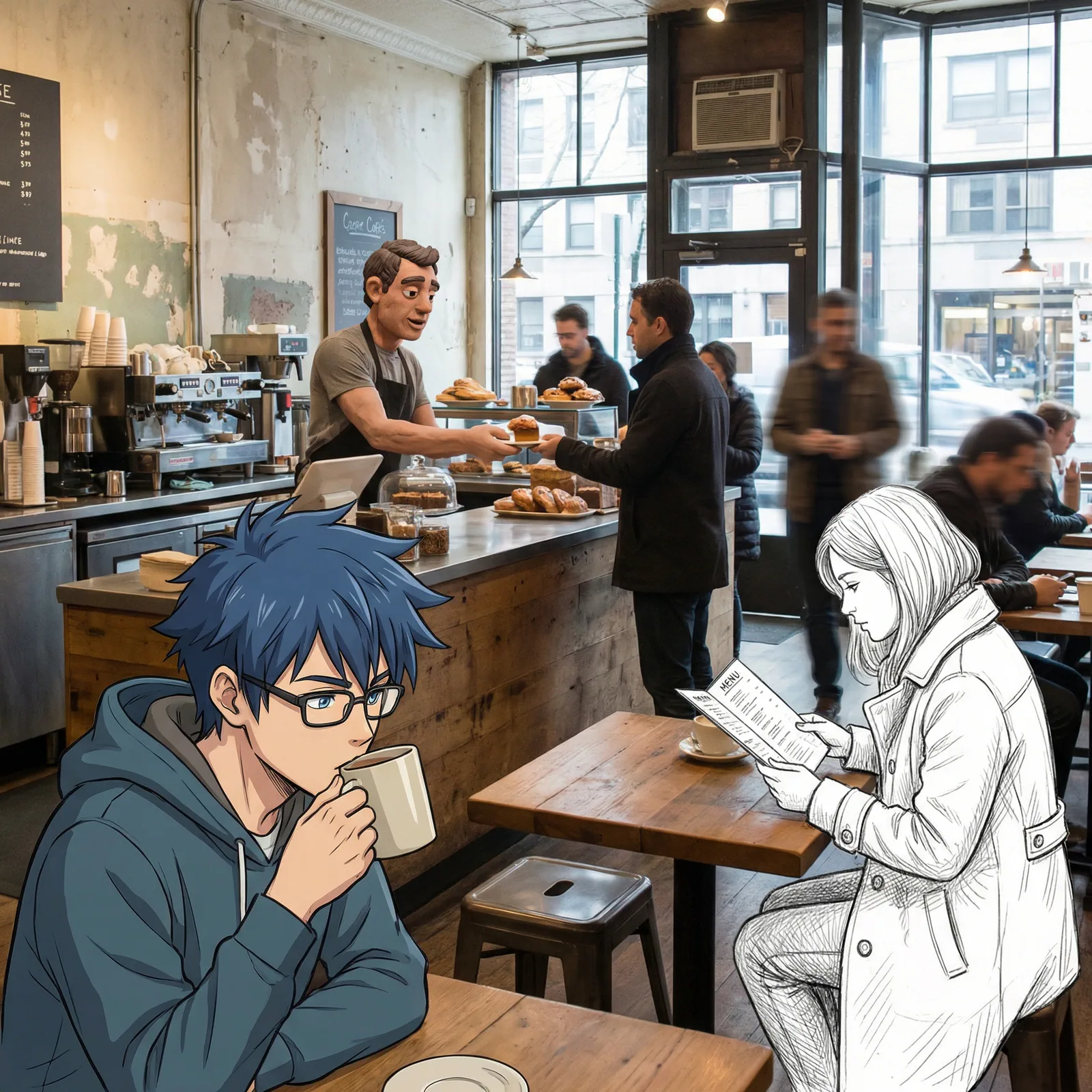
This is not video generation. The output remains a still image or text.
A practical application to evaluate would be generating a thumbnail or promotional still informed by a supplied clip. Developers should test whether the result preserves the intended subject and scene rather than assuming that accepting video guarantees precise use of every moment in it.
Search and video deserve separate integration tests. A successful text-to-image request establishes neither that retrieval is working nor that an application’s video-input handling is correct.
Roll Out Against Accepted Outputs, Not the Release Label
Google’s model card lists distribution through the Gemini app, Google AI Studio, Gemini API, Search AI Mode, Google Ads, Flow, and Stitch. That distribution list should not be read as proof that every surface exposes identical controls or limits. Verify the capabilities available in the environment where the application runs.
For production migration, compare Nano Banana 2.1 against a fixed set of existing requests before expanding traffic. Include prompts that previously failed, not just the examples that already worked well:
- Exact wording and layout requirements.
- Repeated edits involving the same character or product.
- Wide outputs at the resolution the application actually delivers.
- Grounded requests and video-derived images, if those features are used.
Record whether the output is acceptable, how many retries it takes, and how long the complete workflow runs. Google’s claim of retained Flash efficiency is useful positioning, but it does not replace checking current billing terms and measuring the application’s own costs.
The strongest reason to migrate is a higher rate of usable images within the same workflow. If better instruction following or character preservation reduces retries, the release may be worth more than its first-image appearance suggests. If those gains do not survive real prompts, the application needs further tuning before a broad rollout.
Google has supplied a stable replacement and a clear migration recommendation. With no announced shutdown date for Nano Banana 2, developers have reason to begin testing now without treating the deprecation notice as an emergency outage.
Sources
- Gemini API changelogai.google.dev
- Nano Banana 2.1 model pageai.google.dev
- image-generation guideai.google.dev
- DeepMind model carddeepmind.google