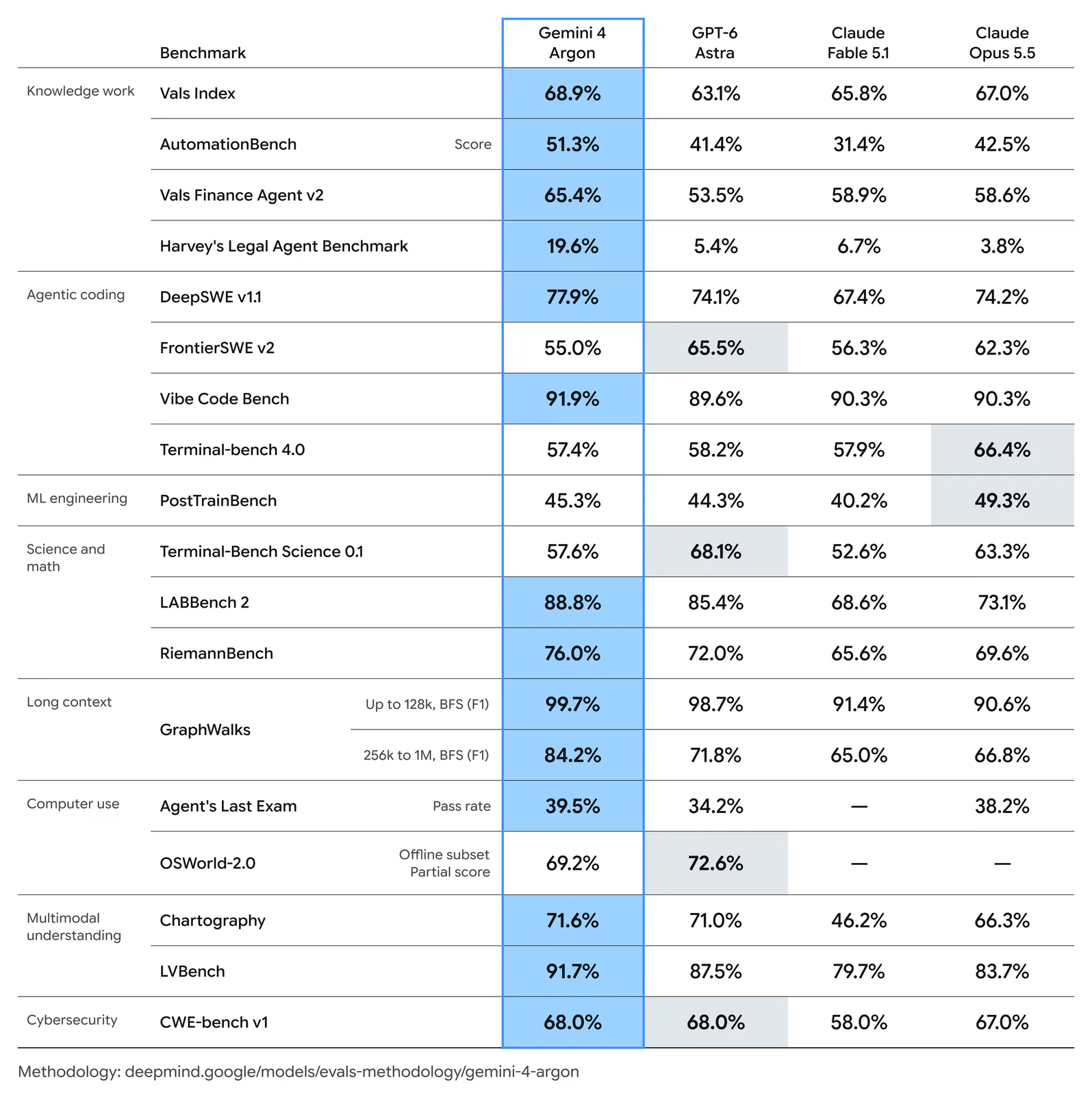
Google says Gemini 4 Argon is rolling out to selected cybersecurity defenders. Broader access for developers, enterprises, and consumers is still pending, so readers looking for a new Gemini model to try should treat this as a restricted release.
The Gemini 4 Argon announcement, dated September 30, 2026, describes a model built for extended software engineering, professional knowledge work, and vulnerability research. Early distribution is through Google DeepMind’s Fairwind Program.
Wiz separately reports using Argon in its Scan for Good initiative. That provides a partner account of deployment without independently establishing Google’s performance claims. The available evidence supports controlled access and reported capabilities; it does not establish broad availability or independently reproduced results.
Google Describes Early Access, Not a Public Launch
Argon is reaching “a set of trusted cyber defenders,” according to Google’s announcement. The company promises to expand availability to developers, enterprises, and consumers after further feedback and work on safeguards, but gives no firm public-release date.
Selected organizations receiving a model does not mean ordinary Gemini users can access it or developers can immediately select it through a generally available service.
September 30 is the stated event date available in the evidence. No publication clock time is supplied, so there is no basis for assigning an exact UTC announcement time. Wiz’s update carries the same calendar date, which leaves the order of the two statements unclear.
Google also lists planned introductory token pricing:
- Input: $2 per million tokens.
- Output: $10 per million tokens.
- Cached input: 95% below the input rate, equivalent to $0.10 per million tokens.
The figures describe a stated launch offer. An open purchasing route has yet to be established, and it remains unclear when people outside the restricted rollout will be able to use the model at those rates.
Fairwind Membership Does Not Guarantee Argon Access
The Fairwind Program aims to give high-priority defenders early access to advanced models before comparable capabilities become widely accessible. Its priority groups include governments and national cyber authorities, critical infrastructure operators, and core technology platforms. Healthcare, telecommunications, energy, and financial networks are among the sectors identified.