

Google Research has introduced Retrieve-for-Train, or R4T, a framework designed to remove one of the more stubborn bottlenecks in complex AI search: using a large language model to reason through every query at inference time.
Rather than asking an LLM to generate and evaluate multiple search directions whenever a request arrives, R4T performs that expensive reasoning during training. The resulting behavior is transferred into a 53.9 million-parameter diffusion model that generates an entire set of retrieval embeddings without autoregressive text generation. Google reports a 12× to 20× speedup over autoregressive fan-out approaches while retaining most of the retrieval quality gained through reinforcement learning.
The Google Research announcement presents R4T as a route to fast, low-cost, “expert-level” search slates. The underlying Retrieve-for-Train paper, published at ICML 2026, supports the performance and latency claims across several retrieval datasets. However, “expert-level” needs qualification: the experiments measure property-aligned retrieval, not a head-to-head contest with human search experts.
Complex AI Search Has a Fan-Out Problem
Many search requests cannot be handled well by finding the documents or products most similar to a single query.
Consider a user asking for a “cross-functional team to launch a sustainable fashion brand.” A useful result needs to cover different roles, such as materials, design, manufacturing, marketing, and supply-chain management. Returning five variations of the same designer profile would produce individually relevant results but a poor overall slate.
This is a set-valued retrieval problem. The system is judged on the complete group of results, including properties such as:
- relevance to the original request,
- diversity across the slate,
- coverage of different parts of the user’s intent,
- grounding in items that actually exist in the database,
- coherence between the retrieved items.
Traditional embedding search ranks candidates independently by similarity. It has no direct mechanism for reasoning about how one selected item should affect the rest of the slate.
LLMs offer a more flexible approach called query fan-out. The model converts a broad request into several focused subqueries, retrieves candidates for each one, and combines them into a final result set. The problem is that generating every subquery token by token can be slow, especially when the application samples multiple candidate slates and scores them before choosing one.
Generic LLMs also tend to produce safe, repetitive search expansions. A request for “bohemian festival style,” for example, may yield several near-identical subqueries containing the same obvious terms. R4T instead optimizes the fan-out process against the properties required by a particular retrieval system.
How Retrieve-for-Train Moves Reasoning Into Training
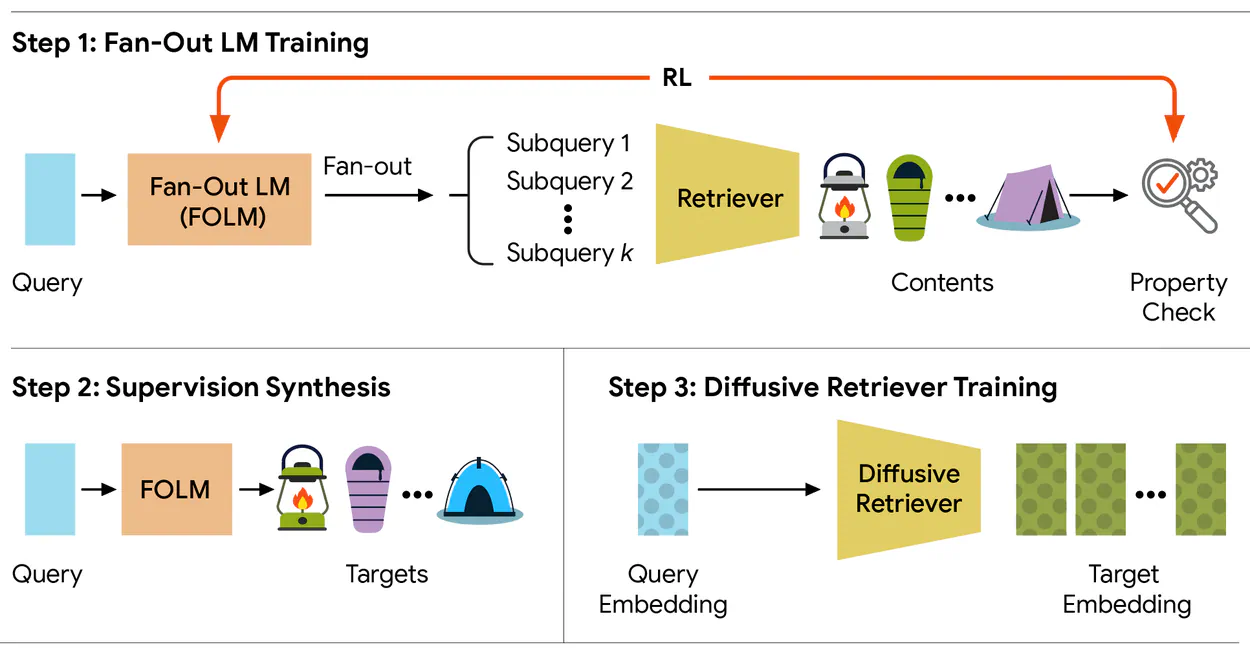
Retrieve-for-Train divides the work into three stages. The first two happen offline. Only the small diffusion retriever is required for normal inference.
Reinforcement Learning Discovers Better Search Directions
R4T starts with a fan-out language model, or FOLM. In the experiments, the researchers used 4-billion-parameter variants of Gemma 3 and Qwen 3 and trained them with Group Relative Policy Optimization, a reinforcement-learning algorithm.
The model receives a broad query and generates a set of more specific subqueries. Those subqueries are converted into embeddings, matched against a database, and evaluated as one slate.
The reward depends on the task. For open-ended abstract retrieval, it combines alignment with the user’s intent, diversity, and grounding in the available collection. For weakly supervised compositional retrieval, the reward emphasizes reference coverage and slate diversity. The system also penalizes duplicated or collapsed subqueries.
This stage is expensive, but it does not run for every user request. Reinforcement learning acts as an offline search process for discovering useful fan-out behavior.
The Trained LLM Generates Synthetic Supervision
Once trained, the FOLM processes thousands of queries and produces reward-aligned subquery sets. These sets are mapped to their retrieved content embeddings and stored as synthetic training pairs.
The paper reports using 10,000 to 20,000 generated query examples per dataset. Because the reward can be computed from the collection, metadata, and retrieval objective, the training pipeline does not require people to manually label every ideal slate.
At this point, the large autoregressive model has completed its primary role. It has converted the desired retrieval properties into examples that a smaller model can imitate.
A Diffusion Model Learns the Complete Slate
The final stage trains a compact transformer-based diffusion model on those synthetic pairs. It receives an embedding of the original query and generates a complete set of target content embeddings.
This is not an image diffusion model. It operates within the retrieval system’s embedding space, gradually transforming noise into the vectors representing the desired result slate. The implementation described in the paper uses 100 deterministic DDIM denoising steps.
All positions in the slate are refined jointly rather than emitted as text one token at a time. After generation, maximum inner-product search maps each generated vector to a real item in the collection. Duplicate matches are removed, and the next-nearest candidates fill any empty positions.
The important distinction is that diffusion learns the relationship between the items in the slate. It is not simply predicting several independent nearest neighbors.
The Diffusion Retriever Cuts Fan-Out Latency by 12× to 20×
Google reports that R4T’s diffusion retriever delivers a 12× to 20× wall-clock speedup over autoregressive fan-out. Under larger contextual batches, the company says autoregressive latency approached 50 seconds, while the diffusion system remained between less than one second and a few seconds.
One experiment provides a more direct comparison. On an open-ended retrieval task, the RL-trained FOLM achieved a general retrieval score of 3.94 with 7.37 seconds of latency. The diffusion model scored 3.70 at 0.69 seconds, making it roughly 10.7 times faster in that particular configuration.
The diffusion system did not fully reproduce the teacher model’s quality, but it preserved substantially more of the RL improvement than simpler distillation methods. An autoencoder baseline scored 3.22, while a deterministic sequence model scored 3.08. Both were slightly faster than diffusion, but the retrieval-quality loss was larger.
Results across the main experiments followed a similar pattern:
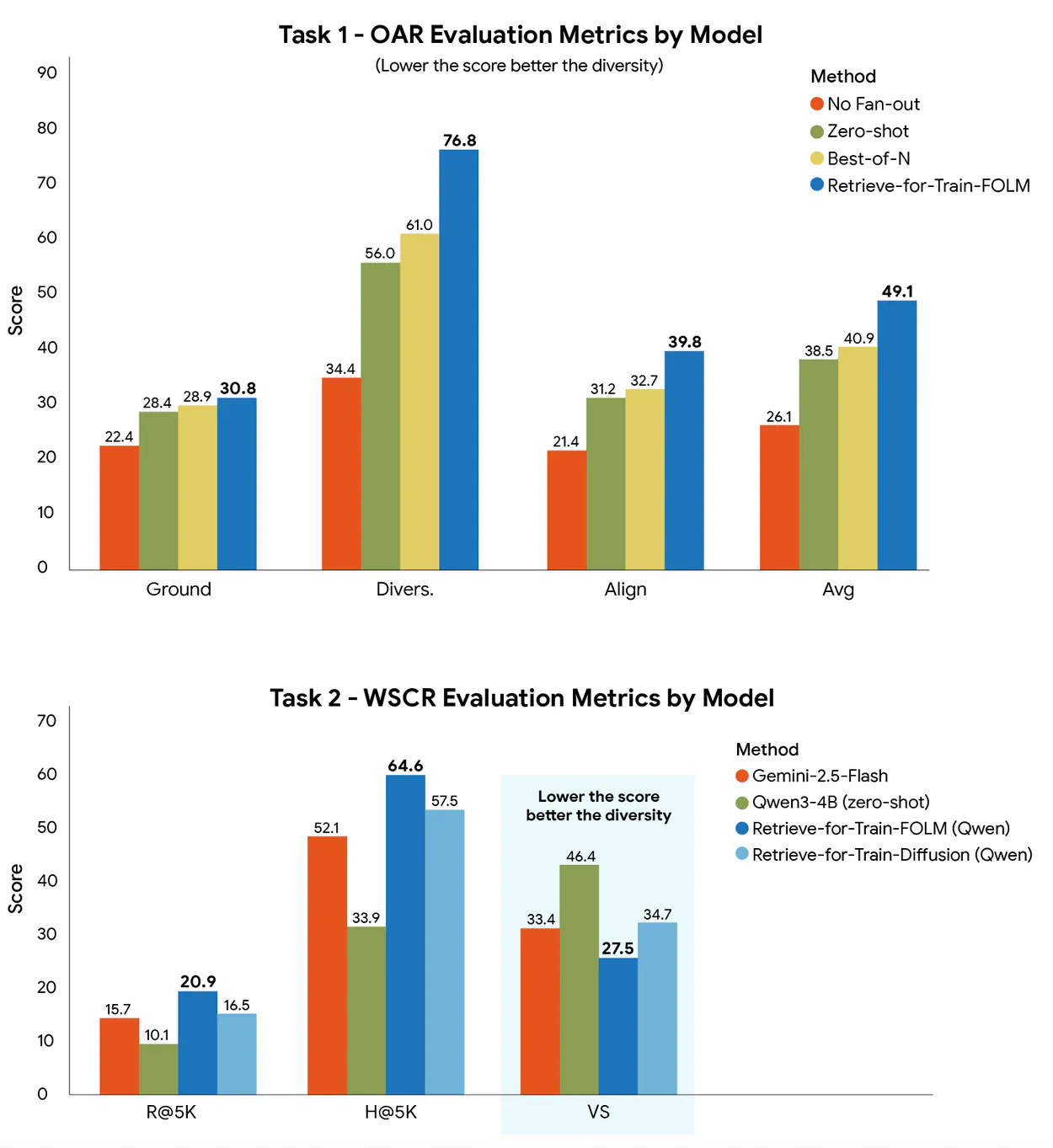
- On the Vocation open-ended retrieval dataset, the general score increased from 2.64 for zero-shot LLM fan-out to 3.94 for R4T-FOLM and 3.70 for R4T-Diffusion.
- On the Ads dataset, the same score increased from 3.04 for zero-shot fan-out to 3.84 for FOLM and 3.67 for diffusion.
- On Polyvore compositional retrieval, Recall@5K rose from 0.273 for single-query retrieval to 0.424 for FOLM and 0.454 for diffusion.
- On the Video dataset, Recall@5K improved from 0.163 for single-query retrieval to 0.205 for FOLM and 0.251 for diffusion.
Those results suggest that the smaller model is doing more than compressing an LLM’s output format. It is learning a set-level retrieval policy shaped by the original reinforcement-learning reward.
The paper’s abstract also describes inference costs as 10× to 100× lower, depending on the task and comparison. That broader range should not be confused with a universal 100× latency improvement. Neither the paper nor Google’s announcement provides a standardized dollar-cost or energy comparison for production deployment.
The Benchmark Win Comes With Boundaries
Retrieve-for-Train was evaluated across two open-ended abstract retrieval tasks and two weakly supervised compositional retrieval tasks. The datasets covered professions, advertisements, fashion outfits, and video collections, giving the researchers a mixture of text and multimodal search problems.
For open-ended retrieval, the study used an LLM judge to score groundedness, alignment, and diversity on five-point scales. The compositional tasks used reference-based coverage metrics such as Hit@5K and Recall@5K, along with the Vendi Score for diversity. The authors explicitly warn that reference sets represent only one plausible interpretation of a broad query, so recall is a semantic-coverage proxy rather than definitive correctness.
These evaluations are useful, but they do not prove that R4T can replace a general-purpose AI search agent.
The framework assumes that developers can define a differentiable reward for the desired slate and access a collection against which generated embeddings can be evaluated. A shopping catalog, advertising database, hiring platform, media library, or recommendation system could satisfy those requirements. Open-web research, where source quality, freshness, conflicting evidence, and multi-step synthesis matter, is a harder and less controlled problem.
“Train once” should also be interpreted at the system level, not as a universal training event. A new domain, collection distribution, or retrieval objective may require another round of RL training and synthetic supervision. R4T shifts compute from online inference to offline optimization; it does not eliminate the cost of acquiring useful behavior.
The anti-reward-hacking constraints are another important part of the method. The researchers penalized repeated subqueries, embedding collapse, and other shortcuts that increased numerical reward without producing a useful slate. In practical deployments, the quality of the system will depend heavily on whether its reward captures what users actually value.
R4T Treats AI Reasoning More Like a Compiler
The broader AI research idea behind R4T is more consequential than any single benchmark score. Instead of treating an LLM’s reasoning process as something that must run live for every request, the framework uses the LLM as a temporary policy-discovery tool.
Reinforcement learning finds a retrieval strategy. Synthetic generation converts that strategy into a dataset. Diffusion then compiles the strategy into a smaller, more predictable serving model.
That design fits applications with high query volume, strict latency targets, and relatively stable objectives. A specialized retriever can generate a coordinated slate without paying repeatedly for an LLM’s token generation, context processing, and best-of-N sampling.
It also creates a practical tradeoff. R4T gives up some of the flexibility of live LLM reasoning in exchange for speed and lower serving costs. The diffusion model is trained to reproduce a particular kind of retrieval behavior. It cannot independently reconsider the reward, explain its choices, or dynamically invent a new search strategy outside what its training distribution supports.
For developers, the most promising use is therefore not “replace every search LLM with diffusion.” It is identifying expensive, repeatable reasoning patterns that can be optimized once and transferred into a smaller model.
Final Thoughts
Retrieve-for-Train offers a credible answer to a growing AI infrastructure problem: inference-time reasoning is useful, but repeating the same category of reasoning for millions of similar requests is wasteful.
The framework’s strongest result is not that diffusion beats the RL-trained LLM on every metric. It generally does not. The stronger finding is that a 53.9 million-parameter retriever can retain much of the teacher’s set-level search behavior while reducing fan-out latency by roughly an order of magnitude or more.
Google’s “expert-level” description is ahead of the published evidence because the paper does not compare R4T directly with human search specialists. Even so, the underlying approach is technically meaningful. If it generalizes across larger, frequently updated collections, R4T could turn expensive LLM search policies into compact retrieval components that are fast enough to serve routinely rather than sparingly.
Frequently Asked Questions
5 questions
1What is Google Research’s Retrieve-for-Train framework?
Retrieve-for-Train is an AI retrieval framework that moves expensive search reasoning from inference into training. It first trains an LLM with reinforcement learning to generate property-aligned subqueries, uses that model to create synthetic supervision, and then trains a 53.9 million-parameter diffusion retriever to generate complete search slates from query embeddings.
2How does diffusion make AI search faster?
Diffusion makes this form of AI search faster by generating the slate in embedding space without autoregressive text generation. Instead of asking an LLM to produce multiple subqueries token by token, the R4T diffusion model jointly refines a set of result embeddings through a fixed denoising process and maps them to items in the search collection.
3How much faster is Retrieve-for-Train?
Google Research reports that Retrieve-for-Train’s diffusion model is 12× to 20× faster than autoregressive fan-out under its tested conditions. One paper experiment recorded 0.69 seconds for diffusion compared with 7.37 seconds for the RL-trained LLM. Actual speed will depend on batch size, hardware, collection size, model configuration, and retrieval pipeline.
4Does Retrieve-for-Train eliminate the need for LLMs?
Retrieve-for-Train does not eliminate LLMs from the training process. It uses an LLM and reinforcement learning to discover effective fan-out behavior, then transfers that behavior into a smaller diffusion model for serving. An LLM may still be needed for new objectives, changing domains, answer synthesis, or queries requiring flexible multi-step reasoning.
5Can Retrieve-for-Train replace general web search?
Retrieve-for-Train is not currently a demonstrated replacement for general web search. The paper evaluates set-valued retrieval over defined collections with measurable rewards, including professions, ads, fashion, and video datasets. Open-web search introduces additional problems involving freshness, source credibility, conflicting information, and evolving user intent that the published experiments do not directly test.
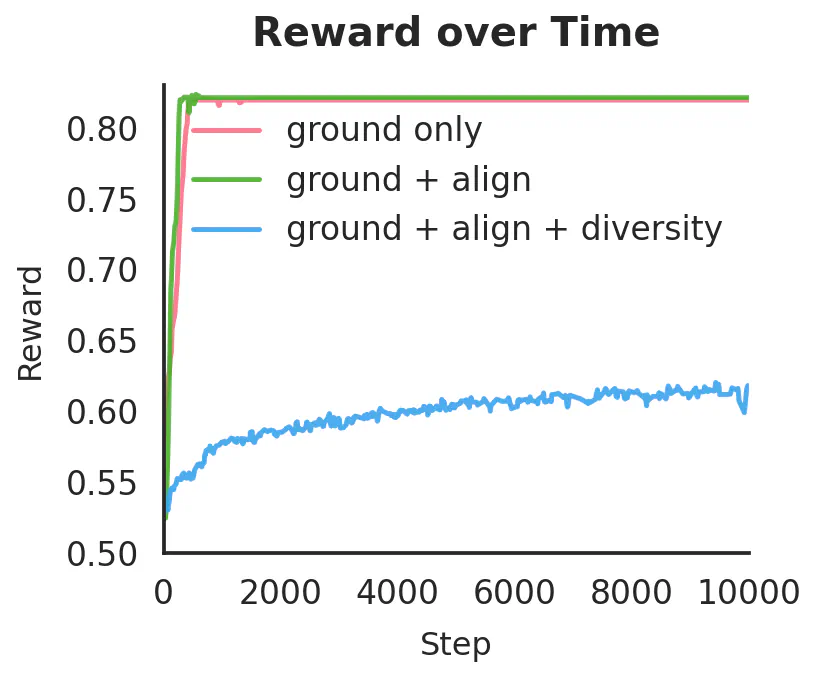
Image: Efficient, Property-Aligned Fan-Out Retrieval via RL-Compiled Diffusion.
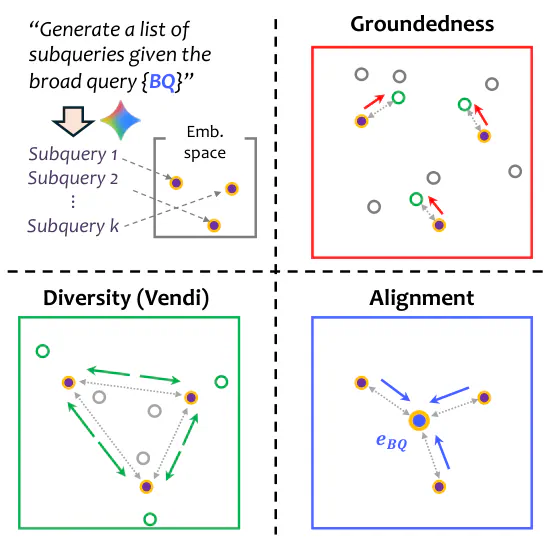
Image: Efficient, Property-Aligned Fan-Out Retrieval via RL-Compiled Diffusion.


