
Google has introduced Agentic Video, a new Gemini API processing mode that changes how its AI models analyze long videos. Instead of loading video frames at a fixed rate and placing everything into the model’s context, Gemini can decide which moments to inspect, which signals to use, and when it needs a closer look.
According to Google’s Agentic Video announcement, the approach can reduce token consumption by up to 88%, lower analysis costs by up to 66%, and improve accuracy by up to 7%. The feature launched on September 1, 2026, for Gemini 3.7 Flash, Gemini 3.6 Flash, and Gemini 3.5 Flash-Lite.
The efficiency claim is important, but the architectural change matters more. Google is moving decisions about video sampling into the model’s reasoning loop. That could make sophisticated video analysis easier to build because developers no longer need to create their own pipelines for searching transcripts, extracting clips, and resampling suspicious moments.
Gemini Decides What to Watch Instead of Sampling Everything
Gemini’s standard video processing mode is static. By default, it extracts frames at one frame per second and places those frames into the context window in a single pass. Developers can change the sampling rate, but the same rate generally applies across the selected footage.
That approach is predictable and useful for short clips. It becomes inefficient as videos get longer, however, because most frames may have little relevance to the user’s question. Fixed sampling can also miss short events that occur between extracted frames.
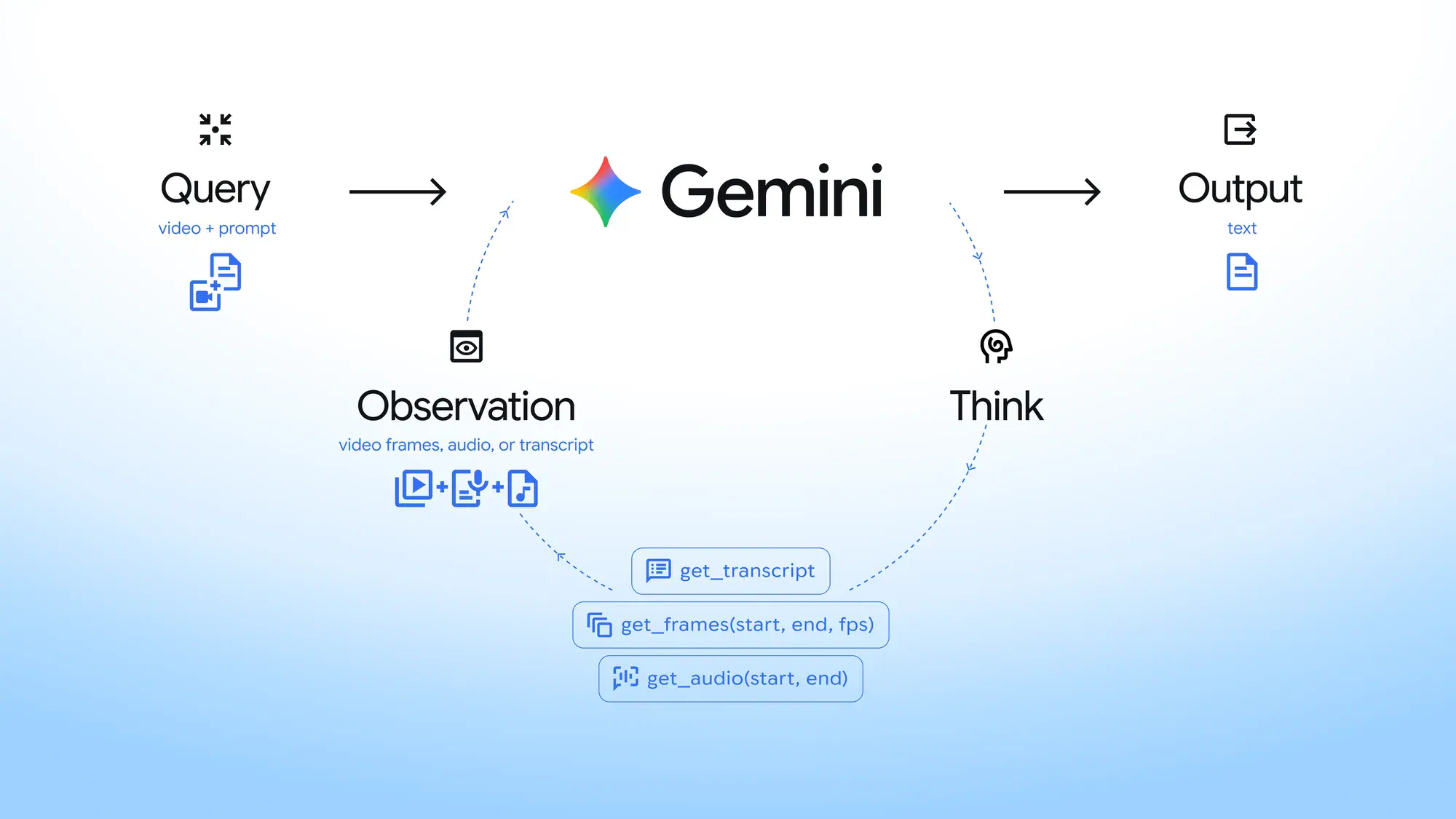
Agentic Video gives the model control over that evidence-gathering process. Gemini can navigate the timeline, inspect the transcript, listen to audio, load selected visual segments, and adjust frame rates or resolution based on the prompt. It can scan broadly before returning to a smaller section at a higher level of detail.
For example, a question about the central arguments in a 90-minute lecture may initially require the transcript and selected slide frames. A request to identify exactly when an object breaks may require a high-frame-rate inspection of a few seconds. The model does not need to process both tasks with the same sampling strategy.
“Agentic” in this context does not mean that Gemini becomes an autonomous software agent controlling external applications. It refers to an internal loop in which the model identifies missing evidence, invokes a native video-processing tool, reviews the result, and decides whether it needs another segment before answering.
Google's Benchmarks Show Lower Cost and Higher Accuracy
Google says Agentic Video reduced token consumption by up to 88% and analysis costs by up to 66% across its video evaluations. The company also reports accuracy improvements of up to 7%, with the largest efficiency gains appearing in long-form material such as tutorials, lectures, and multi-hour recordings.
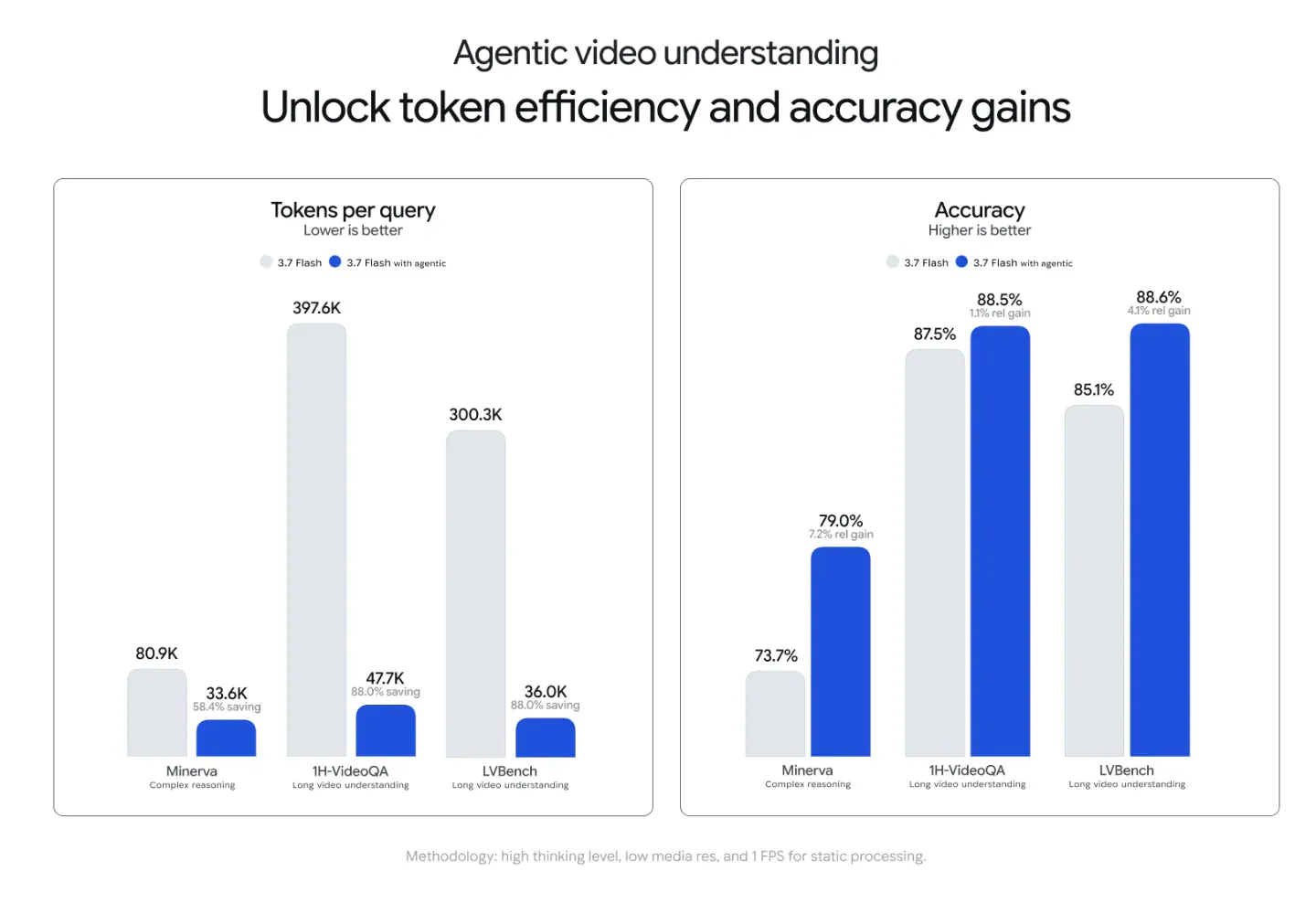
The combination of lower token use and higher accuracy may sound counterintuitive, but it follows from better evidence selection. Reducing input indiscriminately risks losing useful detail. Selectively loading relevant segments can remove redundant frames while preserving, or even expanding, the evidence that matters for the answer.
Google says Gemini 3.7 Flash produced the strongest overall quality and the best accuracy-to-cost balance among the models it tested. In its comparison, the model with Agentic Video sits on the Pareto frontier, meaning no tested alternative simultaneously delivered higher accuracy at a lower cost.
Those figures should still be read as vendor benchmark results. “Up to 88%” describes the best reported reduction, not a guaranteed saving on every video or prompt. Token use will depend on video length, content density, the question, and how many sections the model chooses to inspect. The 88% token figure also should not be presented as an 88% reduction in the final bill because Google’s separate cost claim tops out at 66%.
Google’s public examples include LongVideoBench, along with demonstrations involving fast-action counting and needle-in-a-haystack retrieval. The launch announcement does not provide independent validation, so production teams should benchmark the mode on their own footage rather than budgeting around the maximum reported saving.
Per-Video Control Makes the API Practical
Agentic Video is an opt-in processing mode. Static processing remains the default, and developers activate the new behavior by setting the video input’s processing field to "agentic".
A minimal Python request using the Gemini Interactions API looks like this:
from google import genai

client = genai.Client()

interaction = client.interactions.create(
    model="gemini-3.7-flash",
    input=[
        {
            "type": "video",
            "uri": video_file.uri,
            "mime_type": video_file.mime_type,
            "processing": "agentic"
        },
        {
            "type": "text",
            "text": "Identify the three main arguments in this lecture."
        }
    ]
)

print(interaction.output_text)
The setting belongs to the individual video input rather than the entire request. If an application submits several videos together, it can process a long lecture in agentic mode while keeping a short experiment clip in static mode. Google documents this mixed approach in its Gemini video understanding guide.
Developers can also confirm that the model used Agentic Video by inspecting interaction.steps. A successful agentic process includes processing_call and processing_result entries representing requests for video segments or transcript information. Applications can expose these steps as a progress trace, although they do not require a response from the client.
This visibility is useful for debugging. If a model returns an incomplete answer, a developer can determine whether it dynamically explored the video and compare the result with static processing. The API does not expose every internal reasoning detail, but it does show that additional media retrieval occurred.
Google also separates processing mode from media resolution. Processing determines which parts of a video enter the context, while media_resolution controls the number of tokens used for individual frames. The two settings can be combined, including Agentic Video with lower frame resolution when minimizing tokens is the priority.
Long Videos and Brief Events Benefit Most
Agentic Video is designed for workloads where relevant information is sparse, unevenly distributed, or difficult to capture at one frame per second. Google highlights several applications:
- Moment retrieval: Locate a brief state change or editing boundary without processing every second at a high sampling rate.
- Long-form search: Answer targeted questions across lectures, meetings, tutorials, and recordings.
- Anomaly detection: Resample suspicious time windows at a higher frame rate to inspect rapid movement or visual artifacts.
- Counting: Rewatch selected sections to count repeated actions or objects more accurately.
These tasks expose opposite weaknesses in static processing. Long-video search wastes tokens on irrelevant material, while fast-event analysis risks missing critical detail. Agentic processing can scan economically and then spend more tokens where they are useful.
The approach could simplify products that search media archives, review industrial footage, analyze sports, index educational videos, or create rough editing timelines. Previously, developers could build similar systems by combining speech transcription, vector search, scene detection, and custom frame extraction. Google’s feature places more of that orchestration inside Gemini.
It does not eliminate the need for application-specific validation. A security system, medical workflow, or compliance product still needs thresholds, audit procedures, and tests for missed events. Agentic evidence selection can improve efficiency, but it also makes retrieval quality part of the model’s responsibility.
Static Processing Still Has a Place
Google’s documentation recommends Agentic Video for long-form content, targeted questions, and workloads prioritizing quality or token efficiency. Static mode remains the suggested option for latency-sensitive analysis of short clips under five minutes and for tasks requiring frame-level coverage across an entire video.
That distinction matters. An agentic loop may perform several inspection steps before producing an answer. A short clip that already fits comfortably within the context may not benefit enough to justify dynamic navigation.
Static processing also gives developers direct control over frame-rate sampling and clipping intervals. Google’s current documentation says custom FPS values and start or end offsets are supported when the video uses static mode.
The practical choice is therefore workload-dependent:
- Use agentic mode for long videos, sparse evidence, complex questions, or precise moment retrieval.
- Use static mode for short clips, full-sequence inspection, strict latency requirements, or manually selected time ranges.
- Test both when answer quality, predictable latency, and cost all matter.
Availability and Pricing
Agentic Video is available through the Gemini API in Google AI Studio and the Gemini Enterprise Agent Platform. It supports uploaded videos and public YouTube videos on Gemini 3.7 Flash, Gemini 3.6 Flash, and Gemini 3.5 Flash-Lite. Google says there is no separate feature fee; requests use the selected model’s standard token pricing.
For Gemini 3.7 Flash, Google’s current API pricing lists an introductory paid rate of $0.75 per million input tokens and $3.75 per million output tokens through December 31, 2026. On January 1, 2027, those prices are scheduled to rise to $1.50 and $7.50, respectively.
Google also plans to bring the processing improvements to the Gemini app’s Flash and Flash-Lite models. The company says the same technology will eventually support Ask YouTube, where Gemini answers questions grounded in both a video’s visuals and other available signals.
Final Thoughts
The most meaningful part of Agentic Video is not the maximum 88% token reduction. It is Google’s decision to make video evidence selection part of model inference rather than a preprocessing problem every developer must solve independently.
That shift could make long-video AI applications cheaper and much easier to build. It also creates a new evaluation requirement: developers need to test whether Gemini searches the right moments, not merely whether it reasons correctly after receiving them. Agentic Video looks strongest when important evidence is scattered or brief, while static sampling remains valuable when comprehensive and predictable coverage matters.
Frequently Asked Questions
5 questions
1What is Google Agentic Video?
Google Agentic Video is a Gemini API processing mode that lets supported AI models dynamically explore a video instead of loading frames at a fixed rate. Gemini can inspect transcripts, audio, and selected visual segments, adjusting frame rates and resolution according to the prompt. It is intended to improve long-video analysis while reducing unnecessary token consumption.
2
Sources
- Google’s Agentic Video announcementblog.google
- Gemini video understanding guideai.google.dev
- Google’s current API pricingai.google.dev


