GitHub says more than 40% of pull requests in September 2026 began with a coding agent’s first draft, up from 17% in March. That amounted to about 110 million agent-started pull requests in September, according to its 2026 Octoverse report, published October 28.
The share climbed more than 23 percentage points in six months, reaching more than 2.35 times March’s level. Those calculations describe a substantial change in how proposed code reaches GitHub: developers are increasingly starting with an agent-generated draft.
The finding is about workflow adoption. It tells us where the first draft came from, while leaving the final authorship, review effort and quality of the merged code unresolved. GitHub’s other figures, including multi-file changes, merge rates and model use, help explain that shift without turning it into a productivity verdict.
What GitHub’s 40% Figure Actually Measures
An agent-started pull request is one whose first draft came from a coding agent GitHub can detect. A pull request proposes changes for review and possible integration into a project. Its opening draft can change substantially before anyone merges it.
That distinction matters. A person might direct the agent, edit its output, request another implementation or replace parts of the proposal. The initial classification says little about how much agent-generated code survives that process.
GitHub’s glossary describes an agent signal as an observed sign of agent involvement, such as an agent-opened pull request. It calls that signal “a floor, since not all agent use may be detected,” as Employed AI’s examination of the methodology explains.
GitHub therefore presents the detectable share as an incomplete count. The published material provides no detection method, false-positive rate, false-negative rate or coverage estimate. That makes the direction of the caveat clear, but leaves readers unable to calculate how far the reported figure sits from total agent use.
The report also uses several related labels: agent-started, agent-involved, agent-opened and detected AI involvement. They belong to different analyses and should stay attached to their original measurements.
My reading is that the strongest supported headline concerns the entry point into development work. Agent drafts have become a major source of proposed changes on GitHub. Describing the same figure as the percentage of code written by AI would change both the unit being counted and the claim being made.
The 2026 Counting Rules Changed
GitHub reports 17.9 billion pushes, 34.3 billion commits and 1.3 billion merged pull requests over the Octoverse year. Its announcement says pushes exceeded the combined totals for 2024 and 2025, while merged pull requests more than tripled over the two-year comparison.
Those comparisons need the report’s revised counting rules:
- The reporting window changed. The 2026 edition covers October 1, 2025, through September 30, 2026. Earlier editions used September through August.
- The activity base widened. The general figures now cover public and private repositories, with specific categories, including open-source and industry analyses, remaining public-only.
- GitHub recalculated earlier years. Its 2024 and 2025 comparisons use the updated definitions and reporting window.
These changes, detailed in Employed AI’s methodology analysis, mean comparisons within the 2026 release can be consistent while comparisons against numbers copied from older Octoverse releases can be misleading.
The agent-started figure is not marked public-only. GitHub’s general scope rule consequently points toward public and private coverage, although the company has not separately confirmed that figure’s repository scope. Private activity also limits how much outside researchers could check against public records.
The activity units need similar care. A push sends changes to GitHub and can contain multiple commits. A commit records a saved change. An opened pull request proposes integration; a merged pull request records that the proposal was accepted.
September’s 110 million agent-started pull requests and the annual 1.3 billion merged pull requests therefore describe different events over different periods. Combining them into a single adoption ratio would produce a number with no useful interpretation.
Merge Rates Show Acceptance, With Quality Still Unresolved
GitHub’s September comparisons suggest agent-associated work was reaching integration at a substantial rate.
| Measurement | Agent group | Comparison group | Reported gap |
|---|---|---|---|
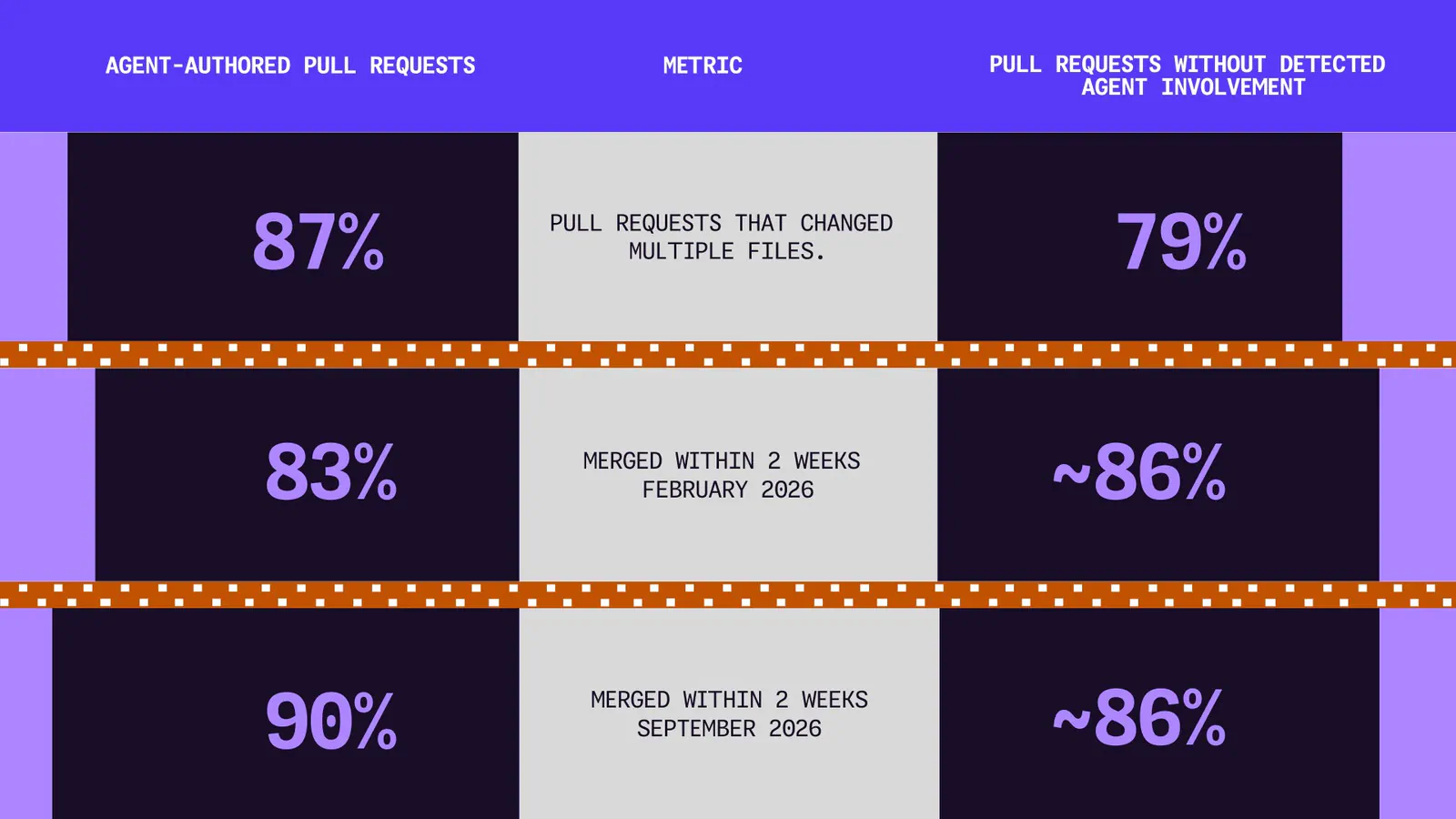
| Pull requests merged within two weeks | 90% of agent-involved PRs | About 86% without detected agent involvement | About 4 percentage points |
| Pull requests changing multiple files | 87% of agent-started PRs | 79% of other PRs | 8 percentage points |
The figures come from GitHub’s Octoverse report. Notice that the merge comparison uses agent-involved, while the file-count comparison uses agent-started. The labels should not be silently collapsed into one cohort.
The merge pattern also changed during the year. In February, 83% of agent-involved pull requests merged within two weeks, compared with about 86% for the comparison group. By September, the agent group had reached 90%, while the comparison group remained around 86%, according to the report’s figures reproduced by Lifehacker.dev.
A higher two-week merge rate means a larger proportion crossed that deadline. It does not give the average time to merge, nor does it show whether equivalent tasks were completed faster. Repository policies, task selection and reviewer availability could all affect the result.
The multi-file figure adds another useful observation: agent drafts frequently extend beyond one file. But file count is a rough description of scope. A repetitive edit across several files can be easier to assess than a subtle behavioral change in one.
I’d treat these numbers as evidence that agent-generated proposals are entering accepted workflows. Quality requires additional measurements, such as escaped defects, reversions, security findings and maintenance effort. A merge records acceptance under a project’s process; it cannot answer all those questions by itself.
Why Eight Times More Commits Is Not Eight Times More Productivity
Among repositories created during the reporting year, the average repository containing an agent-configuration file logged eight times as many commits as the average new repository without one, GitHub reports.
An agent-configuration file provides instructions or setup for a coding agent. Its presence is a useful repository-level signal, but repositories without such a file may still use AI tools.
The comparison has a specific denominator: average commits per new repository. It is neither a per-developer measurement nor a measure of completed features. GitHub does not publish the group sizes alongside the eightfold claim, and an average alone leaves the distribution unclear.
Frequently Asked Questions
3 questions
1Does Agent-Started Mean the Final Code Was Written by AI?
It means the first draft came from a detectable coding agent. People can revise or replace that draft before merging, so the metric cannot measure AI’s share of the final code.