
FUTO has released three streaming speech-recognition models, ranging from 28 million to 97 million parameters, designed to run locally on ordinary CPUs, phones and edge devices. Developers can download the weights now, ahead of their arrival in FUTO’s consumer apps.
ASR4ALL, announced on October 13, 2026, combines small models, streaming transcription and several deployment formats. FUTO provides safetensors for PyTorch and Transformers, ONNX, ExecuTorch and GGUF exports, alongside optional text-cleanup and speaker-processing features.
Builders can evaluate the release for private, offline applications today, though performance on a particular phone or embedded board remains to be tested. FUTO’s speed and Raspberry Pi claims are vendor-reported. Integration into FUTO Keyboard and FUTO Voice is planned for an upcoming release.
Three Sizes Support Live and Recorded Audio
The core ASR4ALL lineup gives developers three model sizes to benchmark:
| Model | Parameters |
|---|---|
| Small | 28 million |
| Medium | 56 million |
| Large | 97 million |
According to FUTO, all three support streaming recognition, producing text while audio is still arriving. Dictation and voice interfaces depend on this responsiveness; waiting until an entire recording finishes would interrupt the interaction.
For recorded audio, the models also support a higher-latency streaming setting that processes larger chunks at a time. FUTO says this improves throughput and accuracy. The company trained the models with both high- and low-latency settings so they could operate across those configurations.
“Offline” has two meanings here. Local inference means transcription does not need an external speech API. Offline transcription, as discussed in the announcement, also refers to processing an existing recording rather than responding immediately to a live microphone. ASR4ALL targets both scenarios, but the latency settings suitable for one may be inappropriate for the other.
Model size and chunking configuration should therefore be evaluated together. A configuration that transcribes stored recordings efficiently may still feel slow in a push-to-talk interface.
The Exports Offer Several Deployment Paths
The ASR4ALL collection is the starting point for downloading the models. FUTO lists four export families:
- Safetensors: Weights for use with PyTorch and Transformers.
- ONNX: An export option for ONNX-based inference environments.
- ExecuTorch: Exports using XNNPACK, targeting CPU and mobile execution.
- GGUF: An additional deployment option with quantized variants.
These formats let developers evaluate the models within their existing inference stack. A Python prototype and an on-device application need not have identical runtime requirements. Each export is a separate integration path, however; applications cannot be assumed to load every export unchanged. Builders should check the selected model’s loading requirements and supported features before committing to a runtime.
FUTO says int8 quantization generally has little effect on recognition accuracy, and that some GGUF quantizations may remain viable at five or six bits. Those vendor assessments do not promise identical behavior across smaller exports.
Quantization deserves its own accuracy test, especially beyond int8. Reducing weight precision can help fit a deployment budget, but parameter count and nominal bit width alone do not tell a developer the application’s total memory use or sustained processing speed.
Text Cleanup, VAD and Speaker Processing Add Different Costs
ASR4ALL’s additional capabilities solve different problems and should be evaluated separately.
Punctuation and Correction Use a Small Language Model
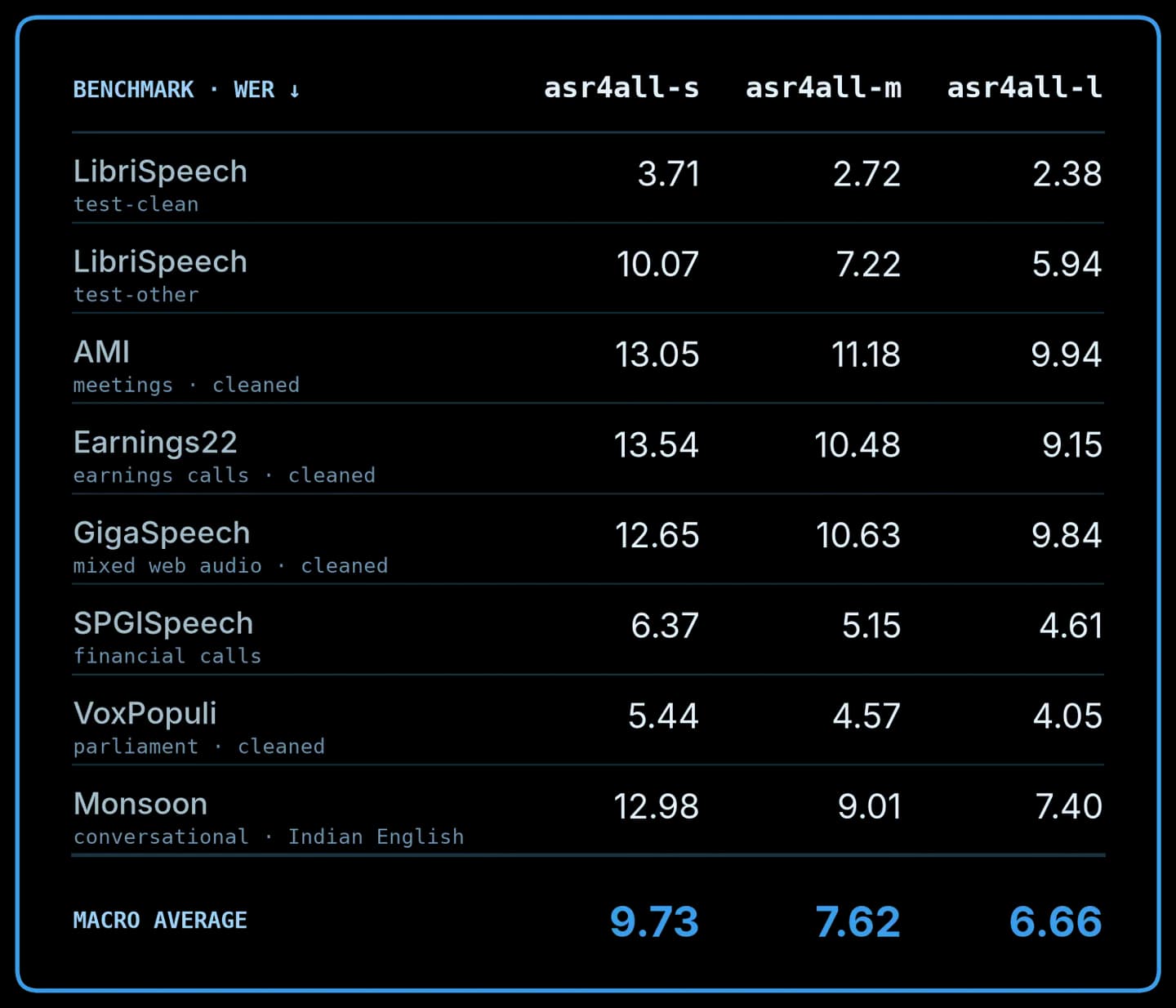
FUTO’s punctuation, capitalization and error-correction module, called PCEC, has 5.3 million parameters. The company says it first trained the module on text, then adapted it to hidden features from the acoustic network.
The module does more than add periods and capital letters. FUTO introduced synthetic text errors during training, including errors modeled on acoustic-network outputs and homophone confusion, so it could learn to correct likely mistakes.
FUTO reports a word-error-rate improvement at low additional inference cost. Developers should check whether those corrections help the intended vocabulary, explicitly testing proper names, specialist terms and product identifiers. A language-informed correction can make text more readable while still changing something the speaker intended.
VAD Can Avoid Decoding Silence
Voice activity detection, or VAD, identifies when speech is present. In an always-listening application, it can gate the recognizer so it does not continuously decode long periods of silence.
FUTO says its lightweight VAD follows the kiloVAD architecture and adds approximately 2,500 parameters. It has a clear role in a local voice-assistant pipeline, where speech recognition feeds an LLM, which produces a response that a text-to-speech system reads aloud.
As a separate component in that chain, the VAD needs to detect speech reliably without cutting off the beginning or end of an utterance. Testing should include quiet speakers, background noise and pauses within sentences. Measuring only the recognizer after clean speech has already been isolated would miss those concerns.
Plus Models Add Speaker Features
ASR4ALL’s Plus variants include a different VAD, fsmn-vad, which FUTO describes as more accurate but slightly slower. They also add a speaker-segmentation “powerset” head and a speaker-embedding verification head, trained as add-ons using adapters on the acoustic network.
These components support pipelines that distinguish speakers, count conversational turns or perform diarization, meaning the assignment of speech segments to speakers.
Speaker-processing functionality alone does not establish resistance to impersonation or replay. Although FUTO lists voice authorization as a possible application, a product using speech to grant access would need a separate security evaluation before treating it as a validated authentication system.
GPU Throughput Does Not Settle the CPU Question
FUTO’s announcement emphasizes its models’ position on the speed-versus-accuracy frontier. It says the fastest model reaches roughly 73,000 RTFx in GPU benchmarks.
RTFx expresses how many seconds of audio a system processes per second of compute. This throughput measure does not directly measure how quickly a phone displays its first partial transcript, nor can a large GPU throughput number establish mobile battery consumption, sustained CPU behavior or interactive latency. FUTO itself notes that H200 GPU benchmarks bear little resemblance to a mobile phone.
For edge developers, FUTO’s report that the medium model can run on a single Raspberry Pi 4 core using the more demanding low-latency setting is more relevant. The company also reports execution on an Intel integrated GPU through OpenVINO using ONNX.
These vendor-reported results offer useful deployment leads and justify trying the models on constrained hardware. Measurements on the intended device are still needed.
Sources
- ASR4ALLfuto.tech
- ASR4ALL collectionhuggingface.co
- large model’s LICENSE filehuggingface.co