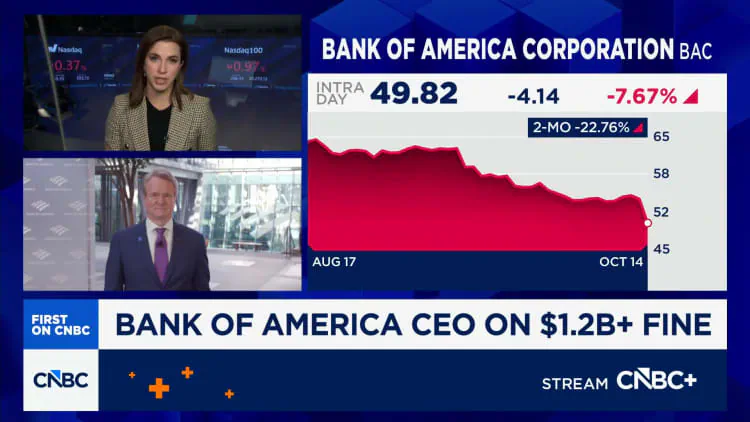
Bank of America hired 1,000 outside contractors to help patch software vulnerabilities exposed by advanced AI models, including Anthropic’s Mythos, CEO Brian Moynihan told CNBC. The contractors supplemented roughly 3,000 internal staff working in the area, according to CNBC’s October 14 report.
The outside workforce amounted to about one-third of the bank’s existing internal staffing in that area. It puts a staffing figure behind the additional work that more capable security models can create for organizations responsible for fixing the vulnerabilities they find.
Moynihan described a response to advanced AI models, with Mythos among them. His comments do not establish that Anthropic found every vulnerability or provide a count of flaws discovered at the bank.
The Contractors Arrived in the Second Quarter
By the time Moynihan discussed the hiring in an interview following Bank of America’s third-quarter earnings release on October 14, 2026, the contractors had been working at the bank for months.
“We put on 1,000 contractors to help us do the patching work in the second quarter, and those people remain here today, helping us, on top of the 3,000 people we have in that area,” Moynihan said.
The work covered both the bank’s internal software and vendor code, CNBC reported. Remediation therefore extended to software Bank of America could not necessarily change on its own.
Together, the figures describe roughly 4,000 people across existing staff and outside contractors, not 4,000 new hires. Moynihan’s wording also does not establish that every internal employee worked exclusively on vulnerabilities discovered by AI.
Bank of America added capacity during the second quarter and still had those contractors in place when it reported third-quarter results. This was an ongoing staffing response, not a hiring plan awaiting implementation.
For security leaders, the duration is as relevant as the headline number. The bank needed sustained staffing beyond a brief assessment and immediate return to normal operations. The disclosure does not specify contractor hours, individual assignments or a completion date.
The Expense Figure Is Not a Standalone Mythos Bill
Moynihan also told analysts that software remediation and regulatory issues related to anti-money laundering compliance together cost the bank a “couple hundred million plus” during the third quarter.
That combined expense should not be presented as the cost of patching Mythos-discovered vulnerabilities alone. The reporting neither separates contractor fees from internal labor and other remediation expenses nor isolates software-security spending from anti-money laundering work. Dividing the figure by 1,000 contractors would produce a misleading estimate of contractor cost.
Bank of America’s response to AI-exposed software weaknesses contributed to a material spending increase, but the public disclosure does not provide a standalone security-remediation total.
Moynihan said he expected the spending to decline as the work progressed.
“Once you patch, you don’t have to patch as much. … The pipeline moves through,” he said.
The report provides no bank-specific vulnerability inventory, closure rate or remaining workload against which to test that expectation. It is not evidence that the backlog has already fallen.
Whether the contractors are primarily clearing an accumulated backlog, handling an increased ongoing flow of discoveries, or doing some combination of both also remains unclear. Each scenario has different implications for how temporary the additional staffing proves to be.
Glasswing Explains the Context, Not Every Bank Finding
Anthropic’s broader effort to give selected organizations access to Mythos Preview for defensive security work provides context for the disclosure. Reporting on Project Glasswing describes that restricted-access program and identifies Bank of America among its early banking participants.
The connection helps explain why Mythos appears in Moynihan’s account, without establishing a one-to-one relationship between Glasswing discoveries and the bank’s entire remediation workload.
Anthropic’s public vulnerability-disclosure data covers a different population: open-source software projects, not a published inventory of Bank of America’s systems.
As of October 2, 2026, Anthropic said it had disclosed 6,157 vulnerabilities across 591 open-source projects, according to its coordinated vulnerability disclosure dashboard. The company attributes those findings to Claude models, including an early snapshot of Claude Mythos Preview. They are not all Mythos-only discoveries.
Anthropic says it works with external security research firms to reproduce and assess findings before reporting confirmed vulnerabilities to maintainers. Its dashboard also describes a direct-disclosure route in which some findings reach maintainers without the same independent check, including when maintainers request untriaged reports.
A model-generated candidate, an independently validated vulnerability, a report delivered to a maintainer and a deployed fix represent different stages of the process. Those distinctions are necessary to interpret the headline total.
Anthropic said that, to its knowledge, 516 of the disclosed vulnerabilities had been patched as of the dashboard’s October 2 update. That is not enough information to label every other disclosed finding an outstanding, confirmed, exploitable flaw. Patch reporting can lag, and the dashboard notes that some valid findings may fall outside a project’s threat model or receive a “won’t fix” decision.
An upstream patch also does not establish that organizations using the affected software have installed it. Anthropic explicitly distinguishes a maintainer releasing a fix from that fix being widely deployed.
None of these open-source totals should be treated as a count of vulnerabilities at Bank of America.
Discovery and Remediation Have Different Capacity Limits
Independent human triage and review are a rate-limiting step in Anthropic’s disclosure process, according to its dashboard. The company says there are additional findings that it or its security partners have investigated and confirmed but have not yet reported to maintainers because of capacity limitations.
Bank of America’s disclosure concerns a later stage: putting people to work on remediation. These are different workloads, yet both show why model performance alone cannot measure the effectiveness of an AI-security program.
A candidate finding still needs assessment. Someone must determine whether it is real, whether affected code is present in the organization’s environment and how urgently it should be addressed. A fix then needs testing and deployment.
For internally developed software, the organization may be able to change the code directly. Its options for vendor software can depend on a supplier’s release schedule, available mitigations and the consequences of changing or disabling the affected component. These are general operational constraints, not a description of Bank of America’s undisclosed patching procedures.
The bank’s contractor figure measures one large institution’s staffing response. It is useful on those terms, but it does not establish how many people another organization should hire per model, per application or per vulnerability.