
A 10-second video generated in 12.45 seconds would make waiting for the next take a much smaller part of an AI video workflow. That is the performance fal reports for FLUX 3 Max, its new post-trained video model, alongside introductory pricing of $0.0425 per output second at 720p.
On its FLUX 3 Max launch page, marked updated October 18, 2026, fal Research describes the model as built with Black Forest Labs on FLUX 3. Both text-to-video and image-to-video endpoints are available through fal’s hosted API. The launch price is 75% below the listed $0.17 per second and runs through November 7.
The immediate opportunity is practical: developers can evaluate two video-generation workflows at a relatively low introductory cost. The more ambitious claims need qualification. fal’s speed figures are vendor-reported, and its quality ranking comes from a preliminary Artificial Analysis image-to-video arena snapshot. Neither establishes how the model will perform across a production application’s requests.
Two Launch Endpoints Cover Prompts and Starting Images
FLUX 3 Max launches with separate routes for generating video from a text description and animating a starting image:
| Workflow | Endpoint ID |
|---|---|
| Text-to-video | black-forest-labs/flux-3-max/text-to-video |
| Image-to-video | black-forest-labs/flux-3-max/image-to-video |
The text-to-video API page is the entry point for prompt-based generation. The image-to-video API page covers the starting-image workflow. fal says both use the same post-trained model at 720p and carry the same per-second price.
These are different product choices, even with a shared model underneath. Text-to-video suits workflows where the application starts with a scene description. Image-to-video lets the developer begin with an existing visual composition, then request motion. A storyboard tool, for example, could use the latter to animate a selected frame rather than regenerate its appearance entirely from text.
fal’s model API documentation specifies that endpoint IDs can be passed to its client libraries or appended to https://queue.fal.run/. That gives the following queue submission routes.
For text-to-video:
curl --request POST \
  "https://queue.fal.run/black-forest-labs/flux-3-max/text-to-video" \
  --header "Authorization: Key $FAL_KEY" \
  --header "Content-Type: application/json" \
  --data-binary @text-to-video.json
For image-to-video:
curl --request POST \
  "https://queue.fal.run/black-forest-labs/flux-3-max/image-to-video" \
  --header "Authorization: Key $FAL_KEY" \
  --header "Content-Type: application/json" \
  --data-binary @image-to-video.json
Set FAL_KEY to your fal API credential, and populate each JSON file using that endpoint’s documented input schema. These examples show the submission routes, not complete request payloads. The available documentation excerpts do not establish the exact field names, defaults, or supported options, so those should not be guessed.
The commands submit jobs to the queue rather than download completed videos. An application still needs to handle completion and retrieve the generated result. Keep credentials on the server, and validate each endpoint’s inputs separately rather than assuming that switching model IDs makes every request interchangeable.
The Discount Makes a 10-Second Clip Cost $0.425
fal lists the introductory 720p rate as $0.0425 per second of output video, compared with a $0.17 list price. The company says text-to-video and image-to-video cost the same, with no subscription or minimum.
The arithmetic is straightforward:
| Generated output | Launch rate | Listed standard rate |
|---|---|---|
| One 10-second clip | $0.425 | $1.70 |
| One minute of output | $2.55 | $10.20 |
| 100 clips of 10 seconds each | $42.50 | $170.00 |
These figures apply the published per-second rates. They are not estimates of the cost of producing an acceptable final shot.
That distinction matters for video generation. If a workflow needs several attempts before a clip is usable, the relevant production metric is cost per accepted result. A cheaper generation can still be expensive if motion errors, missed instructions, or inconsistent subjects force repeated retries.
The promotional window runs through November 7, 2026. Developers evaluating long-term economics should therefore record two budgets: the cost of testing during the promotion and the cost of operating at list price. At the published rates, the same volume costs four times as much outside the discount.
Check the cutoff time with fal before scheduling a large run on the final day. The cited launch information establishes the date, not a precise expiration hour or time zone.
Near-Real-Time Generation Does Not Mean Live Video
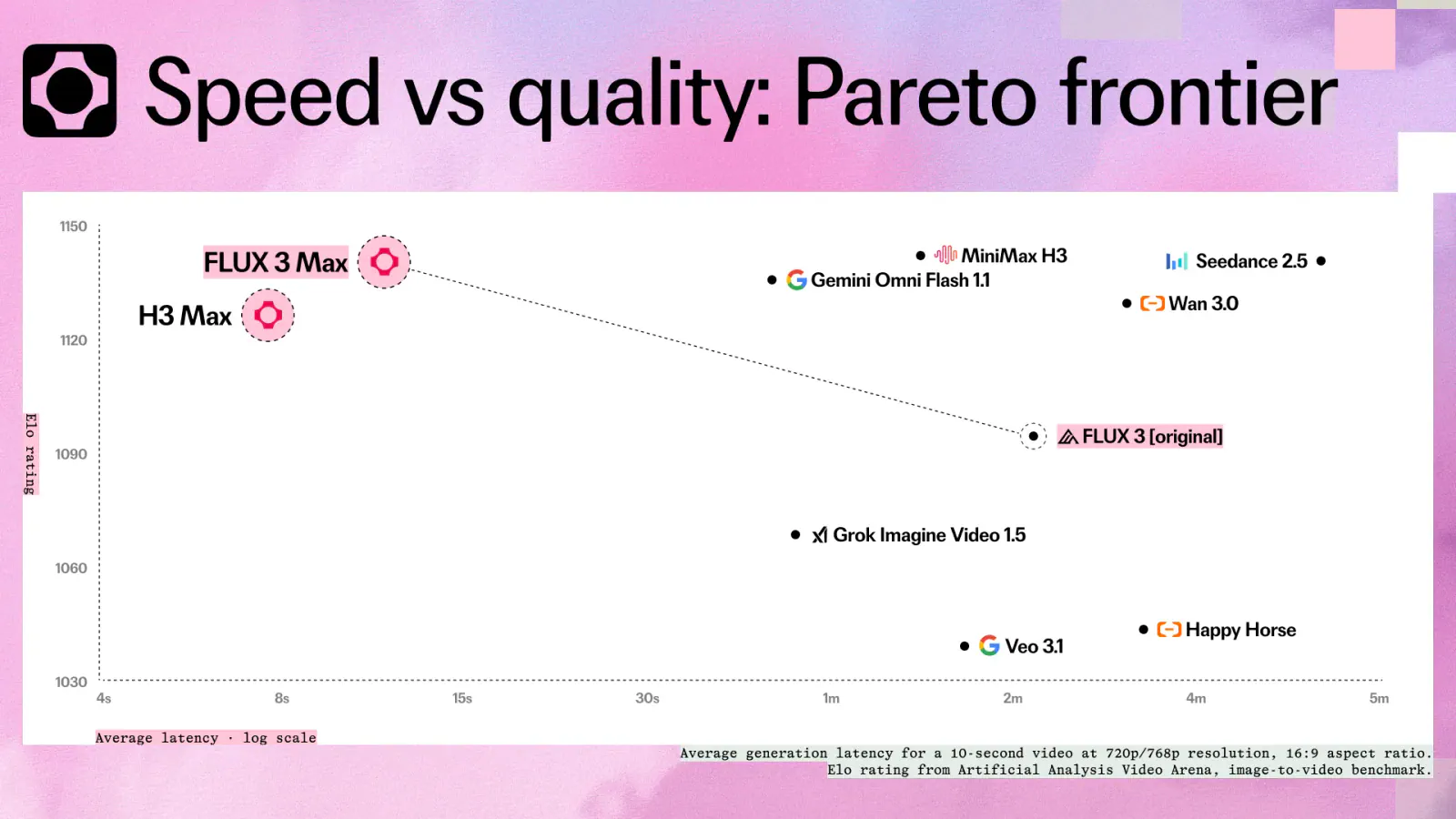
fal reports an average generation time of 12.45 seconds for a 10-second clip. That is approximately 1.25 seconds of generation time for each second of finished video, which supports describing the result as near-real-time clip generation.
It does not establish live, continuously streamed video generation. Nor does it promise that every API request will finish within 12.45 seconds.
For a developer, the useful consequence would be a shorter revision loop. A user could submit a shot, inspect the result, adjust the prompt, and request another version with less waiting between decisions. That could make generated video more practical inside an editing interface rather than only as a background batch job.
The comparison with the base model is substantial on fal’s figures. Its table puts FLUX 3 at 126.44 seconds for a 10-second video, versus 12.45 seconds for FLUX 3 Max, roughly a tenfold reduction.
fal also compares FLUX 3 Max with Seedance 2.5, listing 277.80 seconds for the latter. Dividing those reported times produces the advertised roughly 22-fold speed advantage.
Those ratios describe the published measurements, not guaranteed application performance. A developer’s user-facing wait also depends on queueing, input transfer, result retrieval, and other application work. The table reports averages for 10-second, 16:9 videos at 720p or 768p, so it is not a uniformly identical-resolution comparison either.
Measure the entire request path before building a response-time promise around the headline number.
The Quality Ranking Is Preliminary and Image-to-Video Only
fal reports 1,139 Elo for FLUX 3 Max in Artificial Analysis’s preliminary AA-Video-I2V v1.1 arena. Its launch page describes the model as tied for first in image-to-video quality.
The qualification behind that wording is important. fal’s table lists MiniMax H3 at 1,141 Elo, numerically above FLUX 3 Max. The company explains that FLUX 3 Max’s confidence interval overlaps the leaders.
Sources
- FLUX 3 Max launch pagefal.ai
- text-to-video API pagefal.ai
- image-to-video API pagefal.ai
- model API documentationfal.ai