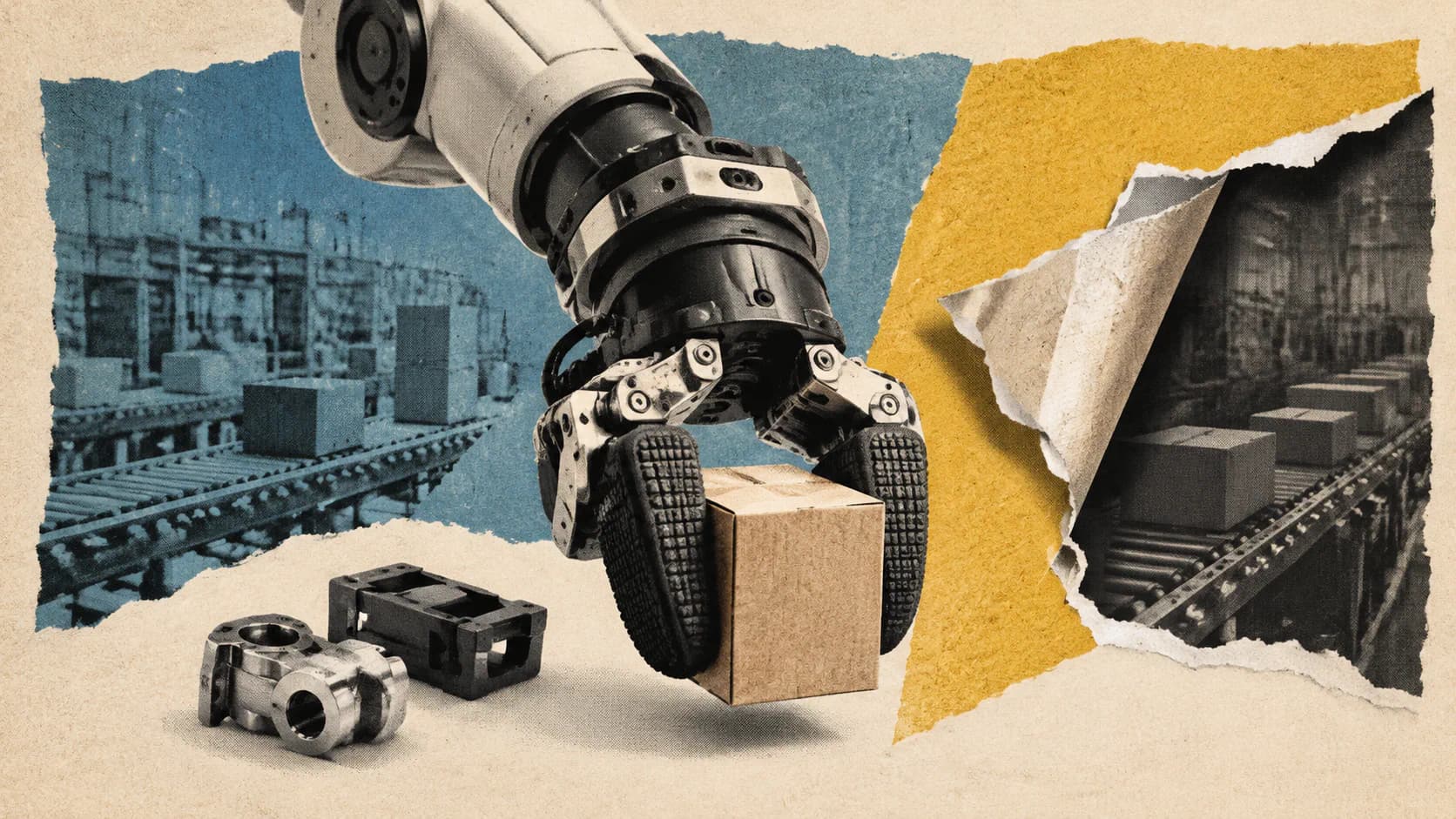
Eka Robotics claims its robot can pick about 1,500 objects an hour, handling items weighing up to one kilogram, and separately reports pick reliability above 95%. Those figures, reported by TechCrunch, are company claims, not independently benchmarked results under a published protocol.
Behind those numbers is Eka’s Vision-Force-Action model, which pairs visual perception with force feedback from a flexible gripper. The company trains manipulation policies through reinforcement learning in physics simulation, reducing its reliance on human demonstrations.
That combination targets a specific weakness in robotic manipulation: seeing where an object is does not necessarily tell a robot how to grasp it, respond when it slips, or push a connector into place without jamming. Eka’s technical bet is that contact should provide information throughout the action.
The evidence supports taking that approach seriously. It does not yet establish that Eka can sustain its reported performance across production shifts, equipment wear, and substantially different industrial tasks.
Force Feedback Addresses the Final Millimeter
Eka describes its Vision-Force-Action model as combining generality, performance, and safe interaction. Those remain company ambitions, not three independently established properties.
The control problem is concrete. Vision can help a robot locate an object and estimate its orientation. Once the gripper makes contact, the robot needs to distinguish between situations that may look similar: a secure grasp, an object beginning to slip, or resistance caused by a misaligned part.
Force feedback provides another observation of what is happening at that contact point. A controller can use resistance to adjust its motion instead of continuing along a planned trajectory or stopping at the first unexpected contact.
Eka co-founder Pulkit Agrawal’s “last millimeter” argument in TechCrunch’s reporting describes this transition from approaching an object to physically controlling it. It is not a published specification for positioning accuracy.
The hardware is part of the approach. TechCrunch reports that Eka developed a more flexible gripper with additional force sensing. Its investor says Eka designs the model, sensing, controller, and hardware together, allowing physical contact itself to inform subsequent actions.
A robot inserting a connector, for example, could use resistance to decide whether to rotate slightly or withdraw instead of simply applying more pressure. That adaptability is the intended advantage; the example does not establish Eka’s success rate across industrial connectors.