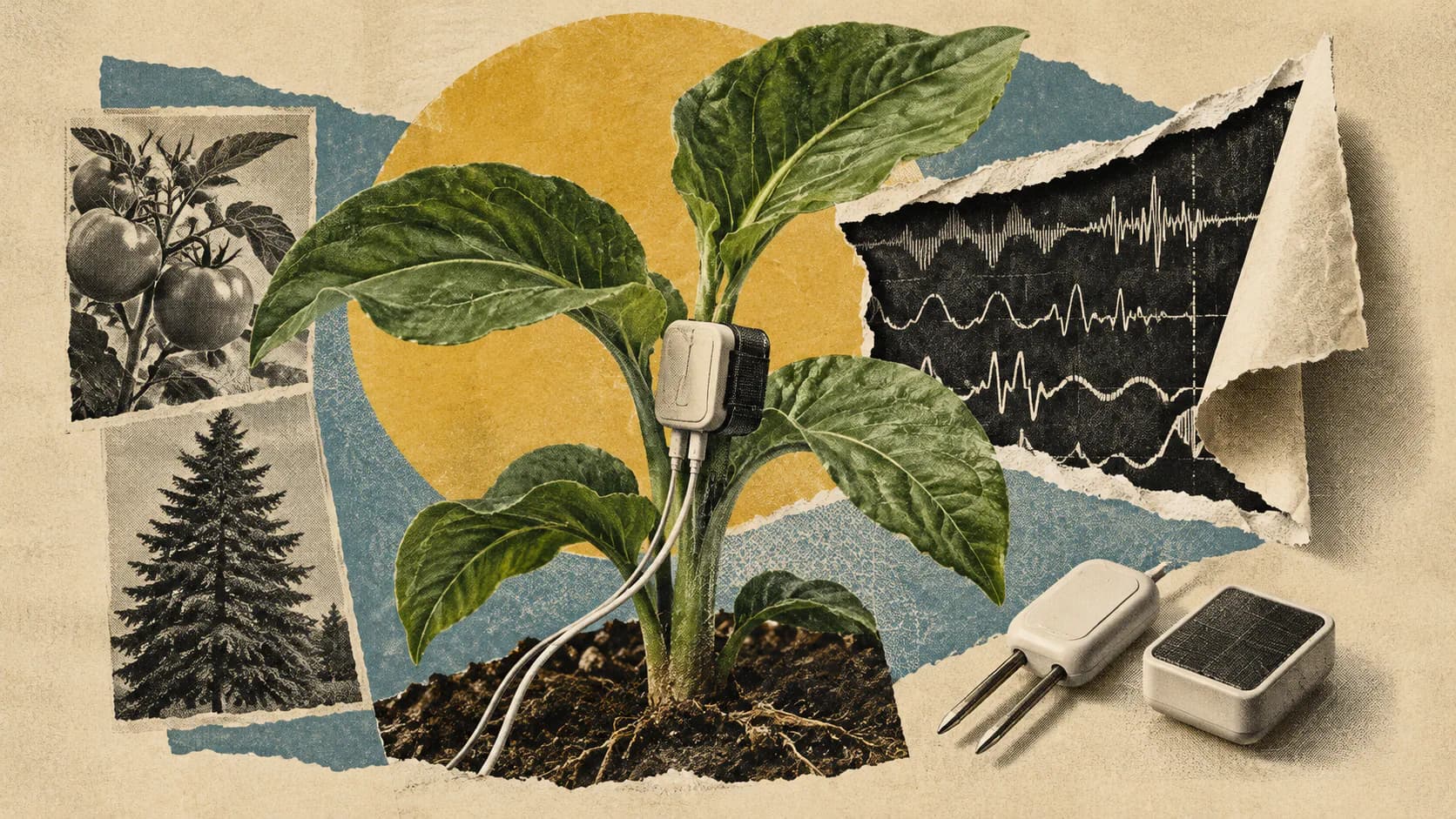
Electric Plant has pretrained Bombadil on more than four million electrode-hours across 100 species, according to its new white paper. The model estimates seven indicators of plant physiology from electrical recordings and is designed to detect changes in plant condition without requiring a separate model for every species and setting.
The approach is to learn reusable patterns in plant electrical activity, then connect those patterns to measurements associated with photosynthesis and transpiration. That could make continuous physiological monitoring more practical across agriculture, forestry and horticulture.
Electric Plant’s commercial ambitions extend further. The company wants inexpensive sensors and AI-generated insights to help operators adjust plant care, conserve water and improve yields. Its October 19, 2026 paper provides first-party evidence for parts of the sensing approach. It does not independently establish those downstream business or environmental benefits.
Bombadil Is a Signal Model, Not an LLM
Despite the language of “listening” to plants, Bombadil is not an LLM translating plant messages into words. It is a Transformer foundation model for electrophysiology: the measurement and analysis of electrical activity in living tissue.
Plants generate electrical signals in response to environmental conditions and damage. Electrodes inserted into signal-conducting tissue can record that activity, providing a continuous measurement from the plant itself rather than only its surroundings.
Those recordings are difficult to interpret. The paper describes weak signals vulnerable to electrical noise, differences between species, and responses that change with a plant’s previous exposure to stress. A waveform does not come with a simple label explaining its cause.
Bombadil uses self-supervised learning to address this. Continuous recordings are divided into 16-minute patches, each containing per-minute signal summaries. Those patches serve as tokens, with 90 covering a day. During pretraining, a reconstruction head learns to fill in masked portions of the signal without physiological labels. A separate task-specific head then learns to estimate physiological indicators from the shared representation, using paired reference measurements.
The resemblance to other foundation models is methodological, not linguistic. Large amounts of unlabeled data teach a reusable representation; a smaller labeled dataset connects it to a particular task. Additional applications would still need suitable training and evaluation. They would not appear automatically because the backbone is a foundation model.
The Corpus Matters More Than the Hours Alone
Electric Plant reports collecting more than four million electrode-hours from over 1,400 plants spanning 100 species and ten environments, including laboratories, greenhouses, commercial orchards and natural forests.
The recording volume is substantial, but the diversity is the more consequential part of the claim. A system trained only on one greenhouse crop might learn patterns specific to that crop, location or experimental setup. Training across species and environments is intended to make the representation more transferable.
Electrode-hours describe accumulated recording time, not millions of independently labeled stress events. Self-supervised pretraining can use recordings without knowing precisely what physiological state each interval represents.
The paper argues that this broad pretraining makes a shared model more useful as the monitored population becomes more varied. It also reports experiments involving species held out of pretraining. These are relevant tests of transfer, though they do not make the corpus universally representative.
Deployment in an unfamiliar species or environment remains a separate question. Prospective users need to consider how closely their intended deployment resembles the conditions in which Bombadil’s estimates were evaluated, alongside how many hours it saw.
Seven Indicators Do Not Mean Seven Stress Diagnoses
Bombadil’s demonstrated task is estimating physiological measurements, not identifying seven distinct causes of stress.
The paper’s stress-factor head targets five indicators assessed through chlorophyll fluorescence and two through leaf thermal characteristics:
| Indicator | What it represents |
|---|---|
| ΦII | Operating efficiency of photosystem II |
| ΦNPQ | Light energy dissipated through regulated non-photochemical processes |
| ΦNO | Light energy dissipated through unregulated non-photochemical processes |
| Fv′/Fm′ | Maximum photochemical efficiency of light-adapted photosystem II |
| LEF | Linear electron transport through photosystem II |
| LTD | Leaf temperature relative to air temperature |
| CWSI | Crop Water Stress Index |
These measurements describe aspects of how a plant handles light energy and water. Changes can provide evidence that its physiological condition is shifting, without necessarily identifying why.
A signal associated with impaired photosynthesis is not, by itself, proof of a nutrient deficiency, a particular chemical exposure or a specific irrigation problem. The paper itself notes that plant electrical recordings mix stimulus-specific and nonspecific components.
Electric Plant’s website discusses a much wider range of potential information, including nutrient needs, pest attacks and chemicals in groundwater. The seven-indicator task should not be treated as validation of every proposed application.
Estimating measurements continuously from installed electrodes could still reduce dependence on repeated manual readings. But an estimate of a physiological indicator, an accurate diagnosis and an effective treatment recommendation are three different things.
Cross-Species Transfer Has Several Meanings
The paper presents several kinds of evaluation, each supporting different conclusions.
Tests of the foundation model include reconstructing masked spans and forecasting signal continuation in species excluded from pretraining. These assess whether the model captures electrical signal structure; they do not directly establish accurate stress diagnosis.
The physiological head is also evaluated on whether it tracks changes within plants undergoing restricted irrigation. Water stress dominates the company’s data collection, making it the principal setting for evaluating the seven indicators.
For species without labeled examples, the authors report that the model can estimate those indicators. They also find that calibration improves every stress factor.
“Without labels” and “never encountered during pretraining” are not interchangeable. A species can appear in unlabeled recordings without contributing paired physiological measurements. The paper addresses both kinds of transfer, but a broad claim about reading unfamiliar species can conceal that distinction.
The non-drought experiments require particular caution. Electric Plant tested responses to increased salinity and glyphosate toxicity, but the authors state that those tests lacked ground-truth MultispeQ readings. They therefore describe them as directional rather than quantitative validation. Outputs moving in an expected direction provide suggestive evidence of transfer; without corresponding reference measurements, those experiments cannot establish how accurately the model estimated each physiological factor.
All of these results are company-authored. They support further investigation, but should not be presented as independently replicated performance across arbitrary crops, stressors or field conditions.
Low-Cost Sensors Are Only Part of the Deployment Cost
Electric Plant combines Bombadil with its own sensing hardware. The paper identifies Bud for outdoor sites and Stem for laboratory and greenhouse settings. The company’s product offering adds an insight layer of dashboards, alerts and agents, alongside on-site installation and calibration. This is a sensing-and-software system, with the model as one component.
Sources
- new white paperelectricplant.co
- company’s product offeringelectricplant.co
- TechCrunch’s reportingtechcrunch.com