Dream Labs has opened a public API that accepts robot observations and a natural-language task, then returns actions for the robot to execute. The company advertises Dream-1 access from $3 per hour and says compatible robots can begin performing tasks without robot-specific demonstrations or fine-tuning.
That makes this a concrete model release for robotics developers to investigate, rather than simply a promise about future capabilities. Dream Labs calls Dream-1 a World Action Model and claims it can transfer to unfamiliar robots, tasks, and environments.
The qualification matters: its stated out-of-the-box scope is bimanual robots with parallel grippers, not arbitrary machines. The launch materials also do not establish independently reproduced reliability, inference latency, or safety certification. Developers should treat this as a research-beta service to evaluate under controlled conditions, not proof that safe, general-purpose robot autonomy has arrived.
The API Connects Visual Observations to Physical Actions
The input-to-action workflow is straightforward at the conceptual level. According to the Dream Labs product page, a developer sends camera images, the robot’s current state, and a task. Dream-1 returns actions for the robot to execute.
For example, a task might ask the robot to put an object into a container. The instruction describes the objective; the visual observations and robot state provide information about the current situation. The model’s output is intended to drive physical behavior rather than merely explain how the task could be completed.
That is the important distinction from a typical conversational LLM API. A plausible answer is insufficient when the output must move hardware accurately.
The research announcement includes a condensed Python client example. It initializes a client with an API key, selects the dreamlabs/dream-1 policy, supplies an observation, requests an action, and closes the client.
That example establishes the basic service interaction, but it is not a complete integration specification. It does not, by itself, explain every required observation field, the action representation, timing requirements, or how a developer should handle a failed request.
Those details determine how much engineering sits between an API call and a functioning robot. A public endpoint removes one access barrier; it does not demonstrate that every compatible-looking machine can be connected without calibration, interface work, or local controls.
For developers, the first practical question is therefore narrower than whether Dream-1 can perform an impressive task: can their existing control stack reliably supply the required inputs and execute the returned actions?
Zero-Shot Transfer Comes With a Hardware Boundary
Dream Labs’ strongest claim is that Dream-1 can control previously unseen robots without collecting demonstrations from those robots or fine-tuning the model for them.
This is a claim about embodiment generalization: transferring learned capabilities across different robot bodies. It is distinct from completing a new task on hardware the model already knows.
The potential benefit is substantial. If a developer can obtain useful behavior before building a robot-specific training dataset, a new platform becomes easier to evaluate. Teams could spend less effort establishing a baseline and more effort measuring where the model succeeds or fails.
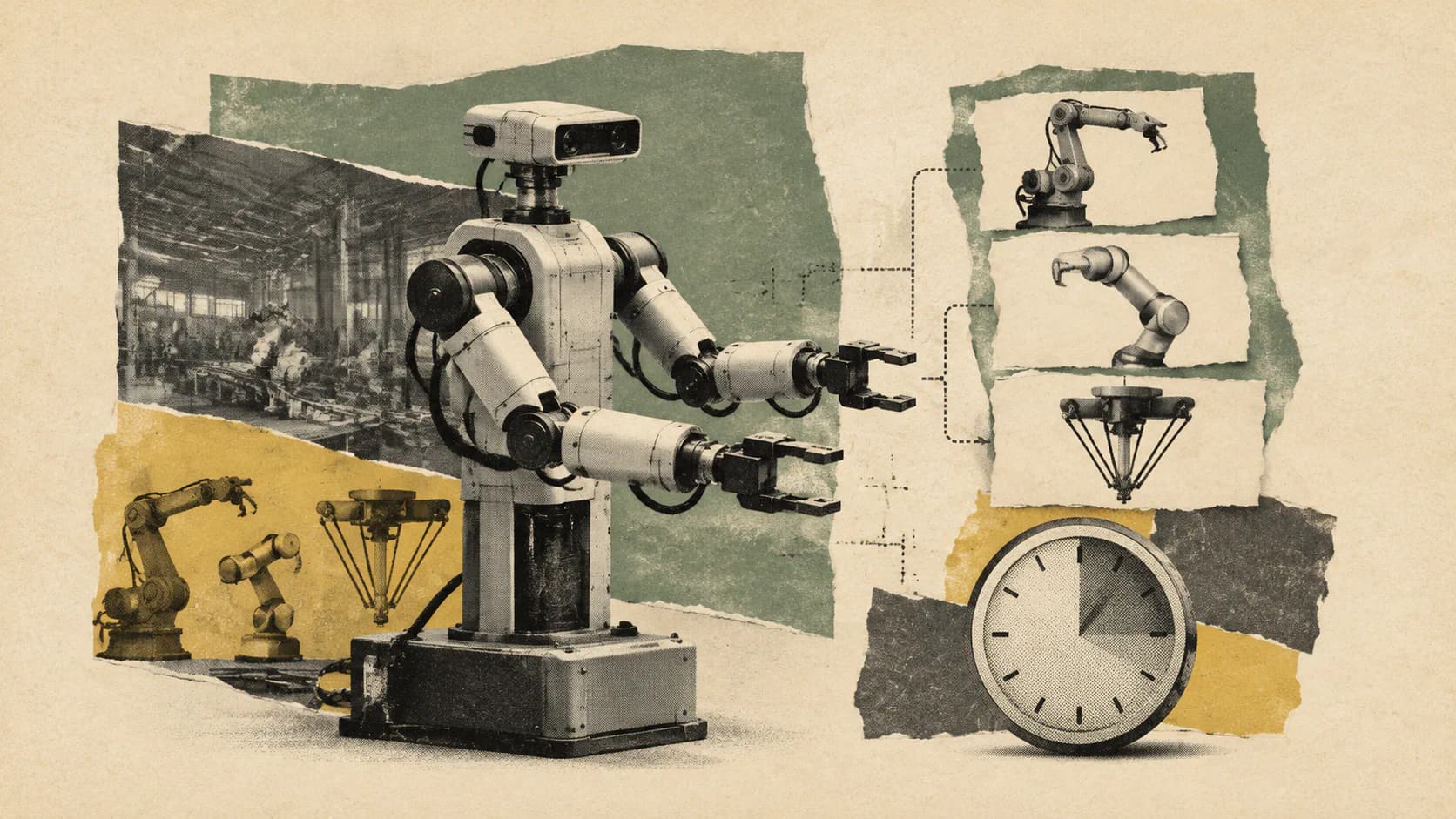
But Dream Labs does not describe unrestricted transfer. Its research announcement specifies new bimanual robots with parallel grippers. Bimanual means a two-arm configuration; parallel grippers are a particular gripping mechanism, not a substitute for every kind of robot hand or end effector.
Nothing in that stated scope establishes equivalent support for dexterous hands, arbitrary tools, legged locomotion, or whole-body control. A model that transfers among two-arm manipulation systems has not thereby demonstrated transfer to every robot category.
There is also a distinction within Dream Labs’ own materials worth preserving. The research announcement emphasizes starting without robot-specific data. The homepage separately describes adaptation using a few hundred demonstrations and offers a fine-tuning workflow in which users upload demonstrations and receive a model ID.
These statements need not conflict. Zero-shot operation can be an initial capability, while fine-tuning remains an option for adaptation. They do mean developers should avoid interpreting “no fine-tuning required to start” as a guarantee that every supported configuration will reach useful performance without further work.
Before choosing the service, a team should establish whether its exact configuration falls within the zero-shot claim or belongs on the adaptation path.
The Posted Price Is a Starting Rate, Not a Deployment Budget
The research announcement advertises Dream-1 from $3 per hour. That is the posted starting price, not evidence that every configuration or usage pattern will cost exactly $3 an hour.
The cited launch materials do not provide enough billing detail to calculate a complete operating budget. Developers still need to establish what counts as a billable hour, whether idle or connected time is charged, and whether fine-tuning or other services carry separate costs.
The API price also should not be confused with the cost of running a robot. Hardware, integration work, supervision, maintenance, and unsuccessful attempts belong in a deployment calculation even when they do not appear on an inference bill.
For early evaluation, a more useful economic question is how much it costs to complete a task successfully and repeatably. A low hourly rate is attractive, but its practical value depends on throughput, reliability, and the amount of intervention required.
Dream Labs also offers a browser-based Robot Playground for people without their own hardware. That provides another entry point for exploring the service, although access to a hosted robot does not establish compatibility with a developer’s own setup.
The Demonstrations Show Breadth, Not a Success Rate
Dream Labs presents demonstrations covering object handling and household-style tasks, including folding clothing, moving dishes, and placing objects into containers.
The presentation includes beta-tester material labeled as coming from 12 sites, alongside 18 in-house runs. A separate transfer section describes 27 unseen robots in simulation, with up to five selected rollouts each, and a real-robot collection containing 21 clips.
These categories should not be merged. Simulated robot embodiments are not physical deployments, and a count of clips is not a count of distinct supported platforms.
The playback labels also matter. Partner-site demonstrations are marked at 8× speed, while in-house demonstrations are marked at 4×. The transfer material includes accelerated playback as well. Those labels make the videos useful for inspecting behavior, but not for judging real-time task duration by watching them at presentation speed.
Most importantly, selected rollouts do not supply a success-rate denominator. A successful clip does not reveal how many attempts failed, how often an operator intervened, or whether the behavior remained reliable across repeated trials.
The launch materials cited here do not establish an independently reproduced performance result. Partner participation broadens the settings represented in the company’s presentation, but participation alone does not turn a demonstration into an independent benchmark.
A stronger evaluation would specify the robot configuration, task set, number of attempts, reset procedure, permitted interventions, completion criteria, and failures. For the zero-shot claim, it would also document what data from each tested robot was excluded from training.
Until that evidence is available, the defensible description is that Dream Labs reports cross-robot transfer and supplies demonstrations supporting its claim. The material is not sufficient to quantify how reliably a new customer’s robot will perform.
Developers Need a Bounded Trial, Not an Autonomy Assumption
The API’s availability changes what developers can investigate. Rather than judging only a launch video, eligible teams can attempt an integration and measure behavior on their own tasks.
A sensible evaluation should separate three questions:
- Compatibility: Can the robot supply the expected observations and execute the returned actions correctly?
- Capability: Can Dream-1 complete a clearly defined task across repeated attempts?
- Operational suitability: Can it do so within acceptable limits for timing, intervention, cost, and risk?
These are different tests. Passing the first does not establish the second, and a few successful task completions do not establish the third.
Initial trials should use bounded tasks and controlled surroundings, with local limits and a reliable way to stop motion. That is an evaluation recommendation, not a claim about safeguards Dream Labs has documented. The accessible launch material does not establish the service’s safety certification or failure-handling guarantees.
Latency deserves particular attention because this is a remote API returning actions for physical execution. Without published timing measurements, developers cannot infer responsiveness from accelerated videos or assume the service fits their control requirements.
Dream-1’s most consequential proposition is therefore testable but still unresolved: can one remotely served model give a new, compatible robot useful manipulation capabilities before that robot accumulates its own training dataset?
The public API creates a way to investigate that proposition. The next meaningful evidence is repeatable performance on clearly specified hardware, with failures and interventions reported alongside successes. Until then, the $3-per-hour starting rate is a price for evaluating a capability, not a guarantee of dependable autonomy.
Sources
- Dream-1 accessdreamlabs.ai
- Dream Labs product pagedreamlabs.ai