
Exa’s new Lite search tier costs $4 per 1,000 requests, compared with $7 for Auto. Developers building agents that repeatedly search the web can spend less per retrieval or pay for the additional computation Exa applies in Auto.
The Exa 3.0 announcement, published October 19, 2026, also makes Dynamic Highlights generally available and expands the company’s independent index. Exa says the upgraded highlights use 95% fewer tokens than full-page text, while the index adds broader coverage of shopping, local businesses, and real-time information.
These changes address different parts of an agent’s budget. Lite lowers the search API charge; highlights reduce the retrieved material passed to a language model. Neither, by itself, establishes that an agent will produce an equally good answer. Developers need to evaluate retrieval quality and content depth separately.
Lite Cuts the Base Search Price by About 43%
Lite and Auto use the same index, according to Exa. Auto applies more computation across candidate generation, highlights, and ranking. Exa positions it as the higher-quality option, while Lite targets cost-sensitive applications.
The API pricing documentation gives the following base rates:
| Search type | Price per 1,000 requests | Results included per request |
|---|---|---|
| Lite | $4 | Up to 10 |
| Auto | $7 | Up to 10 |
Lite’s base price is approximately 43% lower. At one million requests, the listed rates translate to $4,000 for Lite versus $7,000 for Auto, before additional results or other billable operations. That is a $3,000 difference in the search bill alone.
Each result above the first 10 adds $1 per 1,000 additional results. A developer asking for 20 results per request therefore pays for 10 extra results each time. Twice the material is not included at the headline price.
These prices cover individual requests. An agent that reformulates a query several times or searches repeatedly while answering one question will accumulate multiple charges for that research task.
Lite is attractive for high-volume discovery, but the relevant comparison is cost per satisfactory answer. If cheaper retrieval causes enough retries, the initial saving can shrink. If Lite finds the necessary evidence on the first attempt, paying for Auto may add cost without improving the application’s result.
Dynamic Highlights Target the Model’s Input Budget
Dynamic Highlights changes what an agent receives after search, beyond which pages it finds. Exa says the upgraded system selects tokens across the entire result set, allocates more to the best pages, and removes repeated information. Pages do not all receive an equal excerpt allowance regardless of usefulness.
The company reports 95% fewer tokens than full-page text, alongside improved answer quality. Both are vendor-reported findings. The cited announcement does not provide independent confirmation that the same reduction and quality gains will hold for a developer’s particular workload.
A 95% reduction in retrieved-page tokens is not a 95% reduction in an agent’s total token use or bill. System instructions, conversation history, other tool responses, and generated output remain. The financial effect depends on how much of the original workload consisted of full-page retrieval and which model processes it.
For AI products that collect evidence across many searches, smaller responses leave more context-window space for earlier findings and reduce the duplicate source material the model must process. Selective extraction also introduces a tradeoff: a passage useful to the eventual answer may not survive highlight selection.
A qualification elsewhere in a document, for example, could change how a highlighted claim should be interpreted. Highlights provide an efficient evidence layer, without guaranteeing that the agent has read everything relevant.
Exa says improved Dynamic Highlights are included at no additional charge. The separately priced Contents endpoint still has its own billing rules; not every content operation is free.
The Expanded Index Reaches Beyond General Web Documents
Exa says it runs its own crawler and independent index, tracking more than 2 trillion URLs and serving 100 billion pages. Those figures describe different things: tracked URLs should not be read as an equivalent number of pages available for retrieval.
The company attributes part of the Exa 3.0 improvement to adding billions of documents and expanding data partnerships. Its announced coverage includes:
- 1.27 billion ecommerce listings, with prices and availability.
- More than 211 million local businesses, with hours and ratings.
- Real-time news, sports, weather, and market data.
- Flights, local events, transit, and podcasts.
These are Exa’s reported coverage figures, not independently audited counts.
That coverage could support tasks beyond finding another article. A shopping assistant may need price and availability together, while a local-search agent may need opening hours and ratings. For travel and scheduling assistants, the usefulness of information depends heavily on freshness.
Broader coverage does not establish uniform freshness, completeness, or accuracy across every category. Nor does the announcement’s inclusion of “real-time” data prove that every returned record updates at the same frequency.
Developers will need to check whether the relevant fields appear reliably for their target queries and locations. A large global index cannot substitute for checking the particular merchants, businesses, or events an application depends on.
Exa’s Benchmark Lead Needs Workload-Level Testing
Exa describes 3.0 as its largest search-quality improvement and says it ranks first across the evaluations it tested, spanning public benchmarks, coding, finance, deep research, and company intelligence.
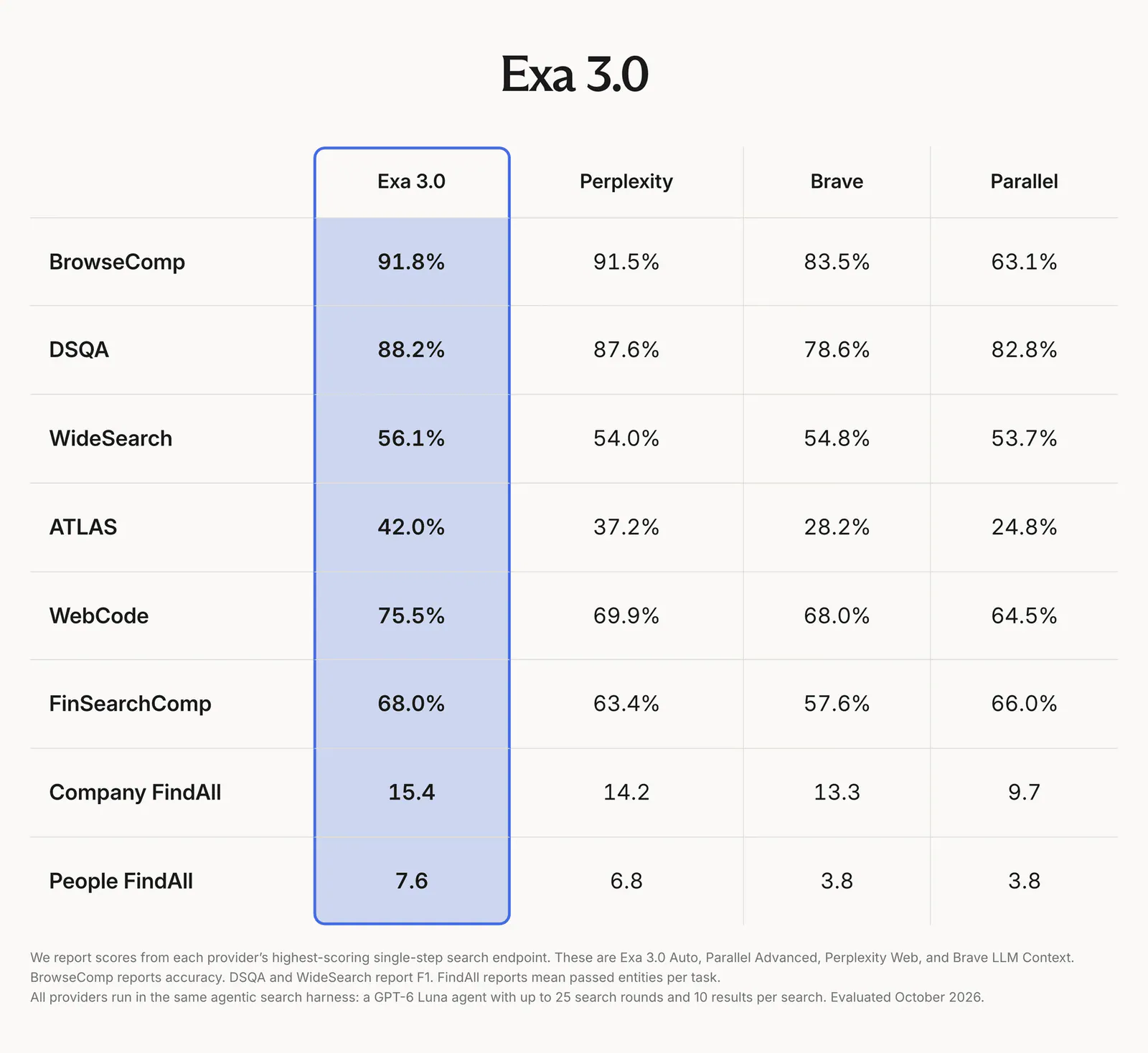
The company attributes the gains to a larger embedding model, improved highlights, and index expansion. It also says every search type benefits from the retrieval-stack improvements. These claims explain Exa’s product positioning, but do not independently establish that Lite or Auto is the best search choice for a particular agent.
Testing needs to answer two questions: does retrieval surface the right sources, and does the returned content preserve enough evidence for the model to answer correctly? Strong page ranking can still produce a weak answer if an essential passage is omitted. More complete content can be unhelpful if the source itself is irrelevant.
A useful evaluation should assess final answer correctness and source support, alongside latency, token consumption, and total cost. Checking only whether a relevant URL appears in the results would miss much of the tradeoff introduced by Dynamic Highlights.
Use the same query set for Lite and Auto, with content settings held constant. Otherwise, a change in excerpt size or retrieval depth could be mistaken for a difference in search quality.
Sources
- Exa 3.0 announcementexa.ai
- API pricing documentationexa.ai
- developer documentationexa.ai