Microsoft Targets Ignite for Offline AI Products | Zeniteq
Loading
Loading article
Microsoft Targets Ignite for Offline AI Products
Foundry Local and GitHub Enterprise Local are scheduled for general availability, while supporting sovereignty capabilities span previews, phased rollouts, and existing services.
Microsoft announced that Foundry Local and GitHub Enterprise Local will reach general availability at Ignite, bringing locally hosted AI models and development tools into customer-controlled environments including disconnected deployments. Other sovereignty capabilities including the Sovereign Control Panel, connected-to-disconnected workload transitions, DocumentDB, and Blob Storage on Azure Local are entering public preview, creating different readiness levels across the stack. Organizations evaluating these products must account for varying release schedules and dependencies, as local operation addresses operational control but does not automatically settle legal jurisdiction or guarantee independence from external services.
Foundry Local and GitHub Enterprise Local are both scheduled for general availability at Microsoft Ignite, according to the company’s October 20 sovereignty announcement. The releases would bring locally hosted AI models and AI-assisted development into customer-controlled environments, including disconnected deployments.
Other parts of the stack are still heading into preview. The Sovereign Control Panel is scheduled to enter public preview at Ignite, while connected-to-disconnected workload transitions, DocumentDB, and Blob Storage on Azure Local are also entering public preview.
Regulated organizations evaluating Microsoft’s AI products will need to account for those different schedules. Local inference could reduce dependence on external connectivity and keep sensitive processing within an environment they operate. The development tools, storage services, transition mechanisms, and oversight controls around that inference, however, have different levels of readiness.
Microsoft’s announcement turns sovereignty commitments into more concrete deployment choices. “Local” still carries no blanket guarantee of operational independence or legal immunity.
The Rollout Has Several Different Release States
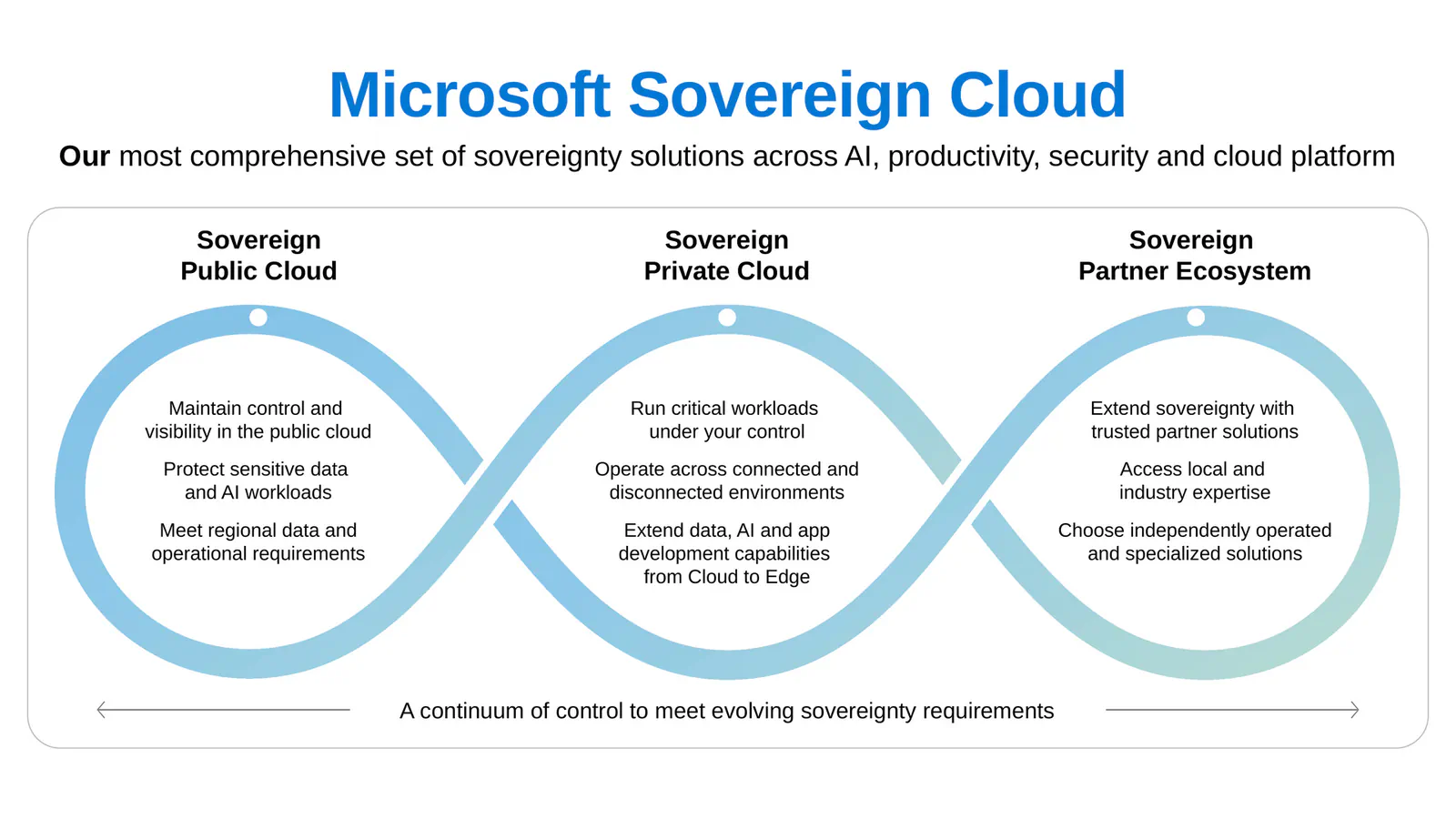
Microsoft describes Sovereign Cloud as a choice among public-cloud services, customer-operated private infrastructure, and partner-operated environments. Organizations can select different arrangements for different workloads without moving everything into one deployment model.
Within that strategy, the release-status map is more useful than a single “sovereign AI” label:
Capability
Announced status
Practical role
Foundry Local on Azure Local
General availability scheduled for Ignite
Run models in connected or disconnected customer-operated environments
GitHub Enterprise Local
General availability scheduled for Ignite
Keep repositories and development artifacts local, with locally hosted models available for Copilot inference
Sovereign Control Panel
Public preview scheduled for Ignite
Bring sovereignty controls, risks, and continuity-readiness signals into an Azure portal experience
Connected-to-disconnected workload transitions
Entering public preview
Work with Zeniteq
Let’s work together
We’re open to thoughtful collaborations with teams building in AI. Explore the ways we can work together.
Support changes between operating modes as connectivity or requirements change
DocumentDB on Azure Local
Entering public preview
Add a local database option
Blob Storage on Azure Local
Entering public preview
Add local object storage
SQL Server on Azure Local
Already generally available
Support connected and disconnected database deployments
External key management with Azure Managed HSM
Generally available
Keep the root encryption key on customer-operated or trusted third-party hardware
Data Guardian and Production Touch Ledger
Rolling out in the EU and EFTA
Add oversight and tamper-evident records for qualifying Microsoft engineer access
Procurement and architecture decisions should reflect these statuses. A planned GA release is not a present production commitment. A preview can support evaluation, but buyers still need to establish its support terms and suitability for their workloads.
Dependencies impose their own readiness constraints: Foundry Local reaching GA would not make a preview storage service or transition mechanism generally available.
Foundry Local and GitHub Bring More of the Workflow Inside
Foundry Local is the model-execution component of the announcement. Microsoft says its Ignite release will support connected and disconnected operation on Azure Local, with a catalog spanning Microsoft, partner, open-weight, and open-source models.
The company also describes local inference and agentic retrieval that let users ask natural-language questions about local enterprise data and receive responses grounded in that data. For a regulated organization, this could keep both the information source and the model processing within its controlled environment.
Model quality still requires evaluation. Organizations would need to test the available models against their own tasks, including answer accuracy, retrieval permissions, hardware requirements, and acceptable response times. The mixed catalog also calls for model-by-model licensing review; buyers cannot assume every model carries the same usage rights.
GitHub Enterprise Local addresses the development side. Microsoft describes it as a validated GitHub Enterprise Server appliance on Azure Local, intended to keep repositories, code, and development artifacts under local control. Developers can pair GitHub Copilot with locally hosted models for inference.
The combination is more consequential than either announcement alone. Keeping a repository on-premises does not necessarily keep AI processing there, and a local model does not bring the surrounding development workflow inside the same boundary. Microsoft is proposing to connect those pieces.
Buyers should verify which Copilot capabilities, models, and integrations their intended deployment supports. Parity with every hosted feature should not be assumed.
Disconnected Operation Needs a Dependency Plan
The Next Web’s reporting describes Foundry Local and GitHub Enterprise Local as capable of working fully offline. That supports the intended deployment direction, though the report covers announced capabilities and is not an independent audit of a disconnected production system.
Generating an answer without internet access is only part of the operational question. An application may also depend on identity services, databases, package repositories, monitoring, or external APIs. Any dependency outside the disconnected environment needs a deliberate solution.
Starting a system in disconnected mode also differs from moving an existing connected workload into that mode. Microsoft’s connected-to-disconnected transition capability is entering public preview. It should not be treated as proof that any Azure workload can automatically continue unchanged after losing connectivity.
A useful acceptance test would exercise the whole workflow: authenticate a user, retrieve authorized data, run inference, record the result, and recover from a failure while external connections are unavailable. Update delivery, security patches, and restoring connectivity need their own procedures.
DocumentDB and Blob Storage previews could bring more application dependencies onto Azure Local. Until those services meet an organization’s production requirements, the architecture must account for their preview status. Local storage cannot yet be treated as a completed part of the rollout.
Access Oversight and Encryption Address Different Risks
Microsoft’s public-cloud controls tackle concerns that local deployment alone does not answer: who can access a system, what they do, and who controls its encryption keys.
For customers in the EU and European Free Trade Association, the company says Data Guardian adds European-resident oversight by a trusted EU partner for qualifying Microsoft engineer remote access to in-scope production systems. Production Touch Ledger, also in phased rollout across those regions, creates tamper-evident records of that access and the actions performed.
The scope is qualified. This access-oversight mechanism does not promise universal coverage of every person, service, or access path. Tamper-evident records improve accountability, but do not themselves prevent every inappropriate action.
External key management with Azure Managed HSM is already generally available. Microsoft says customers can retain the root encryption key in hardware they own and operate on-premises or through a trusted third party, extending key control beyond Microsoft infrastructure.
Encryption-key custody concerns cryptographic authority; operator oversight concerns human access; audit records concern evidence. Buyers should assess each against a specific threat instead of treating them as interchangeable sovereignty guarantees.
The Sovereign Control Panel is intended to make these controls and gaps easier to understand through a unified Azure portal experience. Its planned public preview at Ignite offers an opportunity for evaluation. It is not yet a generally available foundation for compliance reporting.
Local Operation Does Not Settle Legal Jurisdiction
The strongest practical claim in this announcement concerns operational control: organizations can choose where certain systems run, where inference happens, and how much external connectivity they require.
Legal sovereignty requires a separate assessment. Keeping data and processing on customer-operated hardware can change an organization’s exposure, but physical location alone does not answer every question about applicable law, contracting entities, support access, or obligations involving technology suppliers.
External key custody likewise offers no automatic exemption from legal demands. Its significance depends on the architecture, who can access usable data, and the relevant legal framework. Hardware-based confidentiality controls address another technical risk without resolving every jurisdictional issue.
Microsoft itself presents the capabilities as controls that can support a broader sovereignty strategy aligned with legal, policy, security, resilience, and business requirements. That is a narrower and more defensible proposition than claiming sovereignty is a product setting.
The Buying Decision Should Follow the Whole Workload
For organizations preparing an Ignite evaluation, the first task is to define the boundary they need. Keeping inference local, surviving a network outage, restricting support access, and controlling encryption keys are different requirements, even when one deployment needs all four.
Every dependency then needs to be mapped to its release status and test conditions. A pilot should establish the supported model and hardware combination, the development features available locally, the storage architecture, and what happens when connectivity disappears.
The most meaningful test of Microsoft’s sovereignty push will be whether a complete workload can operate within a documented customer-controlled boundary. Foundry Local and GitHub Enterprise Local could make that boundary considerably more useful. How much independence an organization gains will still depend on the preview components, access scope, and legal arrangements.