Google Releases GlucoFM and Sets New AI Benchmarks for CGM
The lightweight dual-stream model learns from unlabeled glucose traces and improves metabolic prediction, post-meal forecasting, and cross-cohort transfer.
Last updated on
AI Summary
Google Research introduced GlucoFM on August 26, 2026, a compact foundation model that sets stronger benchmarks for learning reusable metabolic representations from continuous glucose monitoring data.
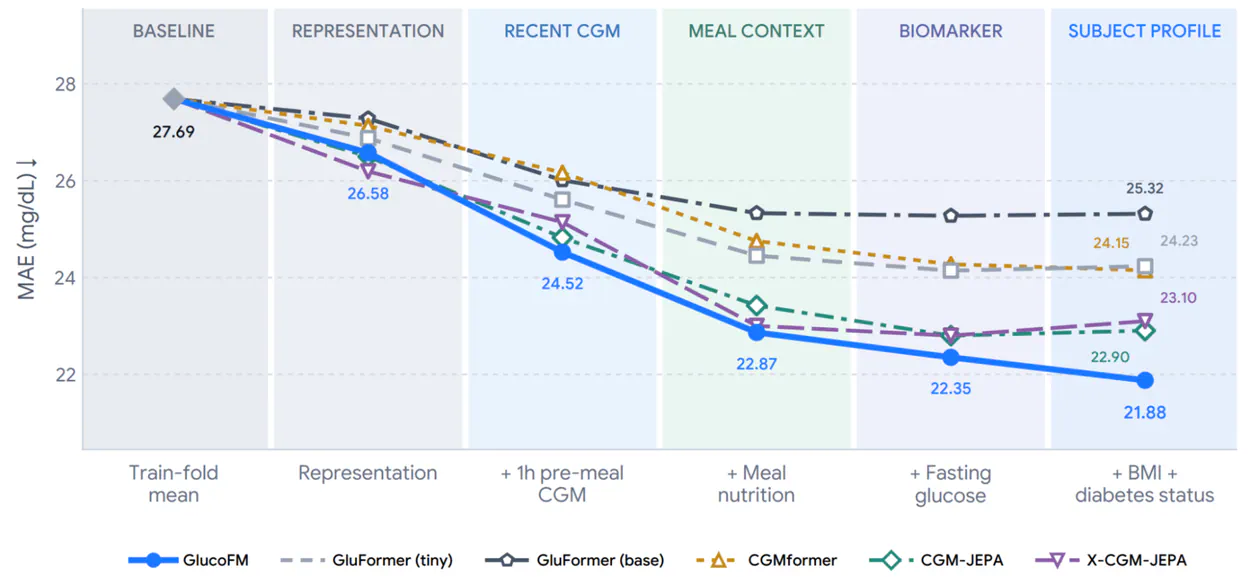
GlucoFM uses a dual-stream architecture for slow metabolic states and short-lived events, processing 24-hour traces as 288 five-minute readings and 24 hourly patches. Its 0.72-million-parameter encoder was self-supervised on 109,066 hours from five datasets using masked latent prediction. Across 14 cohort-task combinations, it achieved 58.8 PR-AUC versus 54.7 for the strongest comparable baseline. For two-hour post-meal forecasting, it reached 21.88 mg/dL mean absolute error, compared with 22.90 mg/dL for the best competitor.
The frozen encoder led 11 of 12 cross-dataset transfer tests and performed best at every few-shot data budget. However, results remain retrospective research benchmarks, the post-meal evaluation included only 874 meal events from 34 participants, and prospective clinical validation is still required before deployment.
Google Research introduced GlucoFM on August 26, 2026, as a foundation model built specifically for continuous glucose monitoring (CGM) data. Instead of treating each glucose reading as an isolated measurement, the model learns reusable representations of the physiological patterns that unfold across an entire day.
The research matters because CGM data are abundant but difficult to interpret at scale. Recordings vary across sensors and populations, contain gaps and artifacts, and rarely come with the clinical labels required for supervised AI training. GlucoFM addresses that problem through self-supervised pre-training on more than 109,000 hours of unlabeled glucose data.
This is not an LLM adapted to medicine. GlucoFM is a compact time-series model designed around the structure of glucose dynamics, with separate processing streams for slower metabolic states and short-lived deviations.
Google Turns CGM Traces Into Reusable AI Representations
A continuous glucose monitor estimates glucose levels in the fluid between cells and records readings throughout the day and night. Those measurements can expose patterns that a fasting test or occasional finger-stick reading cannot capture, including overnight behavior, glucose variability, and responses to meals or exercise.
Most previous CGM models were trained for a narrowly defined outcome or learned from one dataset. That makes them vulnerable to distribution shifts between studies, devices, and patient populations.
Google’s approach is closer to foundation modeling in language or vision: pre-train one encoder on a large volume of unlabeled data, freeze or adapt it, and reuse the resulting representation across multiple downstream tasks. According to the GlucoFM research paper, the encoder has only 0.72 million trainable parameters, while the complete pre-training system contains 1.18 million parameters.
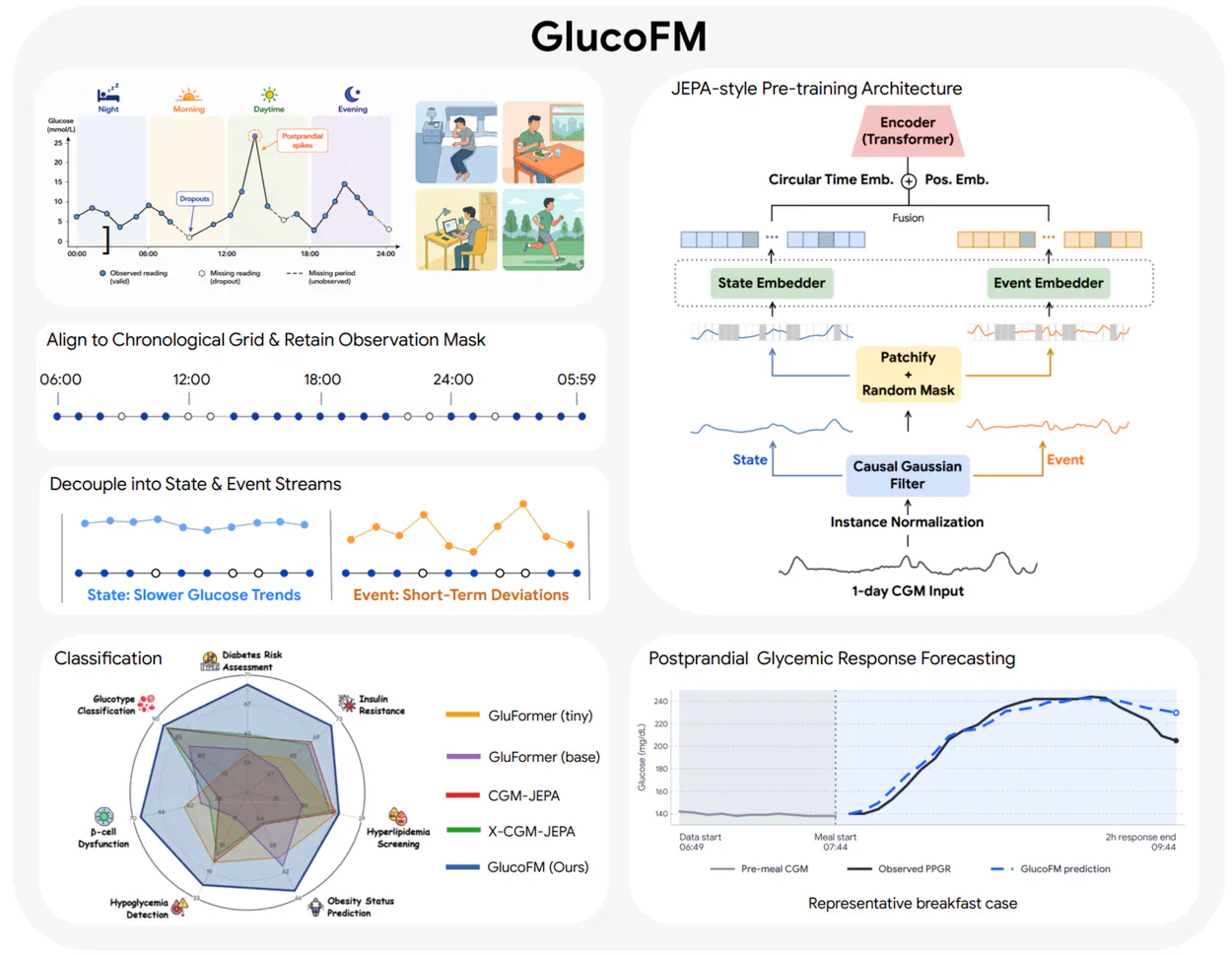
GlucoFM’s defining technical choice is its dual-stream architecture. A person’s glucose trace contains overlapping processes that operate at different speeds. Baseline levels may shift gradually over hours, while meals, medication, movement, stress, and sensor errors can produce sharper deviations.
The model divides these signals into:
A state stream for slower trends and baseline glucose regulation.
An event stream for shorter-lived deviations from that baseline.
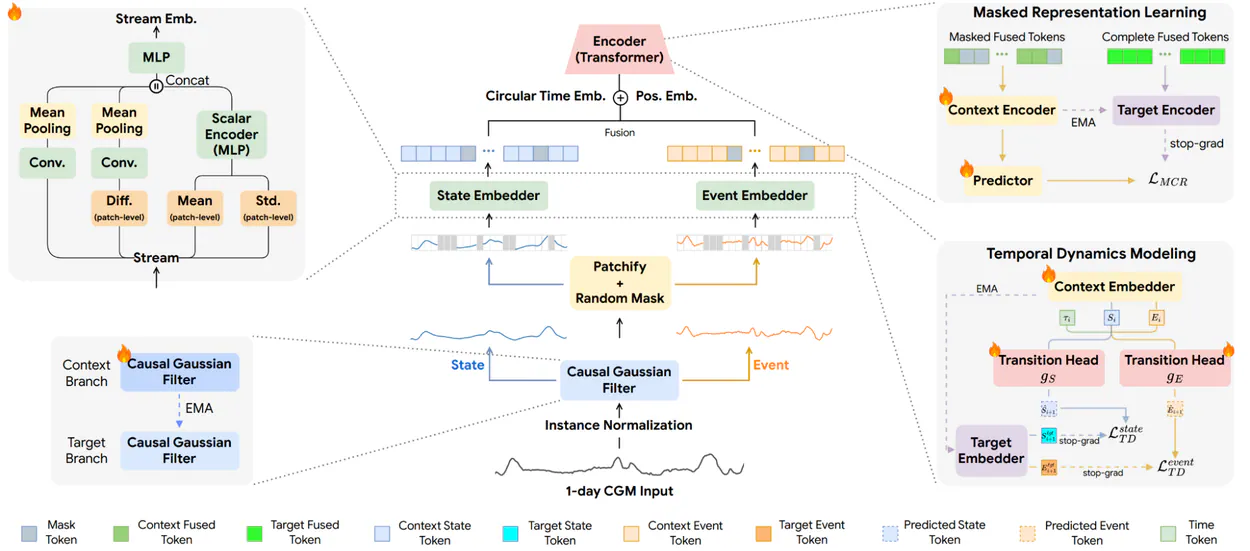
Before entering the model, each CGM recording is aligned to a 24-hour grid with readings every five minutes. That produces 288 positions per day. A learnable causal Gaussian filter estimates the slow-moving state component, while subtracting that estimate from the original trace creates the event component.
GlucoFM then divides each stream into 24 hourly patches. It embeds the state and event patches separately, combines their representations, and passes the fused sequence through a compact transformer encoder.
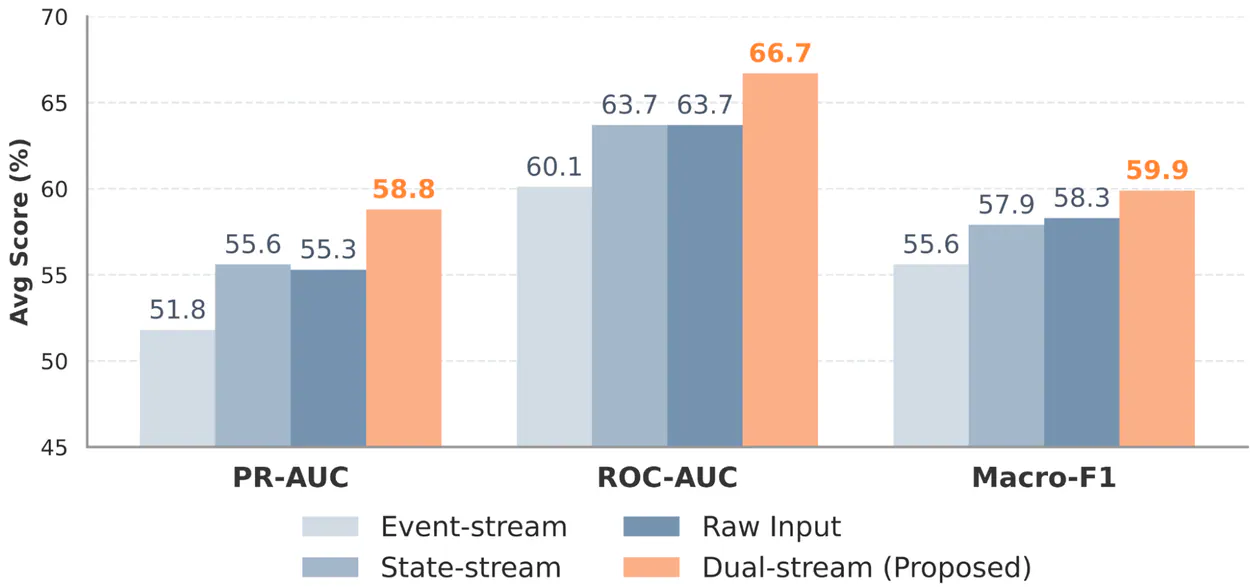
Ablation testing supports this design choice. Google reports that the event-only version produced the weakest results, suggesting that short-term fluctuations do not provide a stable metabolic representation by themselves. The complete dual-stream model outperformed alternatives based on raw glucose, state data alone, or simpler fusion methods across the evaluated metrics.
Self-Supervised Training Avoids Reconstructing Sensor Noise
GlucoFM uses a joint-embedding predictive architecture, or JEPA-style objective. Rather than reconstructing missing glucose values point by point, the model predicts latent representations of masked hourly segments.
During training, Google masked roughly 50% to 60% of the hourly tokens. A context encoder processed the visible segments, while a predictor attempted to infer representations produced by a slowly updated target encoder for the hidden portions. This pushes the model to learn broader physiological structure instead of copying individual measurements or fitting sensor noise.
Two additional objectives shape the representation. A temporal consistency loss encourages adjacent hourly embeddings to change smoothly, reflecting the continuous nature of glucose regulation. A cross-stream decorrelation loss discourages the state and event streams from learning redundant features.
The training pipeline also applies CGM-specific augmentations that simulate baseline drift, compression-like drops, missing readings, sparse sampling, and temporary sensor disconnections. GlucoFM was pre-trained on five datasets covering 109,066 hours and 477 dataset-defined participants or recording sessions.
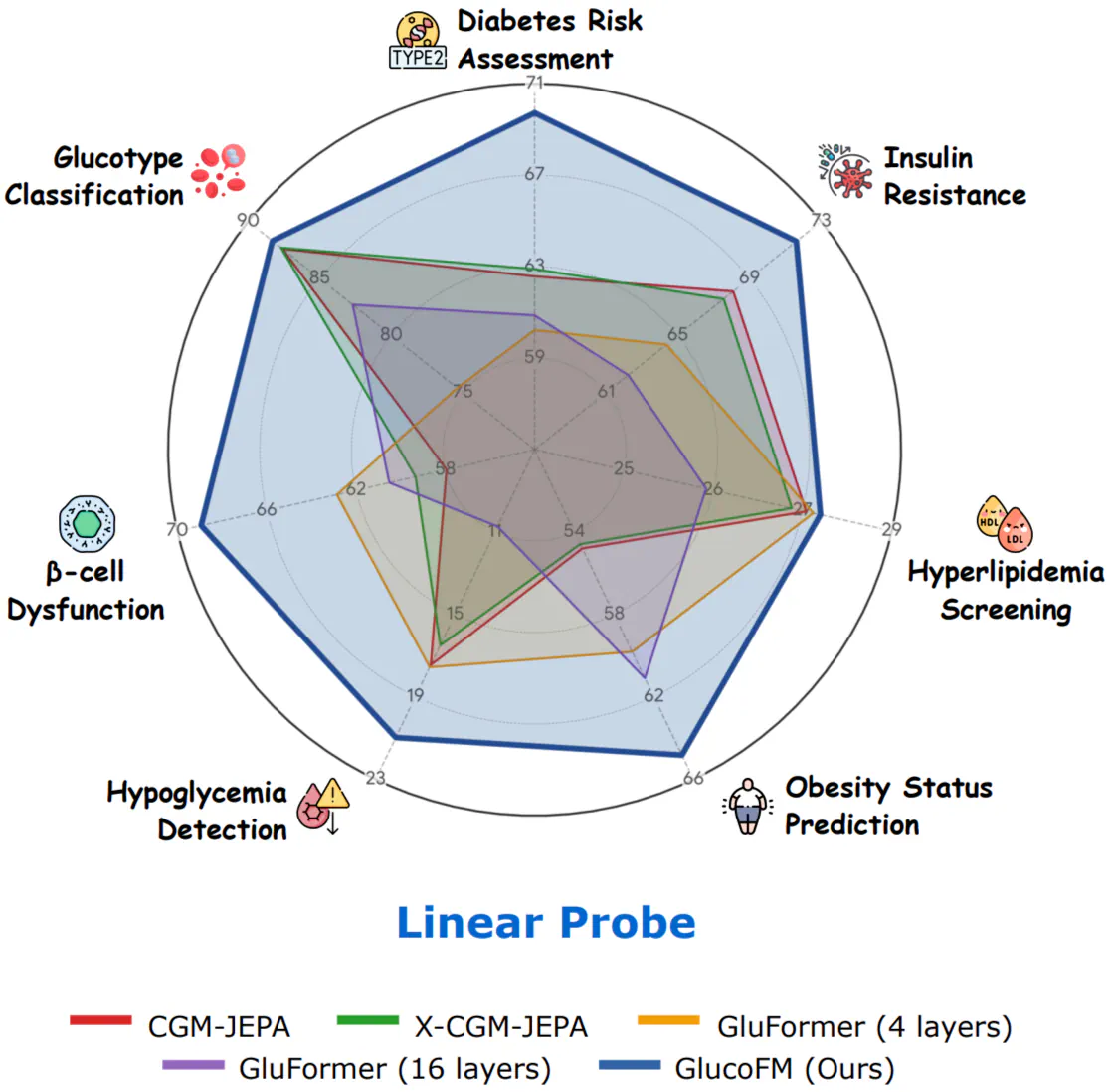
Google evaluated GlucoFM on seven metabolic prediction tasks across four downstream cohorts: CGMacros, Stanford, Hall, and ShanghaiT2DM. The targets covered diabetes risk, insulin resistance, beta-cell dysfunction, and related metabolic conditions.
In the controlled linear-probe evaluation, GlucoFM reached an average precision-recall area under the curve, or PR-AUC, of 58.8 across 14 cohort-task combinations. The strongest CGM-specific baseline trained on the same pre-training data scored 54.7. That is a 4.1-point absolute improvement, or approximately 7.5% relative to the baseline. GlucoFM led all evaluated diabetes-risk and beta-cell-dysfunction tests, along with three of four insulin-resistance tests.
The model was also tested on postprandial glycemic response prediction using 874 paired meal events from 34 participants wearing Dexcom and Libre sensors. The task required predicting the full two-hour glucose-change trajectory after a meal.
With pre-meal CGM, meal nutrition, fasting glucose, body mass index, and diabetes status as context, GlucoFM achieved a mean absolute error of 21.88 mg/dL. The best competing model reached 22.90 mg/dL, while a simple training-fold mean baseline scored 27.69 mg/dL. The improvement over the strongest model was modest, but GlucoFM also recorded the lowest error across all four evaluated post-meal endpoints.
These are retrospective research benchmarks, not clinical validation. PR-AUC also depends heavily on class balance and evaluation design, so the headline scores should be interpreted within the paper’s specific datasets rather than as universal measures of diagnostic accuracy.
GlucoFM’s strongest case is not that it wins one benchmark. It is that the same frozen encoder remains useful across cohorts, tasks, and limited-data settings.
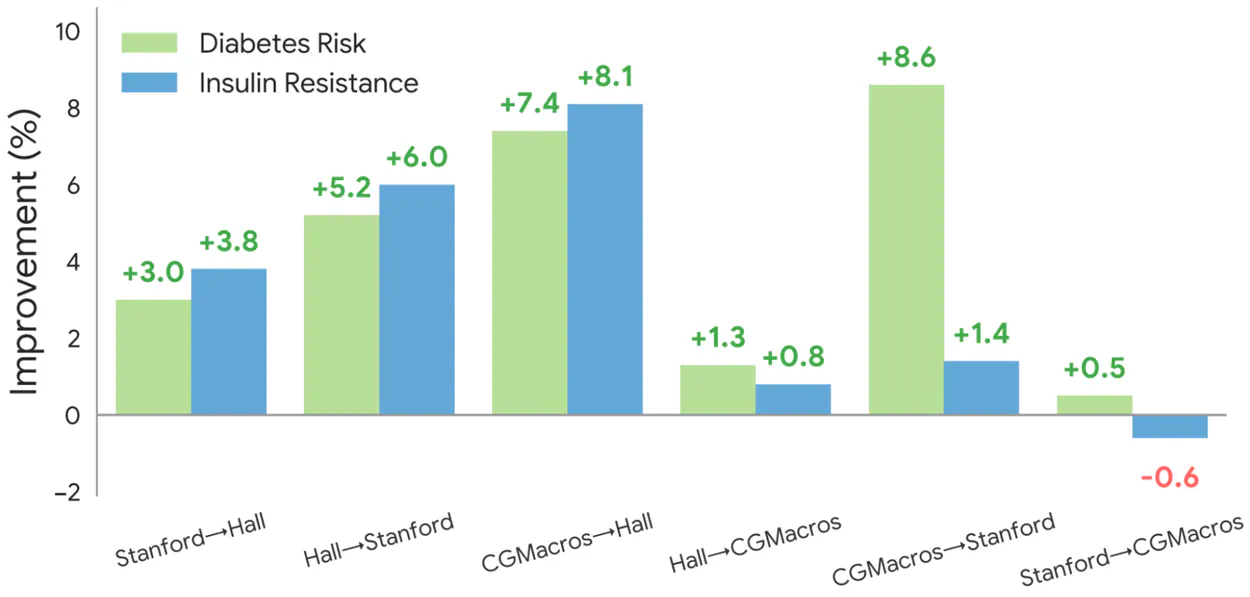
In cross-dataset transfer tests, Google trained a downstream classifier on one cohort and evaluated it on another without adapting the encoder to the target dataset. GlucoFM produced the best result in 11 of 12 transfer directions, exceeding the strongest baseline by between 0.5 and 8.6 PR-AUC points. It trailed by 0.6 points in the remaining direction.
The few-shot results follow the same pattern. GlucoFM recorded the highest task-averaged PR-AUC at every tested data budget, including settings with only one labeled participant per class or 1% of each participant’s observations.
That efficiency is important for medical AI because high-quality labels often require laboratory tests, clinician review, or carefully controlled studies. A representation that adapts from a handful of labeled examples could make smaller clinical datasets more useful, although prospective testing would still be required before deployment.
Google also found that combining representations from multiple CGM days generally improved participant-level predictions. Gains reached 9.6 PR-AUC points for beta-cell dysfunction in the Stanford cohort and 14 points for diabetes risk in the Hall cohort, though not every task benefited from simple averaging.
GlucoFM Is Research, Not a Diagnostic Product
GlucoFM does not diagnose diabetes, prescribe insulin, or replace a clinician. Google’s evaluation estimates whether learned CGM representations contain signals associated with metabolic outcomes in retrospective datasets.
The paper acknowledges several limitations. The pre-training population remains modest compared with large clinical datasets, each 24-hour window is encoded independently, and the experiments do not establish long-term predictive or clinical utility. The post-meal study is also based on only 34 paired-device participants.
Sensor differences remain another concern. GlucoFM performed well across data from multiple CGM systems, but real deployment would require more extensive validation across hardware generations, calibration procedures, patient demographics, medications, eating patterns, and healthcare settings.
The August 26 announcement did not provide a downloadable checkpoint or public repository. The paper says Google plans to release pre-trained models, code, and reproducibility scripts, but researchers cannot yet independently reproduce the complete result from the announcement alone.
Final Thoughts
GlucoFM is technically interesting because it avoids two common excesses in medical AI: treating every task as a separate supervised problem and assuming that a useful foundation model must be enormous. Its dual-stream design embeds a defensible assumption about glucose physiology, while its small encoder makes broader research use more practical.
The next test is independent validation. If GlucoFM’s transfer and few-shot advantages survive new cohorts, prospective studies, and external reproduction, the model could provide a useful common layer for CGM research. Until then, its contribution is a strong modeling result rather than evidence for a deployable clinical system.
Frequently Asked Questions
5 questions
1
What is Google GlucoFM?
Google GlucoFM is a lightweight AI foundation model for continuous glucose monitoring data. It learns reusable representations from unlabeled 24-hour glucose traces and applies them to tasks such as diabetes-risk assessment, insulin-resistance prediction, beta-cell dysfunction classification, and post-meal glucose forecasting. Its encoder contains approximately 0.72 million trainable parameters.
2
How does GlucoFM analyze glucose data?
GlucoFM separates each glucose trace into two streams: a slower state component representing baseline trends and an event component representing short-term deviations. It processes both streams as hourly patches, combines their representations, and uses a transformer encoder trained to predict the latent features of masked portions of the day.
3
How accurate is GlucoFM?
GlucoFM achieved an average PR-AUC of 58.8 across 14 metabolic prediction evaluations, compared with 54.7 for the strongest CGM-specific baseline trained on the same data. In post-meal trajectory prediction, it recorded a mean absolute error of 21.88 mg/dL. These figures come from retrospective research datasets and do not establish clinical diagnostic accuracy.
4
Is GlucoFM available to download?
GlucoFM was not publicly downloadable when Google announced the research on August 26, 2026. The paper says the team intends to release pre-trained checkpoints, code, and reproducibility scripts, but the initial Google Research post links to the publication rather than a public model repository.
5
Can GlucoFM diagnose diabetes?
GlucoFM cannot currently diagnose diabetes or make treatment decisions. It is a research model evaluated on retrospective prediction tasks involving diabetes risk and other metabolic outcomes. Clinical use would require independent replication, prospective validation, safety testing, regulatory review, and integration with additional medical information beyond CGM readings.