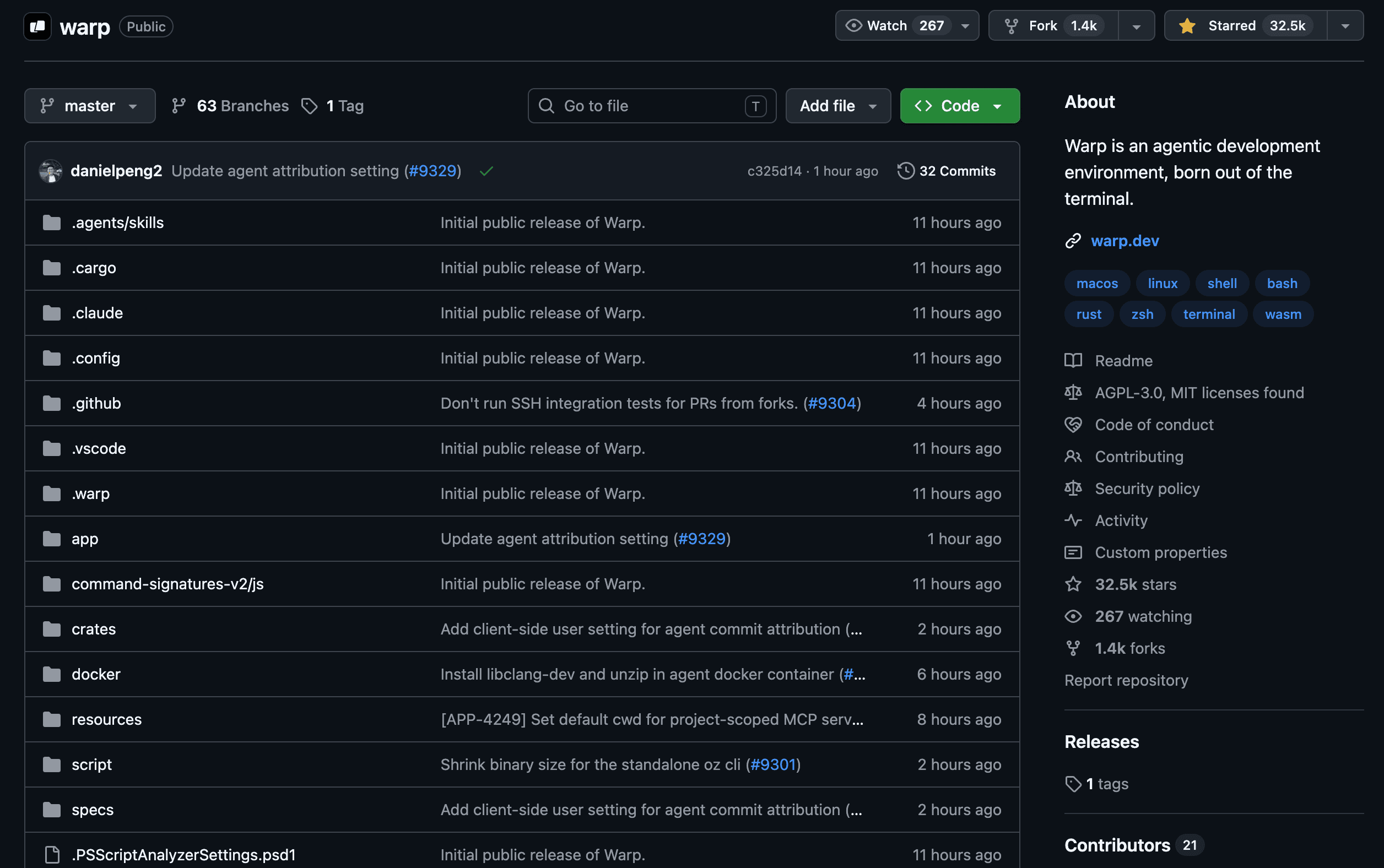
Warp has announced a fundamental change in how it builds its product: the Warp client is now open source, and the community can participate in building it using an agent-first workflow managed by Oz, its cloud agent orchestration platform. For a tool that spent years fielding community requests for exactly this, the timing is deliberate.
When Warp first launched as a terminal five years ago, the plan was always to open source the client. The team debated it every year, and this year it finally became clear that the balance had shifted because of the rise of agents. That context matters. This isn't a pivot forced by competition. It's a calculated bet on a different model of software development.
Today, Warp is used by nearly one million developers at companies including Docker, Ramp, and Peloton, as well as leading AI labs, Big Tech, and over half of the Fortune 500. Opening the codebase at this scale carries real stakes.
What Warp Actually Is
Warp was built to solve two problems the team kept hitting while writing software: terminals haven't kept up with how developers work today, and agentic development tools don't scale beyond your laptop. Warp is a modern terminal built for coding with agents.
What began as a reimagined terminal is now an agentic development environment (ADE) paired with Oz, a cloud-based platform for running and orchestrating coding agents at scale, with built-in visibility and control.
You can use Warp's built-in agent Oz, or run CLI coding agents like Claude Code, Codex, or Gemini CLI. The terminal itself is the interface. Oz is the engine underneath it.
The License and What It Covers
Warp's client codebase is now available on GitHub under the GNU Affero General Public License v3 (AGPLv3). This strong copyleft license ensures that anyone who modifies and distributes the Warp client, or makes it available over a network, must also release the source code of their modifications under the AGPLv3. For developers, this means full transparency and the freedom to audit, inspect, and modify the core terminal application.
One important caveat: the server portion of Warp will remain closed source for now. Oz, the cloud orchestration platform, stays proprietary. The client is open. The infrastructure that runs agents at scale is not.
How the Agent-First Contribution Model Works
This is the part worth paying close attention to. Warp isn't just open sourcing the code and stepping back. It's building a structured workflow where AI agents handle the bulk of implementation.
The primary reason is that Warp thinks it can ship a better product, more quickly, by working with the community to supervise a fleet of agents. The biggest bottleneck to development is no longer writing code. It's all the human-in-the-loop activities around the code: speccing the product and verifying behavior. Agents can handle the implementation heavy lifting really well, which frees contributors to focus on the higher-leverage work of shaping what gets built and making sure it's right.