You upload a screen recording with a voice memo, and you want back a summary, a cut-down clip, or a spoken answer. Which of today's multimodal generative AI models can actually do that? The answer depends on two things most model pages bury: what each model accepts as input and what it can produce as output.
We compared five models using their official model pages, launch posts, and pricing tables as of November 18, 2026. We didn't run the models ourselves, and every price comes from the vendor's own page.
This list is for AI enthusiasts and builders picking a model for a real project. For each one you'll see its inputs and outputs (text, image, audio, video), where it's strongest, its trade-offs, and what API access costs. The order isn't a ranking. It runs from a general-purpose reasoning model to video, voice, and open-weight options, so you can jump to the job you care about.
1. Gemini 4 Hydrogen
Best for: Builders who need one model to read text, images, audio, video, and PDFs at low cost.
Google released Gemini 4 Hydrogen on November 12, 2026 as the fast, everyday member of the Gemini 4 family. The heavier Gemini 4 Carbon and Argon handle long reasoning jobs, while Hydrogen is built for quick execution. It's also the one Google rolled out widely, across the Gemini app, Search, Google AI Studio, and the Gemini API.
On paper, it's the most flexible reader on this list. Google's model page lists text, image, video, audio, and PDF inputs, with text as the only output. That same page shows a context window of 1,048,576 tokens, enough to hold a long meeting recording plus its slides in one request.
Key capabilities for multimodal work:
- Agentic video understanding: Supported, so an agent can watch and reason about clips
- Computer use: Supported, for agents that click through software
- Long output: Up to 65,536 tokens by default, or up to 1,048,576 with long decode
- Grounding: Google Search and Google Maps grounding are both supported
- Image and audio generation: Not supported, so pair it with another model for media output
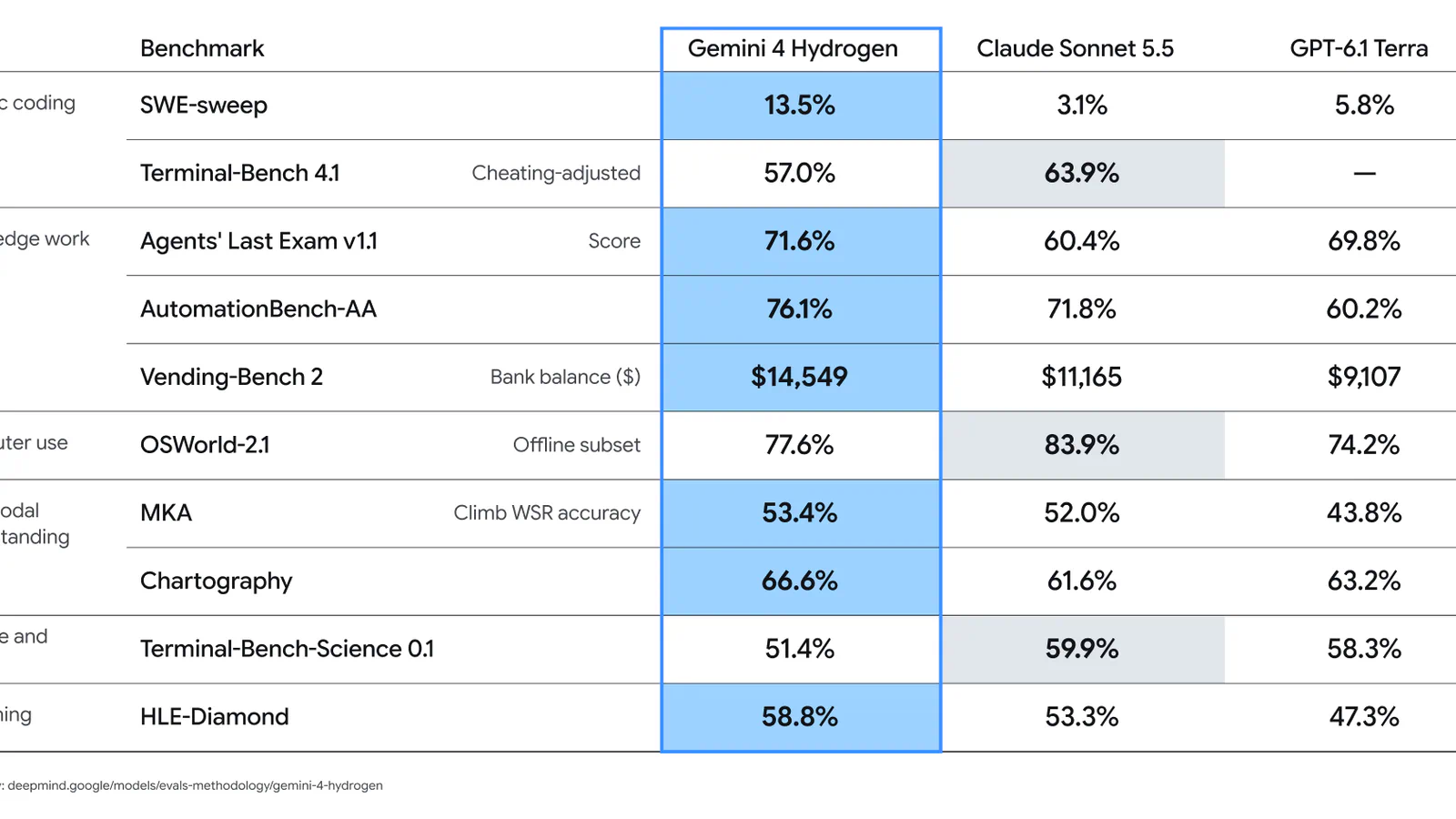
Where Hydrogen shines is reading mixed media. On Google's own benchmark table, it scored 53.4% on MKA and 66.6% on Chartography, both listed under multimodal understanding, ahead of Claude Sonnet 5.5 and GPT-6.1 Terra on those two tests. Google also says Hydrogen reaches 51 on the Artificial Analysis Intelligence Index at its default setting, edging out Argon's 50.
Pricing is simple. Google charges $1.50 per million input tokens and $7.50 per million output tokens, flat across the full context window. There's also a free tier in the API, though free-tier prompts may be used to improve Google's products.
The catch is the output side. Hydrogen can't speak back, draw, or render video, and its model page lists the Live API as unsupported, so real-time voice apps need a different model. It also trails Claude Sonnet 5.5 on the OSWorld computer-use test in that same table (77.6% versus 83.9%). Before you commit, check whether your app needs anything besides text coming out.
2. Gemini Omni 1.2 Flash
Best for: Creators and app builders who want to generate or edit short videos with sound from mixed references.
Gemini Omni is Google DeepMind's "create anything from any input" model, and its first output is video. The model page describes turning any reference, image, text, video, or audio, into a single output. The current API version, Gemini Omni 1.2 Flash, generates and edits up to 15 seconds of video with native audio.
It's the only model here that produces video. You can edit through plain conversation, and each change builds on the last one, which keeps a scene consistent over several turns.
Key features for video work:
- Conversational editing: Swap objects, change camera angles, or restyle a scene step by step
- Multimodal references: Use images, audio, and up to three seconds of reference video
- Frame control: Set the first and last frames of a shot
- Scene extension: Extend clips to build longer stories
- Resolution options: Draft at 360p, then upscale to 1080p or 4K
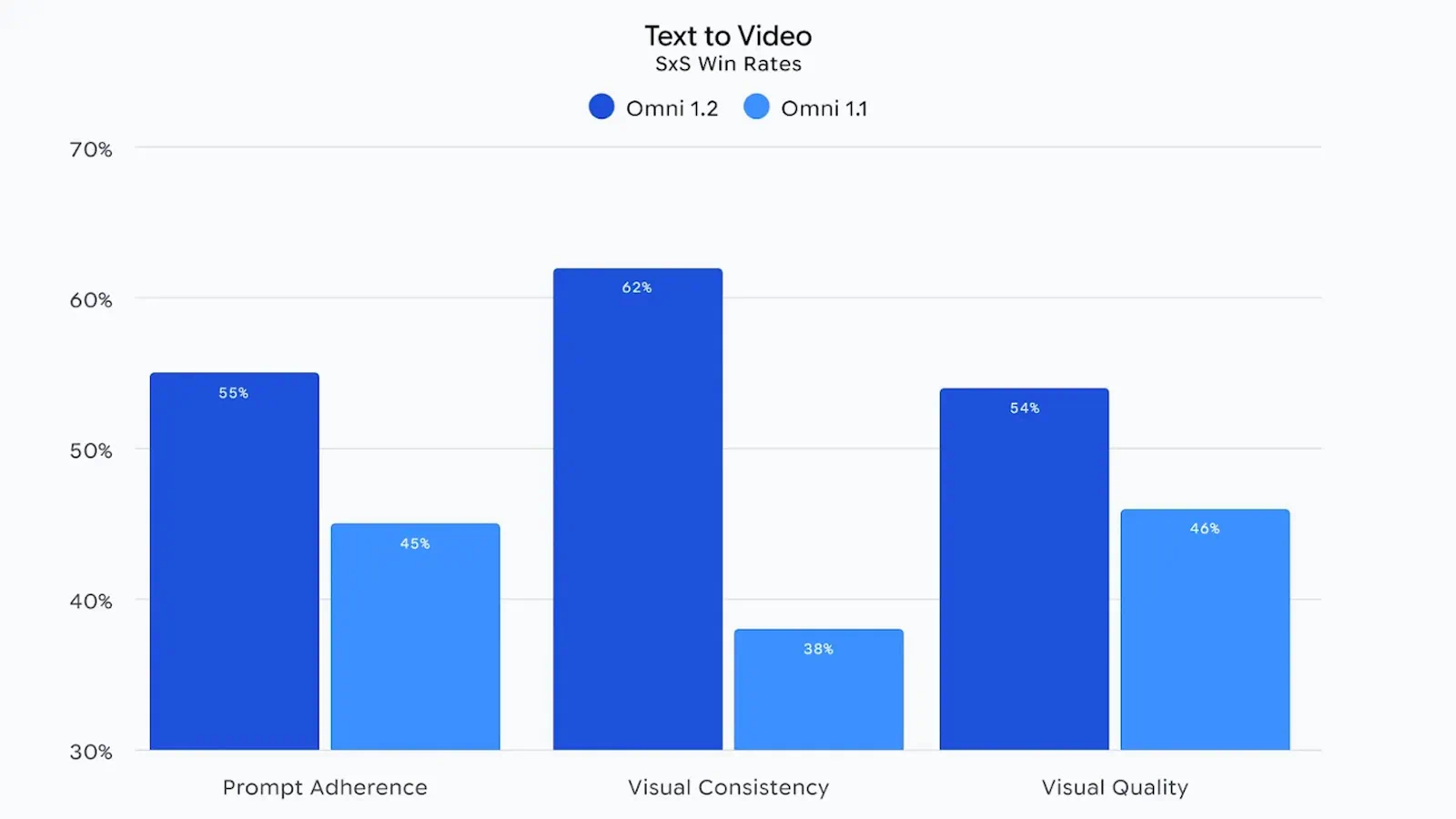
Google's own side-by-side tests show 1.2 beating 1.1 on text to video, including 62% versus 38% on visual consistency. Those are Google's numbers against its own older model, so treat them as a measure of progress. They don't tell you how Omni stacks up against rival video models.
The pricing is per token, but Google translates it into seconds. On the Gemini API pricing table, Omni 1.2 Flash costs:
- Input: $1.50 per million tokens for text, image, and video
- 720p video output: About $0.07 per second, or roughly $0.70 for a 10-second clip
- 360p drafts: About $0.023 per second
- 4K upscaled output: About $0.209 per second
So a 15-second 720p clip runs about $1.04, and five draft rounds at 360p before one 720p final would cost roughly $2.77. That's cheap for prototyping, but it adds up if your app renders thousands of clips a day.
There's no free API tier for Omni, and clips top out at 15 seconds per generation. If you need minutes-long footage, plan on extending scenes and stitching them together. Also note that Gemini Omni 1.1 Flash requests start routing to 1.2 on December 3, 2026, so update any code that pins the older name.
3. GPT-Realtime-2.1
Best for: Teams building voice agents that listen, look at an image, and answer out loud in real time.
OpenAI's GPT-Realtime-2.1 is a speech-to-speech model for live conversation. OpenAI says it improves on GPT-Realtime-2 with better alphanumeric recognition, silence and noise handling, and interruption behavior. That's the stuff that breaks phone agents in practice: misheard order numbers, a dog barking, or a caller cutting in mid-sentence.
Its modality list is short and clear. Text goes in and out, audio goes in and out, images go in only, and video isn't supported. It has a 128,000-token context window and supports function calling, so a voice agent can look up an account or book a slot while it talks.
Key features for voice apps:
- Speech to speech: Hears and answers in audio without a separate transcription step
- Image input: A caller's photo or screenshot can join the conversation
- Configurable reasoning effort: Trade a little latency for better answers on hard turns
- Tool use: Function calling for real actions during a call
OpenAI also says it cut p95 latency (the slowest 5% of responses) by at least 25% across Realtime voice models through better caching. For a voice agent, that tail latency is what callers notice as awkward pauses.
The pricing is where you'll want a calculator. From OpenAI's model page and launch post, per million tokens:
- GPT-Realtime-2.1 text: $4.00 input and $24.00 output
- GPT-Realtime-2.1 audio: $32.00 input and $64.00 output
- GPT-Realtime-2.1 image input: $5.00
- GPT-Realtime-2.1-mini audio: $10.00 input and $20.00 output
Audio output at $64 per million tokens is the priciest line on this whole list, and the mini model cuts it by more than two-thirds. There's no free tier for the full model in OpenAI's rate-limit table. The model page also lists a knowledge cutoff of September 30, 2024, so pair it with a search or retrieval tool for anything recent. If you can live with somewhat weaker reasoning, price out the mini first.
4. Qwen3.5-Omni
Best for: Multilingual voice and audio-visual apps where cost per audio minute matters.
Alibaba's Qwen team released Qwen3.5-Omni on March 30, 2026, as its newest "omnimodal" model. It understands text, images, audio, and audio-visual content and talks back with streaming speech. The series comes in Plus, Flash, and Light sizes, all with 256k-token context.
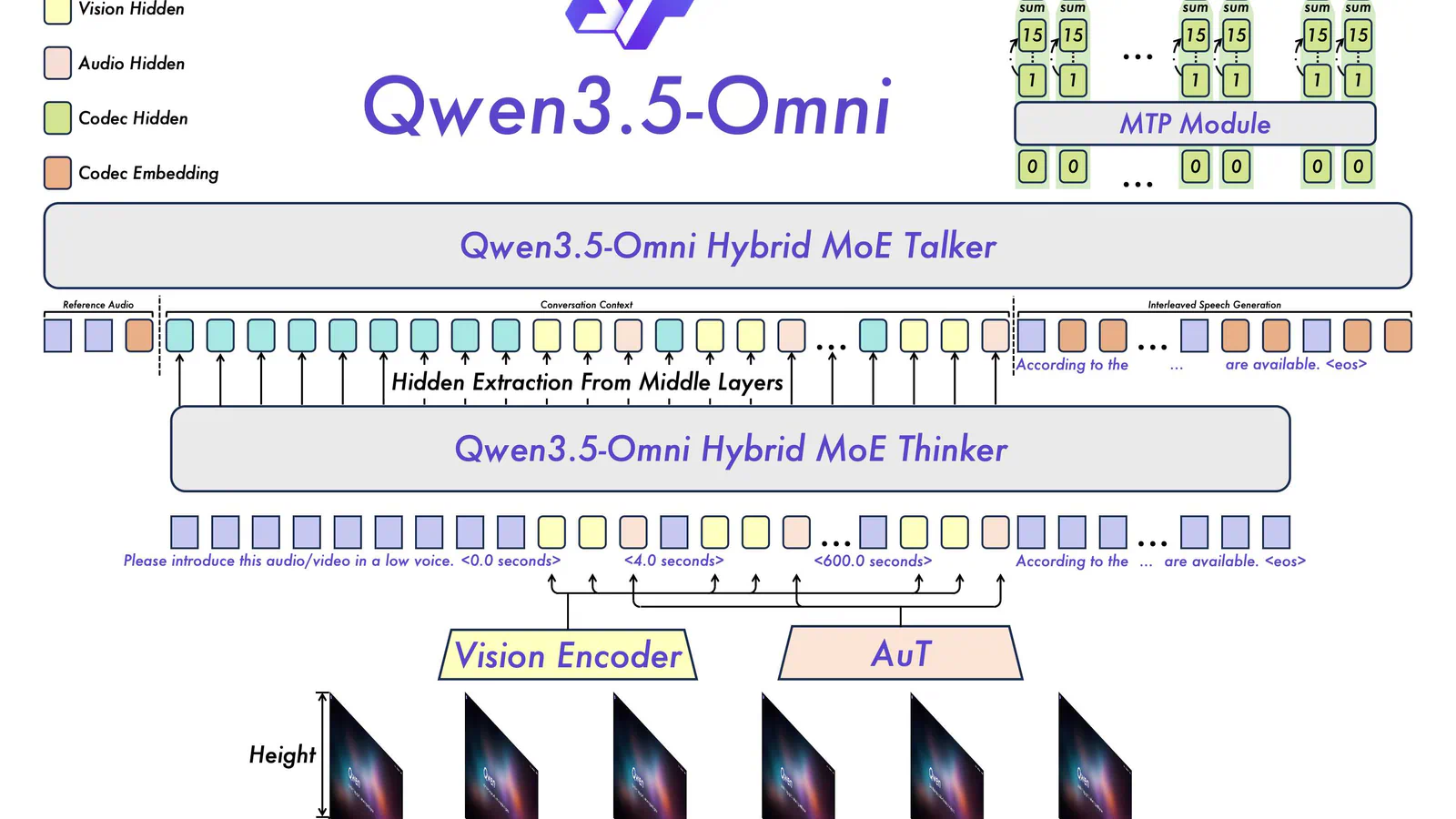
Image: qwen.ai.
Its design splits the work in two: a "Thinker" that reasons over every input and a "Talker" that turns the answer into speech. Qwen says it can take in more than 10 hours of audio or over 400 seconds of 720p video with sound in one go.
Key features that set it apart:
- Language range: Qwen cites speech recognition in 113 languages and dialects and speech output in 36
- Voice cloning: Upload a voice sample to customize the assistant's voice
- Voice control: Ask it to change volume, speed, or emotion mid-conversation
- Semantic interruption: It ignores "uh-huh" backchannel sounds and background noise
- Audio-visual captions: Timestamped, screenplay-style descriptions of video with sound
Qwen claims Qwen3.5-Omni-Plus beats Gemini 3.1 Pro on general audio understanding and reaches its level on audio-visual tasks. Its own table is more mixed: Gemini 3.1 Pro still leads on VideoMME with audio (89.0 versus 83.7), while Plus edges ahead on DailyOmni (84.6 versus 82.7). Note that the comparison is with Google's previous generation.
The bigger draw is price. Alibaba Cloud Model Studio's international (Singapore) rates for qwen3.5-omni-plus are:
- Audio input: $11 per million tokens
- Text, image, or video input: $1.40 per million tokens
- Text and audio output: $44 per million tokens
- Text-only output: $8.30 per million tokens
The China (Beijing) region is cheaper still, at $7.29 for audio input. Either way, audio costs well under GPT-Realtime-2.1's $32 input and $64 output rates for the same million tokens.
There are trade-offs. The API page lists context caching and fine-tuning as unsupported, and the rate limit sits at 60 requests per minute, which is tight for a busy call center. The Model Studio page also quotes narrower language support (60+ for audio input and 30+ for speech output) than the launch post. Check that your target languages are covered on the API, beyond the launch figures.
5. Gemma 4
Best for: Developers who want an open-weight multimodal model they can run and fine-tune on their own hardware.
Frequently Asked Questions
5 questions
1What is a multimodal generative AI model?
A multimodal generative AI model takes in more than one kind of data, such as text, images, audio, or video, and generates new content from it. Some, like Gemini 4 Hydrogen, only answer in text, while others, like Gemini Omni, produce video with sound.