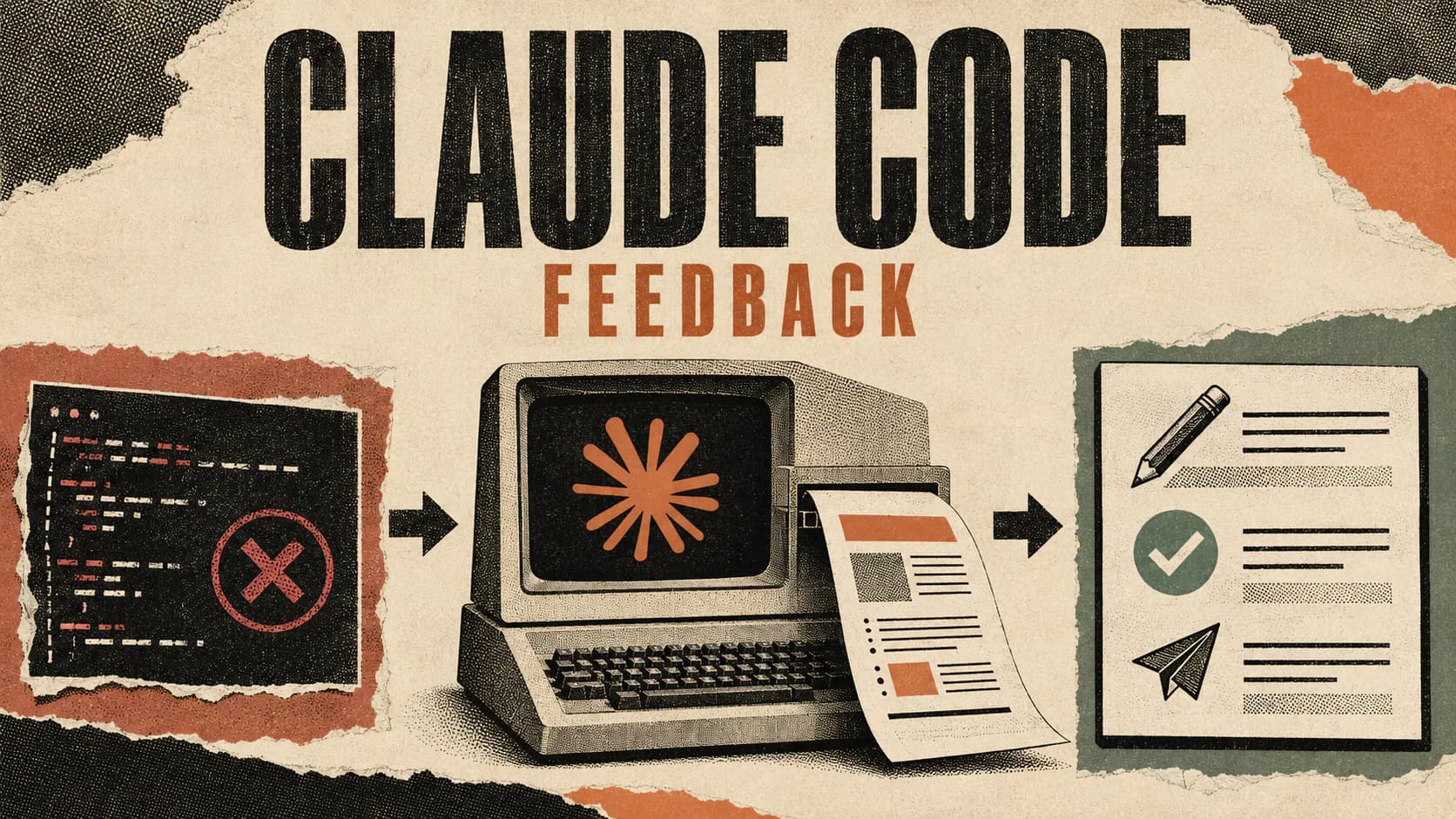
Anthropic’s SendFeedback tool turns Claude Code failures into editable reports while keeping transcript sharing and submission under the developer’s control.
Last updated on
AI Summary
Anthropic added SendFeedback to Claude Code, allowing the coding agent to draft editable failure reports while developers retain control over submission and transcript sharing.
Announced by Thariq Shihipar on August 26, 2026, the feature requires Claude Code 2.1.238 or later and supports Max, Pro, Team, Enterprise, and Console plans. Claude can invoke it after detecting a mistake, receiving a complaint, or being explicitly asked. The session pauses for review, where users can edit, send, or cancel the report and separately choose whether to attach the transcript, which is disabled by default. Drafts remain local until approval and are saved under currentFeedback.lastDraft after cancellation or submission.
SendFeedback is unavailable through the Claude Agent SDK and custom subagents in .claude/agents/, though Anthropic’s built-in general-purpose subagent can access it. Developers should still verify diagnoses and remove sensitive code, credentials, paths, or customer data before sending.
Anthropic has added a model-facing SendFeedback tool to Claude Code. When a command fails, Claude recognizes its own mistake, or a developer identifies a problem, the AI coding agent can draft a feedback report using the context already available in the session.
The developer still decides what leaves the machine. Claude Code pauses the session, displays the draft, and lets the user edit, approve, or cancel it. A separate control determines whether the conversation transcript accompanies the report.
Thariq Shihipar announced the change on August 26, 2026, explaining that developers can ask Claude to prepare feedback instead of manually opening /feedback and writing the report themselves.
SendFeedback is a tool that Claude can invoke, not just another command for the developer to remember. It can enter the workflow in three ways.
A user can explicitly ask Claude to report a problem. Claude may also offer to prepare feedback after the user says something went wrong. In some cases, the agent can initiate the process itself when it recognizes an issue worth reporting.
That last behavior does not amount to automatic error reporting. Claude Code does not silently submit every failed tool call or mistaken answer to Anthropic. Invoking SendFeedback only creates a draft and opens a review form. The report goes nowhere unless the developer chooses to send it.
The active conversation gives Claude material for the first draft. It may already have the command that failed, the resulting error, the intended task, and any corrections supplied by the user. That should produce a more useful starting point than asking someone to reconstruct an incident several minutes later.
It is still a draft, not an authoritative diagnosis. Claude may accurately summarize what happened while misunderstanding why it happened. A failure caused by project configuration, an unavailable dependency, or an ambiguous instruction could be misidentified as a Claude Code bug.
The SendFeedback Workflow Keeps the User in Control
When Claude invokes SendFeedback, the normal coding session pauses and an interactive feedback form appears. The developer can then:
Drafting itself does not trigger a permission prompt because it remains a read-only action until the user confirms submission. The important boundary is the moment information would leave the local environment.
Transcript sharing starts disabled. Claude Code remembers the user’s transcript preference for later feedback forms, although the setting can be changed for each submission. If enabled, the transcript is uploaded alongside the report when the developer selects Send.
Canceling the form does not discard the text completely. The latest draft is saved in Claude Code’s state file under currentFeedback.lastDraft after either cancellation or submission. This can help recover a report that was closed before the developer finished reviewing it.
There is also a deliberate separation between the feedback interface and the conversation. Claude does not see how the user edits the form, whether the transcript toggle changes, or whether the report is eventually submitted. Edited feedback is not automatically added back to the current session.
That separation prevents the model from treating a submitted report as proof that its diagnosis was correct. It also creates a practical limitation: if the developer corrects Claude’s explanation and wants the agent to use that correction during the session, they must tell Claude separately.
Local Drafts Put Consent Before Telemetry
The local-first behavior is the most important part of the feature. Claude can reduce the work involved in reporting a failure without receiving permission to transmit development data on the user’s behalf.
A feedback draft can still contain sensitive information. Error messages and command output may expose internal file paths, repository names, infrastructure details, customer identifiers, or fragments of proprietary code. Developers should review the text with the same care they would apply to a manually written bug report.
The transcript deserves closer scrutiny because it can provide far more context than the short report. It may make a difficult failure easier for Anthropic to investigate, but it may also contain unrelated details from the wider coding session. Keeping transcript sharing off initially gives developers and organizations a safer default.
Anthropic’s Claude Code data-use documentation treats product feedback as optional. Teams with internal rules covering source code, logs, or external support submissions should apply those policies before approving a Claude-generated report. AI-drafted feedback lowers effort, but it does not replace an organization’s data-handling requirements.
Availability Has Important Limits
SendFeedback requires Claude Code version 2.1.238 or later. Anthropic lists support for Max, Pro, Team, Enterprise, and Console plans.
The tool works in the interactive Claude Code application, including remote environments such as Claude Code on the web. Developers using an older, organization-pinned version may not see it until their installation is updated.
It is not available through the Claude Agent SDK. Custom subagents defined in .claude/agents/ cannot call it either. Anthropic currently permits access from Claude’s built-in general-purpose subagent, while other subagents receive an unavailable response.
These restrictions make SendFeedback a Claude Code product feature rather than a general mechanism developers can embed in their own agents. A company building a custom coding assistant with the Agent SDK would still need to create its own reporting interface, storage rules, and consent controls.
The restrictions may also help Anthropic test the behavior inside an environment it controls. Feedback submission touches privacy, external communication, and user trust, so expanding it to arbitrary agents would require clear guarantees about who prepares the report and where it is sent.
Better Feedback Still Needs Human Editing
The feature addresses a familiar problem in developer tooling: the best time to report a bug is immediately after it occurs, but that is also when filing a report feels most disruptive. Developers are trying to finish a task, not switch into support-ticket writing.
Claude can preserve the immediate context and convert it into a first draft. The developer’s job changes from recalling the incident to checking the report. That is usually faster, especially when a long terminal session or sequence of tool calls led to the failure.
Review cannot become a ceremonial click. Before approving AI-drafted feedback, developers should verify:
Observed behavior: Does the report describe what actually happened?
Expected behavior: Does it explain the result the developer anticipated?
Reproduction details: Are the relevant commands, actions, and sequence included?
Diagnosis: Does Claude distinguish evidence from its own interpretation?
Sensitive content: Does the draft expose credentials, code, internal URLs, or customer data?
Transcript value: Is the full conversation necessary to investigate the problem?
This review matters because AI-generated reports tend to sound coherent even when their explanation is incomplete. Claude may confidently connect two events that only happened close together, omit an environment-specific condition, or describe its own mistaken assumption as a product defect.
Anthropic may receive more feedback because the submission cost is lower. Whether that improves Claude Code will depend on report quality. A larger stream of vague or incorrectly diagnosed issues could create extra triage work, while carefully reviewed reports with timely context should be more actionable than short complaints written from memory.
SendFeedback Shows a Useful Pattern for AI Dev Tools
SendFeedback is a modest feature, but its interaction model is worth noting. The AI performs the preparatory work, while the human authorizes the external side effect.
That division is particularly appropriate for development agents. Claude can inspect the conversation, assemble the details, and propose an action. It cannot decide on its own that repository context or a session transcript should be sent to Anthropic.
The pattern could extend beyond product feedback. AI development tools can prepare issue tickets, pull-request descriptions, incident summaries, or support messages while preserving a review boundary before publication. The value comes from automating assembly rather than removing accountability.
Claude’s inability to see the final edits reinforces that boundary. The feedback form is not another conversational turn controlled by the model. It is a separate user interface where the developer becomes the final author, even if Claude supplied most of the initial text.
Final Thoughts
Claude Code’s AI-drafted feedback succeeds because Anthropic has kept its scope narrow. Claude can notice a problem and reduce the effort required to document it, but it cannot quietly turn every failure into telemetry or decide that a transcript should leave the development environment.
The main risk is not automatic submission. It is developers trusting a plausible draft without checking the facts or the data attached to it. Used as a first pass rather than a finished diagnosis, SendFeedback could give Anthropic faster, richer reports while costing developers much less time.
Frequently Asked Questions
4 questions
1
What is the Claude Code SendFeedback tool?
SendFeedback is a built-in Claude Code tool that lets Claude draft a product feedback report from the current session. Claude can use it after a failure, in response to a user’s complaint, or when it identifies an issue itself. The developer reviews the resulting form and must explicitly approve the report before it is sent to Anthropic.
2
Does Claude Code automatically send error reports?
No, Claude Code does not automatically send every error or failure to Anthropic. SendFeedback prepares a local draft and opens an interactive review form. The developer can edit the report, decide whether to include the transcript, send it, or cancel. Nothing is submitted until the user selects the send option.
3
Can developers edit Claude’s feedback before sending it?
Yes, developers can modify the complete feedback draft before submission. They can correct Claude’s interpretation, add reproduction steps, remove sensitive information, or clarify the expected behavior. Those edits are not automatically shown to Claude in the active conversation, so any correction relevant to the ongoing task must also be communicated separately.
4
Which Claude Code plans support AI-drafted feedback?
SendFeedback is available on Max, Pro, Team, Enterprise, and Console plans with Claude Code version 2.1.238 or later. It works in the interactive application and remote environments such as Claude Code on the web. It is not currently available in the Claude Agent SDK or to custom subagents defined in .claude/agents/.