Anthropic used Claude to optimize 36 open-source biomolecular models, achieving an average speedup of roughly four times in fast mode and 1.6 times in exact mode that preserves original outputs. The company released the optimization code and is organizing a protein-design competition with Adaptyv Bio that will synthesize and experimentally test more than 5,000 submitted designs, with support from Modal and Twist Bioscience, to measure whether faster computational tools improve real-world protein engineering outcomes.
On September 17, 2026, Anthropic published an unusually practical example of AI for Science. Instead of asking Claude to interpret experimental data or propose a biological hypothesis, the company used it to optimize the software behind 36 specialized open-source models.
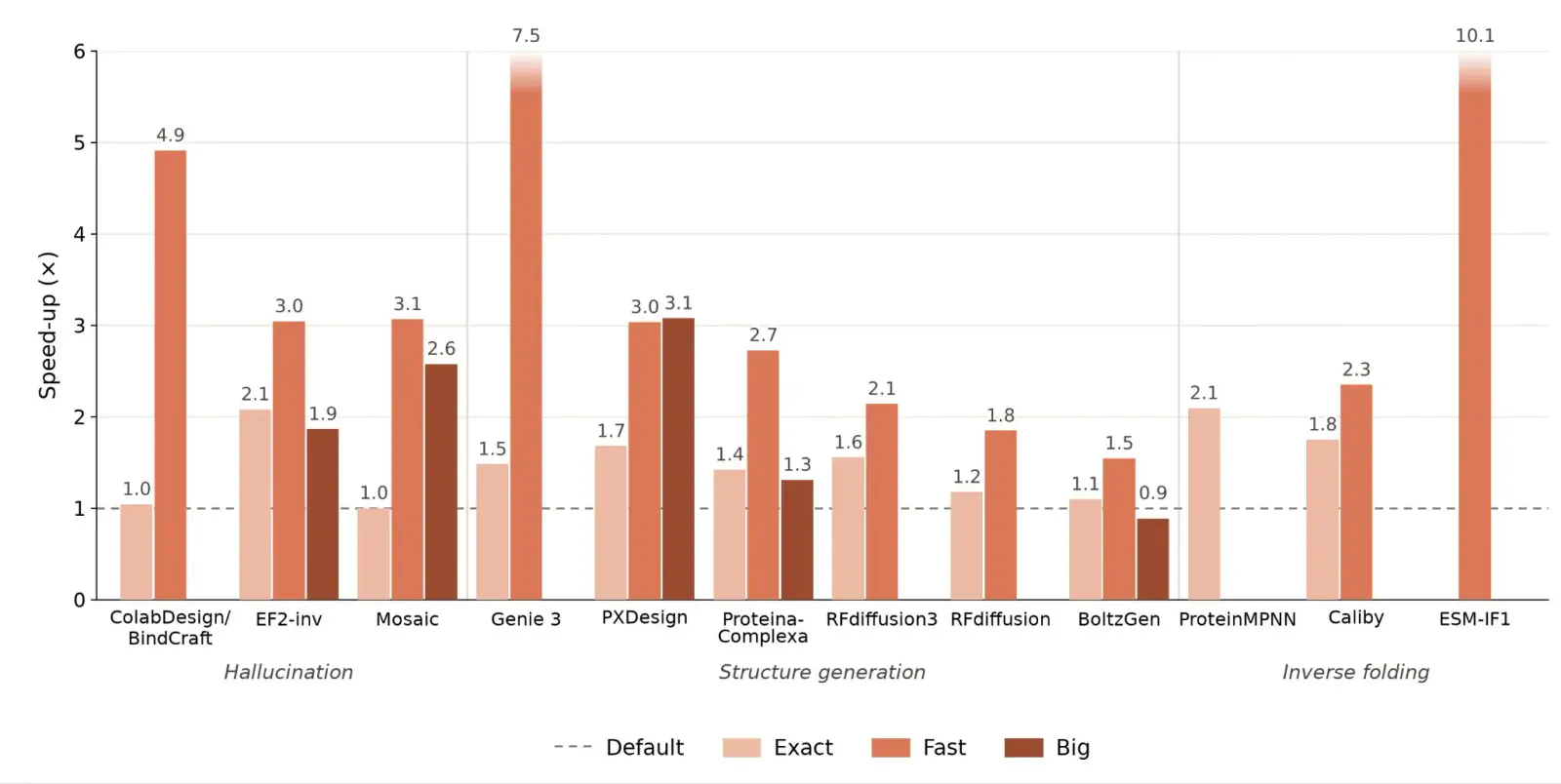
According to Anthropic’s biomolecular modeling report, the optimized structure-prediction models ran roughly four times faster on average in a “fast” mode that permits small numerical differences. An “exact” mode, designed to preserve identical outputs, delivered an average speedup of about 1.6 times. The work covered structure prediction, protein design, protein language modeling, and genomics.
That is important because access to a model’s source code does not make it inexpensive to use. Modeling a large molecular complex or screening thousands of candidate proteins can still require scarce GPU capacity, specialized engineering, and a substantial compute budget.
Anthropic has released the optimization code, but it is also setting up a more demanding test. A protein-design competition organized with Adaptyv Bio will synthesize and experimentally characterize more than 5,000 submitted designs. Anthropic is contributing Claude credits and experimental funding, Modal is providing compute, and Twist Bioscience is supporting DNA synthesis.
The project was carried out in just under four weeks by one postdoctoral researcher who had biomolecular modeling expertise but no previous experience in inference optimization or GPU kernel engineering. Claude helped analyze model repositories, identify bottlenecks, write low-level code, test performance, and adapt the improvements across different architectures.
Anthropic divided the resulting optimizations into two broad categories:
Exact mode preserves the model’s original numerical output while reducing unnecessary work. Across the structure-prediction models, it produced an average speedup of roughly 1.6 times.
Fast mode uses more aggressive changes, including approximate kernels, to reach an average speedup of about four times while accepting small numerical differences.
Individual results varied considerably. The technical report describes exact-mode improvements ranging from 1.45 to 7.12 times and fast-mode gains from 2.91 to 31.07 times across its tested workloads. The four-times figure is an average, not a promise that every model will run four times faster on any GPU.
Anthropic also tested whether faster execution damaged the scientific output. It reports that the fast modes were statistically indistinguishable from the original configurations across a pooled evaluation covering protein pockets, antibody-antigen complexes, and protein interactions with RNA and DNA. Those results are encouraging, although the benchmarks were performed as part of Anthropic’s project rather than by an independent evaluator.
FlashPairformer Targets the Most Expensive GPU Operations
Many current biomolecular structure models contain a component called the Pairformer. It processes relationships between pairs of biological entities, helping a model reason about which residues, molecules, or other components might be close together in a three-dimensional structure.
Two of its most expensive operations are triangle attention and triangle multiplication. These operations model relationships among triplets of tokens, which is useful for reasoning about molecular geometry but costly to calculate. Anthropic says their computational and memory requirements scale cubically in a straightforward implementation. Doubling the size of a system can therefore require approximately eight times as much work for these operations.
Claude helped build a reusable set of optimized GPU kernels called FlashPairformer. Anthropic reports that the kernels accelerated the Pairformer multilayer perceptron by 2.4 times, triangle attention by 1.9 times, and triangle multiplication by 1.5 times relative to the field-standard implementations used for its comparison.
The FlashPairformer and low-memory code can be integrated into multiple models rather than remaining tied to one repository. Claude then applied model-specific optimizations, such as caching calculations that were being repeated and replacing branches that always produced the same result with their constant outputs.
This is a different use of general-purpose AI from asking Claude to operate a biology tool through a command line. Claude contributed to the performance engineering underneath those tools. GPU kernel development normally requires detailed knowledge of memory movement, hardware behavior, numerical precision, and the surrounding model architecture.
The project does not show that this expertise can be removed from the process. The researcher still selected models, defined acceptable behavior, inspected outputs, and verified downstream performance. It does suggest that an experienced scientist can use an AI coding system to tackle engineering work that would otherwise require a separate specialization.
Big Mode Pushes Structure Prediction Past 10,000 Tokens
Speed was only part of the problem. Large cellular machines such as ribosomes, respiratory complexes, and molecular chaperones contain many interacting components, making their structures difficult to fit into GPU memory.
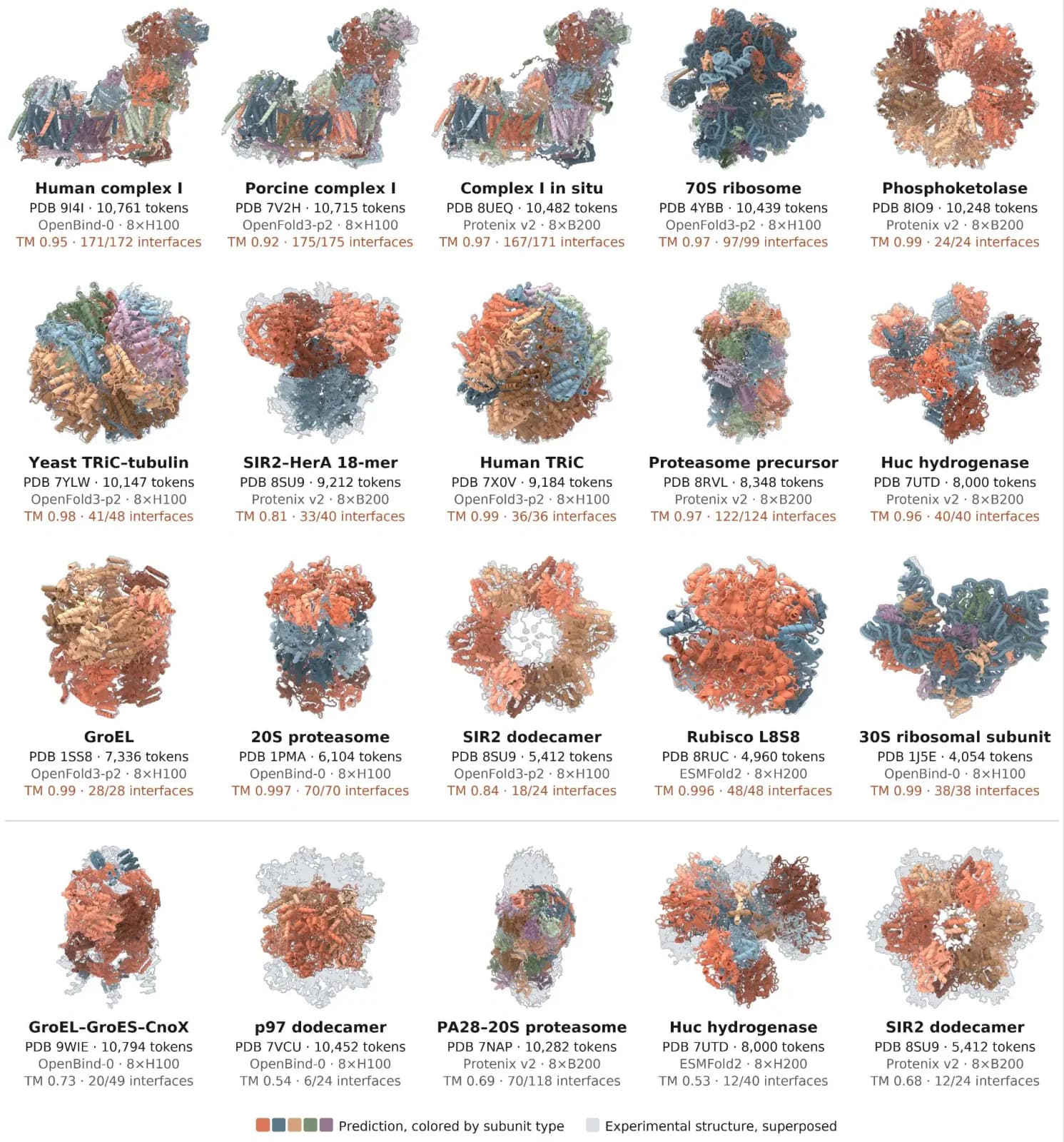
Anthropic asked Claude to create a low-memory “Big” mode for open-source structure-prediction systems. The resulting implementation modeled complexes containing more than 10,000 tokens on one eight-GPU node equipped with 80 GB NVIDIA H100 GPUs, completing inference in under 24 hours. That scale is roughly 1.5 orders of magnitude beyond the context lengths represented in the models’ training distributions.
The memory optimization expands what researchers can attempt, but it does not guarantee that the underlying models will remain accurate at that scale. Anthropic found that predictions began showing a greater tendency to form disconnected or “chunked” complexes once systems exceeded about 3,000 tokens. In its large-system analysis, an interface counted as accurate when it reached a DockQ score of at least 0.23.
That distinction matters. Big mode can make a previously impossible calculation fit on available hardware, but it cannot correct weaknesses caused by limited training data or poor generalization. The result is both a useful tool and a way to expose where current biomolecular models begin to fail.
Protein Design Fell From Thousands of GPU Hours to One H200
Anthropic also tested whether the optimized software could change the economics of AI-guided protein design.
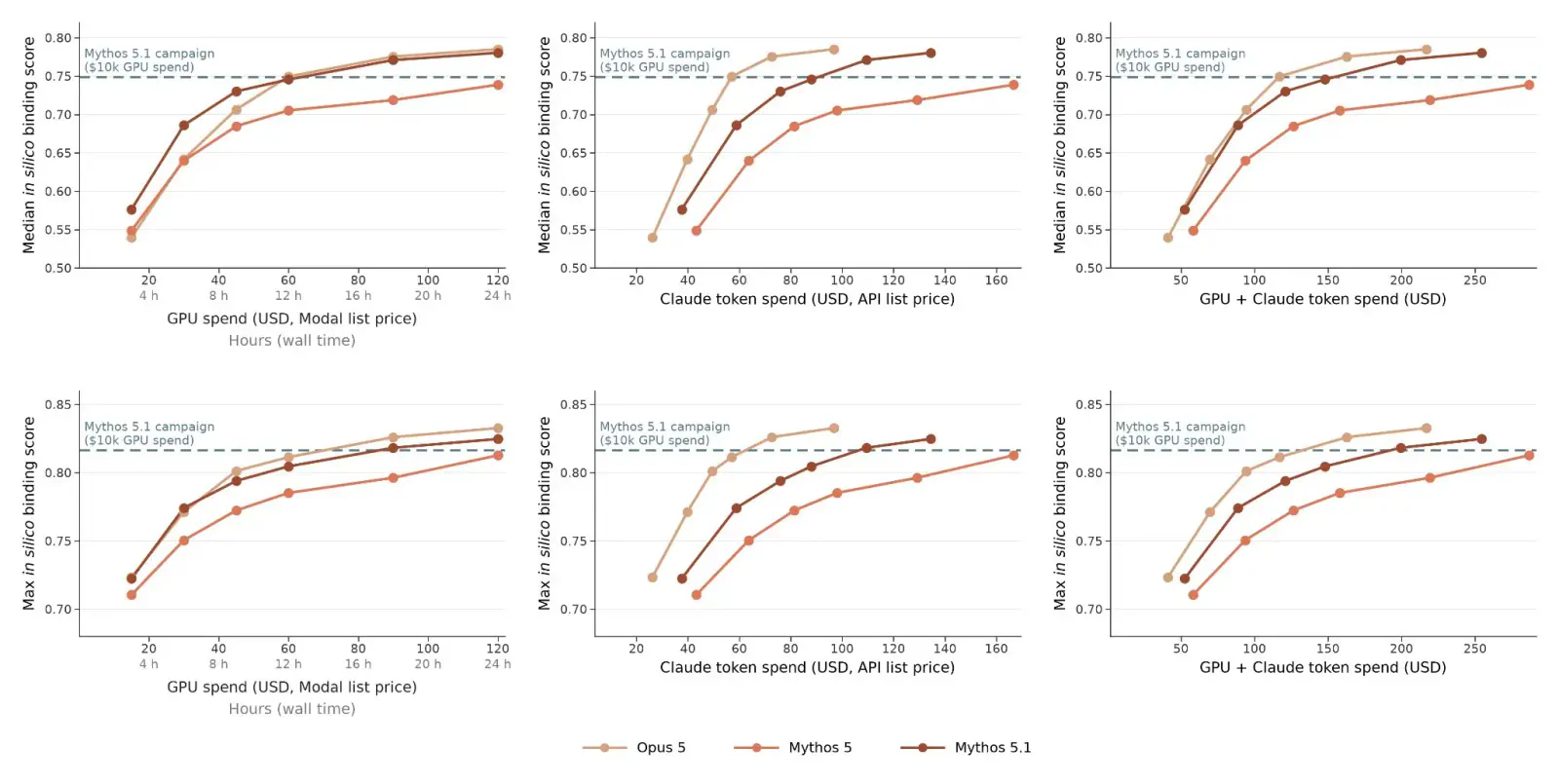
In the company’s earlier biological interfaces experiment, Claude received a prompt of approximately 16,000 words, could delegate work to subagents, and was allowed to spend up to $10,000 per target on Modal. Anthropic estimated that budget at roughly 2,500 NVIDIA H100 GPU hours within a 24-hour period.
The new experiment imposed a far tighter constraint. Each Claude run received access to one NVIDIA H200 for 24 hours, a prompt of about 1,100 words, and a reference sheet covering the installed scientific tools. There were no subagents and no human intervention during the design process.
Anthropic ran three Claude model versions against 16 protein targets using the accelerated modeling stack. Its strongest configuration reached a computationally predicted success rate of up to 50% on some targets and close to 20% on average. The result suggests that faster scientific tools let an agent explore more candidates, apply more filters, or spend more of its limited budget on promising designs.
These success rates are based on computational evaluation, not laboratory measurements. A candidate can look stable, selective, and geometrically plausible to several models yet fail to express, fold, or bind when synthesized. Anthropic’s upcoming competition is meant to test that gap at a much larger experimental scale.
The Anthropic and Adaptyv Bio protein-design competition is scheduled to run from September 28 through October 31, 2026. A new challenge will open each week, producing five challenges in total. As of September 18, the biological targets had not yet been publicly announced.
Participants can enter one or both of two tracks:
The Unlimited Track allows competitors to use Claude and provides access to credits and scientific tools.
The Purist Track asks participants to submit designs without using Claude, creating a comparison with other computational approaches.
Competitors may submit up to 15 designs to a chosen challenge. Across the challenges and tracks, Adaptyv plans to synthesize and characterize more than 5,000 proteins in its automated laboratory. Measurements are expected to include whether a design can be synthesized and expressed, as well as its relevant functional performance.
The support package is substantial. The Proteinbase competition page advertises more than $1 million in Claude credits for participants and $100,000 in total cash prizes. Modal is contributing up to $250,000 in compute, while Twist Bioscience is providing DNA synthesis support. Anthropic’s research post separately describes up to $200,000 in combined API-credit and matched wet-lab support for each challenge.
Testing 5,000 designs does not mean producing 5,000 working drug candidates. Most computational protein designs may fail during synthesis, expression, folding, or functional testing. That failure data is part of the competition’s value, especially because the organizers say results will be made public and top designs will be released under a Creative Commons license.
Large, openly reported wet-lab datasets could help researchers determine which scoring functions and design workflows correlate with actual biological performance. They could also reveal whether Claude adds value beyond increasing the number of computational steps an entrant can run.
Open Source Is the More Durable Contribution
Anthropic is releasing the reusable kernels, low-memory methods, optimized model integrations, and protein-design workflow. The relevant repositories include the optimized OpenFold3 implementation, the Claude protein-design workflow, and the broader FlashPairformer code.
The licensing requires some attention. Anthropic says the portable inference kernels are available under Apache 2.0, while other releases follow the licenses of their original upstream models. “Open source” therefore does not imply that every optimized model has identical terms for commercial deployment, redistribution, or modification.
There are also practical limits. Performance depends on model configuration, input size, GPU architecture, numerical precision, and software versions. Upstream projects will continue changing, so optimized integrations will need maintenance. Researchers should benchmark the code against their own inputs rather than assuming the headline average will transfer directly.
Even with those caveats, reusable optimization code can have a wider effect than a temporary compute grant. It allows laboratories to inspect the implementation, reproduce benchmarks, port the ideas to related models, and redirect saved GPU time toward larger experiments or more candidate designs.
Final Thoughts
The most consequential part of Anthropic’s work is not the claim that Claude can design proteins on its own. Computational scores are still imperfect substitutes for experiments, and making a model faster does not make its biological predictions more accurate.
The stronger result is that a general-purpose AI system helped a scientist improve a diverse, technically demanding software stack in less than a month. If other researchers can reproduce those gains, Claude will have lowered a real barrier between publishing an open model and making it affordable enough for routine scientific use.
The competition will test the next part of the argument. Faster inference clearly produces more computational opportunities per GPU hour. Experimental results from more than 5,000 proteins will show whether those additional opportunities translate into better molecules, better design strategies, or simply a larger volume of plausible-looking failures.
Frequently Asked Questions
5 questions
1
How much faster did Claude make the biology models?
Claude made the tested structure-prediction models roughly four times faster on average in fast mode and about 1.6 times faster in exact mode. Individual gains varied by model and workload, with the technical report describing larger speedups in some cases. Fast mode allows small numerical differences, while exact mode is intended to preserve the original outputs.
2
What is FlashPairformer?
FlashPairformer is Anthropic’s collection of optimized GPU kernels for expensive operations used in Pairformer-based biomolecular models. It targets components such as triangle attention, triangle multiplication, and the Pairformer multilayer perceptron. The kernels can be reused across several structure-prediction systems, reducing the need to create separate low-level implementations for every model.
3
Is Anthropic open-sourcing Claude’s optimization code?
Yes, Anthropic is releasing the optimization code through public repositories. Its portable inference kernels use the Apache 2.0 license, while optimized integrations and other components may retain the licenses of their upstream models. Researchers and companies therefore need to review the terms of each repository rather than assuming that one license applies to the entire release.
4
How will the Anthropic protein-design competition work?
The competition will run from September 28 to October 31, 2026, with five weekly design challenges. Participants can compete in a Claude-enabled Unlimited Track, a no-Claude Purist Track, or both. Adaptyv Bio plans to synthesize and experimentally characterize more than 5,000 submitted proteins, with compute, DNA synthesis, Claude credits, experimental funding, and cash prizes supporting the program.
5
Does faster inference make biomolecular models more accurate?
No, faster inference does not inherently improve scientific accuracy. Exact mode aims to reproduce the same outputs more efficiently, while fast mode trades small numerical differences for greater speed. Big mode allows much larger systems to fit in memory, but Anthropic observed that prediction quality could decline as models moved far beyond the system sizes represented during training.