

OpenAI introduced Astra for Law on September 17, 2026, as a specialized legal AI offering powered by GPT-6 Astra. It combines instructions for legal analysis and writing, settings for high-effort reasoning, and a search index covering U.S. case law, statutes, regulations, court rules, and administrative decisions.
Initial access is limited to selected law firms through OpenAI’s Trusted Access program in ChatGPT and Codex. The company says it will accept customers on a rolling basis and provide API access later, although it has not announced public pricing or a specific API release date.
The significant part of the announcement is not simply GPT-6 Astra’s legal branding. OpenAI is assembling a complete professional system around the model: curated legal retrieval, firm-specific workflows, third-party integrations, and additional governance controls. Its benchmark results suggest that the dedicated search layer improves research, but they also provide a useful warning against treating the system as an autonomous legal authority.
Astra for Law Is a Maintained Legal Configuration
Despite the name, Astra for Law is not described as a separate foundation model. It is a maintained configuration built around GPT-6 Astra, OpenAI’s professional-work model for research, analysis, drafting, tool use, and long-context tasks.
The legal configuration adds three primary components:
- Instructions designed for legal analysis and writing
- High and maximum reasoning-effort settings for more thorough work
- Access to OpenAI’s new Legal Search Index
This distinction matters. A powerful general model may be able to summarize a brief or draft a contract clause, but professional legal work also depends on how the system searches for authority, prioritizes sources, presents citations, and applies repeatable review procedures. Those surrounding components can have as much practical impact as the underlying model.
OpenAI says it will regularly update the legal configuration and maintain it for future API customers. That could spare legal technology firms from building and continuously revising their own collection of legal prompts, retrieval rules, and tool instructions. Developers would still control their products and workflows, while OpenAI manages the model-facing legal layer.
The announcement does not disclose the configuration’s system instructions, retrieval architecture, source-ranking methodology, or update schedule. Firms evaluating it will therefore need to examine the results rather than assume that a specialized configuration automatically produces dependable legal analysis.
The Legal Search Index Produces a Measurable Research Gain
The Legal Search Index is the clearest functional difference between Astra for Law and the standard model. OpenAI says the index searches more than 230 million URLs, with additional sources added daily, and links its answers to the primary authorities and supporting passages used during research.
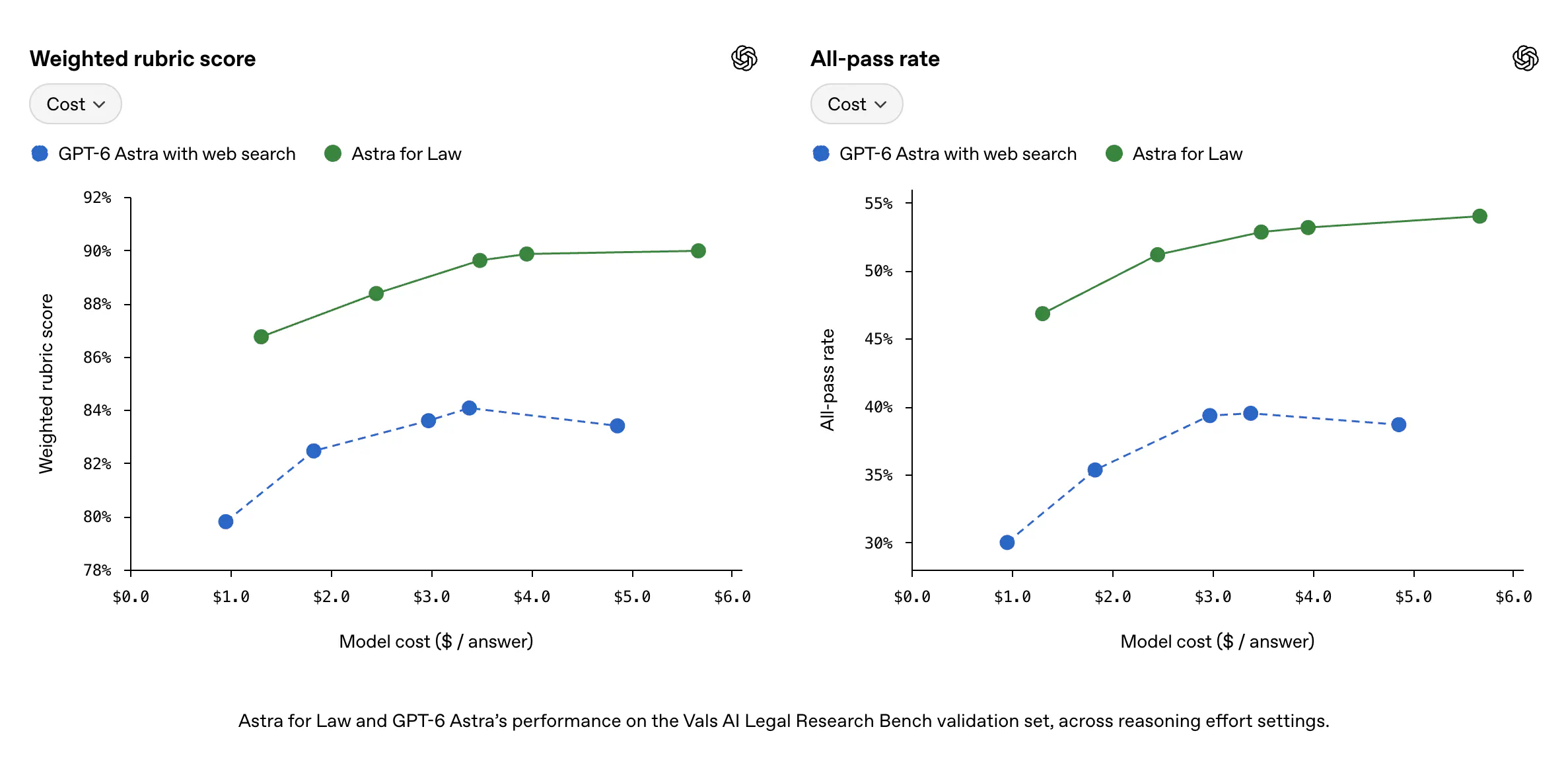
This is designed to address a common weakness in general web research. A search engine may surface law-firm articles, commentary, outdated summaries, or pages that mention a decision without providing the controlling text. A dedicated index can direct the model toward cases, statutes, regulations, court rules, and administrative decisions before it begins constructing an answer.
OpenAI tested the system on the Vals AI Legal Research Bench, which contains 50 research questions contributed by ten major law firms across ten legal domains. Vals reports that the evaluation includes 2,750 graded model responses and more than 1,700 unique cited legal sources. The benchmark uses a 1-to-10 correctness scale and a model-based judge to evaluate the resulting answers.
GPT-6 Astra with ordinary web search scored 5.95. Adding the Legal Search Index raised the score to 6.13 at high reasoning effort and 6.40 at the maximum setting. OpenAI also reports that web-only research failed to retrieve complete or relevant authority in more than half of its observed errors, while the legal index produced grounded citations more than 90% of the time in this test. The results were independently verified by Vals AI, according to OpenAI.
A 0.45-point improvement is meaningful under a consistent evaluation setup, particularly because the underlying model stayed the same. It suggests that domain-specific retrieval can improve performance without retraining the foundation model.
The 6.40 score also sets an important limit on the claim. The benchmark does not show that Astra for Law can conduct unsupervised legal research with near-perfect reliability. It covers 50 questions, relies partly on a language-model judge, and measures a defined research task rather than every step involved in advising a client or preparing a filing.
The index’s size needs similar context. OpenAI reports more than 230 million URLs, not 230 million distinct cases or legal documents. The announcement does not provide a breakdown by jurisdiction, historical depth, duplication, update latency, or negative-treatment analysis. It also does not describe a citator-style feature for identifying authorities that have been reversed, overruled, questioned, or superseded. Lawyers still need to examine the retrieved sources and confirm that they remain good law.
Law Firms Are Turning Their Own Expertise Into Workflows
Astra for Law also serves as a platform for workflows designed with individual firms. OpenAI highlighted three launch projects that encode firm-specific procedures rather than asking lawyers to start each task with a blank chatbot window:
- Sullivan & Cromwell’s Agreement Analyzer compares drafts, identifies changes in negotiating positions, and organizes results for lawyer review.
- Ropes & Gray’s Diligence Engine examines potentially thousands of documents and applies materiality judgments during M&A diligence.
- Cooley’s GO Public checks IPO documentation for consistency across approximately 350 points. Cooley says the system can reduce a process that previously took weeks to less than an hour.
These performance descriptions come from OpenAI and its launch partners, and the underlying tools are not publicly available for independent testing. They are best read as examples of the workflows Astra is intended to support, not as general benchmark results for every firm or matter.
The approach is still notable. Much of a law firm’s value resides in procedures that rarely appear in a public database: how its lawyers classify risk, compare provisions, identify inconsistencies, escalate exceptions, and document their conclusions. Turning that knowledge into a reviewable workflow gives firms a way to use AI without handing the entire task to an opaque general-purpose assistant.
It also keeps lawyers inside the decision loop. The system can collect evidence and apply predefined checks, while the firm’s lawyers review, challenge, and refine the result. That model fits legal practice better than automation built around an unqualified promise to generate a final answer.
Plugins Make Astra Part of the Existing Legal Stack
OpenAI is launching Astra for Law with 26 partner-built plugins and 47 community plugins, for a total of 73 legal plugins. Partner participants include Thomson Reuters, Harvey, Legora, iManage, LexisNexis, Relativity, Clio, Spellbook, Box, Ironclad, Everlaw, Salesforce, Docusign, Snowflake, ServiceNow, and Workday.
The integrations cover different parts of legal and business work, including research, document management, e-discovery, contract review, matter management, enterprise data, and transaction workflows. Instead of copying documents and search results between several applications, lawyers may be able to call those systems from ChatGPT or Codex while working on a matter.
The 47 community plugins take a different approach. OpenAI says lawyers and legal engineers built them to encode specific skills that firms can adapt and extend. They will be distributed through the plugin marketplace in ChatGPT and Codex.
There is an important security distinction. OpenAI’s announcement says community plugins do not qualify for Trusted Access, although they undergo the same internal security review as partner-built plugins. A firm should not interpret availability in the marketplace as permission to send confidential client information through every plugin. Each integration still requires technical, contractual, and ethical review.
The plugin strategy gives Astra for Law a broader role than a standalone research assistant. OpenAI is positioning ChatGPT and Codex as interfaces through which legal professionals can reach the databases, documents, applications, and firm-developed tools they already use.
Trusted Access Does Not Replace Legal Governance
Trusted Access is OpenAI’s controlled rollout mechanism for eligible law firms. The company says the program provides additional privacy, security, and governance controls, but its announcement does not publicly detail the eligibility requirements, data-retention terms, permission model, audit capabilities, or technical boundaries between Astra and connected plugins.
Frequently Asked Questions
5 questions
1What Is OpenAI Astra for Law?
Astra for Law is a specialized legal AI offering powered by GPT-6 Astra. It combines instructions for legal analysis and writing, high-effort reasoning settings, a U.S. Legal Search Index, plugins, and firm-built workflows. OpenAI designed it to support lawyers’ research and review rather than replace professional judgment or independent source verification.
2
Sources
- Astra for Lawopenai.com
- https://x.com/OpenAI/status/2100679992720142459x.com
- GPT-6 Astraopenai.com
- Vals AI Legal Research Benchvals.ai
- ABA Formal Opinion 512americanbar.org


