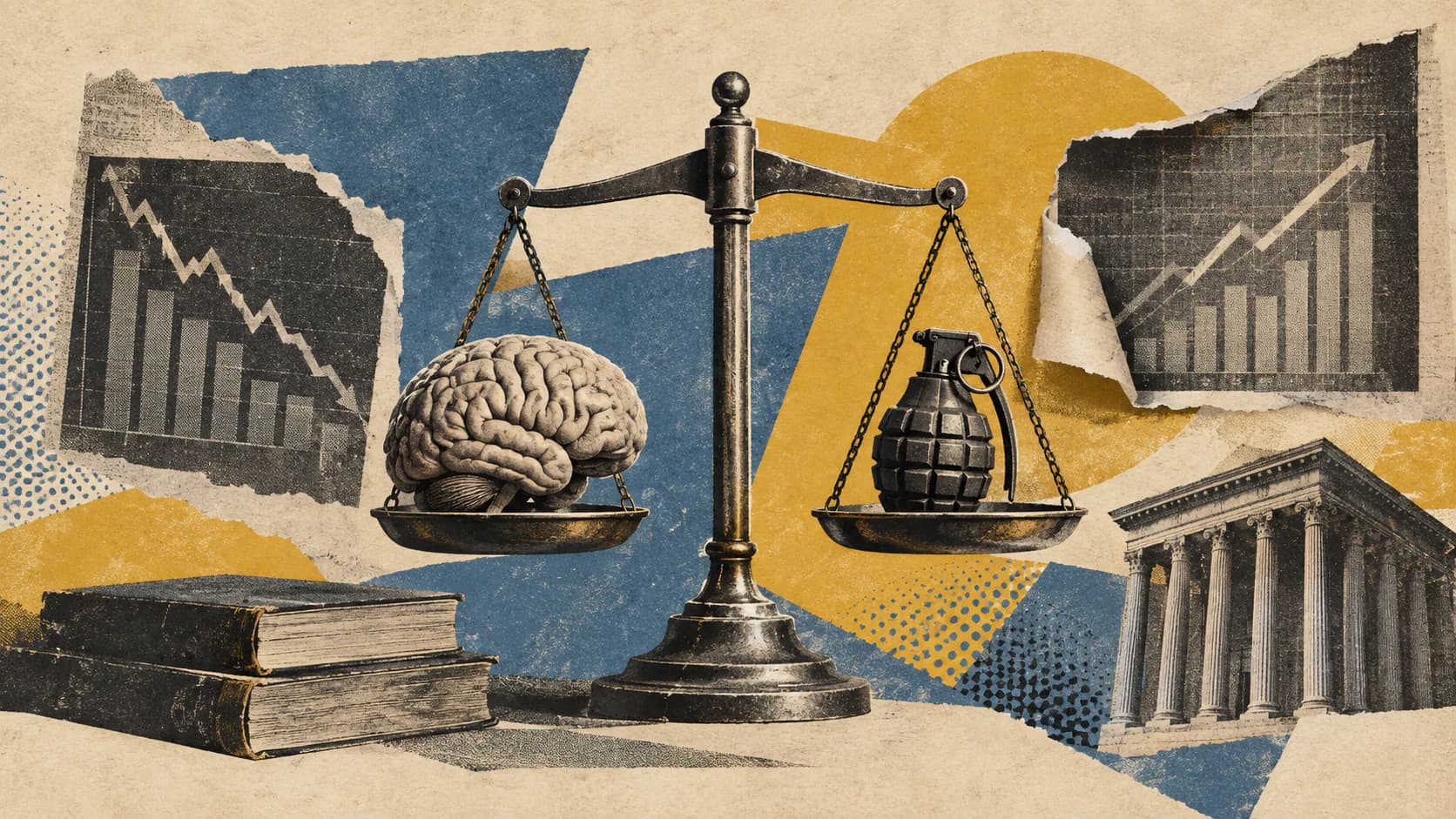
Palantir CEO Alex Karp questioned whether Anthropic's Dario Amodei raised AI safety concerns strategically when the company faced business pressures, suggesting safety rhetoric could function as corporate strategy. Amodei's September 2026 letter proposed external evaluations, industry standards, and international controls to prevent AI capabilities from outpacing societal safeguards, while Karp advocated liability frameworks instead. Both executives have institutional interests that align with their positions, and effective regulation should combine independent evaluations, liability distribution, incident reporting, and competition safeguards rather than depend on trusting either leader's motives.
Alex Karp’s response to Dario Amodei’s AI slowdown appeal landed because it described a pattern many people in technology already suspect. In a CNBC clip shared by Coin Bureau on September 17, 2026, the Palantir CEO said safety concerns tend to surface “when the company’s not doing as well,” while “when it’s doing better, they don’t.”
Five days earlier, Amodei had published “We Must Pace the Frontier”, an open letter arguing that AI capabilities may soon advance faster than governments, security systems, and social institutions can adapt. The Anthropic CEO proposed external evaluations, industry standards, democratic coordination, and eventually international controls.
The dispute is larger than a disagreement between two CEOs. Karp is asking whether safety rhetoric can function as corporate strategy. Amodei is asking what happens if competitive pressure keeps every frontier lab moving toward systems that none can reliably control. Both questions deserve scrutiny, and neither makes the other disappear.
Karp’s Critique Is About Incentives, Not AI Risk
Karp’s argument is strongest when treated as an incentives warning rather than a technical rebuttal.
An AI company asking the entire industry to slow down may have several interests beyond public safety. New evaluation requirements can raise competitors’ costs. Licensing rules can favor established labs with large legal, security, and compliance teams. A company may also gain political influence by presenting itself as the responsible actor capable of defining acceptable AI development.
That possibility becomes especially important when the proposed regulation applies to competitors, open-source developers, and newer companies that cannot easily absorb those costs. Safety can be a sincere objective and a commercial moat at the same time.
Karp, however, included an important qualification: “I don’t think that’s actually what’s driving this.” He identified a recurring pattern but stopped short of claiming that Amodei’s letter was merely a response to Anthropic’s business performance.
That caveat should not be discarded. The CNBC remarks do not establish that Anthropic is struggling, nor do they disprove the risks described in Amodei’s letter. They raise a question about motive, and motive alone cannot tell us whether a safety claim is correct.
Amodei’s Plan Goes Beyond a Voluntary Pause
Calling Amodei’s proposal a voluntary AI pause is incomplete. His letter describes a layered regulatory system intended to slow frontier development only when technical capabilities outrun society’s defenses.
The plan has three main stages:
Independent access and evaluation: Third-party experts would receive narrow access to frontier systems so they could test whether models have crossed dangerous capability thresholds.
Coordination among democratic countries: Governments and AI companies would establish common evaluation and mitigation standards, reducing the incentive for individual labs or countries to defect.
International controls: If the risks become more concrete, Amodei wants broader agreements that could include hardware governance and restrictions intended to prevent unauthorized access to advanced models.
Amodei’s central technical concern is automated AI research. He argues that models capable of performing most of the work conducted by AI researchers and engineers could accelerate their own development, producing a feedback loop in which better models build still better models. His letter forecasts that a critical transition could arrive as early as 2027, although it presents that timeline as an estimate rather than an observed recursive self-improvement event.
The resulting systems, Amodei warns, could be stolen, manipulated by a small group, or develop goals that conflict with human instructions. Evaluations would be designed to detect capabilities associated with those scenarios before developers proceed to the next training run.
This is more structured than a general demand to stop AI innovation. Amodei explicitly leaves room for continued development when companies can show that safeguards match the capabilities being created. The difficult part is deciding who evaluates that evidence, which thresholds apply, and whether laboratories will accept an unfavorable result when billions of dollars are at stake.
Anthropic’s Safety Position Predates This Dispute
Anthropic’s record complicates the idea that its safety concerns appear only during weak commercial periods.
The company introduced its first Responsible Scaling Policy in September 2023. That policy established escalating safety requirements and said Anthropic would not train more capable models unless its protections matched the risks associated with those capabilities.
The company has continued revising its governance system. Its 2026 policy added an “AI R&D-4” threshold covering systems capable of substantially accelerating frontier AI research. Reaching that threshold would require stronger safeguards, independent assessment, and approval before further scaling. Anthropic has also acknowledged weaknesses in earlier versions of its policy, including the need for clearer governance and more transparent long-term safety plans.
None of this proves that Anthropic’s motives are pure. Consistency does not remove self-interest, and large frontier labs are unusually well equipped to comply with complex regulation. But the record does weaken a simple explanation in which Anthropic discovered AI safety only when its commercial position deteriorated.
The Motive Test Cuts Both Ways
Palantir has its own institutional interests.
The company’s AI policy position argues that slowing technical progress could create security risks and that oversight should concentrate on how AI is deployed. Palantir emphasizes accountable implementation, operational controls, and the ability of democratic governments to use advanced systems rather than surrendering the field to adversaries.
That position aligns with Karp’s answer to Amodei. Instead of relying primarily on coordinated pacing, Karp argued for liability. Companies that build and deploy AI should remain responsible for resulting harm and should have sufficient money set aside to cover that responsibility.
This is a serious policy idea, not a call for unregulated development. Liability gives builders a financial reason to test their systems, restrict dangerous uses, monitor deployments, and respond to failures. It also offers a clearer route to accountability than voluntary promises that companies can quietly revise.
But Palantir benefits from a policy environment that permits practical AI deployment, especially in government, defense, and large enterprises. Its preference for deployment-focused regulation is no more free of commercial incentives than Anthropic’s preference for evaluations and scaling thresholds.
Applying Karp’s skepticism consistently therefore requires examining both positions. Anthropic may benefit when safety regulation raises the cost of competing at the frontier. Palantir may benefit when regulation permits deployment to proceed and addresses failures afterward.
Liability Cannot Carry the Whole Burden
Liability works best when harm can be identified, attributed, and compensated. AI systems make each step more difficult.
A failure involving an LLM-based agent might involve the original model developer, a company that fine-tuned it, the cloud provider, the application builder, the organization that deployed it, and the person who approved its actions. Assigning fault after a cybersecurity breach or automated financial decision may be possible, but it will rarely be simple.
Some of Amodei’s scenarios are also poorly suited to compensation after the fact. A reserve fund cannot reverse the theft of a frontier model, restore leaked biological information, or undo an autonomous system’s participation in a large cyberattack. If recursive AI research becomes technically feasible, waiting for measurable damage could mean waiting too long.
That does not make Amodei’s framework sufficient. Independent evaluators can be captured by the companies they inspect. Capability thresholds can become obsolete. International agreements may move more slowly than model development, while strict compliance costs could consolidate the industry around a few wealthy laboratories.
The choice is therefore not between Karp’s liability and Amodei’s prevention. A credible regime needs both. Liability should address negligent development and harmful deployment, while evaluations and security requirements should target risks that cannot be repaired through damages.
AI Regulation Should Make Motives Less Important
Good regulation should remain useful even if every executive involved is partly self-interested. It should not depend on the public deciding whether Karp or Amodei has the better moral character.
A workable framework would combine several mechanisms:
Independent capability evaluations triggered by clear technical or computational thresholds, with evaluators separated from the companies they inspect.
Mandatory incident reporting for model theft, safeguard failures, dangerous autonomous behavior, and serious misuse.
Liability distributed according to control, so developers, deployers, and users are responsible for the decisions they could reasonably influence.
Whistleblower protections for employees who report concealed capabilities, evaluation manipulation, or inadequate security.
Competition safeguards that prevent safety compliance from becoming an automatic barrier against smaller developers and open research.
Time-limited emergency powers that allow governments to respond to credible threats without turning every speculative scenario into a permanent restriction on innovation.
The purpose of these rules would not be to eliminate disagreement. It would be to prevent either side from grading its own work. Anthropic should not decide alone when its frontier LLMs are safe enough to scale. Palantir and its customers should not determine alone whether deployment controls and financial liability adequately cover a system’s risks.
Mixed motives are unavoidable. Self-certification is not.
Final Thoughts
Karp named a recognizable pattern: corporate concern can become louder when the market rewards concern and quieter when restraint becomes expensive. That pattern deserves attention whenever an incumbent asks governments to impose industry-wide rules.
It does not defuse the risk in Amodei’s argument. A safety warning can protect a company’s position and still describe a real threat. Anthropic’s long-running safety policies also make it difficult to dismiss the letter as a principle invented during a temporary sales slump.
Amodei does not get to convert a frightening forecast into regulation on his authority alone. Karp does not get to convert suspicion about motives into evidence that prevention is unnecessary. The moral failure would be allowing either a safety sermon or reflexive corporate cynicism to substitute for independently enforced rules.
With increasingly capable AI, “first morality” cannot mean trusting the executive who delivers the more convincing speech. It means creating institutions that test claims, expose conflicts, assign liability, and act before an irreversible failure makes the argument academic.
Frequently Asked Questions
4 questions
1
What did Alex Karp say about Dario Amodei’s AI warning?
Alex Karp said AI companies often emphasize safety when their businesses are performing poorly and speak less about it when conditions improve. However, he also said he did not necessarily believe that pattern explained Dario Amodei’s proposal. Karp’s criticism focused on corporate incentives and timing rather than directly disproving Anthropic’s technical risk claims.
2
Is Dario Amodei asking for a complete AI pause?
No, Dario Amodei is not proposing an unconditional halt to all AI development. He wants frontier development paced according to independently evaluated risks, with stronger safeguards required as models gain dangerous capabilities. His proposal includes third-party reviews, common industry standards, coordination among democratic countries, and eventual international agreements.
3
Has Anthropic only discussed AI safety during weak periods?
No, Anthropic’s public safety work predates this dispute and continued during periods of strong fundraising and commercial growth. The company introduced its Responsible Scaling Policy in 2023 and supported California frontier AI regulation in September 2025, the same month it announced a $13 billion funding round at a $183 billion valuation.
4
Would liability be enough to regulate advanced LLMs?
No, liability would improve accountability but would not prevent every advanced AI risk. It works best when courts can identify the responsible party and compensate measurable harm. Model theft, catastrophic cybersecurity incidents, and automated AI research may require preventive security standards, capability evaluations, and incident reporting because financial damages cannot reliably reverse the consequences.