

Anthropic introduced Claude Fable 5.1 and Claude Mythos 5.1 on September 1, 2026, positioning them as its most advanced models for coding and knowledge work. Fable 5.1 is the focus of the performance claims, including a science benchmark score that more than doubles its predecessor’s result.
The headline figures are 52.6% on Terminal-Bench-Science 0.1 and 55.8% on Terminal-Bench 4.0. The latter represents a 13.8 percentage-point improvement over Fable 5’s 42.0%, or a gain of roughly 33% relative to the previous score.
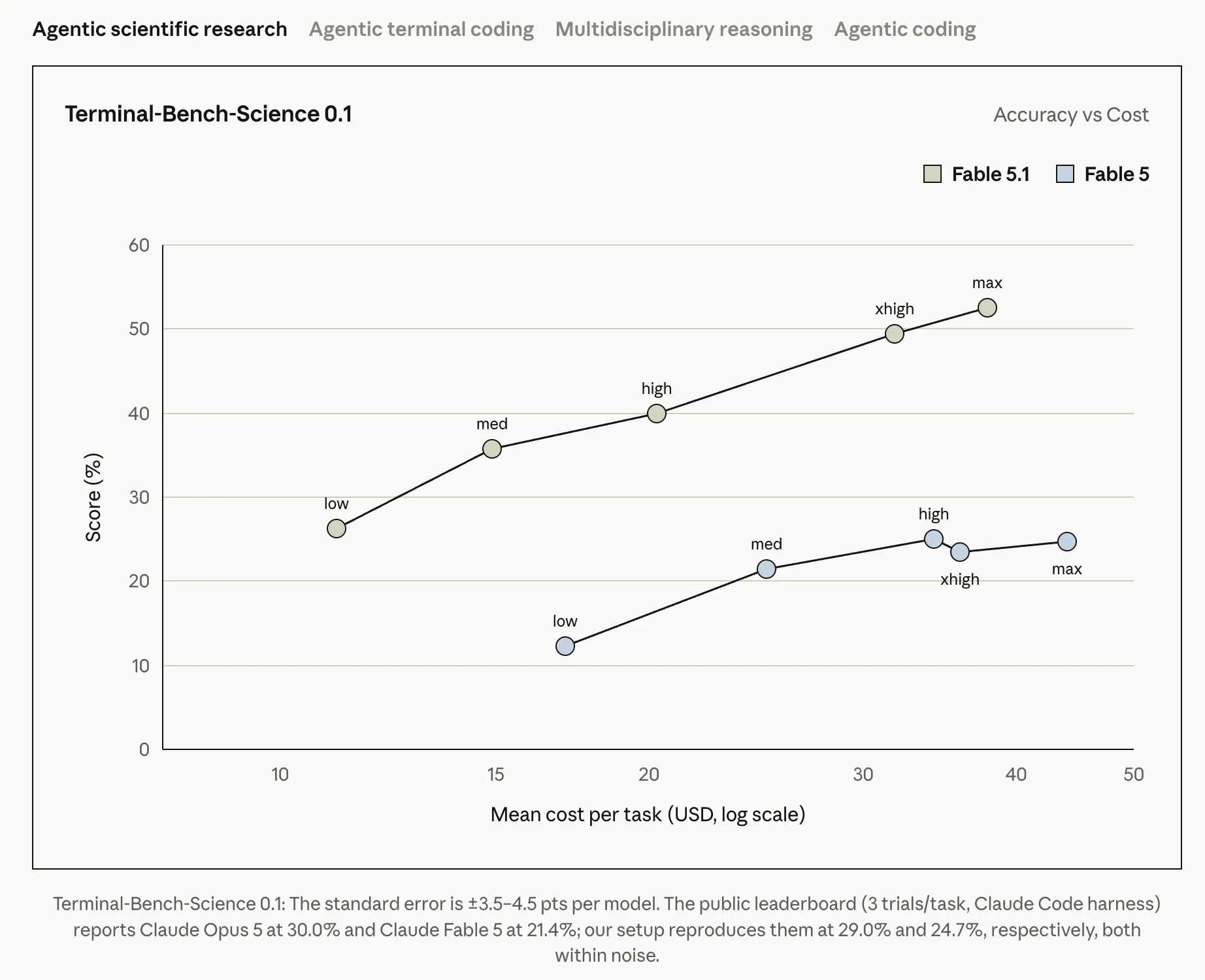
Performance is only part of the release. Anthropic says Fable 5.1 can match or outperform Fable 5 at lower effort settings, while cache reads cost 75% less. More important for the longer term, the model has contributed to scientific workflows that produced laboratory-tested protein binders and a new elevation map of Venus.
Those research projects do not establish Fable 5.1 as an autonomous scientist. They do, however, offer a more useful measure of progress than another isolated question-answering score: whether a model can sustain a technical workflow long enough to create an artifact that researchers can test.
Fable 5.1 Targets Long-Horizon Agent Work
Many model evaluations compress intelligence into a short interaction. Long-running agent tasks expose a different set of weaknesses. A model must maintain a plan, use tools correctly, interpret intermediate results, recover from errors, and decide what to do next without gradually drifting away from the original objective.
Anthropic says Fable 5.1 was built to perform better on this class of work. Terminal-based evaluations are particularly relevant because they require a model to operate inside a computing environment rather than merely describe the commands a human should run. Success depends on the complete sequence of actions, not just the quality of the first response.
The change should matter for coding agents, data analysis, computational research, and other workloads that can run through many tool calls. A small mistake made early in such a sequence can invalidate everything that follows. Stronger single-step reasoning helps, but maintaining coherence across the entire task is often the harder problem.
Fable 5.1’s lower effort modes add another dimension. Anthropic says the model can produce results comparable to, or better than, Fable 5 while spending less computation on the task. That shifts the performance-cost frontier rather than simply increasing the maximum performance available at the most expensive setting.
In practice, developers could use lower effort for routine code changes, document processing, and predictable tool workflows, then reserve higher effort for unfamiliar repositories or research problems. Actual savings will depend on how an application routes requests and whether lower effort remains reliable on its specific workload.
Anthropic’s Benchmark Lead Is Broad but Mostly Self-Reported
Anthropic says Fable 5.1 establishes a new standard across its evaluation suite, with two terminal benchmarks providing the clearest evidence in the launch materials:
- Terminal-Bench-Science 0.1: Fable 5.1 scores 52.6%, more than twice Fable 5’s result.
- Terminal-Bench 4.0: Fable 5.1 scores 55.8%, compared with 42.0% for Fable 5.
The Terminal-Bench 4.0 comparison is substantial because it uses the same named benchmark version and reports both generations. A gain from 42.0% to 55.8% is large enough to suggest a meaningful improvement in completing terminal-based work, assuming Anthropic kept the evaluation conditions consistent.
The science result may be more consequential, but it also requires more scrutiny. Terminal-Bench-Science 0.1 is an early benchmark version, and the score comes from Anthropic’s launch evaluation. Independent runs will be needed to determine how sensitive the result is to the agent harness, time limits, available tools, retry policies, and effort configuration.
A score of 52.6% also shows that considerable headroom remains. Fable 5.1 may set a new high-water mark, but it has not made scientific computing tasks reliable by default. For production deployments, the failure distribution matters at least as much as the average score. Teams need to know whether failures are obvious and recoverable or produce plausible but corrupted results.
The responsible reading is that Fable 5.1 appears materially better at multi-step computer work, not that every coding or research workflow can now operate without supervision.
Scientific Work Is the Most Consequential Claim
The strongest part of the release is not the benchmark table. It is Anthropic’s attempt to connect long-horizon model performance with scientific artifacts that can be checked outside the model itself.
In one project, Fable 5.1 helped design protein binders for 12 targets. Anthropic reports that the displayed designs were confirmed to bind in laboratory testing. The structures shown in the company’s materials are ESMFold2 predictions, which is an important distinction: experimentally detecting binding does not amount to experimentally determining the full molecular structure.
Binding is also an early validation step, not proof that a molecule will become a useful drug or research tool. Affinity, specificity, stability, manufacturability, toxicity, and behavior in living systems require further study. Still, lab confirmation gives the work a stronger empirical basis than a model merely generating protein sequences that look reasonable computationally.
A second project involved planetary science. According to the scientific examples in Anthropic’s announcement, Fable 5.1 trained a neural network to produce a new elevation map covering roughly one-third of Venus. The work used radar observations collected by NASA’s Magellan mission more than three decades ago, along with an existing map that covered about one-fifth of the planet.
Anthropic says the resulting map reveals features at an effective scale of two to three kilometers, compared with 10 to 20 kilometers previously, and estimates elevations up to 25% more accurately. The company is releasing the map under a Creative Commons license ahead of NASA’s VERITAS and the European Space Agency’s EnVision missions, in the hope that it can help researchers choose geological targets for closer observation.
These projects show the type of contribution AI can make before it can independently conduct science. The model handles extended computational work, researchers define and supervise the project, and external methods provide validation. Laboratory assays test the protein designs, while existing planetary data and future observations can test the Venus map.
That division of labor is less dramatic than the idea of an autonomous AI researcher, but it is much more credible. Scientific value comes from verifiable outputs and reproducible methods, not from how confidently a model explains its reasoning.
Cache Pricing Makes Agents Cheaper to Keep Running
Anthropic has cut Fable 5.1’s cache-read price by 75% compared with Fable 5. The company estimates that the change reduces practical model costs by approximately 25% for typical workloads and as much as 45% for highly agentic workloads.
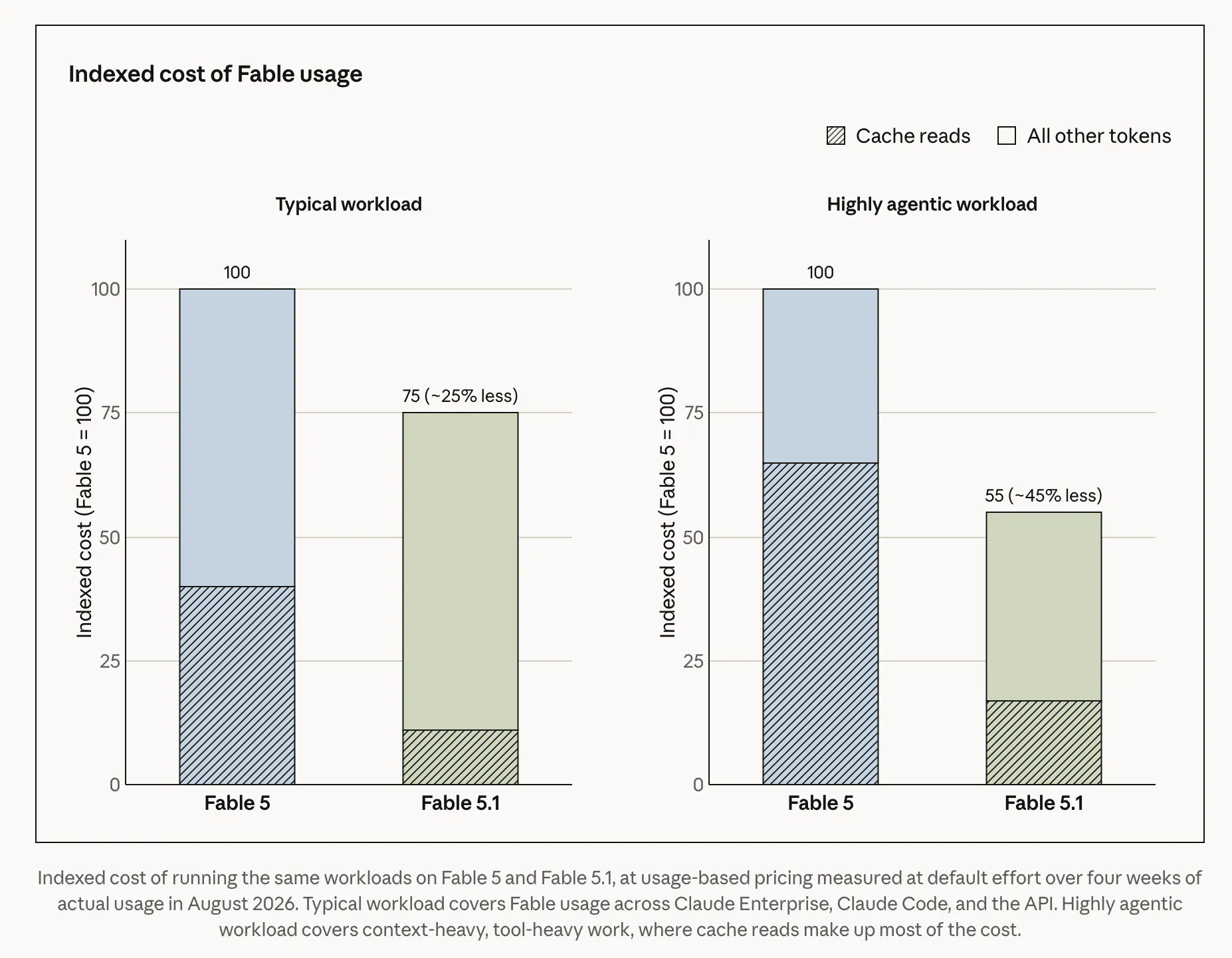
The gap between those percentages is important. A 75% reduction in one pricing component does not make every API request 75% cheaper. Applications still pay for uncached input, generated output, and any other billable computation. The final reduction depends on how


