Amazon CEO Andy Jassy said on October 29, 2026, that AWS could become a $1 trillion annual-revenue business within five to ten years. The cloud division currently has a $184 billion annualized revenue run rate, making that ambition more than a fivefold expansion from its latest quarterly pace.
The cost is substantial. Amazon expects approximately $220 billion in company-wide cash capital expenditure in 2026, mostly for AWS, and Jassy told investors it expects to “spend meaningfully more in 2027,” according to TechCrunch’s earnings-call report.
AWS is growing quickly and generating substantial operating profit. Amazon’s cash flow also shows how expensive that expansion has become. Understanding Jassy’s forecast means separating three things: revenue already earned, growth management expects, and infrastructure Amazon must pay for before the full return arrives.
What AWS Earns Today, and What Jassy Is Projecting
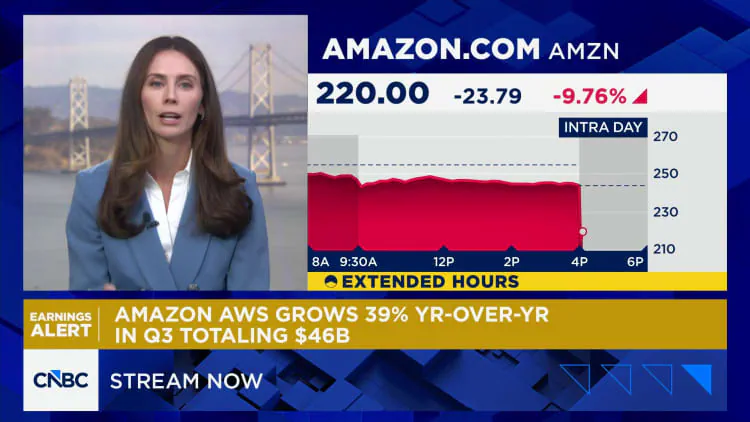
Amazon’s third-quarter earnings release, published October 29, reported $46 billion in AWS sales for the quarter ended September 30. That was a 39.3% increase from a year earlier, its fastest growth in nearly five years.
The release also reported $17.8 billion in AWS operating income, up from $11.4 billion a year earlier.
| AWS measure | Figure | What it represents |
|---|---|---|
| Q3 2026 revenue | $46 billion | Sales recorded during the quarter |
| Q3 revenue growth | 39.3% | Reported year-over-year growth |
| Annualized revenue run rate | $184 billion | Latest quarterly revenue multiplied by four |
| Q3 operating income | $17.8 billion | Reported segment operating profit |
| Expected growth in 2027 and 2028 | Above 40% each year | Management projection |
| Longer-term revenue ambition | $1 trillion annually | Management’s five-to-ten-year outlook |
A run rate is a snapshot, not a completed year’s revenue. Multiplying $46 billion by four describes the annual revenue AWS would generate if that quarterly pace stayed unchanged. It is neither trailing-twelve-month revenue nor a forecast that accounts for future changes in demand.
The operating figures also matter. Dividing AWS’s $17.8 billion operating income by its $46 billion revenue gives an operating margin of approximately 38.7%. AWS contributed about 63% of Amazon’s total quarterly operating income, calculated from the company’s reported $28.1 billion total.
Those calculations show that Amazon is expanding an already profitable business. They do not reveal the eventual return on the next round of infrastructure investment.
The Math Behind a $1 Trillion AWS
Moving from a $184 billion annualized revenue pace to $1 trillion requires roughly 5.43 times the current scale.
The timeline makes an enormous difference. Using the current run rate as an illustrative starting point, the compound annual growth rate required is:
| Time to reach $1 trillion | Required average annual growth |
|---|---|
| Five years | About 40.3% |
| Ten years | About 18.4% |
These are calculations from the published starting figure and target, using compound growth. They are not Amazon guidance, and they simplify the difference between an annualized quarterly pace and actual full-year revenue.
The five-year version of Jassy’s ambition requires AWS to sustain roughly its current growth rate throughout the period. The ten-year version leaves considerably more room for growth to slow as the business gets larger.
Jassy’s projection of growth above 40% in both 2027 and 2028 therefore carries real weight. As a simple illustration, two successive 40% increases applied to $184 billion produce approximately $361 billion. That would be a major expansion, but still only about 36% of the trillion-dollar target.
My view is that the five-to-ten-year range deserves as much attention as the headline number. Its shorter end depends on unusually durable growth at an already enormous scale. Its longer end allows for a more gradual expansion. Treating those as one forecast obscures how different the required paths are.
The Cash Cost Is Already Visible
Amazon reported $168.3 billion in operating cash flow for the trailing twelve months ended September 30, up 29% from a year earlier. Over the same period, however, free cash flow was negative $42.4 billion, compared with positive $14.8 billion a year earlier.
The earnings release attributed the deterioration primarily to a $94.8 billion year-over-year increase in purchases of property and equipment, net of sales proceeds and incentives. Amazon said that increase primarily reflected AI investments.
Several distinctions keep those numbers useful:
- The $220 billion forecast covers Amazon as a whole. Jassy said the majority is for AWS; it is not a disclosed $220 billion AWS-only budget.
- The negative $42.4 billion free cash flow figure covers twelve months. It is not a single-quarter outflow.
- The 2027 spending plan has no stated dollar total in the supplied reporting. “Meaningfully more” signals direction without quantifying the increase.
- Capital spending and operating expenses affect accounts differently. Infrastructure requires cash investment, while assets are generally expensed over their useful lives through depreciation.
That last distinction explains how AWS can report strong operating income while Amazon’s consolidated free cash flow turns negative. Operating profit and cash remaining after capital investment answer different questions.
The spending also accelerated within the quarter. CNBC reported capital expenditure of $77.3 billion, up from $35.1 billion a year earlier and above the $58.7 billion analysts expected, according to FactSet.
The $220 billion figure is therefore spending guidance, not a published price tag for reaching $1 trillion in AWS revenue. Amazon has not supplied a cumulative infrastructure budget for the entire five-to-ten-year ambition.
Amazon’s Spending Is Large Even Among Hyperscalers
CNBC’s report also placed Amazon alongside other major cloud infrastructure investors:
| Company | Reported 2026 capital expenditure forecast |
|---|---|
| Amazon | Approximately $220 billion |
| Microsoft | $170 billion |
| Alphabet | $195 billion–$205 billion |
These are the forecasts reported by CNBC, not a normalized comparison of AI-only investment. The report does not reconcile accounting definitions or reporting periods across the companies, so the figures cannot establish who is buying the most equivalent computing capacity.
They do show the scale of the commitment. Amazon’s stated budget exceeds the other two reported forecasts, and management is already signaling a further increase.
I would avoid treating the largest spending number as evidence of the strongest strategy. Infrastructure creates earning capacity only when customers use it at prices that support an adequate return. The financial question is how effectively that capacity converts into revenue and cash over time.
Why the Share Drop Needs Context
Amazon shares fell about 6% in after-hours trading, according to TechCrunch. Its report described repeated analyst questions about infrastructure spending, evidence of future growth and expected profit margins. That was an after-hours snapshot, not a final subsequent closing price.
The reaction cannot be attributed solely to AI spending.
Frequently Asked Questions
3 questions
1Is AWS Already a $184 Billion Annual-Revenue Business?
AWS reported $46 billion in Q3 revenue. Multiplying that quarter by four produces its $184 billion annualized run rate. That figure is not revenue already earned over a full year.