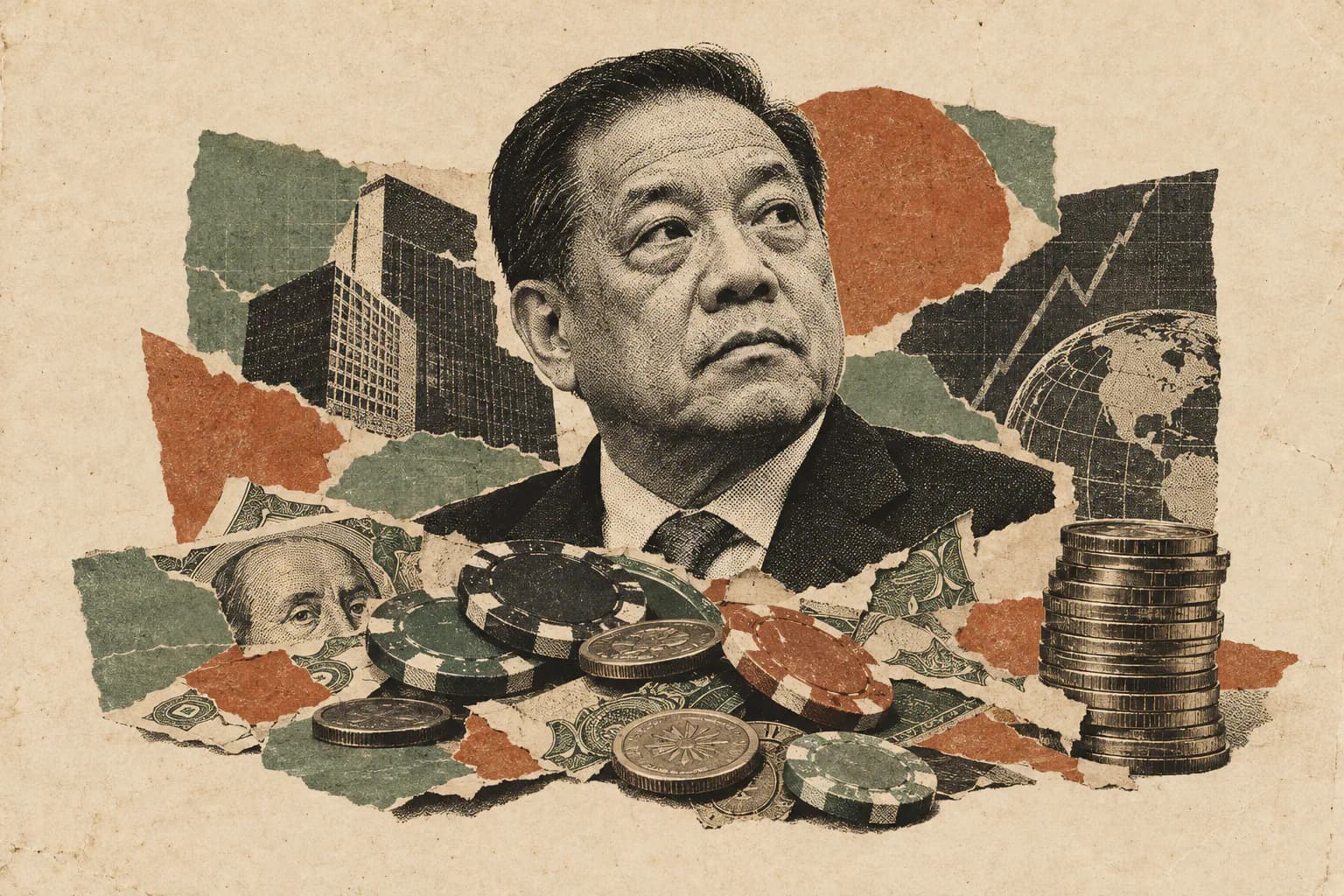
AI Industry’s Next Bottleneck May Be Capital, Says Hock Tan
Broadcom’s CEO sees real demand for frontier models, but questions investor expectations, enterprise learning and the financing needed to sustain expansion.
Listen
AI narration
9:43
0:00 / 9:43
AI SummaryGenerated from this article
Condensed Summary (98 words)
Broadcom CEO Hock Tan warned that capital availability, not chip supply, may become AI's biggest constraint. Speaking at Singapore's DBS Asia Future Forward Conference on October 12, he cited genuine demand from frontier-model providers like OpenAI and Anthropic, but questioned whether some investors held unrealistic expectations and whether enterprise experimentation was producing sufficient learning to justify continued spending. Tan expects memory shortages to ease within a year and wafer constraints by 2028-2029, yet demand for computing infrastructure could exceed supply through 2030. His warning separates three claims: customers are paying for AI services, some businesses may spend ineffectively, and infrastructure expansion may eventually exceed available financing.
Broadcom is overcoming wafer and memory shortages, yet CEO Hock Tan sees another constraint ahead: the money needed to keep expanding AI infrastructure. Speaking at a Singapore panel on October 12, he warned that capital could become the industry’s biggest hurdle even as semiconductor production grows.
Reuters’ account reported that forecast alongside his assessment of improving chip supply. Investing.com described a sharper criticism: Tan compared some AI investors with casino gamblers who set extreme expectations without understanding what they were backing.
The gambling comparison deserves attention, though it captures only part of his argument. Tan also pointed to frontier-model revenue as evidence of genuine demand and questioned whether enterprise experimentation was producing enough learning.
These are three separate claims: customers are paying for AI, some businesses may be spending ineffectively, and the infrastructure buildout may eventually exceed the financing available to sustain it. Treating them as a single declaration that AI is a speculative bubble would misrepresent the warning.
The Casino Comparison Targets Investor Understanding
Tan spoke at the DBS Asia Future Forward Conference, whose official agenda placed him alongside Intel CEO Lip-Bu Tan on a panel about where the next trillion dollars in AI would come from. DBS Group CEO Tan Su Shan moderated the discussion. The panel focused on funding the industry’s expansion, not assessing whether AI models work.
Investing.com’s account described Hock Tan criticizing investors who attach extreme expectations to AI without understanding the businesses receiving their money. His casino analogy targeted that behavior; it was not evidence that every AI investment amounts to gambling.
Work with Zeniteq
Let’s work together
We’re open to thoughtful collaborations with teams building in AI. Explore the ways we can work together.
An investor can correctly anticipate growing AI adoption and still misjudge which companies will capture the resulting revenue, how much infrastructure they will need, or what price makes an investment worthwhile. Strong demand does not settle those questions.
Tan’s position inside the semiconductor industry gives his comments weight. His role, however, does not turn an analogy into a measured finding about investor competence. The available reporting provides no quantified assessment of how widespread the behavior is.
The narrower warning is useful: enthusiasm for AI does not remove the need to understand costs, customers and returns. It is compatible with his expectation of substantial demand for computing infrastructure.
Frontier-Model Revenue Is Evidence of Demand, Not Profit
Reuters reported that Tan cited Anthropic and OpenAI as examples of frontier-model developers generating significant revenue from their latest models deployed for AI personal assistants. Investing.com’s account also described him pointing to OpenAI’s revenue growth as a sign of potential demand despite continuing losses.
The reported remarks offered no detailed financial comparison. These are Tan’s assessments, and they should not be used to infer a particular revenue figure or profitability timeline.
Revenue shows that customers are willing to pay for a product. It does not establish that the provider can deliver that product profitably, recover its investment in model development, or finance the next generation of infrastructure.
A model provider’s revenue also says little about whether every customer is receiving an adequate return. A business can pay for an AI service before it knows whether the service improves its own economics. The same transaction demonstrates paying demand for the provider and spending that still needs justification for the customer.
Tan’s comments allow for genuine commercial adoption alongside uncertainty about sustainable returns. Rising revenue does not prove that every AI business model works, just as continuing losses do not prove that demand is imaginary.
Enterprise Experiments Need to Produce Learning
According to Investing.com, Tan likened some corporate AI experimentation to children quickly spending arcade tokens without learning anything. His reported comparison concerned what companies gain from their spending, beyond the amount they spend.
The account does not establish that enterprise AI broadly fails. It supplies no sample of businesses, failure rate or common method for calculating return on investment.
Still, learning is a useful test distinct from immediate profitability. An experiment can be valuable without producing a positive financial return if it resolves an important uncertainty. It might reveal that a workflow needs better data, that human review remains expensive, or that the proposed automation does not save enough time.
These are illustrative outcomes, not findings from Tan’s panel. Each would leave a company better equipped to decide what to deploy, change or abandon. Spending that produces neither a useful deployment nor a clearer decision is harder to defend. Repeated pilots can consume money without improving the next investment choice.
Enterprise buyers need to identify the result they are seeking, measure the full cost of reaching it and explain what evidence would justify further spending. Simply adopting AI does not meet that test. Tan’s reported arcade comparison warns against skipping this discipline.
Financing Can Become the Constraint While Demand Stays Strong
Tan’s capital argument was a forecast about the next major obstacle. He did not declare that hardware shortages had disappeared.
“Memory shortage today might not be that way a year from now.”
CNBC also reported that Tan suggested wafer shortages could ease by 2028 or 2029. Those are expectations, not confirmed dates for resolving supply constraints.
Meanwhile, he said demand for computing infrastructure exceeded what the industry could supply. CNBC reported that he expected the imbalance could persist through 2029 and potentially into 2030.
Those positions can coexist. Customers can want more computing capacity than suppliers can deliver while the industry faces increasing difficulty financing that capacity. Demand, manufacturing capability and available funding are separate constraints.
Infrastructure requires money before the resulting services generate enough cash to repay the investment. A project can have plausible long-term demand yet struggle to obtain financing on acceptable terms. Expanding chip supply does not automatically resolve that problem.
Intel CEO Lip-Bu Tan made a related point at the same panel. CNBC reported that he identified capital, its cost and the eventual need to demonstrate returns as challenges to continued growth.
Financing need not disappear entirely to slow construction or equipment purchases. Less favorable terms can change whether a project looks worthwhile, even if its technical design and expected customer demand remain unchanged. Access to capital and its cost are distinct concerns.
Hock Tan’s warning concerns the ability to sustain expansion, beyond the amount of money already committed. Revenue growth, better enterprise results and continued financing all contribute to that ability, but none substitutes completely for the others.
The Semiconductor Sell-Off Had Multiple Drivers
Tan’s remarks arrived during a semiconductor sell-off. The Financial Times reported that the global decline deepened after his comments, with Samsung Electronics and SK Hynix falling sharply in Seoul trading. Its account also identified competition from China’s CXMT as another factor affecting sentiment.
The sequence of comments followed by further share-price declines does not establish that Tan alone caused the moves. His warning was relevant to semiconductor investors because it questioned how long infrastructure spending could keep expanding without stronger evidence of returns. Competitive pressures were also part of the reported explanation, and a share-price movement cannot prove that an industry-wide financing shortage has begun.
The central distinction in Tan’s argument is between demand for AI and the financial capacity to serve it. More capable models and more available chips can support expansion, while weak investment decisions or uncertain enterprise outcomes make the next round of financing harder to justify.
His casino comparison captures the danger of expectations detached from understanding. The capital warning extends that concern to the buildout itself: investors and customers will need to explain why the next commitment of money is warranted. The size of the previous commitment is not enough.