Intel D-Series GPUs Start Sampling, With Up to 480GB
Intel's own card carries 160GB; larger partner designs remain an option, and the company has not announced pricing or general availability.
AI SummaryGenerated from this article
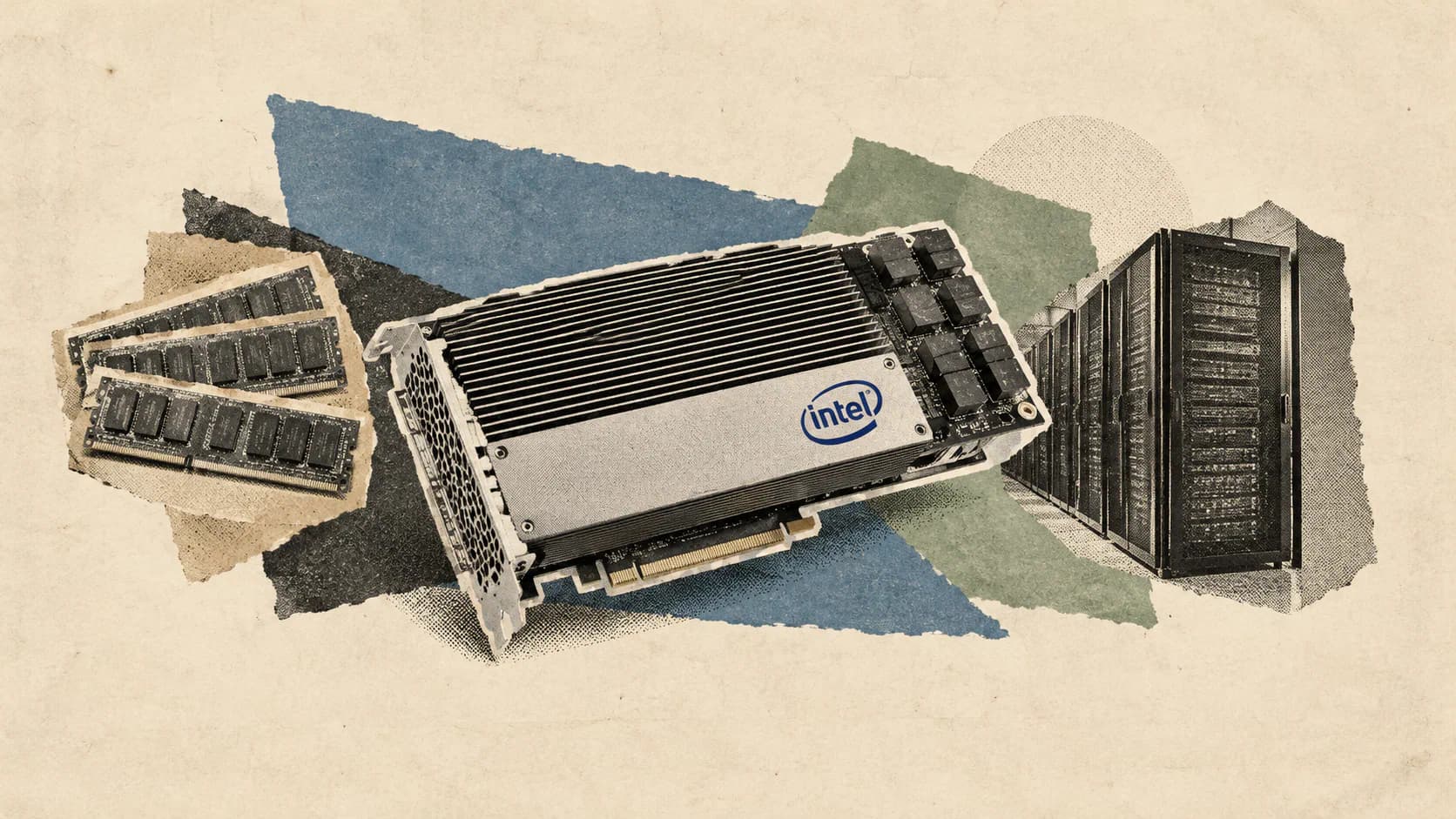
Intel has begun sampling its D-series inference accelerator, a PCIe GPU designed for memory-intensive AI workloads. Intel's own card features 160GB of LPDDR5X memory, while the 480GB maximum highlighted in announcements represents a configuration partners may offer, not Intel's branded product.
The accelerator uses Intel's Xe3P architecture and delivers up to 1.5TB/s memory bandwidth and 1.3 petaflops of FP8 compute in a 350-watt, air-cooled form factor. Intel claims the card can support models up to 300 billion parameters, though the company has not disclosed general availability dates, pricing, or independent performance measurements needed for procurement decisions.
Customers are now sampling Intel’s D-series inference accelerator, whose headline memory specification needs qualification. Intel’s own PCIe card has 160GB of LPDDR5X memory. The 480GB maximum highlighted in its announcement is a configuration the design allows partners to offer, not the capacity of Intel’s branded card.
Intel’s October 13 D-series announcement provided concrete specifications for the GPU formerly code-named Crescent Island and confirmed that customer sampling is underway. It included no general-availability date, pricing, or independent performance results.
The proposition is a memory-heavy inference accelerator in a standard PCIe, air-cooled form factor. For organizations evaluating on-premises AI products, that could offer a way to serve large models without adopting specialized accelerator racks or liquid cooling. Its economics will depend on details Intel has yet to supply, particularly usable model capacity, serving performance, software readiness, and price.
Intel’s Card Has 160GB; Partners May Offer 480GB
D-series uses Intel’s Xe3P architecture. The company describes it as an accelerator for sustained, memory-intensive inference, including large language models, long-context workloads, and concurrent inference services.
The announced specifications are:
Memory: 160GB of LPDDR5X on Intel’s branded card, with partner configurations potentially reaching 480GB.
Memory bandwidth: Up to 1.5TB/s.
FP8 compute: 1.3 petaflops.
Power envelope: 350 watts.
Deployment format: Standard PCIe, with an air-cooled design.
Buyers cannot treat every specification in the announcement as belonging to a single available product. Intel’s footnote separates its 160GB card from the design’s higher memory ceiling. Customer sampling does not establish that a 480GB partner card is shipping, orderable, or priced.
There is also no configuration-by-configuration breakdown showing how memory capacity, bandwidth, and other specifications vary across partner implementations. A procurement decision would require the specification sheet for the actual card, rather than the maximum figures for the broader design.
Intel’s emphasis on inference explains the appeal of high memory capacity; it is not presenting D-series as a general-purpose answer to every AI workload. Still, that positioning does not establish better inference economics. The published compute and bandwidth figures describe hardware resources, not measured tokens per second, response latency, or cost per completed request.
Work with Zeniteq
Let’s work together
We’re open to thoughtful collaborations with teams building in AI. Explore the ways we can work together.
Model Capacity Depends on Precision and Working Memory
Intel says D-series can support models with up to 300 billion parameters on one card and more than one trillion parameters in an eight-GPU system. These are Intel’s model-capacity claims, not independently measured serving results.
Interpreting those claims requires more than parameter counts. A model’s memory needs depend on how its weights are stored and the memory required to run it.
As an illustrative calculation, a 300-billion-parameter model requires approximately:
300GB for weights at eight bits per parameter.
150GB for weights at four bits per parameter.
These raw weight-storage estimates use decimal gigabytes. They exclude quantization metadata, temporary buffers, runtime overhead, and the key-value cache used during language-model generation.
On Intel’s 160GB card, four-bit weights for a 300-billion-parameter model would consume most of the nominal capacity before those additional requirements. The calculation neither proves that such a model can run usefully on that card nor establishes the configuration behind Intel’s claim.
A 480GB implementation would provide substantially more room. Even then, a model that fits may generate responses too slowly for the intended application, especially under concurrent demand.
Long contexts add another constraint. The key-value cache stores information from previously processed tokens so the model does not have to recompute it at every generation step. Its memory requirements grow with factors including context length and the number of active requests. Extra memory may therefore provide room for longer conversations or greater concurrency, as well as larger weights.
Buyers need to know more than whether a model loads: which model, precision, context length, and batch size Intel tested, and what latency and throughput the system sustained. The announcement does not provide that complete serving configuration.
Air Cooling Could Lower the Deployment Barrier
D-series’ conventional deployment format is arguably more consequential than its highest advertised parameter count.
Intel says the standard PCIe form factor and air-cooled design are intended to let customers add inference capacity within existing data-center environments, without specialized rack or cooling infrastructure. If validated systems deliver that promise, organizations could have a more accessible route to local model serving than a dedicated, tightly integrated accelerator installation.
Memory capacity can also affect system complexity. When a model exceeds one accelerator’s usable memory, operators may need to divide it across multiple devices or use another memory tier. Keeping a suitable model on one card could avoid some of that distribution work and its associated data movement. Whether D-series reduces the required accelerator count will depend on the model and serving configuration.
Enterprises that prioritize private deployment, manageable infrastructure changes, and enough capacity for a specific workload over maximum performance at any cost may find this appealing. For an operator seeking the highest possible throughput, the case is less compelling unless Intel can demonstrate competitive serving results.
Air cooling does not make the card a universal drop-in upgrade. Servers still need appropriate slots, power delivery, chassis space, firmware support, and sufficient airflow. A 350-watt accelerator introduces a meaningful thermal load, and compatibility must be validated at the system level.
The power envelope alone cannot establish efficiency, either. A slower accelerator can consume less power while requiring more devices, or more time, to complete the same work. The relevant comparison is delivered service at a defined latency and quality target.
Evaluating D-series will require separate measurements of prompt processing and token generation, realistic concurrency tests, and whole-system power readings. Until those results are available, the air-cooled PCIe design remains a credible deployment advantage to investigate, not proof of lower operating cost.
Xeon Racks and Agent Software Address Different Work
Intel presented D-series alongside high-density Xeon infrastructure and an enterprise agent software stack at the 2026 OCP Global Summit.
Select Xeon 6+ configurations exceed 46,000 cores per rack at 133.45kW of total rack power, according to the company. Many of the showcased Xeon systems use the Open Compute Project’s Open Rack v3 standard.
Those figures describe separate CPU rack designs. They are neither specifications for a D-series deployment nor evidence that the entire infrastructure Intel showcased fits conventional air-cooled environments. The GPU’s deployment claim and the CPU rack’s density claim answer different questions.
Intel’s broader argument is that agent applications need substantial general-purpose computing around model inference. An agent may retrieve records, call APIs, execute code, maintain state, and coordinate multiple operations. GPUs handle model computation, while CPUs can perform much of the surrounding work.
The Enterprise Agent Toolkit repository makes that division more concrete. Intel’s open-source stack combines components for API access, inference routing, memory, sandboxed execution, and observability. Its documented defaults include LiteLLM, Redis, PostgreSQL with pgvector, and monitoring tools such as Langfuse and Prometheus.
Replaceable provider blocks allow individual components to be substituted without replacing the entire stack. Intel says the toolkit is optimized and deployable on Xeon today, while its provider-based architecture is designed to extend to Intel GPUs.
The available Xeon agent stack does not establish production readiness or performance for D-series. Software portability across Intel GPU platforms also remains Intel’s stated objective, not a guarantee that every existing application will run unchanged or efficiently on the new accelerator.
Sampling Establishes Progress, Not Purchase Readiness
D-series has moved beyond an architectural preview: Intel has disclosed specifications and says customers are evaluating hardware. The information needed to judge a production purchase is still missing.
When will Intel’s 160GB card become generally available? Which partners will offer higher-capacity designs, and when? What will those systems cost? How do they perform on representative models at useful context lengths and service-level targets?
Price deserves particular attention because memory capacity is only one part of inference economics. A larger card might reduce the number of accelerators needed for a workload, but that advantage can disappear if acquisition cost is high, throughput is insufficient, or software integration requires substantial work.
The strongest case for D-series is narrower than Intel’s broad agentic AI positioning: a large-memory accelerator that could make selected models practical to serve in conventional PCIe, air-cooled servers. That would be valuable even without leading every compute benchmark.
Buyers should keep a 160GB Intel card, potential 480GB partner configurations, and products actually available to buy separate when reading the announcement. Sampling gives customers an opportunity to test the proposition; production availability, validated serving results, and pricing will determine whether D-series becomes a practical alternative.