

Anthropic appears to be preparing Claude Money, a personal finance feature that would connect users’ bank accounts to its AI assistant. TestingCatalog reported the unreleased iOS interface on September 14, 2026, describing a dedicated place for financial questions.
The potential benefit is more convenient access to financial context: asking about a budget without assembling account information for every conversation. But bank linking introduces questions that a chatbot’s writing or reasoning abilities alone cannot answer, particularly around permissions, incomplete transaction data, and privacy.
The iOS Report Shows Intent, Not a Release
The reported interface includes a Money navigation entry and this onboarding message:
“Understand your money with Claude”
The accompanying description invites users to link bank accounts and ask about spending and plans. Account types, the connection provider, and supported actions remain unspecified.
That establishes the intended direction, not a working product’s full capabilities. A bank-linking invitation should not be interpreted as evidence of payment execution, investment trading, or automatic financial management.
Claude’s public App Store listing does not advertise Money. Readers should therefore distinguish the reported interface from a public rollout, and should not assume that an existing subscription includes the prospective feature.
Claude Already Has Financial Data Connectors
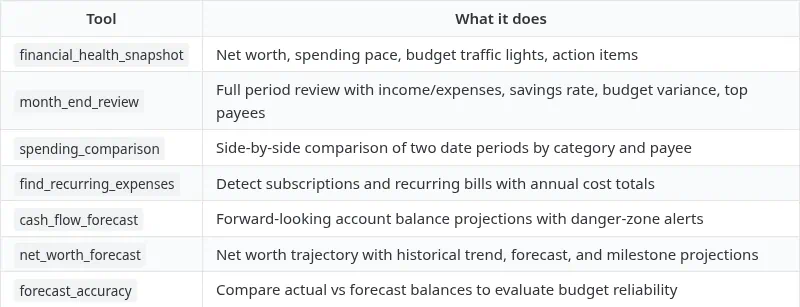
Bank-connected conversations would not be entirely new to Claude. Anthropic’s connector directory already includes Era Context, whose tools cover account balances, spending analysis, and recurring charges, alongside PocketSmith, which connects personal finance records to Claude.
PocketSmith illustrates why the implementation matters. Its Model Context Protocol integration, which gives an AI assistant access to external tools and data, offers two permission modes:
- Read-only access allows users to examine financial information without changing it.
- Full access additionally permits operations such as categorizing transactions and creating or editing budget events in PocketSmith.
Those are permissions over PocketSmith’s records, not interchangeable claims about authority over a bank account. “Connect your finances” can describe substantially different products depending on what the connection allows.
There is also an existing consumer-finance partnership. Intuit announced on April 23, 2026, that apps including TurboTax and Credit Karma were available within Claude. That announcement establishes a broader financial-services relationship, but does not identify Intuit as Claude Money’s provider.
The meaningful opportunity for a native Money section would therefore be simpler setup and a more coherent experience. Anthropic would need to explain what it improves over these existing integrations, rather than merely presenting financial-data access as a new capability.
ChatGPT Finances Provides a Useful Comparison
OpenAI already offers a comparable product called Finances in ChatGPT. Its June 25, 2026 update expanded availability to US Plus and Pro users across web, iOS, and Android. OpenAI’s current documentation still describes a gradual rollout, so eligibility does not guarantee immediate access.
ChatGPT Finances uses Plaid for account connections. It supports questions about spending, subscriptions, balances, net worth, and investments, with a dashboard that brings those categories together.
Crucially, OpenAI distinguishes analysis from execution: ChatGPT Finances cannot move money, pay bills, make trades, or change account settings. That is a documented boundary for OpenAI’s product, not a confirmed description of Claude Money.
A US-first Claude Money launch is plausible, but remains unconfirmed. TestingCatalog presents that possibility as speculation. ChatGPT’s regional restriction provides a precedent, not evidence that Anthropic has selected the same countries or banking infrastructure.
For a useful comparison at launch, Anthropic would need to disclose supported institutions, account types, subscription eligibility, synchronization behavior, and permissions. A similar onboarding message does not establish feature parity.
Privacy Requires More Than a Secure Connection
The most important privacy question is what happens after financial information becomes available to the assistant.
Anthropic’s existing consumer policy distinguishes raw connector content from conversation content. It says raw data from connectors, including MCP servers, is excluded from the conversation data used for model improvement, while information directly copied into a conversation may be included under the applicable training conditions. That general policy should not be presented as a product-specific guarantee for Claude Money.
Before linking accounts, users should expect clear answers about:
- Access: Which accounts and data fields are shared, and can access be restricted?
- Retention: What remains after disconnecting, including information reproduced in conversations?
- Training: How are transaction records, generated summaries, and submitted feedback treated?
OpenAI’s documentation demonstrates why these distinctions matter. Disconnecting financial accounts triggers deletion of synced account data from OpenAI’s systems within 30 days, but does not remove financial information already contained in conversation history. Financial memories have separate deletion controls.
For Claude Money, the standard should be equally understandable controls. A single disconnect button would be insufficiently informative if users could not tell which copies of their information it removes.
Correct Transaction Data Matters More Than Fluent Answers
Connecting accounts can improve relevance without guaranteeing accuracy.
OpenAI’s troubleshooting documentation acknowledges that financial institutions may provide incomplete histories or omit fields such as loan details and payment dates. It also warns that transfers, credit-card payments, reimbursements, and duplicate pending transactions can distort spending totals when categorized incorrectly.
Consider a budgeting system that counts both a card purchase and the subsequent card payment as spending. Its explanation could sound convincing while overstating expenses. Better prose would not fix the underlying accounting error.
For Claude Money, I would put more weight on transaction-level evidence, visible synchronization timestamps, and straightforward correction tools than on the sophistication of its generated advice. Users should be able to see which accounts informed an answer and which information was missing.
Those are practical evaluation criteria, not confirmed Claude Money features. They would make it easier to verify material figures against bank records before relying on an AI-generated plan.
Final Thoughts
Claude Money’s strongest potential contribution is reducing the work required to ask a useful financial question. A well-designed native experience could make account-connected analysis more approachable than configuring separate integrations.
That convenience is worth pursuing only if the resulting answers are inspectable. Anthropic should make data coverage, permissions, and deletion behavior as easy to understand as the onboarding promise. The decisive test is whether a user can check a financial conclusion, correct its inputs, and confidently withdraw access afterward.
Frequently Asked Questions
3 questions
1When will Claude Money be released?
No official Claude Money release date has been verified. TestingCatalog describes an unreleased iOS interface, while Claude’s public App Store listing does not advertise the feature. Users should not assume that installing the latest Claude update will enable Money or that their current subscription will include it.
2
Sources
- MCP Serverdevelopers.pocketsmith.com


