A vision model built on 2015’s Inception v3 architecture beat GPT-6 Astra and Claude Fable 5.1 at identifying skin lesions in a dermatologist’s 200-case comparison. Its preset discharge threshold, however, sent home far more melanomas than either general-purpose model.
Consultant dermatologist Magnus Lynch published the comparison on October 25, 2026. His fine-tuned convolutional neural network, or CNN, correctly named 125 lesions across six diagnostic categories. OpenAI’s GPT-6 Astra named 84 correctly; Anthropic’s Claude Fable 5.1 named 85.
The architectural lesson is useful, with an important qualification: this was a task-specific model competing against generally prompted LLMs. It shows that a specialized approach can outperform frontier general-purpose systems on a bounded image-classification task. It does not isolate architecture as the cause, and it is not clinical validation.
The safety results deserve equal billing. At its preset threshold, the CNN discharged 18 of 30 melanomas. Adjusting its operating threshold sharply reduced that number. None of the systems should be used as a standalone diagnostic tool.
The CNN Won Overall, but Still Misidentified Most Melanomas
Lynch asked all three systems to select among the same six diagnoses. The CNN finished about 20 percentage points ahead of both LLMs on first-choice accuracy.
The percentages below are calculated directly from Lynch’s published counts, retaining the half-percentage points that disappear in rounded summaries.
| Model | Correct diagnoses, all 200 lesions | Overall accuracy | Melanomas correctly named |
|---|---|---|---|
| GPT-6 Astra | 84/200 | 42% | 8/30 |
| Claude Fable 5.1 | 85/200 | 42.5% | 11/30 |
| Fine-tuned Inception v3 | 125/200 | 62.5% | 13/30 |
The CNN correctly classified 40 more lesions than Claude and 41 more than GPT. That is a substantial difference within this test.
Its melanoma performance was much less reassuring. Even the overall winner correctly named fewer than half of the 30 melanomas. GPT performed best on basal cell carcinoma, identifying all 25 cases, while the CNN identified 24. Claude led the three systems on actinic keratosis, with 12 correct out of 20.
Those differences matter because an aggregate score combines several kinds of success and failure. A model can improve its overall accuracy by recognizing benign lesions more reliably while remaining weak on a dangerous category.
I’d read the headline result as evidence for choosing a specialist baseline, not as a reason to trust the winning model with patient decisions. The category-level results make that distinction concrete.
What the 200-Lesion Dataset Actually Measures
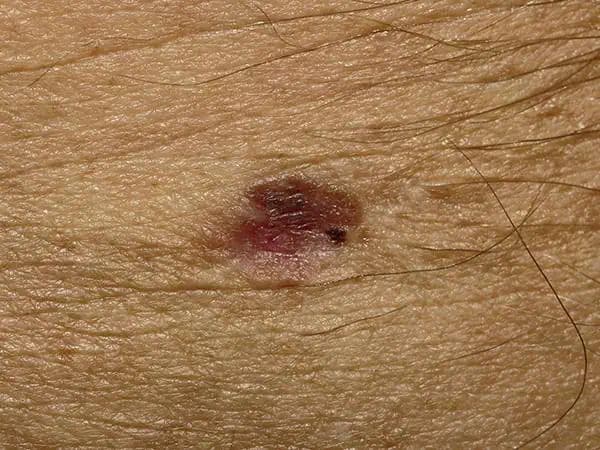
Lynch drew the cases from MILK10k, a public dataset released through the International Skin Imaging Collaboration in 2025. Each lesion had two views: a clinical close-up photograph and a dermoscopic image taken through the illuminated magnifying instrument dermatologists use.
The test’s six categories were deliberately balanced into two management groups:
- 100 lesions designated unsuitable for discharge: 30 melanomas, 25 basal cell carcinomas, 25 squamous cell carcinomas, including Bowen’s disease, and 20 actinic keratoses.
- 100 lesions designated safe to discharge: 50 benign naevi, or moles, and 50 seborrhoeic keratoses.
All 200 had histopathology confirmation, meaning tissue examination supplied the reference diagnosis.
That gives the comparison a firmer answer key than unverified image labels. It also creates a selection problem. Even the benign lesions had been biopsied, so they were lesions that had prompted enough concern to remove or sample. Lynch explicitly notes that this makes them harder cases.
The 50:50 discharge grouping is another condition readers should keep attached to the results. It is a constructed evaluation mix, not a measurement of how frequently these conditions appear in ordinary screening.
A system’s workload and the usefulness of its reassuring answers depend partly on that underlying mix. These 200 cases cannot tell a clinic how many patients it would safely discharge in routine practice.
A Specialized Training Pipeline Faced General Prompting
Inception v3’s age refers to its architecture, not to an untouched model downloaded from 2015.
Lynch started with a network pretrained on everyday photographs, then fine-tuned all its layers on 68,011 dermoscopic and clinical images from the ISIC Archive. He reports doing that on one H100 GPU in about 20 minutes. That is the author’s training-time report, not an independently measured speed or cost comparison.
The data exclusions are important. According to Lynch’s methodology, the 200 test lesions, other photographs of those lesions, and images from the same patients were removed from training and validation. The test cases were also excluded from model selection and threshold setting.
That patient-level separation helps address a common leakage risk: recognizing another photograph of the same case instead of generalizing to an unseen patient.
The CNN scored both image views, combined them with most of the weight assigned to dermoscopy, and selected one of the six diagnoses.
GPT-6 Astra and Claude Fable 5.1 received both images and the same prompt at default settings. They were asked for:
- The most likely diagnosis among the six categories, or an unsure response.
- A confidence value.
- A second-choice diagnosis.
- Whether the lesion could be discharged without treatment, biopsy or follow-up.
Neither LLM refused a case. Each case was run once, so the results do not measure variation across repeated responses.
This setup compares two practical deployment approaches: training a specialist on labeled examples and prompting a general model without task-specific fine-tuning. The CNN’s advantage could reflect specialization, training data, image handling, architecture, or their combination. The test cannot separate those contributions.
The Discharge Threshold Changed the Safety Result
The most consequential result sits outside the six-way accuracy ranking.
Correctly naming a lesion and deciding whether it needs further care are different tasks. A melanoma incorrectly labeled as another condition could still be retained for biopsy or treatment. Conversely, a reassuring discharge decision can be dangerous even when a system performs reasonably across the full label set.
Lynch’s reported melanoma discharge counts show that distinction:
| Model or operating condition | Melanomas discharged |
|---|---|
| GPT-6 Astra | 3/30 |
| Claude Fable 5.1 | 4/30 |
| CNN at its preset threshold | 18/30 |
| CNN under Lynch’s matched-threshold comparisons | 2/30 or 1/30 |
At the preset threshold, the CNN discharged 60% of the melanomas. GPT discharged 10%, and Claude approximately 13%. These percentages are calculated from Lynch’s counts.
That reverses the impression created by the diagnostic leaderboard. The strongest six-way classifier initially made the most dangerous discharge decisions on this subset.
A threshold determines where a model’s scores become an action. Moving that boundary toward caution can keep more lesions for further assessment, including lesions whose diagnostic labels remain wrong. The usual tradeoff is retaining more benign cases too. Evaluating that tradeoff requires both sides of the decision, not only the melanoma count.
that matching safety thresholds reduced the CNN’s melanoma discharges to two or one, depending on the comparison. Those results show that the preset operating point was a major part of its poor safety performance. They should not be read as a validated clinical cutoff.
Frequently Asked Questions
3 questions
1Did a Model From 2015 Beat Current LLMs?
A newly fine-tuned model using the 2015 Inception v3 architecture beat GPT-6 Astra and Claude Fable 5.1 on six-way diagnosis in Lynch’s 200-lesion test. It was not an unchanged 2015 model.