Novice operators using portable ultrasound probes collected scans that allowed a Google research AI system to estimate gestational age with accuracy comparable to expert-sonographer biometry. The prospective study covered 385 participants in Chicago and Nairobi and tested the approach in clinical workflows, beyond previously collected images.
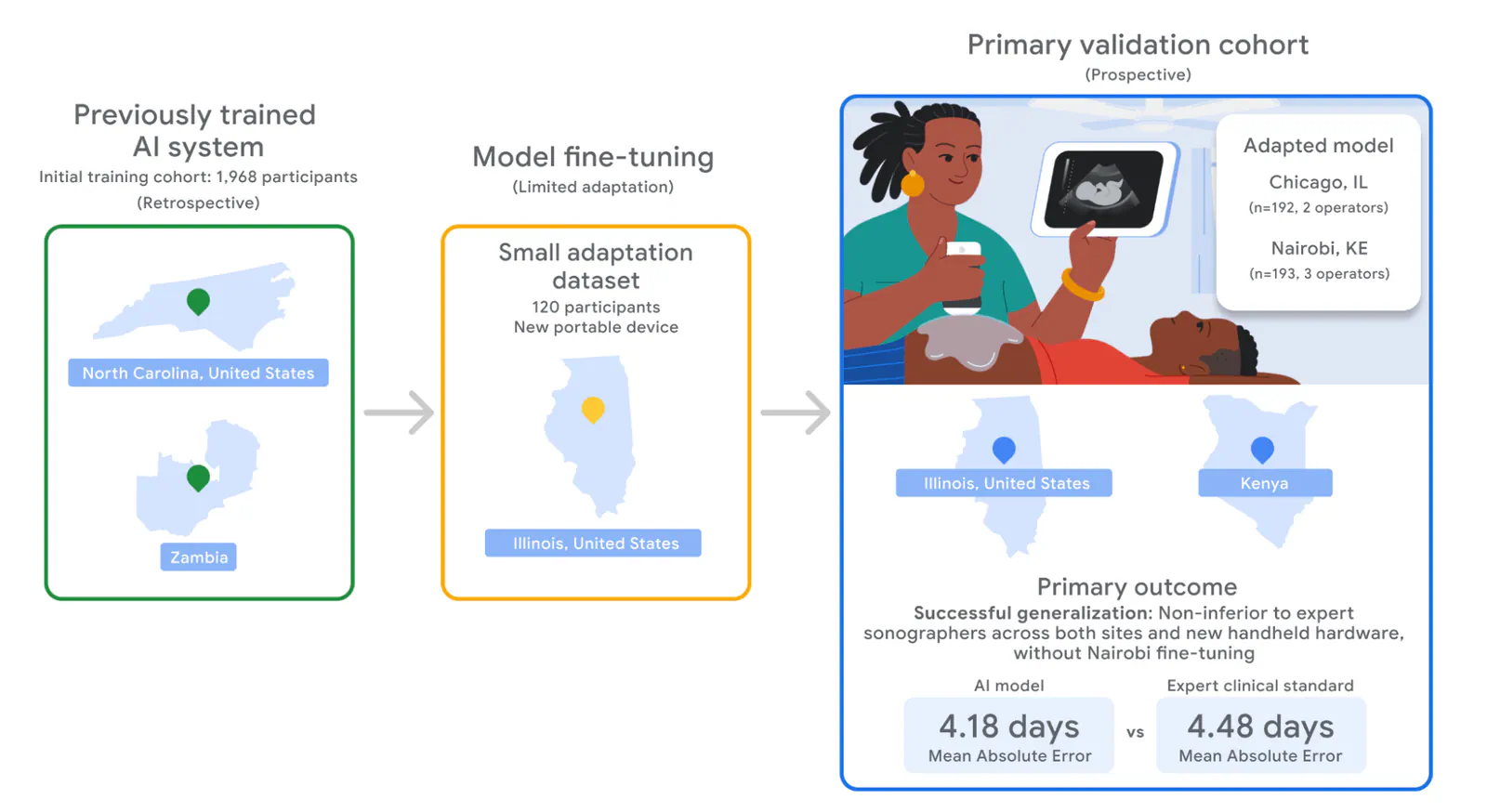
According to Google’s study announcement, the AI’s combined mean absolute error was 4.18 days, compared with 4.48 days for the expert approach. The researchers reported that the system met the study’s non-inferiority criterion, meaning its error was not worse than the comparator beyond the study’s allowed margin.
Nairobi provided the strongest evidence for broader applicability: the model achieved a mean absolute error of 4.27 days there despite receiving no local fine-tuning.
Google described the findings on October 21, 2026, and says the study, Generalization of AI-Based Gestational Age Assessment Using Blind Sweep Ultrasonography, was published in JAMA Network Open. The findings support a specific clinical capability. The system is not a generally available diagnostic product.
Novices Collected Sweeps Instead of Targeted Measurements
Conventional ultrasound-based pregnancy dating requires an expert sonographer to identify particular views of the fetus, take anatomical measurements, and use those measurements in formulas that estimate gestational age. Both image acquisition and interpretation depend on specialized skills.
The research workflow changes the acquisition task. Operators without specialized sonography training move a portable probe across the abdomen in a standardized sequence. These “blind sweeps” collect ultrasound images without requiring the operator to find the precise anatomical cross-sections needed for conventional biometry. The AI then estimates gestational age from the collected scans.
By having non-sonographers acquire the input, the study evaluated a workflow that addresses part of the staffing constraint limiting access to ultrasound. It went beyond testing software’s ability to interpret an expert’s images.
Gestational age provides the timeline used for prenatal screening, treatment decisions, and decisions about delivery, as Google’s clinical lead explains in the announcement. Making that estimate available where a sonographer is unavailable could have practical value.
Pregnancy dating, however, is a narrower task than a complete obstetric ultrasound examination. These results do not establish that the system can replace the broader assessment performed by a trained sonographer or identify every condition that prenatal imaging is intended to investigate.
The Result Establishes Non-Inferiority, Not Superiority
The primary analysis covered participants between 16 and 36 weeks of pregnancy, split almost evenly between the two locations.
| Study location | Participants | AI mean absolute error |
|---|---|---|
| Chicago | 192 | 4.10 days |
| Nairobi | 193 | 4.27 days |
| Combined | 385 | 4.18 days |
The combined expert-sonographer biometry result was 4.48 days. Numerically, the AI’s average error was 0.30 days lower, but that difference should not be presented as proof that AI outperformed experts.
A non-inferiority analysis asks whether a new approach is worse than an established comparator by more than a predefined, acceptable amount. A superiority test asks whether one approach is demonstrably better.
That design fits the practical question here. A method requiring less specialized image acquisition could be valuable even without improving accuracy, provided any loss of accuracy stays within an acceptable clinical margin.
Google’s announcement supplies the average errors and the non-inferiority conclusion, but omits the margin and confidence interval needed to scrutinize that statistical conclusion. Without those details, readers cannot fully judge the uncertainty surrounding the comparison.
Mean absolute error also summarizes a group; it is no guarantee for an individual patient. An average error of 4.18 days does not mean every estimate fell within roughly four days of the study’s reference. Before relying on the system in routine care, clinicians would need to understand the frequency and size of larger errors.
The supported conclusion remains specific: the researchers reported non-inferior gestational-age error for this workflow, in the studied population and pregnancy range.
Nairobi Tested Transfer Without Local Fine-Tuning
The cross-site design makes this study more informative than a test on new patients drawn from the same data source used for model development.
According to Google, the original model was trained on scans from 1,968 participants in North Carolina and Zambia, collected using Sonosite, GE, and Butterfly Network ultrasound equipment. For the new study, the research system used a Clarius C3 handheld transabdominal probe.
The researchers adapted the model using a pilot dataset of 120 participants from Chicago, approximately 6% of the original training cohort’s size. Google says this tuning addressed the new probe hardware and aimed to extend the prediction range beyond 36 weeks.
The subsequent prospective evaluation took place at Northwestern Medicine in Chicago and Jacaranda Health in Nairobi. No Nairobi data was used for fine-tuning.
The Kenyan result therefore carries particular weight: the researchers had not first adjusted the model to scans from the clinic being evaluated. Its 4.27-day mean absolute error was also close to the 4.10-day result in Chicago.
There are limits to what this establishes. Nairobi was a new evaluation site, but the original training already included participants in Zambia. The result should not be described as a model encountering African patients for the first time, nor does it establish universal generalization.
Similarly, adaptation to the Clarius C3 does not establish compatibility with arbitrary ultrasound hardware. The evidence supports transfer through the particular training, tuning, and evaluation process the researchers tested.
The pregnancy range requires care as well. Although extending predictions beyond 36 weeks was an aim of the tuning, the headline 385-participant analysis concerns pregnancies between 16 and 36 weeks. Its average accuracy should not be assumed to apply at every stage of pregnancy.
Prospective Validation Exposes Workflow Problems
Retrospective testing can establish whether a model performs well on stored images. Prospective evaluation asks whether the approach still works when operators collect new scans within an actual clinical workflow.
Google says the research system ran live on mobile devices, with novice operators using equipment unfamiliar to the original model. The two sites also differed in care patterns, including when patients first attended prenatal care, how many routine scans they received, and how gestational age was ordinarily established.
Similar performance across those settings is more persuasive evidence of transfer than a single-site result alone. The evaluation tests a combination of patients, acquisition practices, equipment, and workflow, beyond changing the images in an existing dataset.
Those changes also complicate interpretation. The study does not separately establish how much each factor affected performance, and similar average errors across two sites cannot guarantee similar results at a third clinic with different operating conditions.
The prospective work surfaced practical implementation issues, too. Google reports that swappable batteries were more useful than plug-in docking stations for keeping devices charged between consecutive patients. Even an accurate system has limited practical value if it is unavailable when a patient arrives.
These observations strengthen the study’s relevance to deployment without establishing deployment readiness.
The Access Case Still Depends on Safeguards
Google identifies uncertainty handling as an important next consideration, describing confidence estimates that could help reject poor-quality sweeps and communicate uncertainty to clinicians. The announcement does not establish a fully validated safety workflow around those functions.
A non-sonographer needs more than a number on a screen. A usable clinical system must support decisions about when a scan is adequate, when to repeat it, and when to seek a more specialized assessment.
The study also does not demonstrate improved maternal or newborn outcomes. Its headline finding concerns gestational-age estimation error. Better access to that information could support care, but the reported accuracy comparison does not itself show that the workflow reduces complications or deaths.
The Clarius probe is commercial equipment; the AI workflow described by Google remains research. The announcement does not report regulatory clearance, general availability, or a commercial launch for this system.
Further evidence would need to show how reliably the workflow handles failed or uncertain scans, how clinicians act on its estimates, and whether those decisions improve care where expert imaging is scarce. Matching the comparator’s error addresses one necessary question. The access benefit also depends on what happens when the system cannot confidently provide an answer.