Listeners on YouTube Music will see a label on the player page for tracks created primarily using generative AI. Tapping it opens a menu with additional details about the track’s AI use.
In its October 14 announcement, YouTube said the rollout was starting that day and would expand to the main YouTube app. The company’s examples include music with AI-generated composition and vocals.
YouTube says it will identify tracks using information from music partners alongside its own detection tools. The announcement provides no accuracy figures or guarantee that every qualifying track will receive a label. It also does not announce a filter for removing AI music from listening sessions.
AI Information Moves Onto the Music Player
Placing the disclosure on the player puts information about AI involvement alongside the listening experience. Listeners no longer have to investigate a song’s production separately to find that disclosure.
The interface has two layers: a visible label and a menu that opens when someone taps it. YouTube says the menu provides more information, but its announcement does not specify a complete set of fields listeners should expect. It promises neither a full production history nor a list of every model used or a detailed accounting of human and machine contributions.
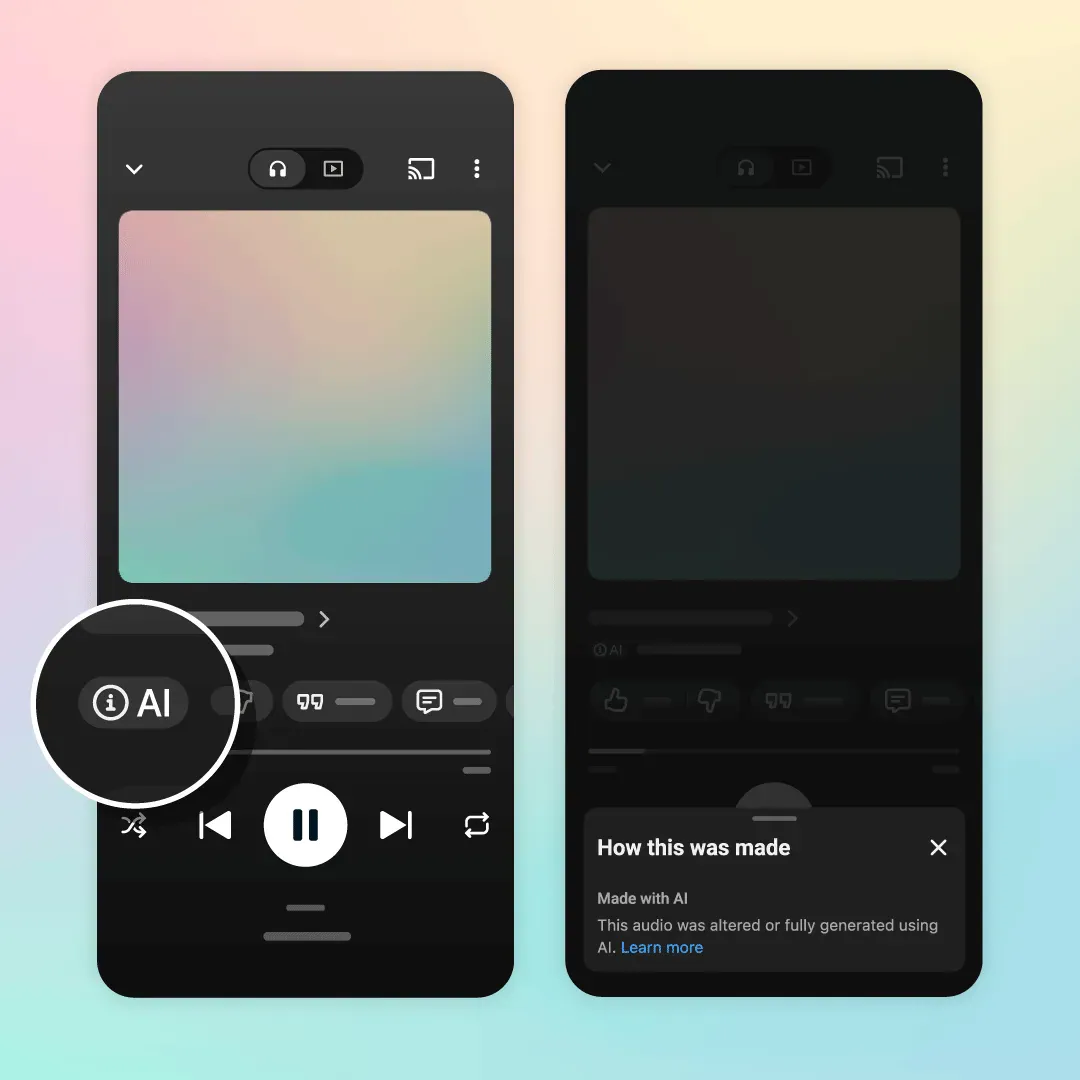
The rollout covers songs created primarily using generative AI. That is a narrower scope than every song touched by an AI tool.
Qualifying tracks will carry a visible disclosure as the rollout reaches them. YouTube has not supplied a complete country list or rollout timetable, and the planned expansion to the main YouTube app does not establish that the feature is already available there.
Partner Disclosures and Detection Work Together
YouTube says it is working with music partners and using its own detection tools to identify AI-generated tracks.
Its music disclosure guidance explains how these inputs work together. Partners should provide information about generative AI use, while YouTube may use additional signals to supplement those declarations. If a partner supplies no AI information, YouTube says it can rely on those signals and may designate content as fully or partly AI-generated.
The system therefore does not depend entirely on creators or distributors voluntarily identifying every AI-generated track. YouTube can make a determination when a declaration is missing.
Detection tools, however, do not establish that the platform can reliably identify every generated song. The announcement does not disclose their methodology, error rates, or coverage. There is no published basis here for calculating how often a human-made recording might be mislabeled or an AI-generated recording might go unnoticed.
Missing metadata has a specific meaning in the guidance: YouTube initially treats an absent value as unknown unless other signals allow a determination. Unknown is not the same as “No Gen AI.” An unlabelled track should not be read as certification that no generative AI contributed to it.
Creators still need accurate disclosures even when YouTube also runs detection. A partner declaration and a platform determination are separate inputs; neither provides an interchangeable guarantee.
Creators Have Three Disclosure Categories
YouTube’s partner guidance distinguishes between three affirmative declarations:
- Fully Gen AI: All content was created using generative AI. Examples include downloading a track produced from a text prompt, or using a model to generate the composition, instrumental performance, and vocals.
- Partly Gen AI: Some content was created using generative AI. Examples include generating a bassline or string section and recording live performances over it, or using generative tools to help write lyrics or develop melodies before recording.
- No Gen AI: No content was created using generative AI. YouTube places standard pitch correction for minor vocal tuning errors and automated mastering adjustments in this category.
Under this guidance, correcting a singer’s tuning or automatically adjusting equalization and compression does not, by itself, put the work in a generative-AI category. YouTube distinguishes those automated production tools from systems that generate song content.
A recording can fall into the partly generated category even when a person performs the final audio. The guidance includes AI-assisted lyric and melody development as well as generated sounds embedded in the recording.
The disclosure framework also reaches beyond audio. One example of “Partly Gen AI” is a song with entirely human-performed audio accompanied by an AI-generated music video.
How that broader metadata framework maps to the new music-player labels remains unclear. The announcement does not specify how every partly generated declaration translates into a listener-facing label, nor does it define a numerical threshold for “primarily” generated music. It would be premature to claim that every example in the disclosure guide will automatically trigger the same YouTube Music label.
Partners can submit declarations through DDEX ERN 4.3.2 or later, or through supported CSV delivery templates. Those uploading through YouTube Studio can mark disclosures in its attribute section. For artists working through a label or distributor, the practical question is whether the information delivered with their release accurately describes the generative AI contribution.
A Disclosure Is Not an AI-Music Filter
The announcement adds information at playback. It does not announce a setting to hide AI-generated tracks, automatically skip them, or exclude them from recommendations.
A label can help listeners decide what to do about the song currently playing. Anyone hoping to avoid generated music altogether would need a preference that changes what the service serves next, which this update does not provide.
Sources
- October 14 announcementblog.youtube
- music disclosure guidancesupport.google.com
- TechCrunch’s reporting on the rollouttechcrunch.com