
Xiaomi’s MiMo-V2.6 release gives developers a trillion-parameter LLM, a smaller efficiency-focused model, a 9B distill and resources for training agents. The practical choice is less obvious than the model names suggest. The cheaper Flash option performs well in independent testing, though it may not be the fastest or most concise model to use.
Announced on September 22, 2026, the release calls for a distinction between Xiaomi’s claims and outside measurements. Xiaomi reports ambitious results for Pro’s reasoning and its reinforcement-learning gains. Artificial Analysis has independently evaluated Flash, offering a narrower check on the series.
Xiaomi Released Three Models, Not Just a Flagship
The MiMo-V2.6 announcement names two main models: MiMo-V2.6-Pro, with 1 trillion parameters, and MiMo-V2.6-Flash, with 311 billion. Xiaomi describes both as natively multimodal. A third release, MiMo-V2.6-Distill-Qwen-9B, is a smaller Qwen-based distill.
Their weights are listed in Xiaomi’s Hugging Face collection, allowing developers to inspect or deploy a model without relying solely on Xiaomi’s API. The three are not equally practical to run. At two bytes per parameter, the weights alone would occupy roughly 2 TB for Pro, 622 GB for Flash and 18 GB for the 9B distill, before runtime overhead. Quantization can reduce those figures; actual hardware requirements depend on the serving setup.
“Open” needs to be read asset by asset. Xiaomi has made weights and training resources available, but that does not establish identical licensing terms for every component or permission for every commercial use. Developers planning a deployment should check the relevant model cards, code repositories and licenses instead of treating the collection as a blanket permission.
The Reinforcement-Learning Stack Is a Substantial Part of the Release
Alongside the models, Xiaomi says it released more than 7,000 reinforcement-learning task environments, an end-to-end RL framework, lightweight harnesses and a technical report. The environments supply tasks and feedback for training. The framework and harnesses address parts of the process needed to run those tasks and use their results. All are distinct from the model weights.
Xiaomi’s stated approach is to improve models through repeated attempts at complex, verifiable tasks. Its announcement describes training across coding, general, visual and cyber tasks, with systems intended to manage large batches and reward signals. It also describes safeguards against reward hacking, where a model learns to satisfy a scoring rule without accomplishing the underlying task.
The company reports a roughly six-day live RL training phase and says performance improved on its DeepSWE v1.1 software-engineering evaluation. Those figures are Xiaomi’s account of its training run, not independent confirmation that another team can reproduce the gains. The released resources make that question more testable than a checkpoint alone would, provided researchers can establish comparable conditions and compute budgets.
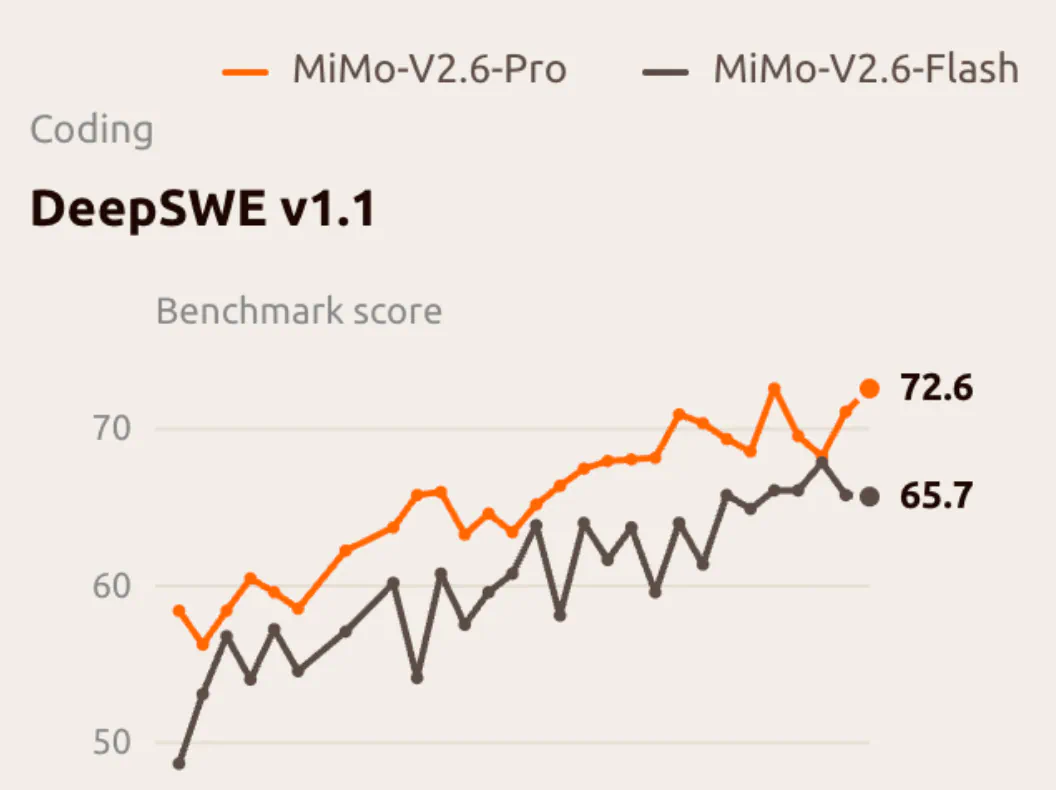
For agent researchers, these resources may be the most consequential part of MiMo-V2.6. A model’s score reveals relatively little about the tasks, feedback loops and infrastructure behind it. Publishing those components gives others something concrete to examine, even if reproducing a large-scale run remains expensive.
Pro, Flash and the 9B Distill Serve Different Jobs
Pro is Xiaomi’s high-end option. The company positions its 1T-parameter model for demanding reasoning and agent work, and reports strong results against other leading models. Its size makes hosted access the more realistic starting point for most teams. Xiaomi’s benchmark comparisons are not an independent evaluation of Pro.
Flash is a candidate for repeated, cost-sensitive API calls. It has fewer total parameters than Pro, and Xiaomi presents it as the efficiency-focused model. That could suit applications that run many analyses or tool-using steps, provided its output speed meets the application’s needs. Fewer parameters alone do not prove a latency or cost advantage in every serving environment.
The 9B distill is the accessible download for smaller-scale experimentation. Its much smaller weight footprint changes the range of hardware a developer might consider. Belonging to the same release does not mean it retains all of Pro’s reasoning or multimodal behavior.
Evaluate Pro when answer quality on difficult tasks is worth a larger serving commitment. Test Flash when volume and cost matter, or consider the distill when a smaller deployable model is the requirement. Each choice still needs testing on the application’s actual tasks.
A Million-Token Window Helps With Long Inputs, Not Guaranteed Recall
Artificial Analysis lists a one-million-token context window for MiMo-V2.6-Flash, along with text and image input. The window can accommodate substantial documents, long conversations or large collections of code in a single request. It is a capacity limit, not proof that the model will reliably find and use every relevant detail buried near the middle of that input.
Long requests change the economics, too. Passing an entire repository or document archive to a model may be convenient, but developers still pay for processed tokens under an API’s pricing rules and must account for latency. Retrieval or selective prompting may be preferable when only a small fraction of the material is relevant.
Xiaomi describes Pro and Flash as natively multimodal and shows applications involving visual input, interface interaction and 3D work. Its examples include using visual feedback while building a game scene or operating software. They show the workflows Xiaomi is targeting, without independently establishing how reliably the models complete unfamiliar versions of those tasks. Artificial Analysis’s Flash listing confirms support for text and image input in its evaluated setup.
API, Desktop and Downloaded Weights Offer Different Access
Xiaomi says the series is available through its API and a desktop client. The API lets developers integrate model calls into applications and automated workflows; the desktop client offers a way to interact with MiMo directly. Neither is the same as downloading weights and operating an independent deployment. Using a client does not, by itself, mean the model runs on the user’s computer.
Xiaomi says MiMo-V2.6 keeps the V2.5 series’ API pricing. Existing customers have a reference point, though a model budget still depends on the specific tier, token usage and output length. Xiaomi also advertises a Pro UltraSpeed mode with output up to 20 times faster. “Up to” is part of the claim, not a measured speed guarantee across workloads.
Input rates tell only part of the cost story. A model that generates substantially more output can consume more tokens per completed task. Slow token generation can also hold up a user-facing workflow, even when the nominal price is attractive.
Independent Flash Tests Show Both Value and Friction
The independent evidence supplied for this release is strongest for Flash, not Pro. Artificial Analysis lists Flash as an open-weight model and reports strong intelligence and cost results for its class. Its tests also find relatively slow output and high verbosity. Results may differ under another provider’s serving configuration or on a developer’s own prompts.
That complicates the name “Flash.” Slower generation may be acceptable for a background task if the model solves difficult problems at a favorable cost. In an interactive coding assistant or chat interface, the wait may matter more. Detailed output can help when an explanation is required, but verbosity can raise token consumption and make short answers harder to obtain.
Xiaomi’s announcement cites a 46-point Artificial Analysis Intelligence Index score for Pro and makes broader competitive claims. Xiaomi is reporting that score; the independent Flash results discussed here do not verify Pro’s overall performance. Comparisons between the models need to account for which model was tested, how it was evaluated and who reported the result.
Final Thoughts
MiMo-V2.6 gives other teams training resources to examine alongside its models, and the 9B distill offers a smaller-scale entry point. Flash is a plausible cost-conscious alternative to Pro for API users, with a practical caveat: its measured intelligence and cost results come with slower output and more verbose responses. Testing a real workload means counting latency and total tokens alongside answer quality.
Frequently Asked Questions
4 questions
1Is Xiaomi MiMo-V2.6 Open Source?
Xiaomi has released model weights for Pro, Flash and a 9B distill, along with reinforcement-learning resources that include task environments and a training framework. Those releases offer more than API-only access. “Open source” does not guarantee that all assets have the same license or permit every use; check each asset’s terms before deployment.
2What Is the Difference Between MiMo-V2.6-Pro and Flash?
MiMo-V2.6-Pro is Xiaomi’s 1T-parameter flagship, aimed at demanding reasoning and agent tasks. MiMo-V2.6-Flash has 311 billion parameters and is positioned as the more efficiency-focused option for repeated use. Independent Artificial Analysis testing supports Flash’s competitive intelligence and cost results, but also reports relatively slow output and high verbosity. The Flash assessment does not independently validate Pro.
3Does MiMo-V2.6-Flash Support a Million Tokens?
Yes. Artificial Analysis lists a one-million-token context window for MiMo-V2.6-Flash. It allows very large inputs, such as lengthy documents or code collections, in a single request. It does not guarantee accurate recall of every detail, and processing more tokens can affect cost and latency.
4Can I Use MiMo-V2.6 Without Xiaomi’s API?
Yes. Xiaomi lists downloadable model weights in its Hugging Face collection. Self-deployment is a separate undertaking: Pro and Flash have very large weight footprints, and serving requirements depend on the setup. Xiaomi also offers a desktop client, but using it is not the same as running downloaded weights locally.
Sources
- Artificial Analysis has independently evaluated Flashartificialanalysis.ai
- MiMo-V2.6 announcementmimo.mi.com
- Hugging Face collectionhuggingface.co