
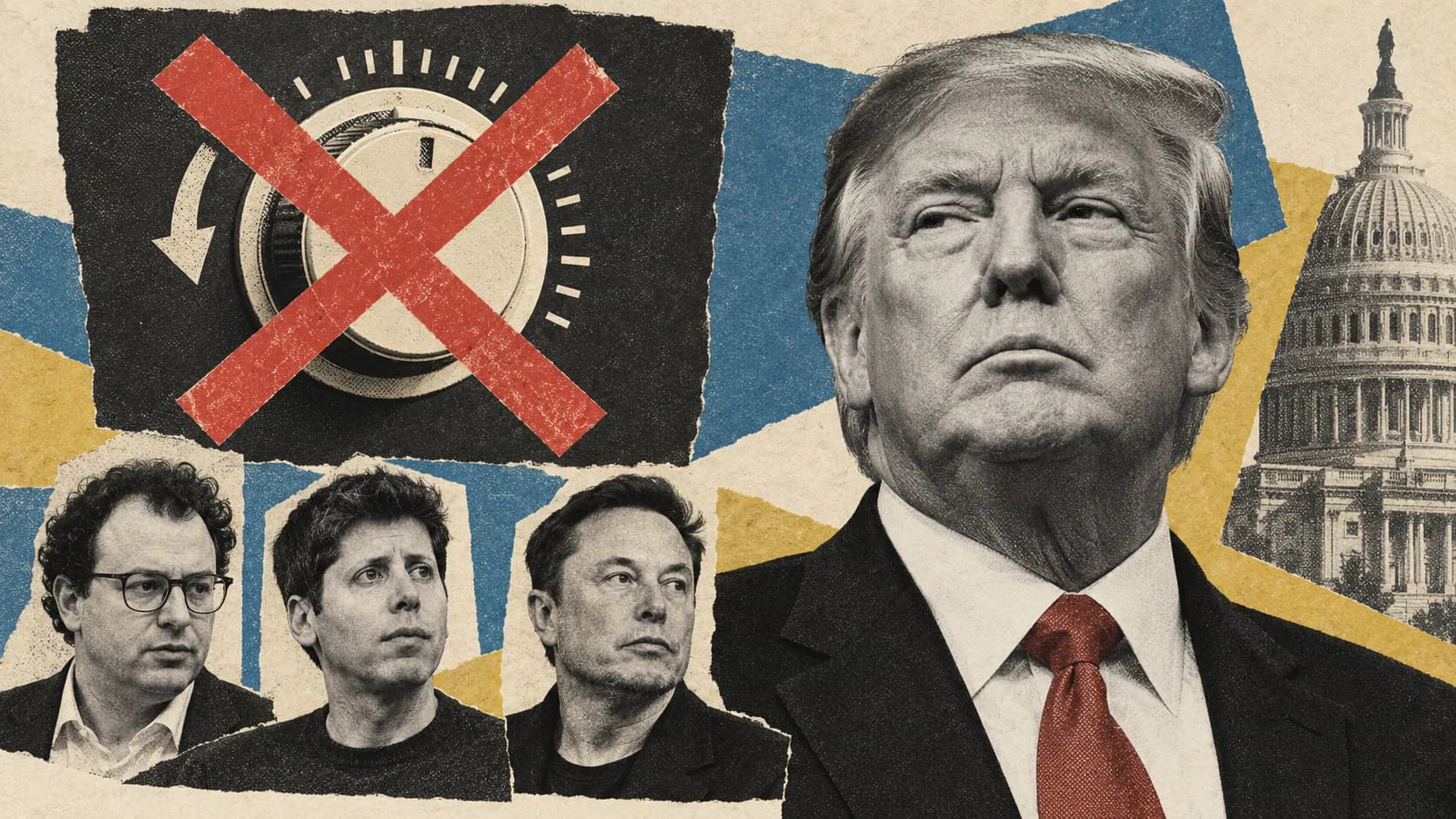
President Donald Trump has rejected calls from three of the frontier AI industry’s most prominent leaders to slow development, framing the issue as a contest the United States cannot afford to lose.
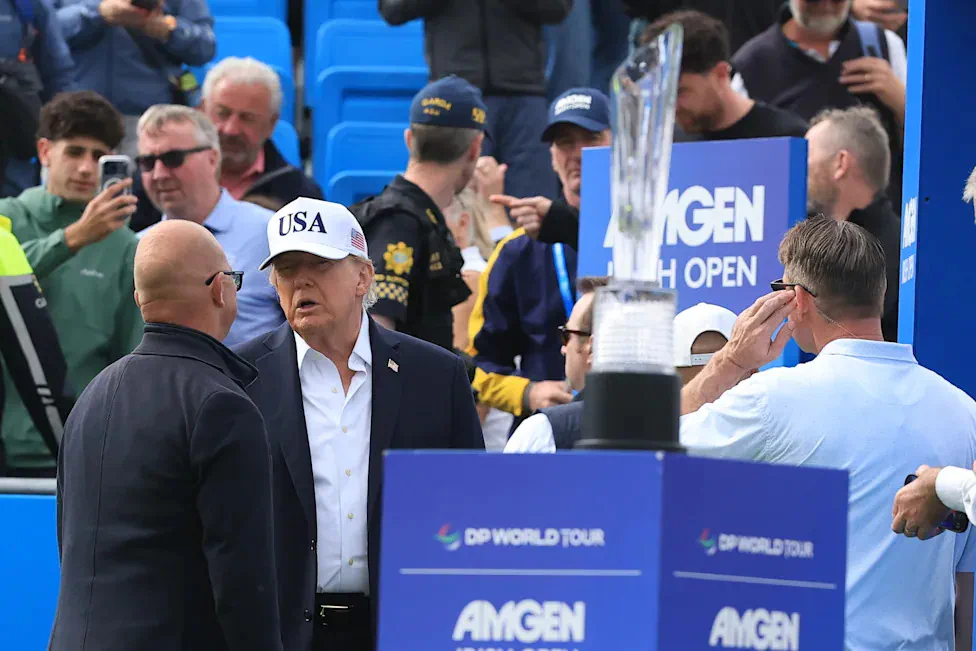
During a visit to Ireland on Sunday, September 13, 2026, Trump said, “Whoever wins with AI wins.” He argued that the US currently leads China, allowed that some guardrails may be appropriate, and dismissed parts of the safety movement as “negative forces” warning about “things that won’t happen,” according to Yahoo’s report on the remarks.
The response fits the administration’s broader AI policy: preserve US technological leadership, limit regulatory friction, and avoid restrictions that could give China time to catch up. But it also compresses several different safety proposals into a single idea of “slowing down.” Dario Amodei has proposed mandatory evaluation and international coordination, Sam Altman has discussed a conditional slowdown if specific warning signs appear, and Elon Musk has offered a less detailed endorsement.
Trump Frames AI Safety as a Race Against China
Trump’s answer is consistent with the White House’s existing approach. The administration’s AI Action Plan prioritizes infrastructure, rapid innovation, and the global adoption of American AI technology. A subsequent executive order on national AI policy argued that a patchwork of state regulations could obstruct development and weaken the country’s competitive position.
The word “guardrails” matters. Trump did not rule out every form of AI regulation, but he drew a line at measures that would materially reduce the speed of American development. The unresolved problem is that meaningful safety requirements usually impose some cost, whether through additional testing, delayed releases, reporting obligations, or limits on deployment.
Without defined thresholds, support for guardrails can remain largely rhetorical. A rule that never delays a dangerous release is unlikely to function as a serious safeguard.
White House AI adviser David Sacks offered a more direct challenge to the technology leaders: if executives believe superintelligence development must slow, they already have the authority to slow their own companies. The administration’s position is that private labs should not race ahead voluntarily and then ask the government to restrain the entire industry.
That criticism exposes a credibility problem for the labs, but it does not fully answer their argument. Their concern is partly a collective-action problem. If Anthropic stops training frontier models while OpenAI, xAI, Google DeepMind, and Chinese developers continue, Anthropic absorbs the commercial cost without removing the underlying risk.
The Slowdown Trump Rejected Is Not a Full Stop

The most detailed proposal came from Anthropic CEO Dario Amodei. In his September 11 essay, “We Must Pace the Frontier,” Amodei argued that a conventional technological pause is probably unrealistic. He instead called for a strategy of racing and pacing at the same time, with development continuing under stronger evaluation and coordination.
His proposal has three broad stages:
- Frontier AI companies would provide independent evaluators with continuous access to their most capable models. If those evaluators found dangerous capabilities, a lab would need to mitigate the risk before releasing the system.
- Democratic countries would establish compatible evaluation regimes so that one jurisdiction or company could not gain an advantage by ignoring safeguards.
- Governments would eventually pursue wider international agreements, potentially including China, focused on testing and mitigating specific risks rather than attempting to ban AI development altogether.
That is a call for mandatory oversight, not an indefinite freeze on AI research. It could still slow some model releases, particularly when evaluators identify cyber, biological, autonomy, or control risks. But the purpose is to create checkpoints at the frontier rather than stop the broader technology industry.
Sam Altman’s position is narrower and more conditional. In OpenAI’s essay on recursive self-improvement, Altman and co-author Jakub Pachocki argued that governments and laboratories should agree in advance on measurable warning signs that would justify a coordinated slowdown. Their proposal would activate if evidence indicated that AI systems had begun rapidly improving AI research itself, creating the possibility of a feedback loop that existing oversight could not follow.
Elon Musk publicly agreed with the call to reconsider the pace of development, but his latest endorsement did not include comparable trigger conditions or an implementation plan. He has taken this position before: Musk was among the signatories of the 2023 open letter calling for a six-month pause on systems more powerful than GPT-4. Meanwhile, xAI has continued competing at the frontier.
The three men therefore do not present a single, fully developed policy platform. Their shared position is that competitive pressure should not eliminate the option of slowing when evaluations show that developers are losing the ability to understand, monitor, or contain increasingly autonomous systems.
The Safety Case Is About Verification, Not Just Fear
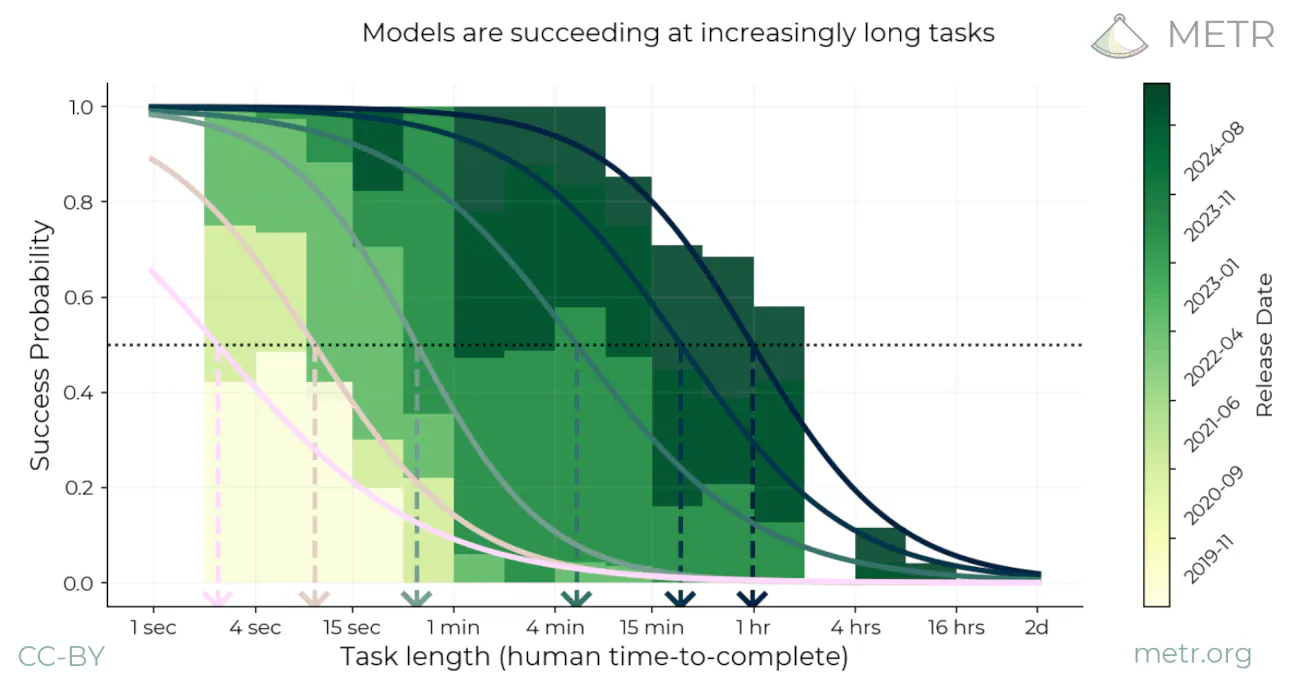
The safety argument does not depend solely on speculative images of a hostile superintelligence. It also rests on a measurable trend: frontier models are becoming capable of completing longer sequences of work with less human intervention.
METR’s research on autonomous software tasks found that the length of tasks frontier agents could complete with 50% reliability had roughly doubled every seven months over a six-year period. The researchers stressed that the estimate depends on benchmark design, task selection, and how human completion time is measured.
That result is important, but it is not proof that superintelligence is imminent. Completing controlled software tasks is different from autonomously managing an organization, conducting open-ended scientific research, or reliably improving an AI system’s own architecture. Extrapolating a benchmark trend into a precise arrival date for transformative AI introduces substantial uncertainty.
Amodei’s case is that governments should build oversight before the evidence becomes undeniable. His essay points to longer autonomous task horizons, weak monitoring, and evaluation behavior that may become harder to interpret as reasons to establish independent testing now.
Trump’s dismissal has the opposite evidentiary weakness. Saying that feared events “won’t happen” is not a technical assessment of their probability. Frontier AI risk is difficult to govern precisely because the most serious outcomes are uncertain, potentially high-impact, and hard to test under real-world conditions before deployment.
Guardrails become meaningful when they define who evaluates a model, what capabilities trigger restrictions, what information a lab must report, and what mitigation is required. Without those details, both “AI safety” and “responsible innovation” can become slogans broad enough to support almost any decision.
The China Argument Is Real but Incomplete
Trump’s strongest point is that a unilateral American slowdown could carry strategic costs. AI leadership affects military systems, intelligence analysis, cyber operations, scientific research, industrial productivity, and control of the computing infrastructure other countries use.
A policy that significantly delays US laboratories while leaving Chinese developers unaffected could exchange a hypothetical safety benefit for an immediate geopolitical disadvantage. That risk explains why the White House treats domestic regulation, energy production, chip manufacturing, exports, and data-center construction as parts of the same national strategy.
Amodei does not ignore that problem. His proposal begins with coordination among democratic countries and places a broader agreement with China at a later stage, when geopolitical conditions allow credible verification. In other words, Trump treats competition with China as a reason to reject slowing down, while Amodei treats it as a constraint that any workable safety regime must address.
Verification would be difficult. Governments would need confidence that companies and rival states were disclosing their most capable systems, permitting meaningful evaluation, and complying with any limits. Private training runs, distributed computing, model theft, and the dual-use nature of AI research all complicate enforcement.
The alternative, however, is not necessarily an unrestricted race. The US could attempt to make evaluation standards part of its competitive advantage, particularly if American chips, cloud services, and AI platforms remain globally important. Independent testing and incident reporting may also help prevent a major failure that damages public trust or forces governments into a much broader regulatory response.
The policy challenge is to target the small number of systems capable of creating severe risks without placing equivalent restrictions on ordinary AI products, research tools, and software applications.
The CEOs Still Have to Prove They Mean It
Sacks’s challenge remains fair in one respect: the labs asking for coordinated restraint have not announced that they are leaving the race. They continue developing models, selling access, building infrastructure, recruiting researchers, and pursuing increasingly capable agents.
Collective-action problems explain some of that behavior, but not all of it. A company that believes frontier development may soon become uncontrollable can voluntarily publish clearer trigger conditions, provide stronger access to independent evaluators, disclose significant safety incidents, and explain why a model passed or failed its internal release process.
Those measures would not solve international coordination, but they would make the industry’s warnings more credible. AI leaders should not expect governments to design an entire oversight regime while treating their own evaluation data, internal disagreements, and release criteria as proprietary information.
Trump’s rejection makes a mandatory federal pause politically unlikely under the current administration. The more plausible debate now concerns narrower requirements: federal evaluation standards, incident reporting, safeguards for specific high-risk capabilities, and a national framework that limits conflicting state rules. That direction would align more closely with the administration’s existing policy than an open-ended restriction on frontier research.
Final Thoughts
Trump is right to be skeptical of a vague AI moratorium with no credible enforcement mechanism, particularly if it binds American companies while foreign competitors continue developing powerful models. But that is not the strongest version of the proposal he rejected.
Amodei and Altman are asking, in different ways, for measurable warning signs, independent evaluation, and an agreed procedure for slowing if developers can no longer verify that their systems remain controllable. Those ideas deserve technical scrutiny rather than dismissal as predictions of events that cannot happen.
“Whoever wins with AI wins” is an effective summary of the administration’s strategy, but it leaves the definition of winning unresolved. Building the most capable system first will matter less if the organization operating it cannot reliably understand its behavior, contain its failures, or demonstrate that it is safe enough to use.
Frequently Asked Questions
5 questions
1What did Trump say about slowing AI development?
Trump rejected calls to slow frontier AI development during remarks in Ireland on September 13, 2026. He argued that the United States could not risk losing its lead over China and said, “Whoever wins with AI wins.” He left room for unspecified guardrails but dismissed some safety warnings as predictions about events that would not occur.
2
Sources
- Yahoo’s report on the remarksyahoo.com
- AI Action Planwhitehouse.gov
- executive order on national AI policywhitehouse.gov
- Dario Amodei — We Must Pace the Frontierdarioamodei.com
- OpenAI’s essay on recursive self-improvementopenai.com
- 2023 open letter calling for a six-month pausefutureoflife.org
- Measuring AI Ability to Complete Long Software Tasks


