
SpaceX has committed to enter an approximately $40 billion master finance lease for GPUs and related equipment through an entity managed by Apollo Global Management. The company’s October 26, 2026 announcement identifies NVIDIA Vera Rubin as the hardware platform for a terrestrial compute expansion intended to support Grok and cloud services. The financing has not yet closed. (Apollo announcement)
SpaceX’s SEC filing supplies the important distinction: it signed a binding commitment letter on October 24 to enter the lease. Entry into the master lease remains subject to closing conditions, with closing expected before the end of 2026. Individual equipment leases are expected to start upon GPU delivery in the first half of 2027.
The headline amount also needs care. Approximately $40 billion represents expected aggregate principal payments, excluding financing charges and certain ongoing costs. It is neither a disclosed upfront cash payment nor the complete lifetime cost of the arrangement.
What Is Binding, and What Still Has to Close
The October 24 commitment establishes a contractual step toward financing the equipment. It does not mean the final master lease has been entered into, that all equipment has been acquired, or that the GPUs are operating.
SpaceX describes three distinct stages:
| Stage | Disclosed timing | What it means |
|---|---|---|
| Binding commitment letter | Signed October 24, 2026 | SpaceX committed to enter the contemplated master finance lease. |
| Master lease closing | Expected before year-end 2026 | Entry into the lease remains subject to specified closing conditions. |
| Individual lease commencement | Expected in the first half of 2027 | Lease schedules begin as GPUs and related equipment are delivered. |
The filing warns that the transaction could close on different terms or timing, or fail to close, and that deliveries and principal payments could differ from expectations. Those qualifications matter because both the financing and delivery milestones were still ahead when SpaceX announced the commitment. (SEC Form 8-K)
I’d treat lease closing and equipment delivery as separate milestones when tracking this project. Closing would establish the financing arrangement; delivery would start the equipment-specific payment schedules. Neither announcement alone would reveal how much usable compute capacity had reached production.
How the $40 Billion Lease Would Work
The Apollo-managed entity would acquire GPU pods and related equipment, then lease them to SpaceX for use at data centers selected by the company.
Equipment would arrive in tranches, meaning separate batches. Each batch would have its own lease schedule lasting approximately five to five and one-quarter years from its commencement date. That structure allows the financing and payment obligations to follow deliveries instead of requiring the entire deployment to arrive together.
Under the contemplated terms, quarterly rent would be payable in advance and would generally include:
- A principal component equal to one-twentieth of the financed cost of that equipment tranche.
- A financing charge calculated at a fixed annual rate on the outstanding lease balance.
- Certain ongoing costs and expenses.
The fixed rate would be determined at pricing before SpaceX enters the master lease. The filing does not disclose that rate. (SEC lease terms)
A simple example makes the principal component easier to understand. For a hypothetical $1 billion equipment tranche, one-twentieth would equal $50 million per quarter, before the financing charge and other expenses. That is arithmetic based on the disclosed formula, not a payment schedule SpaceX has announced.
This explains why calling the transaction a “$40 billion financing” leaves out part of its economic burden. The principal is the base amount to be repaid. Financing charges and other costs sit above it, so the published figure is insufficient to calculate total payments.
The delivery-linked structure also creates a practical tradeoff. SpaceX would not begin every tranche’s lease clock at the master closing, but quarterly rent would be due in advance once an individual schedule starts. Getting delivered systems into productive service promptly therefore has a direct financial benefit.
A five-year schedule beginning in early 2027 would extend into 2032. That duration makes utilization over several years consequential, even if the initial hardware performs well: the equipment needs useful work throughout a substantial repayment period.
Who Is Providing the Financing
Apollo’s published announcement describes financing parties led by Apollo and Goldman Sachs, with Goldman Sachs serving as the sole structuring agent.
It also identifies anchor commitments from:
- Funds and accounts managed by BlackRock.
- Funds and accounts managed by Goldman Sachs Asset Management.
- Capital accounts advised by KKR.
The contractual lessor described in the SEC filing is an entity managed by Apollo. That is more precise than saying Apollo itself is buying and leasing every system directly. The announcement does not break out each participant’s commitment amount. (Apollo transaction details)
The structure brings several capital providers into one equipment-financing arrangement. SpaceX says the lease diversifies its funding sources and covers a portion of the financing needed for its growth plans. It should therefore be read as one component of a broader compute expansion, with the company still responsible for turning financed equipment into an operating service.
What NVIDIA Vera Rubin Adds
SpaceX identifies NVIDIA Vera Rubin as the platform for the buildout, but the announcement does not specify the exact GPU count, pod configuration, tranche sizes or mix of supporting systems. The $40 billion figure cannot reliably be converted into a GPU count without those details and equipment pricing.
NVIDIA’s published reference architecture shows the type of infrastructure involved. Its Vera Rubin NVL72 rack combines 72 Rubin GPUs and 36 Vera CPUs, connected through NVLink 6, alongside ConnectX-9 network adapters and BlueField-4 data-processing units. These are specifications for NVIDIA’s platform, not a confirmed inventory for SpaceX’s deployment. (NVIDIA platform announcement)
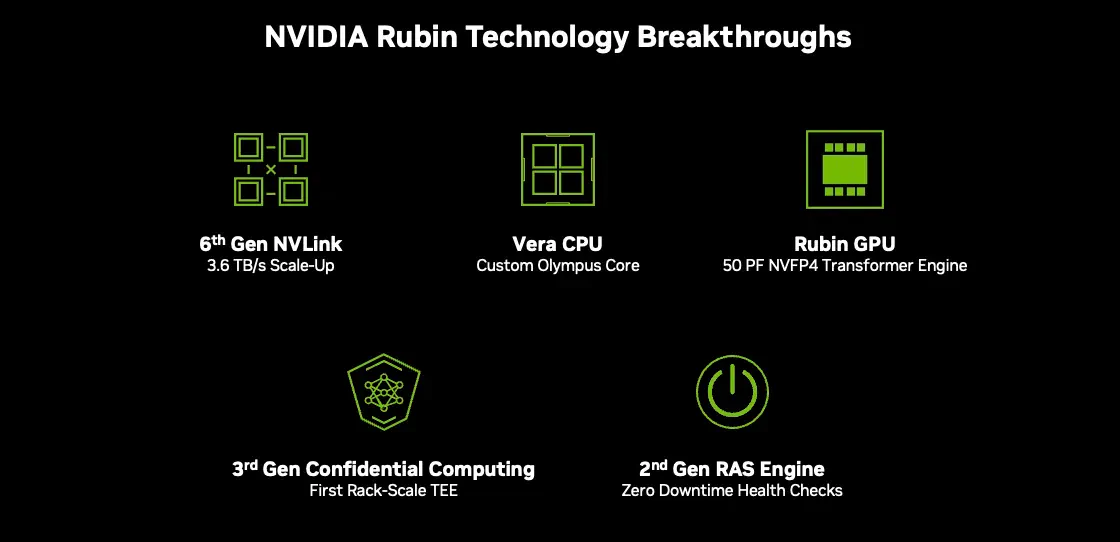
NVIDIA’s July 21, 2026 technical description lists the following Rubin capabilities:
| Component or specification | NVIDIA’s published figure | Practical relevance |
|---|---|---|
| GPU compute organization | 224 streaming multiprocessors and 896 Tensor Cores | Provides parallel compute capacity for AI workloads. |
| HBM4 memory capacity | Up to 288 GB per GPU | Holds model weights and working data, including cached state used during inference. |
| HBM4 memory bandwidth | Up to 22 TB/s | Determines how quickly data can move between GPU memory and compute resources. |
| NVLink 6 bandwidth | 3,600 GB/s, or 3.6 TB/s | Supports communication between GPUs in the connected system. |
Frequently Asked Questions
3 questions
1Has SpaceX Closed the $40 Billion Financing?
At the October 26 announcement, SpaceX had signed a binding commitment letter. Master lease closing remained subject to conditions and was expected before year-end 2026.