
SkillScout ranks AI skills, plugins, MCP servers, and apps against a description of how someone works and where their current AI tools fall short. Its pitch is straightforward: a tool’s popularity tells you little about whether it will solve your particular problem.
The service’s October 27, 2026 public introduction includes a Show HN announcement positioning it as an alternative to popularity-led discovery. On its website, SkillScout says users can ask their existing AI assistant to write a work profile, submit that profile, and receive personalized recommendations in about two minutes. Access is free, according to the site.
The useful idea is the handoff: turn the context an assistant already has into a portable description of unmet needs. The important limitation is that a personalized ranking still leaves users with several separate decisions, including whether a suggested tool is trustworthy, compatible, affordable, and worth setting up.
How a Work Profile Becomes a Tool Shortlist
SkillScout’s landing page describes a three-part discovery process:
- Ask your AI assistant to describe your work. The profile should cover the areas where you use AI and where the assistant falls short.
- Provide that profile to SkillScout. The service says it scores tools against the profile and the gaps it identifies.
- Review the ranked recommendations. SkillScout says results arrive in about two minutes.
That is the documented workflow, not a walkthrough of a tested interface. The published description does not provide a scoring formula, a score scale, or an independent evaluation of recommendation quality.
The profile is the consequential input. A description such as “I write, research, and code” gives a recommendation service little basis for distinguishing among thousands of broadly relevant products. A more useful profile identifies the recurring task, the point where it breaks down, and the constraints on a replacement.
For example, a hypothetical analyst might describe a need to compare weekly spreadsheet exports, trace conclusions back to source rows, and work within an approved set of applications. That is more actionable than simply saying they need a better research assistant. It identifies a workflow gap and gives a discovery system reasons to exclude otherwise popular tools.
I’d make the profile specific about the job and deliberately vague about confidential content. Useful fields include:
- Recurring tasks: What you repeatedly ask AI to help with.
- Failure points: Where the output needs substantial correction or another tool.
- Existing software: The applications or environments a new tool must work with, where sharing that information is permitted.
- Constraints: Budget, installation permissions, data-handling requirements, and tolerance for setup.
- Desired outcome: What a successful improvement would let you finish or avoid.
These are suggested profile-writing practices, not documented SkillScout input fields.
Review What the Assistant Says About You
SkillScout’s premise depends partly on an assistant having enough context to describe your work. That will vary with the conversations and information available to it. A profile generated from a narrow project discussion may describe that project well while missing most of your actual responsibilities.
Read the profile before submitting it. Check for inferred responsibilities, outdated software choices, and supposedly important problems that were only mentioned once. Remove details that do not help distinguish a useful recommendation.
This creates a practical tradeoff: more detail may improve relevance, but it also increases what you disclose. The best profile for discovery is not necessarily the most complete account of your working life.
A Personalized Score Is Only One Part of the Decision
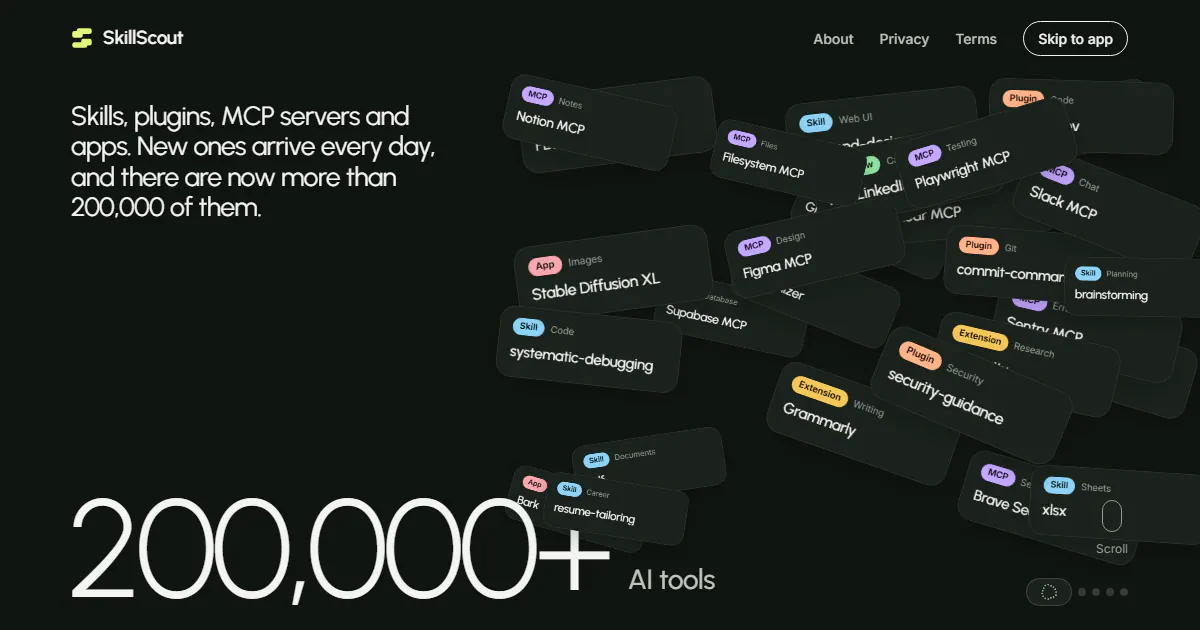
SkillScout says it gives tools individual scores and ranks them against a user’s gaps. Its website also claims there are now more than 200,000 skills, plugins, MCP servers, and apps. That is the service’s market-size claim; the page does not explain how those items are counted or how many are available in its own recommendation catalog.
The distinction matters. A large ecosystem creates a discovery problem, but a recommendation service’s usefulness depends on which tools it actually covers, how current its information is, and how accurately it connects capabilities to a user’s needs.
The published material reviewed for this article includes no independent audit of SkillScout’s ranking or privacy claims. It also does not explain whether its scoring incorporates installation effort, maintenance activity, permissions, pricing, or compatibility.
Those are separate questions from personal relevance:
| Decision | What the work profile contributes | What still needs checking |
|---|---|---|
| Does this address my task? | A description of the recurring need and current failure point | Whether the tool’s documented capabilities actually cover it |
| Can I use it in my environment? | Existing applications and deployment constraints | Supported clients, versions, platforms, and installation requirements |
| Can I trust it with this work? | The sensitivity of the intended task | Publisher identity, permissions, and data-handling terms |
| Is it worth adopting? | Task frequency and the value of solving the gap | Price, setup effort, maintenance, and likely time savings |
This is where I’d treat SkillScout as a shortlist generator. A high position can justify looking more closely at a tool; it cannot, on the evidence available, stand in for checking the tool’s own documentation.
Look for the Reason Behind a Recommendation
A useful recommendation should connect a documented capability to a specific need. “This tool matches your interest in productivity” is weak evidence. A concrete explanation linking a capability to a recurring task gives the reader something to verify.
When reviewing results, look for three things:
- The matched gap: Which part of the profile led to this suggestion?
- The supporting capability: What does the tool actually offer that addresses that gap?
- The adoption conditions: What must be installed, connected, purchased, or permitted before it can help?
The landing page does not establish that SkillScout supplies all of these explanations. They are a way to evaluate its output.
The reasoning is simple: personalization can reduce the search space, but it cannot remove deployment friction. A tool that fits the task perfectly may still be unusable under an employer’s access rules or incompatible with the user’s preferred AI environment.
What the Privacy Promise Actually Covers
SkillScout makes a direct assurance on its landing page: “its server never saves your profile.”
That claim concerns server-side storage of the submitted profile. It should not be read as a complete description of how the data moves through the service.
Processing and retention are different questions. A server can receive and process information without saving a persistent copy. The quoted assurance, by itself, does not explain whether any external provider processes the profile, what operational logs contain, how errors are recorded, or what happens to generated recommendations.
These are unanswered implementation questions, not evidence that SkillScout is retaining or misusing profiles. The landing-page statement is simply too narrow to resolve them.
A work profile can also reveal sensitive information without containing an obvious secret. A description of recurring tasks may expose internal processes, software dependencies, upcoming projects, or gaps in a company’s current systems. Removing passwords and customer names is therefore only the first step.
Before submitting a profile, I’d:
- Replace client, colleague, and project names with generic roles.
- Remove internal URLs, account identifiers, credentials, and copied business records.
- Describe the task without including the underlying confidential material.
- Check workplace rules before sharing nonpublic workflow details with another service.
Frequently Asked Questions
3 questions
1What Does SkillScout Recommend?
SkillScout says it recommends AI skills, plugins, MCP servers, and apps based on a submitted work profile and identified capability gaps.